
Hybrid Photonic Integrated Circuit Market Report 2026
Global Outlook – By Type (Lasers, Modulators, Detectors, Transceivers, Multiplexer Or Demultiplexer, Optical Amplifiers), By Raw Material (III-V Material, Lithium Niobate, Silica-On-Silicon, Silicon-On-Insulator, Other Raw Materials), By Application (Data Center Interconnects, Telecommunications Networks, Light Detection And Ranging (Lidar) Systems, Optical Sensing, Biomedical Imaging, High Performance Computing), By End-Use (Information Technology (IT) And Telecom, Healthcare, Aerospace And Defense, Manufacturing And Industrial, Other End-Uses) – Market Size, Trends, Strategies, and Forecast to 2030
Hybrid Photonic Integrated Circuit Market Overview
• Hybrid Photonic Integrated Circuit market size has reached to $8.03 billion in 2025 • Expected to grow to $18.75 billion in 2030 at a compound annual growth rate (CAGR) of 18.5% • Growth Driver: Surging Demand For High-Speed Data Transmission Driving The Market Growth Due To Expanding Cloud Computing And Data Center Infrastructure • Market Trend: Next-Generation Hybrid Optical Transmitters Enable Ultra-High-Bandwidth Data Center Networks • North America was the largest region in 2025 and Asia-Pacific is the fastest growing region.What Is Covered Under Hybrid Photonic Integrated Circuit Market?
A hybrid photonic integrated circuit (HPIC) is a device that combines multiple photonic materials and components on a single chip to leverage their distinct optical properties. It integrates active and passive elements such as waveguides and filters to achieve enhanced functionality. Hybrid integration enables higher performance, greater flexibility, and more compact photonic systems than circuits made from a single material platform. The main types of hybrid photonic Integrated Circuits include lasers, modulators, detectors, transceivers, multiplexer or demultiplexer, and optical amplifiers. Lasers are components that generate coherent light and serve as the primary source in photonic circuits for high-speed data transmission and sensing applications. The raw materials used include III-V materials, lithium niobate, silica-on-silicon, silicon-on-insulator, and other raw materials. They find application in data center interconnects, telecommunications networks, light detection and ranging (LiDAR) systems, optical sensing, biomedical imaging, and high-performance computing, serving end users including information technology (IT) and telecom, healthcare, aerospace and defense, manufacturing and industrial, and other end-users.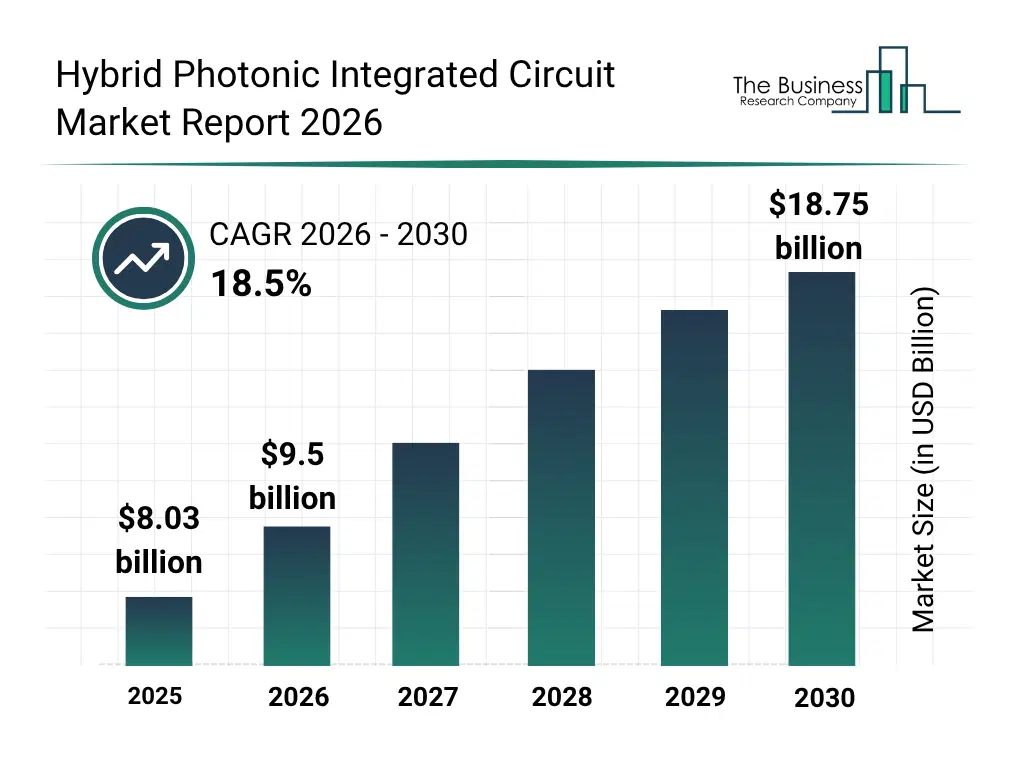
What Is The Hybrid Photonic Integrated Circuit Market Size and Share 2026?
The hybrid photonic integrated circuit market size has grown rapidly in recent years. It will grow from $8.03 billion in 2025 to $9.5 billion in 2026 at a compound annual growth rate (CAGR) of 18.3%. The growth in the historic period can be attributed to increasing demand for high speed data transmission, growth of data center infrastructure, advancement in Silicon Photonics technology, rising adoption of wavelength division multiplexing, expansion of telecommunications networks.What Is The Hybrid Photonic Integrated Circuit Market Growth Forecast?
The hybrid photonic integrated circuit market size is expected to see rapid growth in the next few years. It will grow to $18.75 billion in 2030 at a compound annual growth rate (CAGR) of 18.5%. The growth in the forecast period can be attributed to growing deployment of AI driven data centers, increasing demand for high performance computing systems, rising adoption of 5g and next generation telecom networks, expansion of lidar applications in autonomous systems, increasing investment in integrated photonics research. Major trends in the forecast period include increasing adoption of co-packaged optics (cpo) architectures, rising integration of iii-v materials with silicon platforms, growing demand for high bandwidth optical transceivers, expansion of hybrid integration for compact photonic modules, rising focus on energy efficient optical interconnects.
Global Hybrid Photonic Integrated Circuit Market Segmentation
1) By Type: Lasers, Modulators, Detectors, Transceivers, Multiplexer Or Demultiplexer, Optical Amplifiers 2) By Raw Material: III-V Material, Lithium Niobate, Silica-On-Silicon, Silicon-On-Insulator, Other Raw Materials 3) By Application: Data Center Interconnects, Telecommunications Networks, Light Detection And Ranging (Lidar) Systems, Optical Sensing, Biomedical Imaging, High Performance Computing 4) By End-Use: Information Technology (IT) And Telecom, Healthcare, Aerospace And Defense, Manufacturing And Industrial, Other End-Uses Subsegments: 1) By Lasers: Distributed Feedback (DFB) Lasers, Distributed Bragg Reflector (DBR) Lasers, Vertical-Cavity Surface-Emitting Lasers (VCSELs), Tunable Lasers, Quantum Dot Or Quantum Well Lasers 2) By Modulators: Electro-Optic Modulators, Mach–Zehnder Modulators (MZM), Electro-Absorption Modulators (EAM), Phase Modulators, Ring Resonator Modulators 3) By Detectors: PIN Photodiodes, Avalanche Photodiodes (APD), Germanium Photodetectors, Infrared (IR) Photodetectors 4) By Transceivers: Optical Transceiver Modules, Co-Packaged Optics (CPO), Pluggable Transceivers, Integrated Optical Engines 5) By Multiplexer Or Demultiplexer: Wavelength Division Multiplexers (WDM), Arrayed Waveguide Gratings (AWG), Thin-Film Filter (TFF) Based Devices, Planar Lightwave Circuit (PLC) Mux Or Demux 6) By Optical Amplifiers: Semiconductor Optical Amplifiers (SOA), Erbium-Doped Fiber Amplifiers (EDFA), Raman Optical Amplifiers, Hybrid Optical AmplifiersWhat Is The Driver Of The Hybrid Photonic Integrated Circuit Market?
The surging demand for high-speed data transmission is expected to support the growth of the hybrid photonic integrated circuit market in the coming years. High-speed data transmission refers to the rapid transfer of large volumes of digital information across communication networks at increasing bandwidth capacities. Demand for high-speed data transmission is rising due to the expansion of cloud computing, data-intensive applications, and digital services, which require faster, more reliable connections between users, data centers, and network infrastructure. Hybrid photonic integrated circuits address these requirements by integrating optical and electronic components onto a single chip, enabling higher bandwidth capacity, faster signal processing, lower latency, and improved energy efficiency compared to traditional electronic-only solutions. For instance, in February 2024, according to the report published by Office of Communications (Ofcom), a UK-based government office, average monthly data usage per fixed broadband connection increased by 53 GB, or 11%, reaching 535 GB in 2023. Therefore, surging demand for high-speed data transmission is driving the growth of the hybrid photonic integrated circuit industry.Key Players In The Global Hybrid Photonic Integrated Circuit Market
Major companies operating in the hybrid photonic integrated circuit market are Huawei Technologies Co. Ltd., Cisco Systems Inc., Intel Corporation, Broadcom Inc., STMicroelectronics N.V., GlobalFoundries Inc., Marvell Technology Inc., Ciena Corporation, Lumentum Holdings Inc., Infinera Corporation, Tower Semiconductor Ltd., Source Photonics Inc., POET Technologies Inc., Rockley Photonics Ltd., EFFECT Photonics B.V., NeoPhotonics Corporation, Luxtera Inc., Ligentec SA, Ayar Labs Inc., and Sivers Semiconductors AB.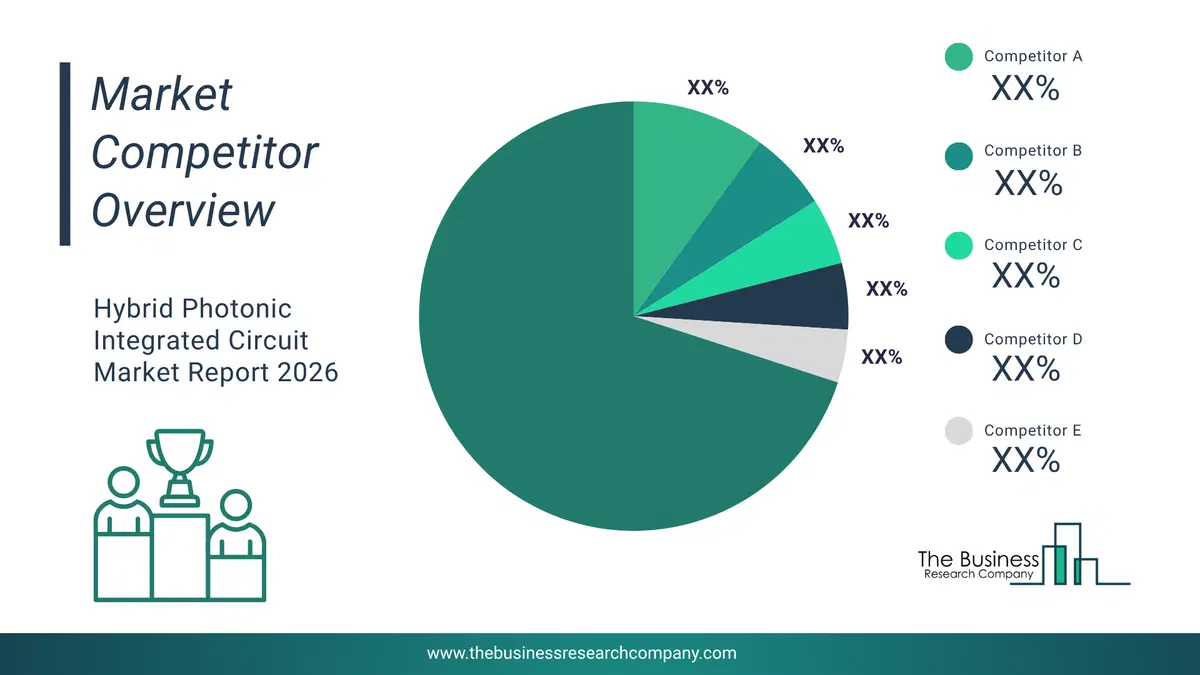
This chart is for illustrative purposes; the full report includes a detailed competitor analysis and comprehensive overview of the top 10 companies in the market.
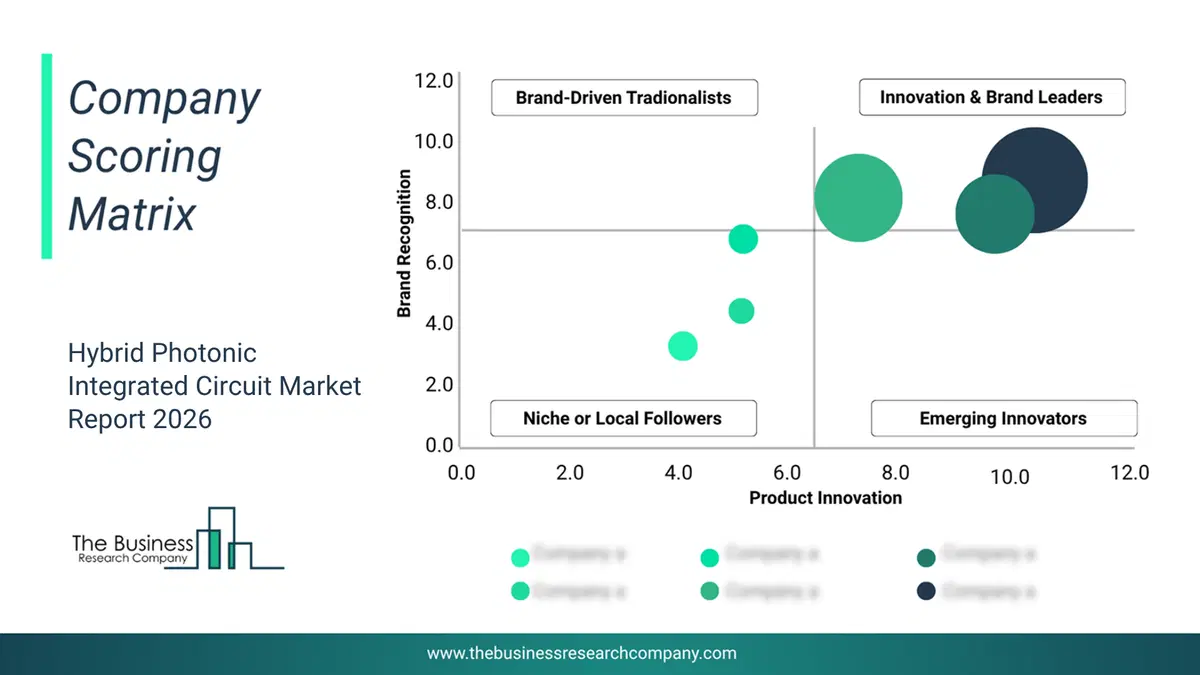
This chart maps companies by product innovation and brand strength, with bubble size indicating relative revenue, helping identify market leaders, challengers, and niche players. This is an illustrative chart; the full report provides a complete and accurate competitive analysis.
Global Hybrid Photonic Integrated Circuit Market Trends and Insights
Major companies operating in the hybrid photonic integrated circuit market are focusing on developing innovative products such as, hybrid high-speed optical transmitter circuits to support ultra-high-bandwidth, low-power data transmission for AI-driven data centers and next-generation cloud infrastructure. Hybrid high-speed optical transmitter circuits are integrated devices that combine photonic components such as lasers and multiplexers with electronic driver ICs on a single chip, enabling faster data transmission, lower power consumption, improved signal integrity, and scalable high-bandwidth connectivity for AI-driven data centers and next-generation cloud networks. For instance, in December 2025, POET Technologies Inc., a Canada-based photonics design and manufacturing company, launched its Hybrid-Integrated 1.6T 2xFR4 Transmitter PIC, a hybrid high-speed optical transmitter circuit built on its Optical Interposer platform. The device integrates four 2x200G electro-absorption modulated laser (EML) arrays, eight high-speed driver ICs, and two monolithically integrated arrayed waveguide gratings (AWGs) used as multiplexers within a compact chip-scale package. It delivers a total capacity of 1.6Tbps across eight 106 Gbaud PAM4 lanes and supports transmission over up to 2 km of duplex single-mode fiber.What Are Latest Mergers And Acquisitions In The Hybrid Photonic Integrated Circuit Market?
In January 2024, ORCA Computing Limited, a UK-based technology company, acquired the Integrated Photonics Division of GXC Inc. for an undisclosed amount. With this acquisition, ORCA Computing Limited aimed to accelerate its technological capabilities and strengthen its competitive position in the global quantum computing market by integrating advanced photonics expertise and intellectual property into its scalable quantum systems roadmap. GXC Inc. is a US-based technology company that specializes in providing hybrid photonic integrated circuit.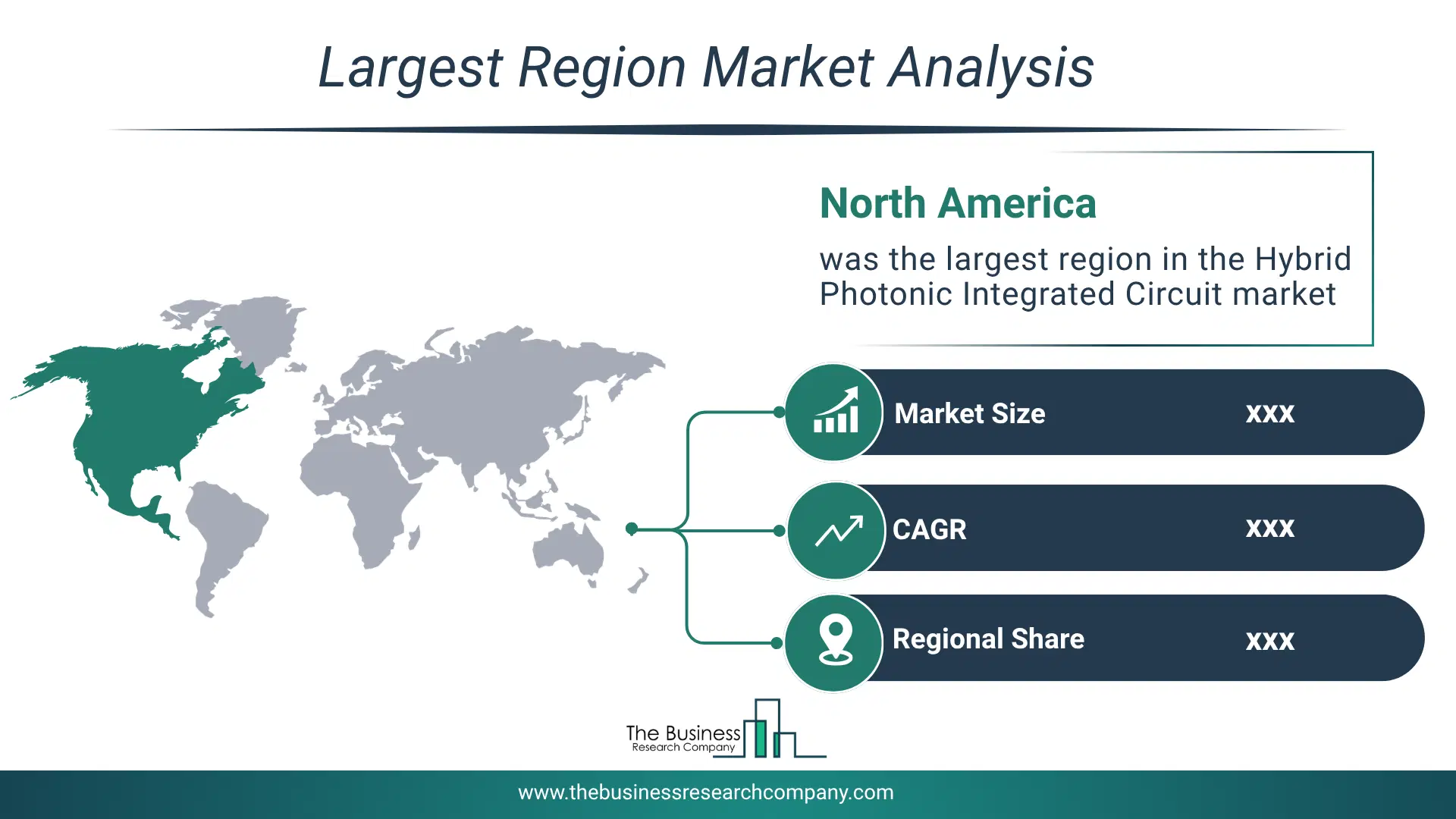
Regional Insights
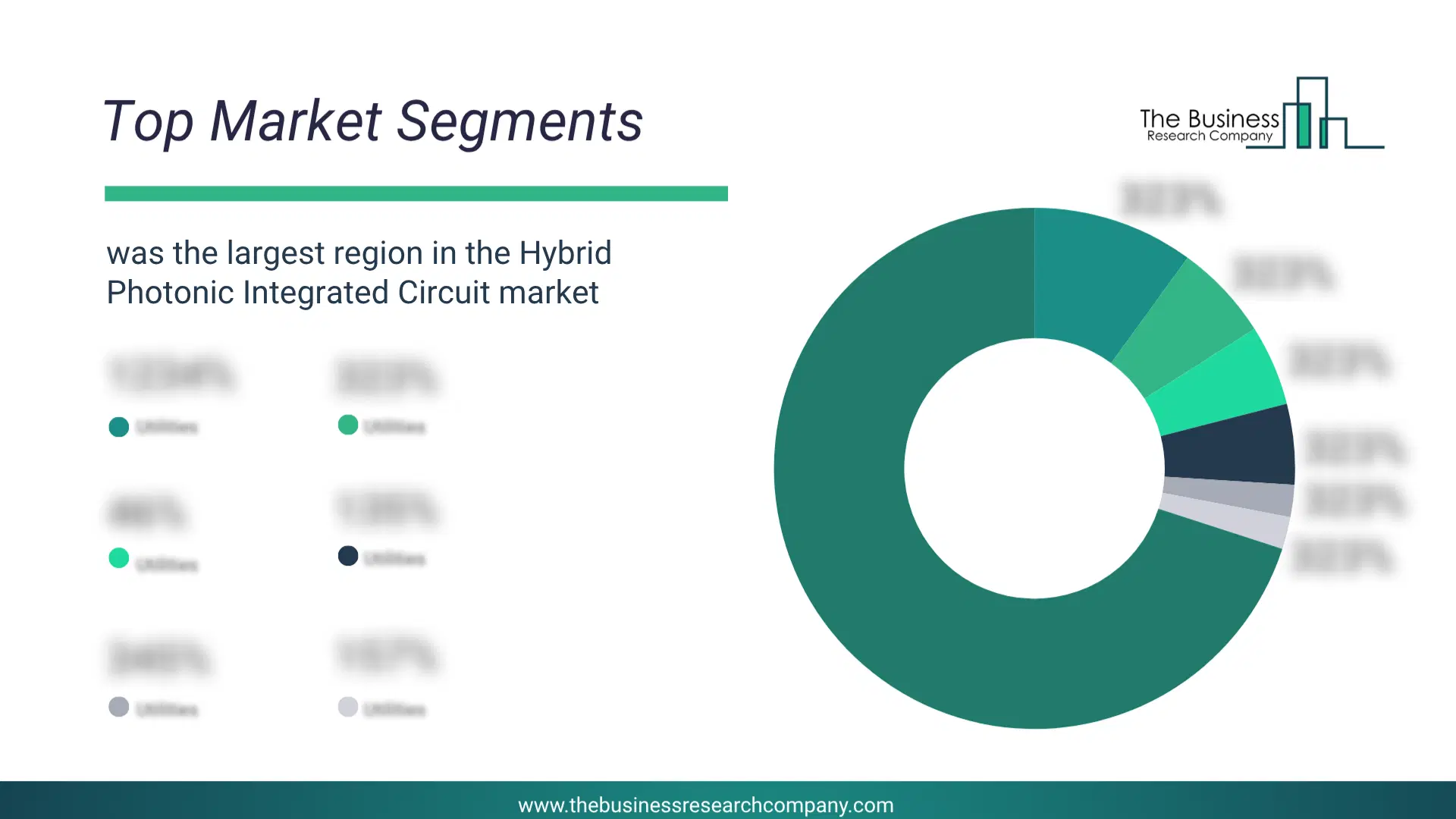
North America was the largest region in the hybrid photonic integrated circuit market in 2025. Asia-Pacific is expected to be the fastest-growing region in the forecast period. The regions covered in this market report are Asia-Pacific, South East Asia, Western Europe, Eastern Europe, North America, South America, Middle East, Africa. The countries covered in this market report are Australia, Brazil, China, France, Germany, India, Indonesia, Japan, Taiwan, Russia, South Korea, UK, USA, Canada, Italy, Spain.What Defines the Hybrid Photonic Integrated Circuit Market?
The hybrid photonic integrated circuit market consists of sales of optical transceivers, photonic sensors, wavelength converters, and optical switches. Values in this market are ‘factory gate’ values, that is, the value of goods sold by the manufacturers or creators of the goods, whether to other entities (including downstream manufacturers, wholesalers, distributors, and retailers) or directly to end customers. The value of goods in this market includes related services sold by the creators of the goods.How is Market Value Defined and Measured?
The market value is defined as the revenues that enterprises gain from the sale of goods and/or services within the specified market and geography through sales, grants, or donations in terms of the currency (in USD unless otherwise specified). The revenues for a specified geography are consumption values that are revenues generated by organizations in the specified geography within the market, irrespective of where they are produced. It does not include revenues from resales along the supply chain, either further along the supply chain or as part of other products.
This chart presents market attractiveness based on a quantitative evaluation of growth, competition, strategic alignment, and risk, offering a clear view of opportunity areas for decision-making. This chart is for illustrative purposes; the full report contains the complete analysis.

This chart highlights the Total Addressable Market (TAM) by estimating the maximum revenue opportunity using an assumption-driven approach, supporting strategic planning and opportunity sizing across markets. The chart is illustrative; the full report provides a more comprehensive analysis.
What Key Data And Analysis Are Included In The Hybrid Photonic Integrated Circuit Market Report 2026?
The hybrid photonic integrated circuit market research report is one of a series of new reports from The Business Research Company that provides market statistics, including industry global market size, regional shares, competitors with the market share, detailed market segments, market trends and opportunities, and any further data you may need to thrive in the hybrid photonic integrated circuit industry. The market research report delivers a complete perspective of everything you need, with an in-depth analysis of the current and future state of the industry.Hybrid Photonic Integrated Circuit Market Report Forecast Analysis
| Report Attribute | Details |
|---|---|
| Market Size Value In 2026 | $9.5 billion |
| Revenue Forecast In 2030 | $18.75 billion |
| Growth Rate | CAGR of 18.3% from 2026 to 2030 |
| Base Year For Estimation | 2025 |
| Actual Estimates/Historical Data | 2020-2025 |
| Forecast Period | 2026 - 2030 |
| Market Representation | Revenue in USD Billion and CAGR from 2026 to 2030 |
| Segments Covered | Type, Raw Material, Application, End-Use |
| Regional Scope | Asia-Pacific, Western Europe, Eastern Europe, North America, South America, Middle East, Africa |
| Country Scope | The countries covered in the report are Australia, Brazil, China, France, Germany, India, Indonesia, Japan, Taiwan, Russia, South Korea, UK, USA, Canada, Italy, Spain. |
| Key Companies Profiled | Huawei Technologies Co. Ltd., Cisco Systems Inc., Intel Corporation, Broadcom Inc., STMicroelectronics N.V., GlobalFoundries Inc., Marvell Technology Inc., Ciena Corporation, Lumentum Holdings Inc., Infinera Corporation, Tower Semiconductor Ltd., Source Photonics Inc., POET Technologies Inc., Rockley Photonics Ltd., EFFECT Photonics B.V., NeoPhotonics Corporation, Luxtera Inc., Ligentec SA, Ayar Labs Inc., and Sivers Semiconductors AB. |
| Customization Scope | Request for Customization |
| Pricing And Purchase Options | Explore Purchase Options |