
Hydroelectric Cells Market Report 2026
Global Outlook – By Metal Oxide ( Tin(IV) Oxide (SnO,, Aluminum Oxide (AI2O,, Zinc Oxide (ZnO), Titanium Dioxide (TiO,, Magnesium Oxide (MgO), Silicon Dioxide (SiO,), By Application ( Portable Battery, Stationary Battery, Automotive Battery, Other Applications), By End-Use Industry ( Consumer Electronics, Automotive, Energy And Utilities, Industrial, Aerospace And Defense) – Market Size, Trends, Strategies, and Forecast to 2030
Hydroelectric Cells Market Overview
• Hydroelectric Cells market size has reached to $1.99 billion in 2025 • Expected to grow to $2.71 billion in 2030 at a compound annual growth rate (CAGR) of 6.4% • Growth Driver: Growing Electrical Energy Demand Drives The Hydroelectric Cells Market • Market Trend: Innovations In Self-Powered Cellular Phone Base Stations Utilizing Hydroelectric Technology • Asia-Pacific was the largest region in 2025.What Is Covered Under Hydroelectric Cells Market?
Hydroelectric cells (HEC) are a key source of green energy that generates electricity by splitting water molecules into hydronium and hydroxide ions at room temperature. These cells use available water as a fuel for power generation, replacing toxic chemicals that endanger the safety of consumers and are harmful to the environment. The main types of metal oxides involved in hydroelectric cells are tin (IV) oxide (SnO2), aluminum oxide (Al2O3), zinc oxide (ZnO), titanium dioxide (tio2), magnesium oxide (MgO) and silicon dioxide (sio2). Tin (IV) oxide (SnO2 is an inorganic compound that is used in hydroelectric cells to generate electricity by dissociating water into H3O+ and OH- ions without releasing any toxic waste. The various applications involved are portable batteries, stationary batteries, automotive batteries and others.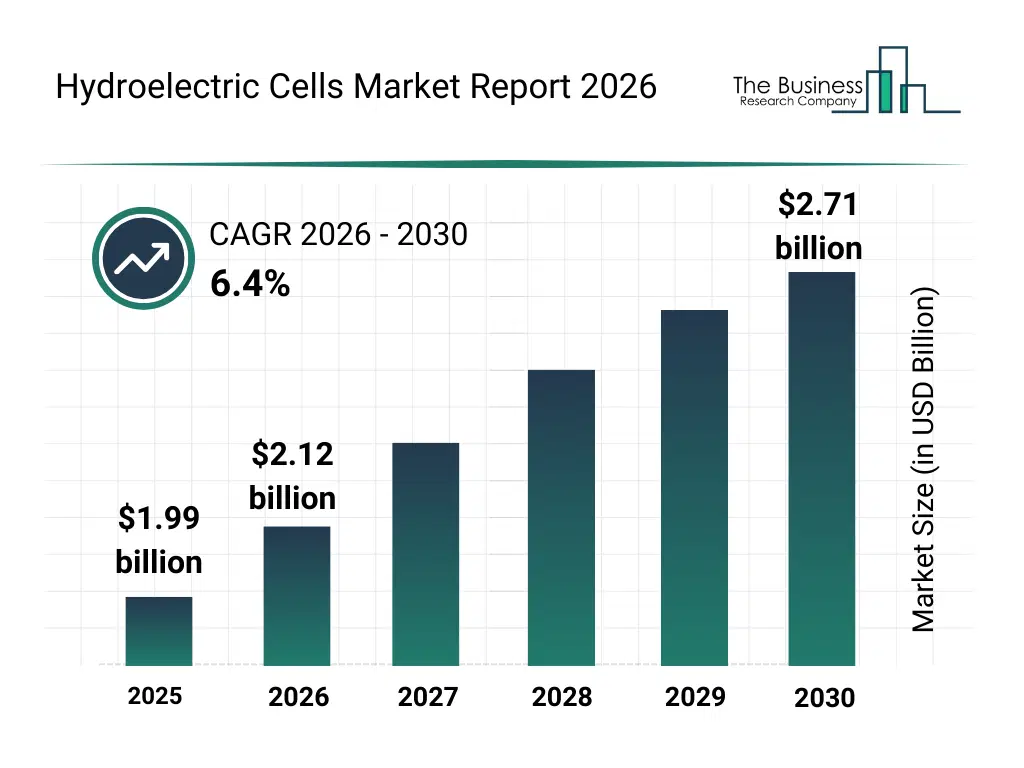
What Is The Hydroelectric Cells Market Size 2026 And Growth Rate?
The hydroelectric cells market size has grown strongly in recent years. It will grow from $1.99 billion in 2025 to $2.12 billion in 2026 at a compound annual growth rate (CAGR) of 6.5%. The growth in the historic period can be attributed to early research on water-splitting technologies, limited pilot-scale deployments, reliance on traditional portable battery chemistries, initial testing in academic and industrial labs, growth in green energy storage awareness.What Is The Hydroelectric Cells Market Growth Forecast?
The hydroelectric cells market size is expected to see strong growth in the next few years. It will grow to $2.71 billion in 2030 at a compound annual growth rate (CAGR) of 6.4%. The growth in the forecast period can be attributed to increasing investment in eco-friendly battery alternatives, rising adoption of portable green power systems, expansion of stationary water-based storage solutions, development of high-efficiency oxide materials, growing demand for safe non-toxic battery technologies. Major trends in the forecast period include expansion of sustainable water-based power solutions, development of intelligent energy conversion systems, integration of IoT-enabled green power devices, advancement of automated hec production technologies, adoption of digitally monitored renewable storage systems.
Global Hydroelectric Cells Market Segmentation
1) By Metal Oxide: Tin(IV) Oxide (SnO2), Aluminum Oxide (AI2O3), Zinc Oxide (ZnO), Titanium Dioxide (TiO2), Magnesium Oxide (MgO), Silicon Dioxide (SiO2) 2) By Application: Portable Battery, Stationary Battery, Automotive Battery, Other Applications 3) By End-Use Industry: Consumer Electronics, Automotive, Energy And Utilities, Industrial, Aerospace And Defense Subsegments: 1) By Tin(IV) Oxide (SnO2): Nanostructured SnO2, Doped SnO2 2) By Aluminum Oxide (Al2O3): a-Alumina, ?-Alumina 3) By Zinc Oxide (ZnO): Nanostructured ZnO, Doped ZnO 4) By Titanium Dioxide (TiO2): Anatase TiO2, Rutile TiO2, Doped TiO2 5) By Magnesium Oxide (MgO): Nanostructured MgO, Doped MgO 6) By Silicon Dioxide (SiO2): Amorphous SiO2, Crystalline SiO2What Is The Driver Of The Hydroelectric Cells Market?
Growing global demand for electrical energy is expected to contribute significantly to the growth of the hydroelectric cell market. Electrical energy refers to the production of electricity by moving electric charges called electrons. Hydroelectric cells are a sustainable and renewable energy source to meet the growing demand for electrical energy. There is a growing demand for energy solutions that can supply steady, dependable power without depleting limited resources as the world's population and industrialization increase. For instance, in October 2023, according to the Energy Information Administration (EIA), a US-based government agency responsible for collecting, analyzing, and disseminating energy information, the world's electricity demand could rise by roughly one-third to three-quarters by 2050. Nuclear and renewable energy sources are expected to generate up to two-thirds of the world's electricity. Therefore, growing global demand for electrical energy is expected to propel the growth of the hydroelectric cell industry going forward.Key Players In The Global Hydroelectric Cells Market
Major companies operating in the hydroelectric cells market are GE Renewable Energy, Andritz AG, IHI Corporation, ABB Ltd., CSIR - National Physical Laboratory, Voith GmbH, Siemens Energy AG, Aurora Power & Design Inc., Mitsubishi Heavy Industries Ltd., Hitachi Ltd., Sungrow Power Supply Co. Ltd., Bharat Heavy Electricals Limited, Hydro Green Power Inc., GenCell Energy Inc., CellCube Energy Storage Inc., Plug Power Inc., Ballard Power Systems Inc., Bloom Energy Corporation, Hydrogenics (Cummins Inc.), Enapter GmbH
This chart is for illustrative purposes; the full report includes a detailed competitor analysis and comprehensive overview of the top 10 companies in the market.
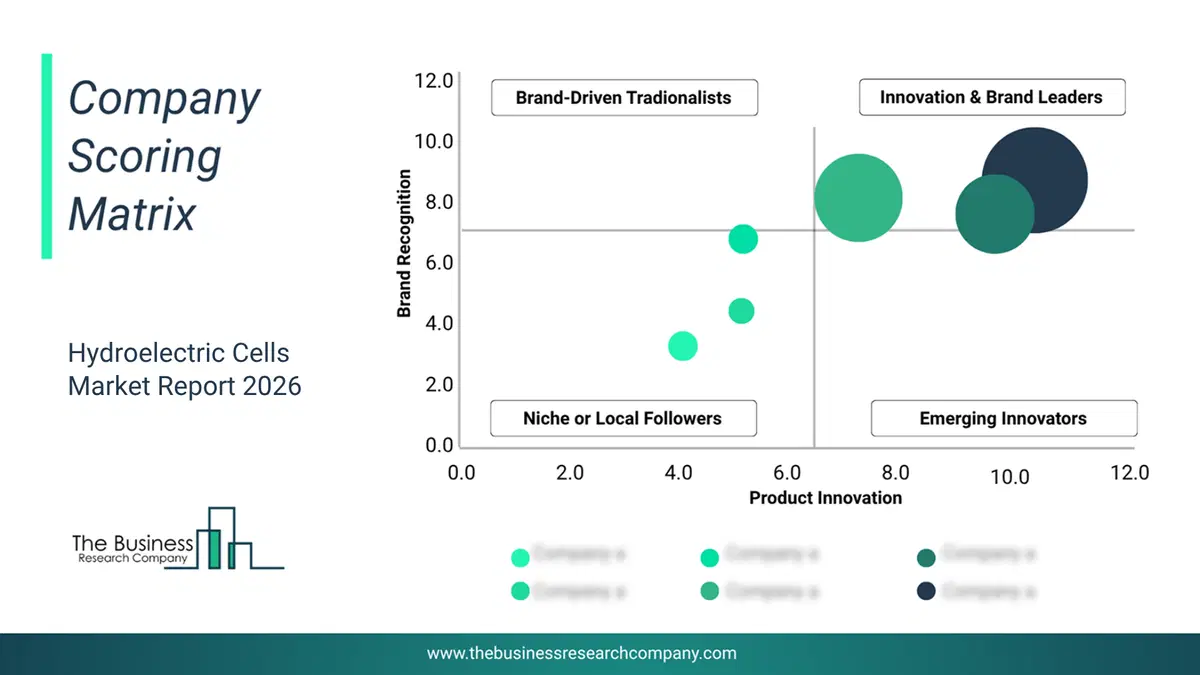
This chart maps companies by product innovation and brand strength, with bubble size indicating relative revenue, helping identify market leaders, challengers, and niche players. This is an illustrative chart; the full report provides a complete and accurate competitive analysis.
Global Hydroelectric Cells Market Trends and Insights
Major companies operating in the hydroelectric cell market are focusing on developing innovative solutions, such as self-powered cellular phone base stations, to enhance energy efficiency and sustainability. A self-powered cellular phone base station refers to a telecommunications tower or base station that can operate independently of external power sources by generating its own energy. For instance, in May 2024, NTT Docomo, a Japan-based mobile phone operator company, launched Japan's first demonstration of a self-powered hydropower cellular base station, utilizing water from irrigation canals to generate sustainable energy for mobile networks, particularly in rural areas. The system features an innovative jet turbine designed by Professor Yukihiro Shimatani, which efficiently converts water flow into electricity. This approach simplifies traditional hydroelectric systems and is compatible with 3D printing technology. The base station collects essential data monitored through Docomo's Energy Management System (EMS).What Are Latest Mergers And Acquisitions In The Hydroelectric Cells Market?
In October 2024, Quanta Computer, a Taiwan-based computer manufacturing company, acquired Bloom Energy Systems for $80 million. This acquisition aims to secure a reliable and clean energy solution for its manufacturing expansion in Fremont, California, by implementing a 24/7 microgrid powered by Bloom's fuel cell technology, thus addressing immediate power needs and maintaining a competitive edge amid the growing demand for AI infrastructure. Bloom EnergySystems is a US-based green energy company, is transforming energy generation with its solid-oxide platform for distributed electricity and hydrogen production.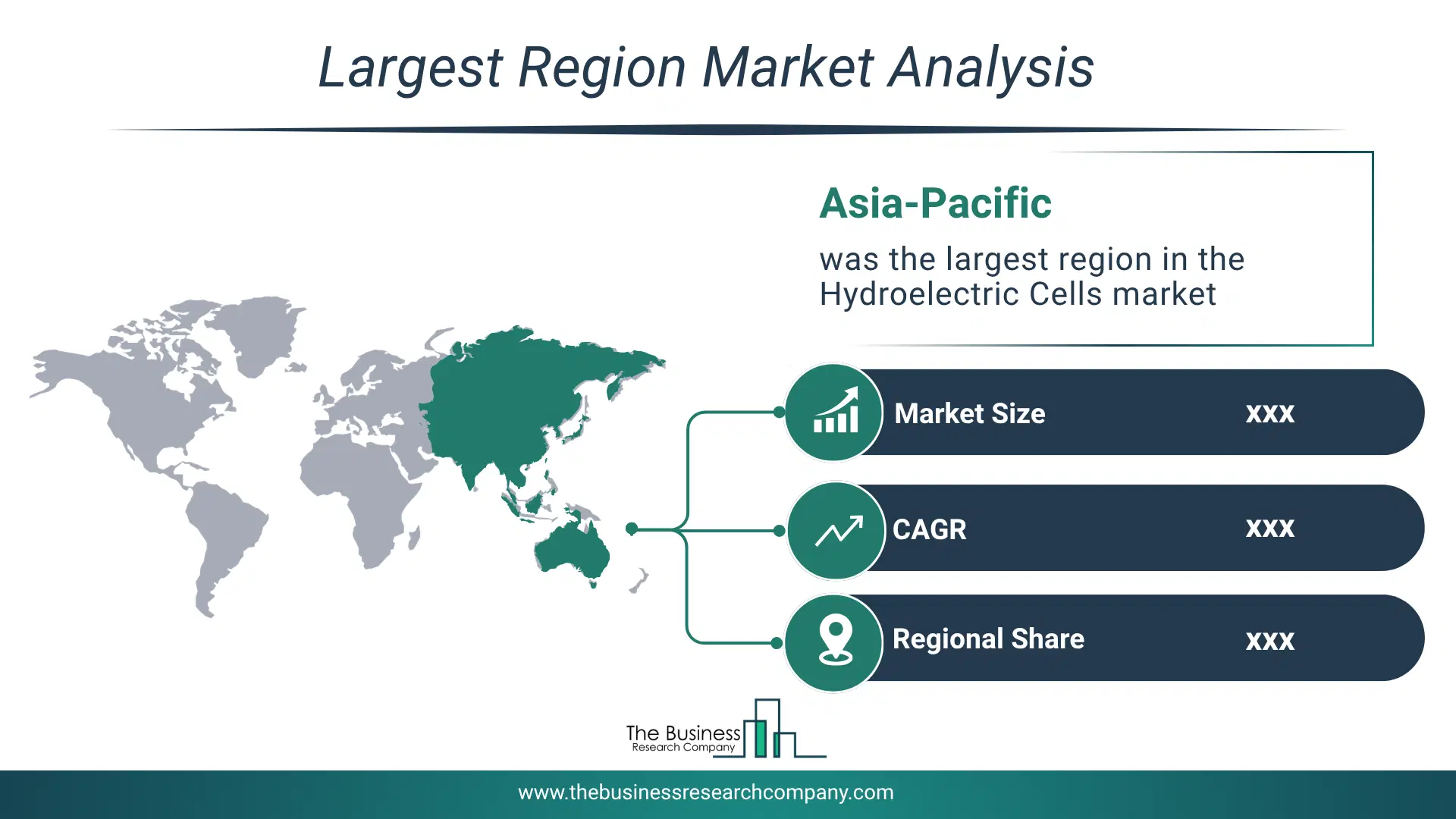
Regional Outlook
Asia-Pacific was the largest region in the hydroelectric cells market in 2025. The regions covered in this market report are Asia-Pacific, South East Asia, Western Europe, Eastern Europe, North America, South America, Middle East, Africa. The countries covered in this market report are Australia, Brazil, China, France, Germany, India, Indonesia, Japan, Taiwan, Russia, South Korea, UK, USA, Canada, Italy, Spain.What Defines the Hydroelectric Cells Market?
The hydroelectric cells market consists of sales of proton-exchange-membrane fuel cells and regenerative fuel cells. Values in this market are ‘factory gate’ values, that is the value of goods sold by the manufacturers or creators of the goods, whether to other entities (including downstream manufacturers, wholesalers, distributors and retailers) or directly to end customers. The value of goods in this market includes related services sold by the creators of the goods.How is Market Value Defined and Measured?
The market value is defined as the revenues that enterprises gain from the sale of goods and/or services within the specified market and geography through sales, grants, or donations in terms of the currency (in USD unless otherwise specified). The revenues for a specified geography are consumption values that are revenues generated by organizations in the specified geography within the market, irrespective of where they are produced. It does not include revenues from resales along the supply chain, either further along the supply chain or as part of other products.
This chart presents market attractiveness based on a quantitative evaluation of growth, competition, strategic alignment, and risk, offering a clear view of opportunity areas for decision-making. This chart is for illustrative purposes; the full report contains the complete analysis.

This chart highlights the Total Addressable Market (TAM) by estimating the maximum revenue opportunity using an assumption-driven approach, supporting strategic planning and opportunity sizing across markets. The chart is illustrative; the full report provides a more comprehensive analysis.
What Key Data and Analysis Are Included in the Hydroelectric Cells Market Report 2026?
The hydroelectric cells market research report is one of a series of new reports from The Business Research Company that provides market statistics, including industry global market size, regional shares, competitors with the market share, detailed market segments, market trends and opportunities, and any further data you may need to thrive in the hydroelectric cells industry. The market research report delivers a complete perspective of everything you need, with an in-depth analysis of the current and future state of the industry.Hydroelectric Cells Market Report Forecast Analysis
| Report Attribute | Details |
|---|---|
| Market Size Value In 2026 | $2.12 billion |
| Revenue Forecast In 2030 | $2.71 billion |
| Growth Rate | CAGR of 6.4% from 2026 to 2030 |
| Base Year For Estimation | 2025 |
| Actual Estimates/Historical Data | 2020-2025 |
| Forecast Period | 2026 - 2030 |
| Market Representation | Revenue in USD Billion and CAGR from 2026 to 2030 |
| Segments Covered | Metal Oxide, Application, End-Use Industry |
| Regional Scope | Asia-Pacific, Western Europe, Eastern Europe, North America, South America, Middle East, Africa |
| Country Scope | The countries covered in the report are Australia, Brazil, China, France, Germany, India, Indonesia, Japan, Taiwan, Russia, South Korea, UK, USA, Canada, Italy, Spain. |
| Key Companies Profiled | Major companies operating in the hydroelectric cells market are <b> GE Renewable Energy, Andritz AG, IHI Corporation, ABB Ltd., CSIR - National Physical Laboratory, Voith GmbH, Siemens Energy AG, Aurora Power & Design Inc., Mitsubishi Heavy Industries Ltd., Hitachi Ltd., Sungrow Power Supply Co. Ltd., Bharat Heavy Electricals Limited, Hydro Green Power Inc., GenCell Energy Inc., CellCube Energy Storage Inc., Plug Power Inc., Ballard Power Systems Inc., Bloom Energy Corporation, Hydrogenics (Cummins Inc.), Enapter GmbH </b> |
| Customization Scope | Request for Customization |
| Pricing And Purchase Options | Explore Purchase Options |