
Hydrogen Transmission Pipelines Market Report 2026
Global Outlook – By Pipeline Type (Dedicated Hydrogen Pipelines, Blended Hydrogen Pipelines), By Hydrogen Form (Gas Form, Liquid Form), By Pipe Material (Steel, Plastic, Composite, Other Pipe Materials), By Application (Power Stations, Hydrogen Storage Stations, Gas Stations, Refineries, Other Applications), By End User (Industrial Refining Or Ammonia Or Chemicals, Power Generation, Transportation Fueling) – Market Size, Trends, Strategies, and Forecast to 2030
Hydrogen Transmission Pipelines Market Overview
• Hydrogen Transmission Pipelines market size has reached to $6.52 billion in 2025 • Expected to grow to $19.78 billion in 2030 at a compound annual growth rate (CAGR) of 24.9% • Growth Driver: Rising Green Hydrogen Production Fueling The Growth Of The Market Due To Need For Scalable Hydrogen Transport Infrastructure • Market Trend: Development Of Embrittlement-Resistant Steel for Safe Hydrogen Flow • North America was the largest region in 2025 and Asia-Pacific is the fastest growing region.What Is Covered Under Hydrogen Transmission Pipelines Market?
Hydrogen transmission pipelines refer to specialized pipeline infrastructure designed to transport hydrogen from production facilities to storage sites, industrial users, or distribution networks over long distances. They enable safe and efficient hydrogen flow by using dedicated materials, compression systems, and monitoring technologies suited to hydrogen’s physical properties. The pipelines support large-scale hydrogen distribution and play a critical role in connecting hydrogen supply with end-use applications across energy, industrial, and mobility sectors. The main pipeline types of hydrogen transmission pipelines are dedicated hydrogen pipelines and blended hydrogen pipelines. Dedicated hydrogen pipelines refers to pipelines exclusively designed for transporting pure hydrogen safely and efficiently across long distances. These pipelines transport hydrogen in different forms, including gas form and liquid form, and are constructed using various pipe materials, such as steel, plastic, composite, and other pipe materials. They are used across multiple applications, including power stations, hydrogen storage stations, gas stations, refineries, and other applications, and serve a range of end-users, such as industrial refining or ammonia or chemicals, power generation, and transportation fueling.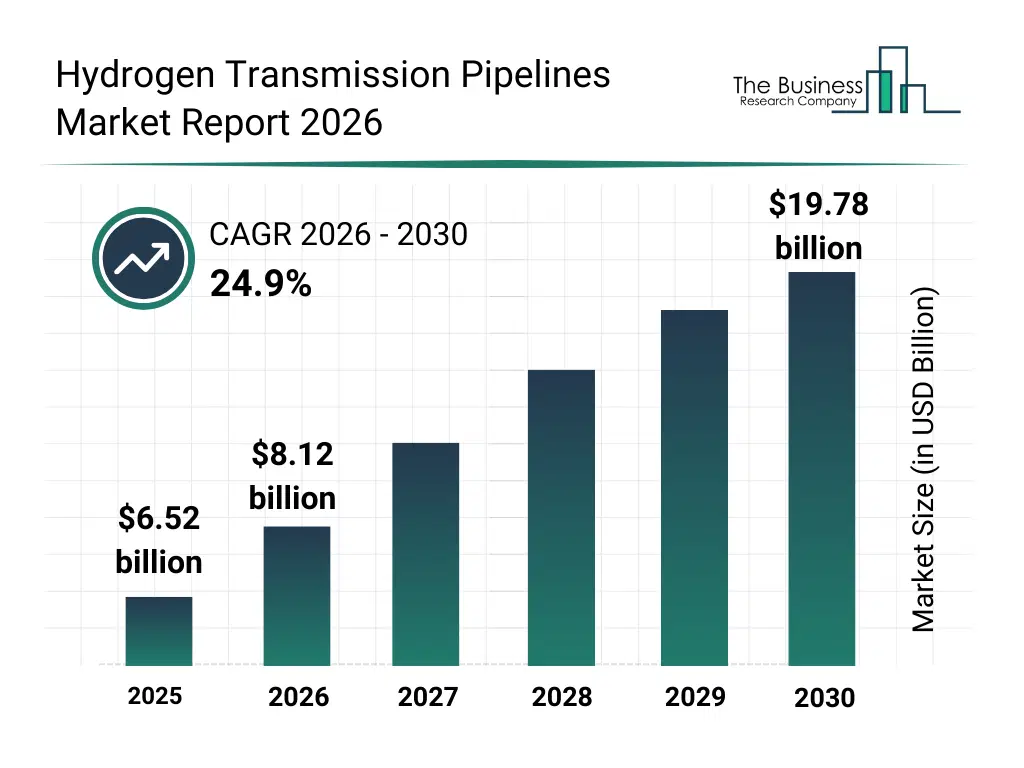
What Is The Hydrogen Transmission Pipelines Market Size and Share 2026?
The hydrogen transmission pipelines market size has grown exponentially in recent years. It will grow from $6.52 billion in 2025 to $8.12 billion in 2026 at a compound annual growth rate (CAGR) of 24.7%. The growth in the historic period can be attributed to development of industrial Gas Pipeline Infrastructure, early hydrogen distribution projects, reliance on localized hydrogen transport, adoption of steel-based pipeline systems, growth of industrial hydrogen usage.What Is The Hydrogen Transmission Pipelines Market Growth Forecast?
The hydrogen transmission pipelines market size is expected to see exponential growth in the next few years. It will grow to $19.78 billion in 2030 at a compound annual growth rate (CAGR) of 24.9%. The growth in the forecast period can be attributed to increasing investments in hydrogen infrastructure, expansion of national hydrogen backbone networks, rising demand for long-distance hydrogen transport, growing integration with renewable energy hubs, increasing focus on safe hydrogen distribution. Major trends in the forecast period include expansion of dedicated hydrogen pipeline networks, growing use of advanced hydrogen-compatible materials, rising integration of real-time pipeline monitoring systems, development of blended hydrogen distribution networks, increased focus on pipeline safety and leak detection.
Global Hydrogen Transmission Pipelines Market Segmentation
1) By Pipeline Type: Dedicated Hydrogen Pipelines; Blended Hydrogen Pipelines 2) By Hydrogen Form: Gas Form; Liquid Form 3) By Pipe Material: Steel; Plastic; Composite; Other Pipe Materials 4) By Application: Power Stations; Hydrogen Storage Stations; Gas Stations; Refineries; Other Applications 5) By End User: Industrial Refining Or Ammonia Or Chemicals; Power Generation; Transportation Fueling Subsegments: 1) By Dedicated Hydrogen Pipelines: New Construction; Retrofitted Natural Gas Pipelines; High Pressure Transmission Lines; Distribution Mains 2) By Blended Hydrogen Pipelines: Low Percentage Blending Networks; High Percentage Blending Networks; Industrial Cluster Networks; Municipal Distribution GridsWhat Is The Driver Of The Hydrogen Transmission Pipelines Market?
The rising demand for green hydrogen production is expected to propel the growth of the hydrogen transmission pipelines market going forward. Green hydrogen production refers to the generation of hydrogen by splitting water into hydrogen and oxygen using electricity from renewable energy sources, resulting in minimal or zero greenhouse gas emissions. Green hydrogen demand is increasing because governments and industries worldwide are expanding renewable electricity capacity rapidly to reduce carbon emissions and replace fossil fuels in hard-to-decarbonize sectors. Hydrogen transmission pipelines support the rising demand for green hydrogen production by enabling the efficient and scalable transport of hydrogen from renewable-based production facilities to industrial users, storage hubs, and export terminals, ensuring reliable supply chains. For instance, in September 2025, according to the International Energy Agency (IEA), a France-based intergovernmental organization, global hydrogen demand reached nearly 100 million tonnes in 2024, reflecting a 2% increase over 2023 and aligning with the broader growth trend in overall energy consumption. Therefore, the rising demand for green hydrogen production is driving the growth of the Hydrogen Transmission pipelines industry.Key Players In The Global Hydrogen Transmission Pipelines Market
Major companies operating in the hydrogen transmission pipelines market are BP p.l.c., E.ON SE, Enbridge Inc., Linde plc, L’Air Liquide S.A., RWE AG, National Grid plc, Saipem S.p.A., TC Energy Corporation, Kinder Morgan Inc., Air Products and Chemicals Inc., McDermott International Ltd., Technip Energies N.V., Snam S.p.A., N.V. Nederlandse Gasunie, Open Grid Europe GmbH, Enagás S.A., Fluxys Belgium SA, Teréga S.A., Nordion Energi AB, ONTRAS Gastransport GmbH, GRTgaz SA, and Hellenic Gas Transmission System Operator S.A. (DESFA).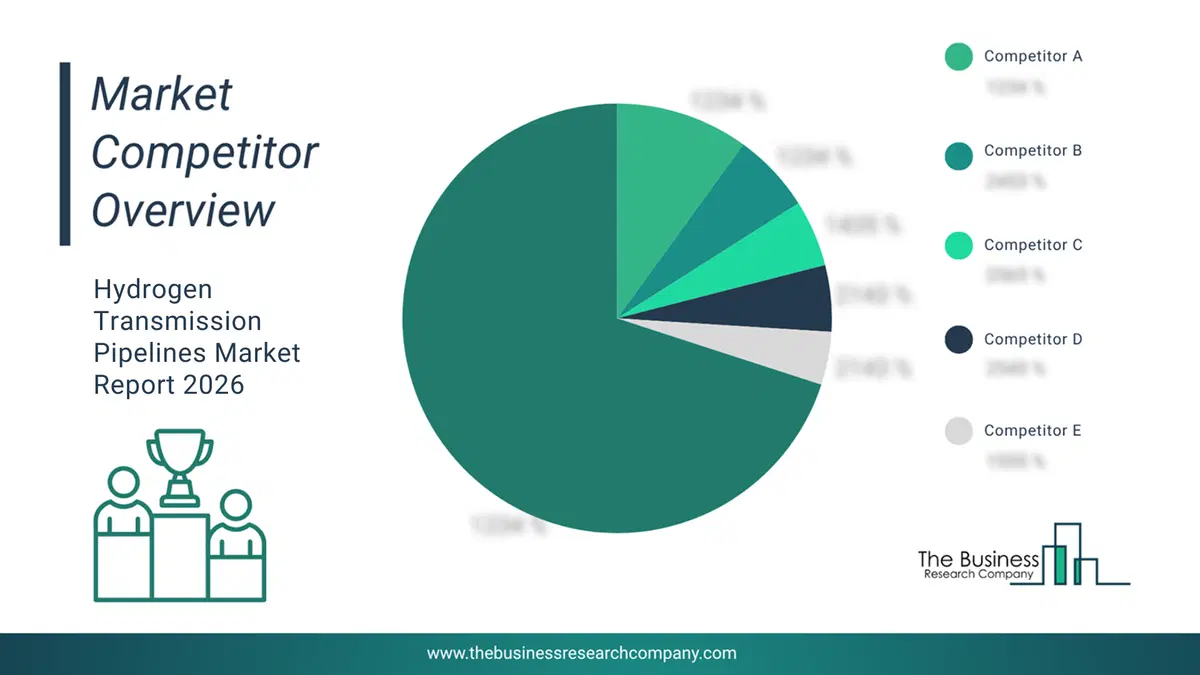
This chart is for illustrative purposes; the full report includes a detailed competitor analysis and comprehensive overview of the top 10 companies in the market.
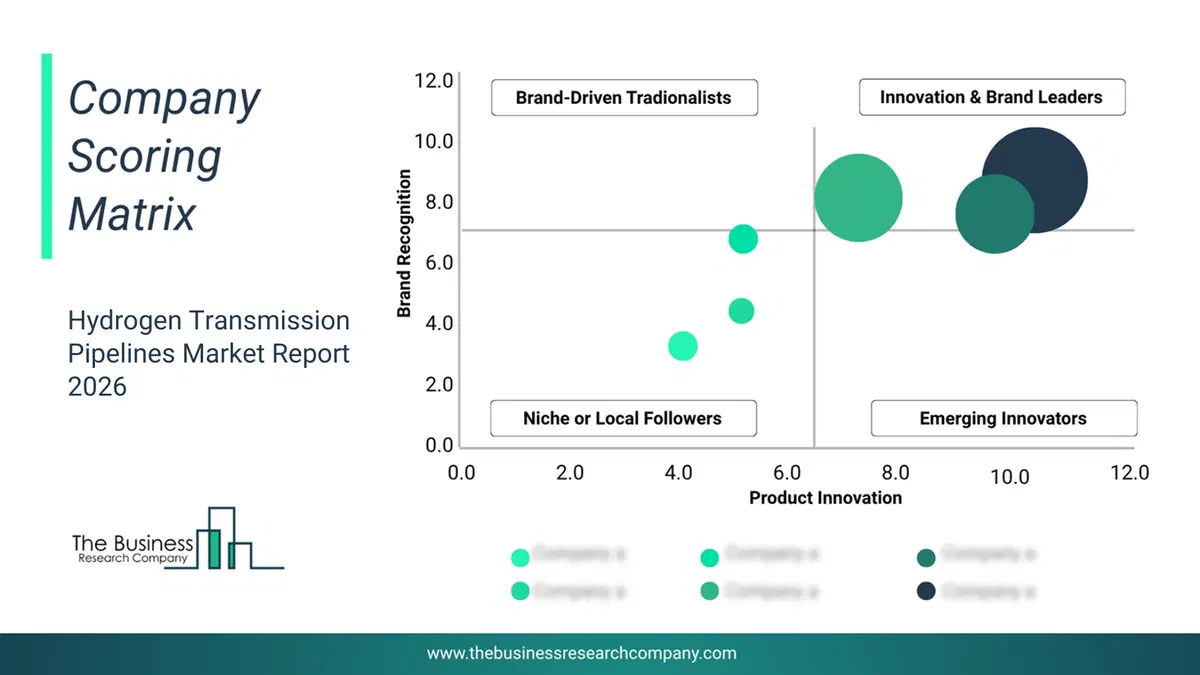
This chart maps companies by product innovation and brand strength, with bubble size indicating relative revenue, helping identify market leaders, challengers, and niche players. This is an illustrative chart; the full report provides a complete and accurate competitive analysis.
Global Hydrogen Transmission Pipelines Market Trends and Insights
Major companies operating in the hydrogen transmission pipelines market are focusing on developing hydrogen-compliant pipeline materials, such as specialized API X65 grade steel pipes engineered for high-pressure hydrogen flow, to complete the sentence. API X65 grade steel pipes are high-strength, low-alloy line pipes manufactured to API 5L standards and engineered to withstand high pressures while resisting hydrogen embrittlement, making them suitable for safe long-distance hydrogen transmission. For instance, in January 2025, Tata Steel, an India-based steel manufacturer, introduced hydrogen-compliant API X65 grade steel pipes, which include properties for transporting 100 percent gaseous hydrogen under high pressure, require less frequent welding due to advanced metallurgy, and undergo rigorous qualification testing by an accredited agency to ensure hydrogen service suitability and longevity.What Are Latest Mergers And Acquisitions In The Hydrogen Transmission Pipelines Market?
In January 2025, Natran, a France-based gas grid operator and subsidiary of Engie, partnered with Terega and Enagás to develop a cross-border hydrogen pipeline project. The partnership aims to establish the Barcelona-to-Marseille underwater pipeline, known as BarMar, as part of the broader €2.5 billion H2Med initiative designed to connect Portugal, Spain, France, and Germany by 2030 to support hydrogen transport across Europe. Terega is a France-based gas storage operator, and Enagás is a Spain-based energy infrastructure company specializing in gas transmission and renewable gas projects.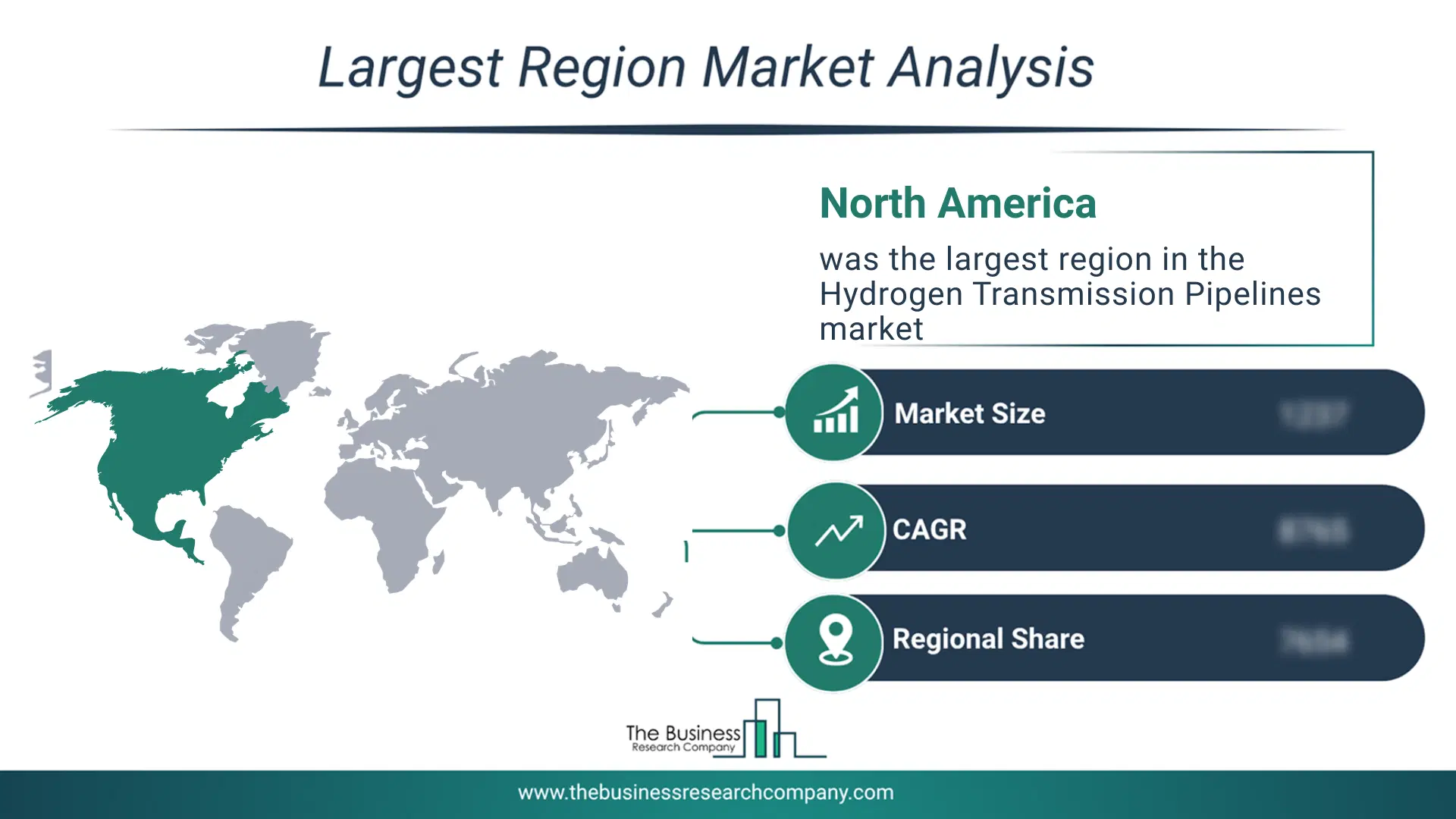
Regional Insights
North America was the largest region in the hydrogen transmission pipelines market in 2025. Asia-Pacific is expected to be the fastest-growing region in the forecast period. The regions covered in this market report are Asia-Pacific, South East Asia, Western Europe, Eastern Europe, North America, South America, Middle East, Africa. The countries covered in this market report are Australia, Brazil, China, France, Germany, India, Indonesia, Japan, Taiwan, Russia, South Korea, UK, USA, Canada, Italy, Spain.What Defines the Hydrogen Transmission Pipelines Market?
The hydrogen transmission pipelines market consists of sales of hydrogen compressors, hydrogen valves, hydrogen meters, hydrogen sensors, hydrogen pipelines, hydrogen fittings, hydrogen pumps, hydrogen storage tanks, hydrogen flow controllers, and hydrogen regulators. Values in this market are factory gate values, meaning the value of pipeline infrastructure sold by manufacturers or project developers to other entities such as contractors, distributors, or directly to buyers. The market value also includes associated services provided by the creators of these pipeline systems.How is Market Value Defined and Measured?
The market value is defined as the revenues that enterprises gain from the sale of goods and/or services within the specified market and geography through sales, grants, or donations in terms of the currency (in USD unless otherwise specified). The revenues for a specified geography are consumption values that are revenues generated by organizations in the specified geography within the market, irrespective of where they are produced. It does not include revenues from resales along the supply chain, either further along the supply chain or as part of other products.
This chart presents market attractiveness based on a quantitative evaluation of growth, competition, strategic alignment, and risk, offering a clear view of opportunity areas for decision-making. This chart is for illustrative purposes; the full report contains the complete analysis.

This chart highlights the Total Addressable Market (TAM) by estimating the maximum revenue opportunity using an assumption-driven approach, supporting strategic planning and opportunity sizing across markets. The chart is illustrative; the full report provides a more comprehensive analysis.
What Key Data and Analysis Are Included in the Hydrogen Transmission Pipelines Market Report 2026?
The hydrogen transmission pipelines market research report is one of a series of new reports from The Business Research Company that provides market statistics, including industry global market size, regional shares, competitors with the market share, detailed market segments, market trends and opportunities, and any further data you may need to thrive in the hydrogen transmission pipelines industry. The market research report delivers a complete perspective of everything you need, with an in-depth analysis of the current and future state of the industry.Hydrogen Transmission Pipelines Market Report Forecast Analysis
| Report Attribute | Details |
|---|---|
| Market Size Value In 2026 | $8.12 billion |
| Revenue Forecast In 2030 | $19.78 billion |
| Growth Rate | CAGR of 24.7% from 2026 to 2030 |
| Base Year For Estimation | 2025 |
| Actual Estimates/Historical Data | 2020-2025 |
| Forecast Period | 2026 - 2030 - 2030 |
| Market Representation | Revenue in USD Billion and CAGR from 2026 to 2030 |
| Segments Covered | Pipeline Type, Hydrogen Form, Pipe Material, Application, End User |
| Regional Scope | Asia-Pacific, Western Europe, Eastern Europe, North America, South America, Middle East, Africa |
| Country Scope | The countries covered in the report are Australia, Brazil, China, France, Germany, India, Indonesia, Japan, Taiwan, Russia, South Korea, UK, USA, Canada, Italy, Spain. |
| Key Companies Profiled | BP p.l.c., E.ON SE, Enbridge Inc., Linde plc, L’Air Liquide S.A., RWE AG, National Grid plc, Saipem S.p.A., TC Energy Corporation, Kinder Morgan Inc., Air Products and Chemicals Inc., McDermott International Ltd., Technip Energies N.V., Snam S.p.A., N.V. Nederlandse Gasunie, Open Grid Europe GmbH, Enagás S.A., Fluxys Belgium SA, Teréga S.A., Nordion Energi AB, ONTRAS Gastransport GmbH, GRTgaz SA, and Hellenic Gas Transmission System Operator S.A. (DESFA). |
| Customization Scope | Request for Customization |
| Pricing And Purchase Options | Explore Purchase Options |