
Hydrogen Market Report 2026
Global Outlook – By Mode Of Distribution (Pipeline, High-Pressure Tube Trailers, Cylinders), By Application (Chemical, Refinery, Metal Processing, Other Applications), By End User (Chemicals, Refining, Glass, Welding And Metal Fabrication, Other End Users) – Market Size, Trends, Strategies, and Forecast to 2030
Hydrogen Market Overview
• Hydrogen market size has reached to $47.66 billion in 2025 • Expected to grow to $75.92 billion in 2030 at a compound annual growth rate (CAGR) of 9.8% • Growth Driver: Stringent Fuel Emissions Norms To Drive Market Growth • Market Trend: Advancements In Hydrogen Fuel Cell Electric Vehicles For Sustainable Transportation • Asia-Pacific was the largest region in 2025 and North America is the fastest growing region.What Is Covered Under Hydrogen Market?
Hydrogen is produced as a by-product of industrial chlorine production by electrolysis. Although it requires expensive technologies, hydrogen can be cooled, compressed, and purified for use in other processes on-site or sold to a customer via pipeline, cylinders, or trucks. The mode of distribution of the hydrogen in the pipeline is high-pressure tube trailers or cylinders. A pipeline is a line of pipes with pumps, valves, and control devices for conveying liquids, gases, or finely divided solids. The applications involved are chemicals, refineries, metal processing, and other applications. The various end-users are chemicals, aerospace and automotive, energy, refining, glass, welding, metal fabrication, and other end-users.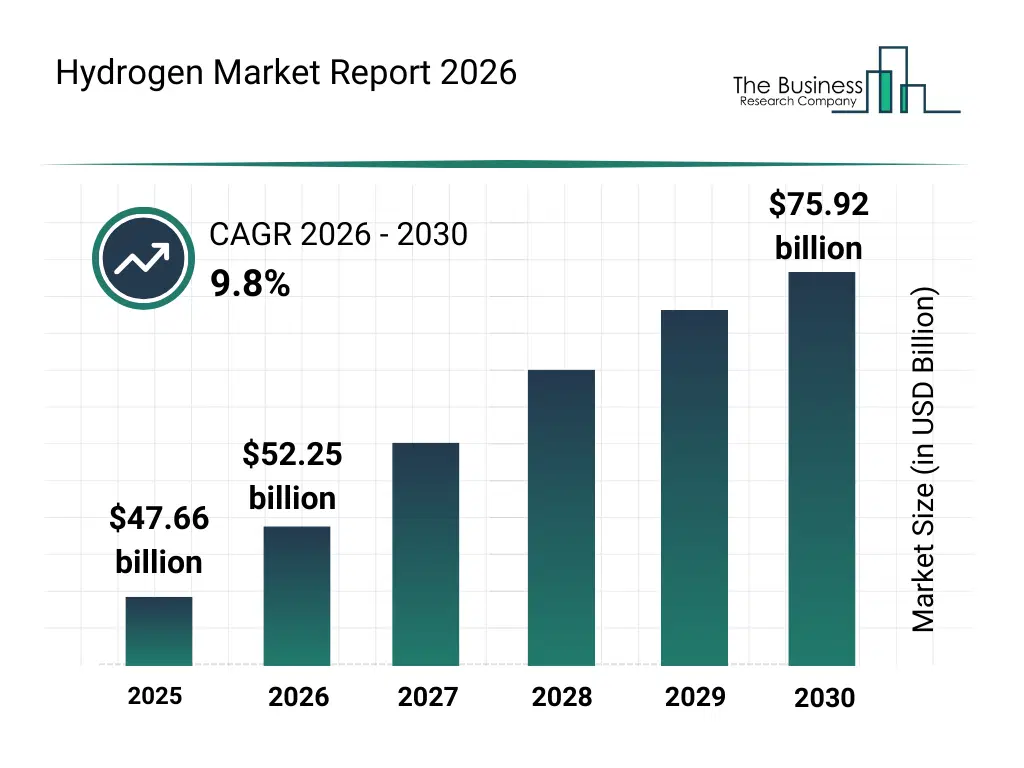
What Is The Hydrogen Market Size and Share 2026?
The hydrogen market size has grown strongly in recent years. It will grow from $47.66 billion in 2025 to $52.25 billion in 2026 at a compound annual growth rate (CAGR) of 9.7%. The growth in the historic period can be attributed to expansion of chlor-alkali production, growth of refinery hydrogen consumption, increasing use in metal processing, availability of industrial hydrogen by-product streams, expansion of pipeline infrastructure.What Is The Hydrogen Market Growth Forecast?
The hydrogen market size is expected to see strong growth in the next few years. It will grow to $75.92 billion in 2030 at a compound annual growth rate (CAGR) of 9.8%. The growth in the forecast period can be attributed to increasing investments in low-carbon hydrogen projects, rising demand from fuel cell applications, expansion of hydrogen distribution networks, growing adoption in energy transition projects, increasing focus on hydrogen purity standards. Major trends in the forecast period include growing adoption of hydrogen as an industrial feedstock, rising use in refining and chemical processing, expansion of pipeline-based hydrogen distribution, increasing demand for high-purity hydrogen, enhanced focus on on-site hydrogen generation.
Global Hydrogen Market Segmentation
1) By Mode Of Distribution: Pipeline, High-Pressure Tube Trailers, Cylinders 2) By Application: Chemical, Refinery, Metal Processing, Other Applications 3) By End User: Chemicals, Refining, Glass, Welding And Metal Fabrication, Other End Users Subsegments: 1) By Pipeline: Hydrogen Pipeline Networks For Large-Scale Distribution, On-Site Hydrogen Generation And Pipeline Delivery 2) By High-Pressure Tube Trailers: Compressed Hydrogen In Tube Trailers For Transport, Bulk Hydrogen Delivery Via Trailers 3) By Cylinders: Small-Scale Hydrogen Cylinders, Portable Hydrogen Storage For Industrial And Commercial UseWhat Is The Driver Of The Hydrogen Market?
The stringent fuel emission norms are expected to propel the growth of the hydrogen market. Fuel emission norms refer to the legally established limits on the number of pollutants and greenhouse gases that vehicles, such as cars, trucks, and motorcycles, are allowed to emit into the environment. Fuel emission regulations push industries and governments to seek cleaner energy sources, making hydrogen an attractive option. Hydrogen is used in zero-emission transportation, decarbonizing industries, and energy storage, aligning with emission reduction goals. For instance, in April 2023, according to the United States Environmental Protection Agency (EPA), a US-based government agency, the EPA proposed stricter emissions standards for light- and medium-duty vehicles, targeting various pollutants emitted by vehicles, including greenhouse gases, ozone, particulate matter, and air toxics. The proposed standards are projected to result in a 56% reduction in projected fleet average GHG emissions target levels for light-duty vehicles in 2032 compared to the existing 2026 standards. Therefore, the stringent fuel emission norms are driving the growth of the hydrogen industry.Key Players In The Global Hydrogen Market
Major companies operating in the hydrogen market are Shell plc, Chevron Corporation, BP p.l.c., TotalEnergies SE, Equinor ASA, Exxon Mobil Corporation, Saudi Arabian Oil Company (Saudi Aramco), Linde plc, Air Liquide S.A., Air Products and Chemicals, Inc., Engie S.A., Uniper SE, Plug Power Inc., Bloom Energy Corporation, Hydrogenics Corporation, Nel ASA, Cummins Inc., Ballard Power Systems Inc., Siemens Energy AG, Mitsubishi Heavy Industries, Ltd., Kawasaki Heavy Industries, Ltd., Toyota Motor Corporation, Hyundai Motor Company
This chart is for illustrative purposes; the full report includes a detailed competitor analysis and comprehensive overview of the top 10 companies in the market.
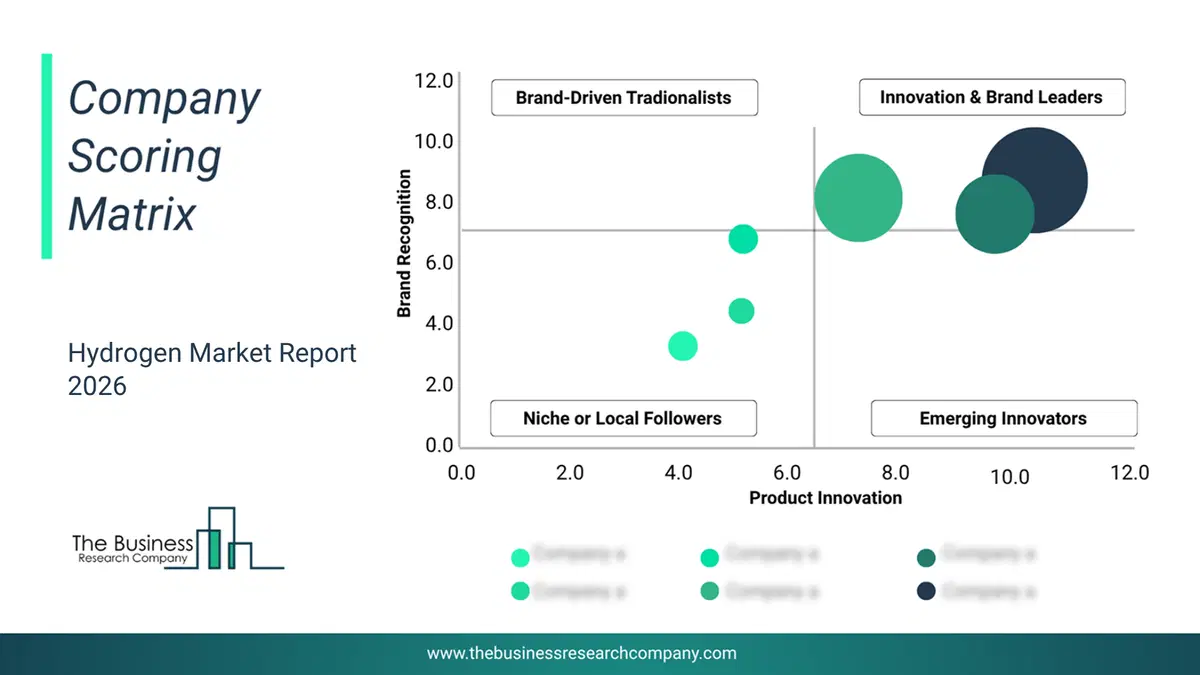
This chart maps companies by product innovation and brand strength, with bubble size indicating relative revenue, helping identify market leaders, challengers, and niche players. This is an illustrative chart; the full report provides a complete and accurate competitive analysis.
Global Hydrogen Market Trends and Insights
Major companies operating in the hydrogen mobility market are focusing on developing advanced fuel cell electric vehicles (FCEVs) with enhanced performance, longer driving ranges, and innovative designs to accelerate hydrogen adoption in transportation. Fuel cell technology converts hydrogen gas into electricity through an electrochemical reaction, producing only water as a byproduct. For instance, in April 2025, Hyundai Motor, a South Korea-based automotive manufacturer, unveiled the all-new NEXO FCEV featuring a bold new design, improved fuel cell efficiency, and advanced driver-assistance systems. The vehicle showcases Hyundai’s commitment to sustainable mobility, integrating cutting-edge hydrogen technology to offer enhanced range, faster refueling, and reduced environmental impact. The launch of the all-new NEXO provides consumers with the advantages of zero-emission driving, lower operating costs, and a more sustainable alternative to conventional vehicles.What Are Latest Mergers And Acquisitions In The Hydrogen Market?
In September 2025, Electric Hydrogen, a US-based clean energy company, acquired Ambient Fuels for an undisclosed amount. With this acquisition, Electric Hydrogen aims to establish a global project financing capability with Generate Capital, accelerate the deployment of hydrogen infrastructure, expand its clean energy solutions portfolio, and strengthen long-term project development and financing strategies. Ambient Fuels LLC is a US-based company specializing in hydrogen production and fuel solutions.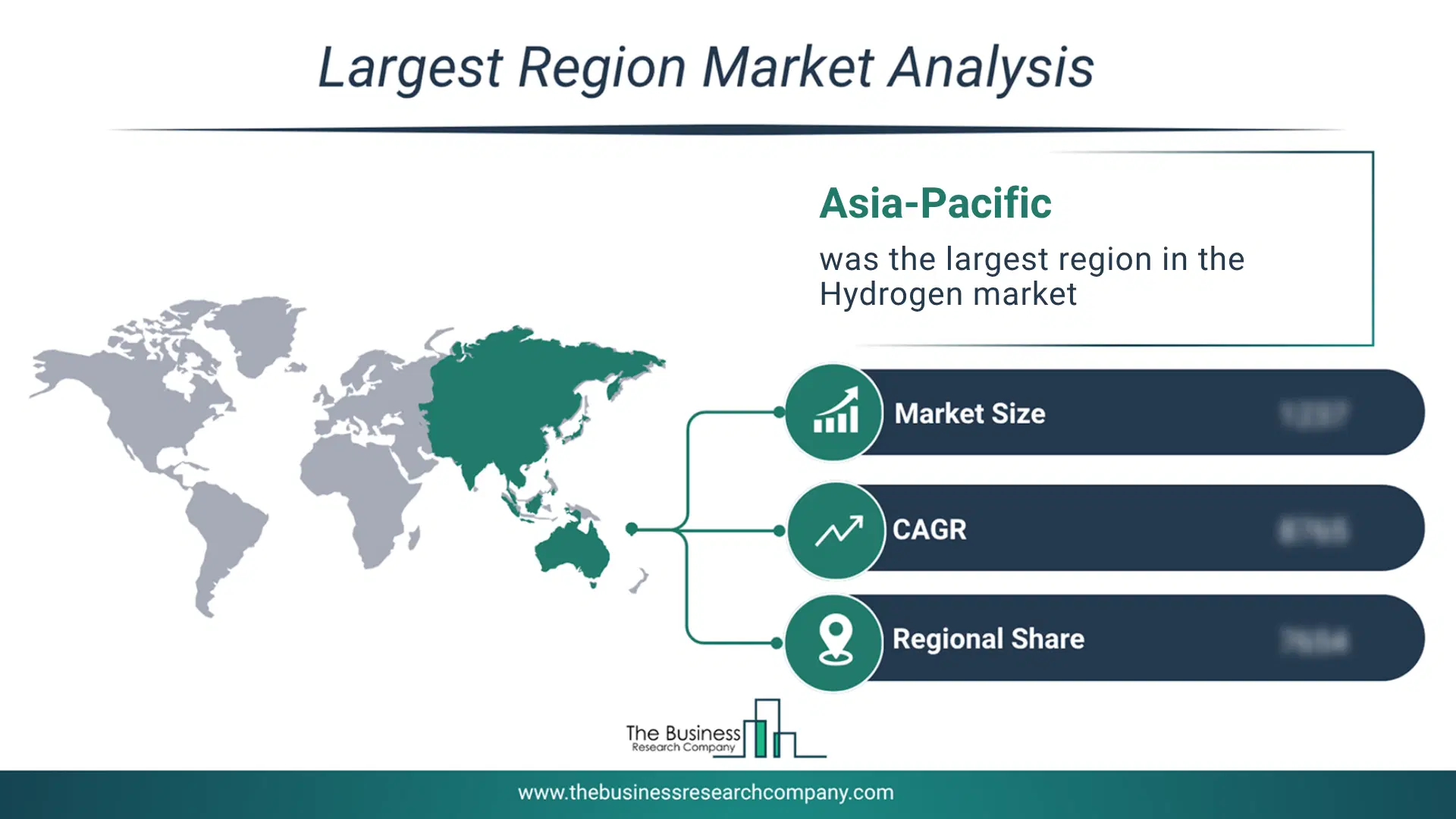
Regional Insights
Asia-Pacific was the largest region in the hydrogen market in 2025. North America was the second-largest region in the global hydrogen market. The regions covered in this market report are Asia-Pacific, South East Asia, Western Europe, Eastern Europe, North America, South America, Middle East, Africa The countries covered in this market report are Australia, Brazil, China, France, Germany, India, Indonesia, Japan, Taiwan, Russia, South Korea, UK, USA, Canada, Italy, SpainWhat Defines the Hydrogen Market?
The hydrogen market consists of the sales of green hydrogen, blue hydrogen, brown hydrogen, yellow hydrogen, turquoise hydrogen, and pink hydrogen. Values in this market are factory gate values, that is the value of goods sold by the manufacturers or creators of the goods, whether to other entities (including downstream manufacturers, wholesalers, distributors, and retailers) or directly to end customers. The value of goods in this market includes related services sold by the creators of the goods.How is Market Value Defined and Measured?
The market value is defined as the revenues that enterprises gain from the sale of goods and/or services within the specified market and geography through sales, grants, or donations in terms of the currency (in USD unless otherwise specified). The revenues for a specified geography are consumption values that are revenues generated by organizations in the specified geography within the market, irrespective of where they are produced. It does not include revenues from resales along the supply chain, either further along the supply chain or as part of other products.
This chart presents market attractiveness based on a quantitative evaluation of growth, competition, strategic alignment, and risk, offering a clear view of opportunity areas for decision-making. This chart is for illustrative purposes; the full report contains the complete analysis.

This chart highlights the Total Addressable Market (TAM) by estimating the maximum revenue opportunity using an assumption-driven approach, supporting strategic planning and opportunity sizing across markets. The chart is illustrative; the full report provides a more comprehensive analysis.
What Key Data and Analysis Are Included in the Hydrogen Market Report 2026?
The hydrogen market research report is one of a series of new reports from The Business Research Company that provides market statistics, including industry global market size, regional shares, competitors with the market share, detailed market segments, market trends and opportunities, and any further data you may need to thrive in the hydrogen industry. The market research report delivers a complete perspective of everything you need, with an in-depth analysis of the current and future state of the industry.Hydrogen Market Report Forecast Analysis
| Report Attribute | Details |
|---|---|
| Market Size Value In 2026 | $52.25 billion |
| Revenue Forecast In 2030 | $75.92 billion |
| Growth Rate | CAGR of 9.7% from 2026 to 2030 |
| Base Year For Estimation | 2025 |
| Actual Estimates/Historical Data | 2020-2025 |
| Forecast Period | 2026 - 2030 |
| Market Representation | Revenue in USD Billion and CAGR from 2026 to 2030 |
| Segments Covered | Mode Of Distribution, Application, End User |
| Regional Scope | Asia-Pacific, Western Europe, Eastern Europe, North America, South America, Middle East, Africa |
| Country Scope | The countries covered in this market report are Australia, Brazil, China, France, Germany, India, Indonesia, Japan, Taiwan, Russia, South Korea, UK, USA, Canada, Italy, Spain |
| Key Companies Profiled | Shell plc, Chevron Corporation, BP p.l.c., TotalEnergies SE, Equinor ASA, Exxon Mobil Corporation, Saudi Arabian Oil Company (Saudi Aramco), Linde plc, Air Liquide S.A., Air Products and Chemicals, Inc., Engie S.A., Uniper SE, Plug Power Inc., Bloom Energy Corporation, Hydrogenics Corporation, Nel ASA, Cummins Inc., Ballard Power Systems Inc., Siemens Energy AG, Mitsubishi Heavy Industries, Ltd., Kawasaki Heavy Industries, Ltd., Toyota Motor Corporation, Hyundai Motor Company |
| Customization Scope | Request for Customization |
| Pricing And Purchase Options | Explore Purchase Options |