
Hydrophobic Coatings Market Report 2026
Global Outlook – By Product (Polysiloxanes, Fluoro-Aklylsilanes, Fluoropolymers), By Function (Anti-Icing, Antifouling, Anti-Corrosion, Self Cleaning), By Fabrication Method (Chemical Vapor Deposition, Phase Separation, Sol-Gel Process, Electro Spinning And Etching), By Application Method (Dip-Coating, Brushing, Roll Coating, Spraying, Other Application ), By End-User (Automotive, Electronics, Building And Construction, Marine, Textiles, Healthcare, Aerospace, Oil And Gas, Food And Beverages, Other End-Users) – Market Size, Trends, Strategies, and Forecast to 2030
Hydrophobic Coatings Market Overview
• Hydrophobic Coatings market size has reached to $2.09 billion in 2025 • Expected to grow to $3.19 billion in 2030 at a compound annual growth rate (CAGR) of 8.8% • Growth Driver: Construction Boom Ignites Growth In Hydrophobic Coatings Market • Market Trend: Advanced Thromboresistant Coating Technology For Enhanced Patient Safety • Asia-Pacific was the largest region and fastest growing region.What Is Covered Under Hydrophobic Coatings Market?
Hydrophobic coatings refer to a tendency to reject water or not mix with it. Coatings with a hydrophobic (EU) or superhydrophobic surface can provide a variety of benefits to the substrate and coating surface to which they are applied. Many consumer products use hydrophobic coatings to increase water repellant, water filtering, moisture detection, and corrosion protection. The main types of products for hydrophobic coatings are polysiloxanes, fluoro-alkylsilanes, fluoropolymers, titanium dioxide, and others. Polysiloxanes refer to a wide spectrum of fluids, resins, or elastomers formed from siloxane polymerization. They are administered for various functions such as anti-microbial, anti-icing, anti-fouling, anti-corrosion, and self-cleaning and are fabricated through various methods such as chemical vapor deposition, phase separation, sol-gel process, electro-spinning, and etching. They are used in various applications such as dip-coating, brushing, roll coating, spraying, and others. They are used in various industries such as automotive, electronics, building and construction, marine, textiles, healthcare, aerospace, oil and gas, food and beverages, and other industries.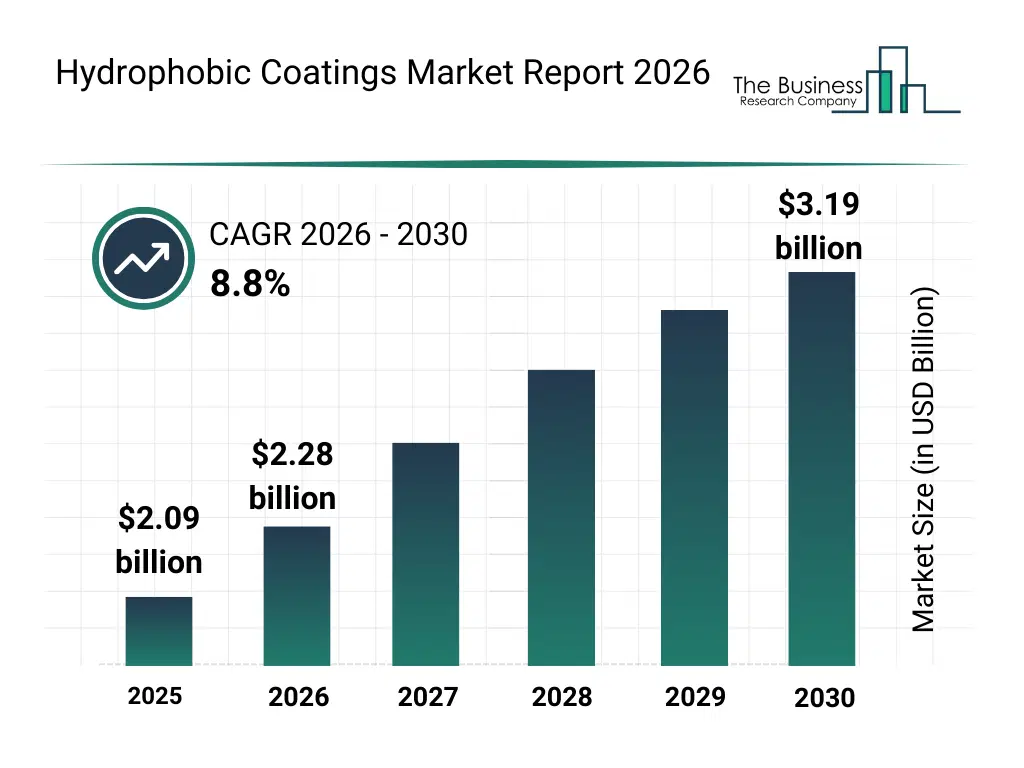
What Is The Hydrophobic Coatings Market Size and Share 2026?
The hydrophobic coatings market size has grown strongly in recent years. It will grow from $2.09 billion in 2025 to $2.28 billion in 2026 at a compound annual growth rate (CAGR) of 8.7%. The growth in the historic period can be attributed to expansion of construction and infrastructure projects, increased use in automotive applications, rising demand for corrosion protection, growth of consumer electronics usage, advancements in coating formulation technologies.What Is The Hydrophobic Coatings Market Growth Forecast?
The hydrophobic coatings market size is expected to see strong growth in the next few years. It will grow to $3.19 billion in 2030 at a compound annual growth rate (CAGR) of 8.8%. The growth in the forecast period can be attributed to increasing adoption in electric vehicles, rising use in smart building materials, expansion of marine and aerospace applications, growing demand for low-maintenance surfaces, increasing investments in advanced coating technologies. Major trends in the forecast period include growing adoption of self-cleaning coating solutions, rising demand for anti-corrosion surfaces, increasing use of nano-structured hydrophobic coatings, expansion of water-repellent applications, enhanced focus on long-lasting surface protection.
Global Hydrophobic Coatings Market Segmentation
1) By Product: Polysiloxanes, Fluoro-Aklylsilanes, Fluoropolymers 2) By Function: Anti-Icing, Antifouling, Anti-Corrosion, Self Cleaning 3) By Fabrication Method: Chemical Vapor Deposition, Phase Separation, Sol-Gel Process, Electro Spinning And Etching 4) By Application Method: Dip-Coating, Brushing, Roll Coating, Spraying, Other Application 5) By End-User: Automotive, Electronics, Building And Construction, Marine, Textiles, Healthcare, Aerospace, Oil And Gas, Food And Beverages, Other End-Users Subsegments: 1) By Polysiloxanes: Silicone-Based Coatings, Alkyl-Modified Polysiloxanes 2) By Fluoro-Alkylsilanes: Long-Chain Fluoro-Alkylsilanes, Short-Chain Fluoro-Alkylsilanes 3) By Fluoropolymers: PTFE (Polytetrafluoroethylene), PVDF (Polyvinylidene fluoride)What Is The Driver Of The Hydrophobic Coatings Market?
Increasing construction activities are expected to propel the growth of the hydrophobic coatings market going forward. Construction activities refer to the various tasks, processes, and operations involved in building or assembling structures, infrastructure, facilities, or any physical edifice. Hydrophobic coatings are applied to various surfaces, including concrete, glass, metal, and stone, to mitigate water-related damage, improve durability, and minimize maintenance efforts, contributing to the overall longevity and sustainability of structures. For instance, in April 2023, according to the reports shared by the United States Census Bureau (USCB), a US-based government agency, the amount spent on construction in February 2023 was $1.84 billion. The first two months of this year saw a $260.8 billion increase in construction investment, a 5.9% (1.2%) gain over the $246.1 billion for the same period in 2022. Therefore, increasing construction activities drive the hydrophobic coatings industry.Key Players In The Global Hydrophobic Coatings Market
Major companies operating in the hydrophobic coatings market are PPG Industries, AkzoNobel, BASF, Dow, Evonik Industries, Arkema, Lanxess, Shin-Etsu Chemical, Momentive, Wacker Chemie, Solvay, Clariant, DuPont, Covestro, Mitsubishi Chemical Corporation, Toray Industries, 3M, Axalta Coating Systems, Hempel, Henkel
This chart is for illustrative purposes; the full report includes a detailed competitor analysis and comprehensive overview of the top 10 companies in the market.
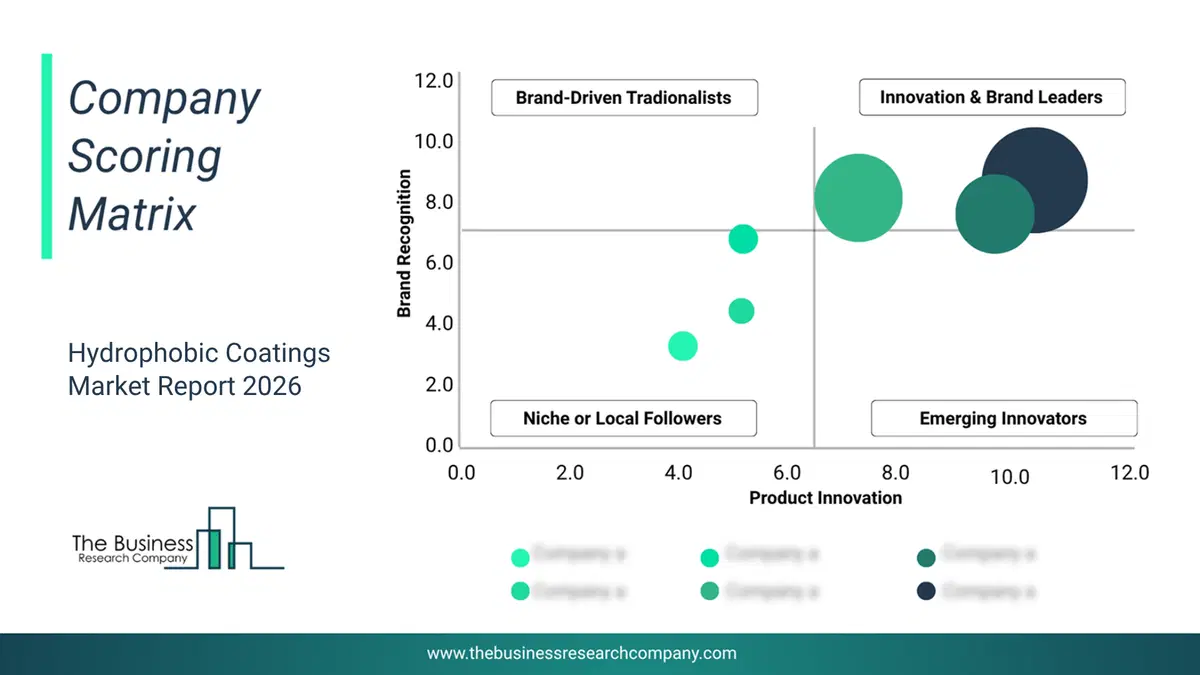
This chart maps companies by product innovation and brand strength, with bubble size indicating relative revenue, helping identify market leaders, challengers, and niche players. This is an illustrative chart; the full report provides a complete and accurate competitive analysis.
Global Hydrophobic Coatings Market Trends and Insights
Major companies in the hydrophobic coatings market are focusing on producing innovative technology, such as thromboresistant coatings, to enhance device performance and improve patient outcomes in medical applications. A thromboresistant coating is a specialized surface treatment applied to medical devices that reduces platelet adhesion and minimizes blood clot formation, helping to prevent complications like thrombosis and embolism when the device is inserted into the body. In June 2024, Hydromer Inc., a US-based hydrophilic and thromboresistant coating company, launched HydroThrombXTM, an advanced version product. This next-generation thromboresistant coating significantly reduces platelet adhesion and cell mitosis, aiding in the prevention of restenosis. HydroThrombX is designed to enhance safety and environmental sustainability while maintaining efficacy. The coating aims to improve patient safety and clinical outcomes by reducing blood clot formation risk in medical devices such as catheters and vascular implants.What Are Latest Mergers And Acquisitions In The Hydrophobic Coatings Market?
In May 2024, Kansai Helios, a Japan-based chemical company, completed the acquisition of Weilburger, for an undisclosed amount. With this acquisition, Kansai Helios aims to expand its specialty chemical portfolio, strengthen its global market presence, enhance innovation capabilities in high-performance coatings, and improve operational synergies across its European and Asian facilities. Weilburger is a Germany-based specialty coatings and additives manufacturer specializes in advanced coatings solutions and additives for various industrial applications.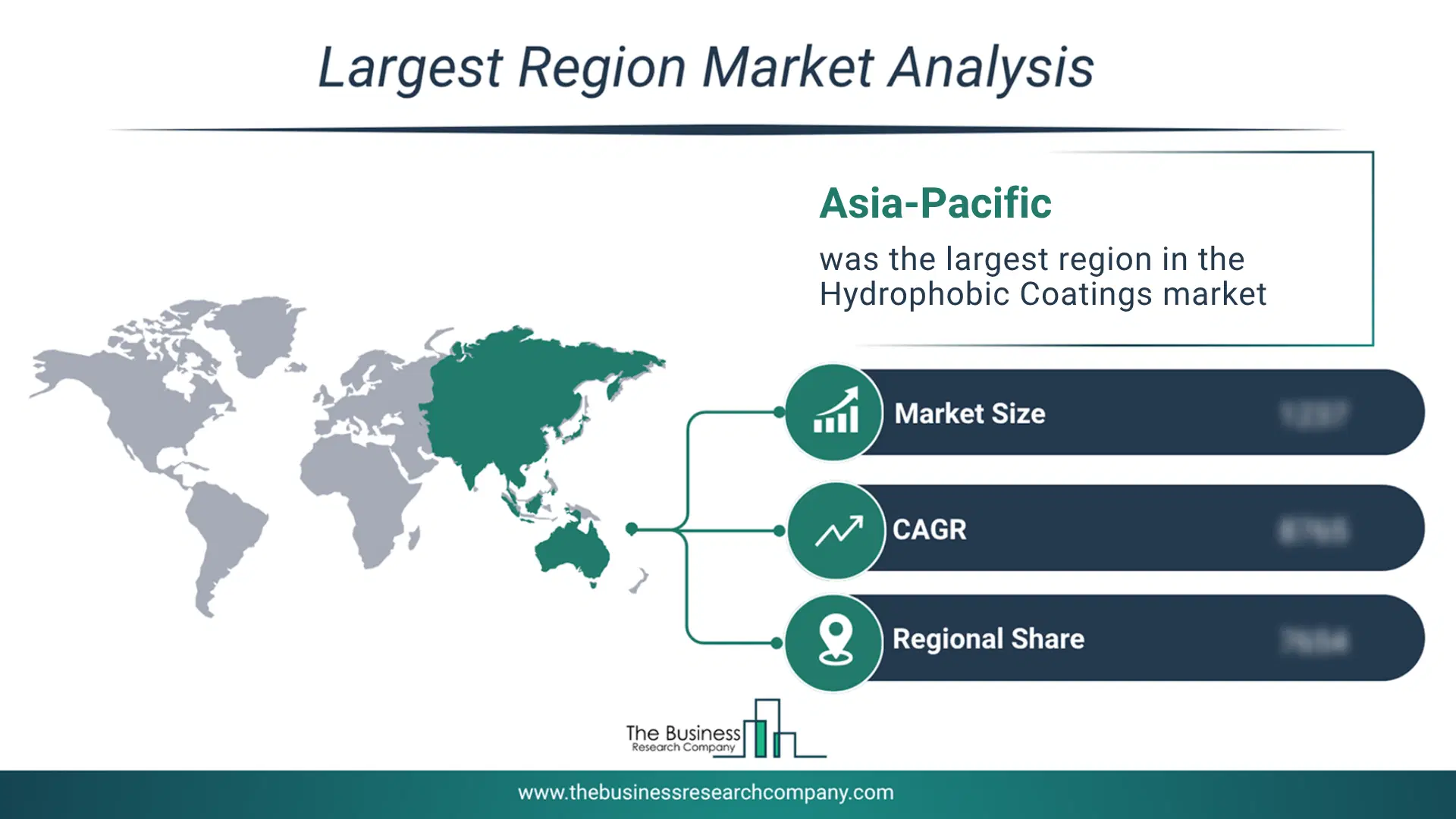
Regional Insights
Asia-Pacific was the largest region in the hydrophobic coating market in 2025. Asia-Pacific is expected to be the fastest-growing region in the global hydrophobic coating market during the forecast period. The regions covered in this market report are Asia-Pacific, South East Asia, Western Europe, Eastern Europe, North America, South America, Middle East, Africa The countries covered in this market report are Australia, Brazil, China, France, Germany, India, Indonesia, Japan, Taiwan, Russia, South Korea, UK, USA, Canada, Italy, SpainWhat Defines the Hydrophobic Coatings Market?
The hydrophobic coatings market consists of sales of teflon hydrophobic coating, ceramic coating, lotus leaves, and fluorocarbon materials. Values in this market are ‘factory gate’ values, that is, the value of goods sold by the manufacturers or creators of the goods, whether to other entities (including downstream manufacturers, wholesalers, distributors, and retailers) or directly to end customers. The value of goods in this market includes related services sold by the creators of the goods.How is Market Value Defined and Measured?
The market value is defined as the revenues that enterprises gain from the sale of goods and/or services within the specified market and geography through sales, grants, or donations in terms of the currency (in USD unless otherwise specified). The revenues for a specified geography are consumption values that are revenues generated by organizations in the specified geography within the market, irrespective of where they are produced. It does not include revenues from resales along the supply chain, either further along the supply chain or as part of other products.
This chart presents market attractiveness based on a quantitative evaluation of growth, competition, strategic alignment, and risk, offering a clear view of opportunity areas for decision-making. This chart is for illustrative purposes; the full report contains the complete analysis.

This chart highlights the Total Addressable Market (TAM) by estimating the maximum revenue opportunity using an assumption-driven approach, supporting strategic planning and opportunity sizing across markets. The chart is illustrative; the full report provides a more comprehensive analysis.
What Key Data and Analysis Are Included in the Hydrophobic Coatings Market Report 2026?
The hydrophobic coatings market research report is one of a series of new reports from The Business Research Company that provides market statistics, including industry global market size, regional shares, competitors with the market share, detailed market segments, market trends and opportunities, and any further data you may need to thrive in the hydrophobic coatings industry. The market research report delivers a complete perspective of everything you need, with an in-depth analysis of the current and future state of the industry.Hydrophobic Coatings Market Report Forecast Analysis
| Report Attribute | Details |
|---|---|
| Market Size Value In 2026 | $2.28 billion |
| Revenue Forecast In 2030 | $3.19 billion |
| Growth Rate | CAGR of 8.7% from 2026 to 2030 |
| Base Year For Estimation | 2025 |
| Actual Estimates/Historical Data | 2020-2025 |
| Forecast Period | 2026 - 2030 |
| Market Representation | Revenue in USD Billion and CAGR from 2026 to 2030 |
| Segments Covered | Product, Function, Fabrication Method, Application Method, End-User |
| Regional Scope | Asia-Pacific, Western Europe, Eastern Europe, North America, South America, Middle East, Africa |
| Country Scope | The countries covered in this market report are Australia, Brazil, China, France, Germany, India, Indonesia, Japan, Taiwan, Russia, South Korea, UK, USA, Canada, Italy, Spain |
| Key Companies Profiled | PPG Industries, AkzoNobel, BASF, Dow, Evonik Industries, Arkema, Lanxess, Shin-Etsu Chemical, Momentive, Wacker Chemie, Solvay, Clariant, DuPont, Covestro, Mitsubishi Chemical Corporation, Toray Industries, 3M, Axalta Coating Systems, Hempel, Henkel |
| Customization Scope | Request for Customization |
| Pricing And Purchase Options | Explore Purchase Options |