

Ice Cream Market 2026
By Type (Impulse Ice Cream, Take-Home Ice Cream, Artisanal Ice Cream), By Flavor (Vanilla, Chocolate, Fruit, Other Flavors), By Packaging (Cup, Cone, Stick, Brick, Tub, Other Packaging), By Category (Dairy, Non-Dairy), By Distribution Channel (Hypermarket Or Supermarket, Ice Cream Parlor, Online Retailer, Other Distribution Channels), And By Region, Opportunities And Strategies – Global Forecast To 2035
Ice Cream Market Definition
Ice cream is a frozen dessert typically made from a combination of dairy ingredients such as milk and cream, or plant-based alternatives, mixed with sweeteners, flavorings, stabilizers and air. It is churned while being frozen to create a smooth, palatable texture. Ice cream is consumed across a wide range of occasions, or as part of celebrations and gatherings. It is enjoyed by people of all age groups, from children to adults and is often associated with indulgence and leisure. The ice cream market consists of sales by entities (organizations, sole traders and partnerships) of ice cream that is consumed in households, used by foodservice establishments and by mobile ice cream vendors.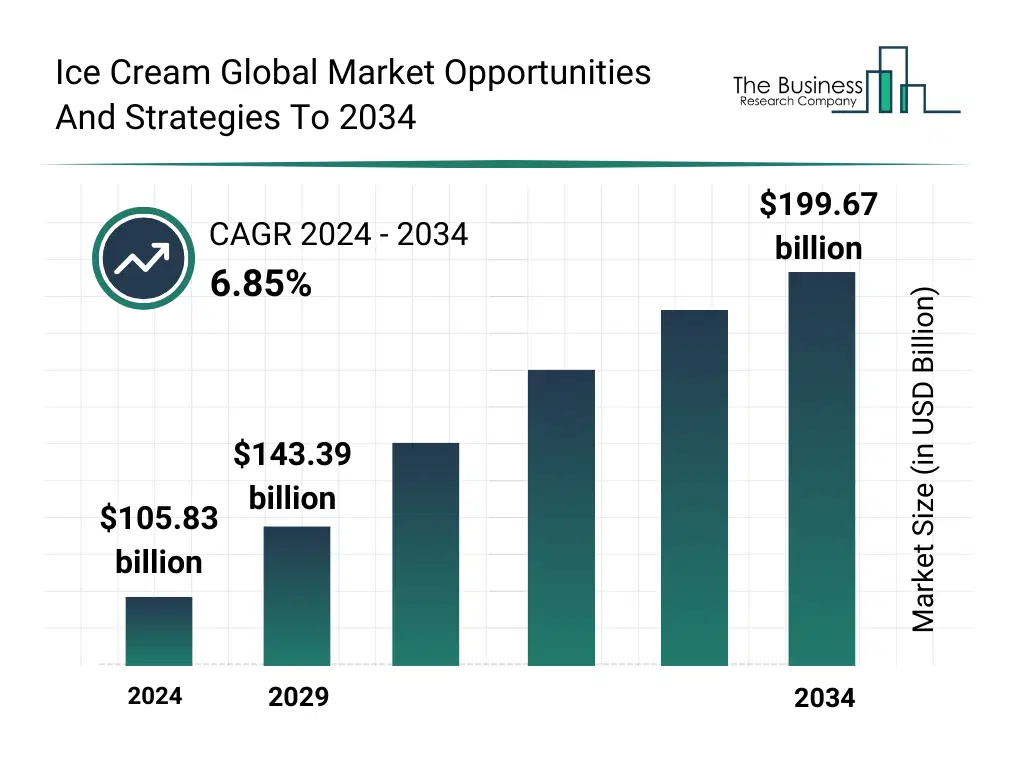
Ice Cream Market Size
The global ice cream market reached a value of nearly $105,831.17 million in 2024, having grown at a compound annual growth rate (CAGR) of 5.60% since 2019. The market is expected to grow from $105,831.17 million in 2024 to $143,386.81 million in 2029 at a rate of 6.26%. The market is then expected to grow at a CAGR of 6.85% from 2029 and reach $199,671.93 million in 2034. Growth in the historic period resulted from expansion of the foodservice industry, rising consumer spending on out-of-home convenience foods, rising consumption of confectionery products and demand for processed and packaged products. Factors that negatively affected growth in the historic period were raw-material price volatility and labor shortage. Going forward, growth in dairy farming and milk production, rising global demand for dairy products consumption, expansion of quick commerce and food delivery apps and enhanced cold-chain and distribution improvements will drive growth. Factors that could hinder the growth of the ice cream market in the future include seasonality of demand, rising consumer health consciousness and impact of trade war and tariffs.Ice Cream Market Drivers
The key drivers of the ice cream market include: Growth In Dairy Farming And Milk Production During the forecast period, growth in dairy farming and milk production will propel the growth of the ice cream market. Ice cream manufacturing relies heavily on milk, cream and other dairy ingredients and the steady expansion of dairy farming ensures a reliable supply of these essential raw materials. Improvements in animal health, feed efficiency and farm management practices are expected to enhance productivity, while investments in modern dairy infrastructure will further strengthen the value chain. Rising output from key dairy-producing regions will help stabilize supply, support large-scale production and enable the development of diverse ice cream varieties, including premium and indulgent offerings. As the availability of milk and dairy products continues to expand globally, ice cream manufacturers will be better positioned to innovate, meet growing consumer demand and sustain long-term market growth. The growth in dairy farming and milk production growth contribution during the forecast period in 2024 is 1.50%.Ice Cream Market Restraints
The key restraints on the ice cream market include: Seasonality Of Demand The seasonality of demand is restricting the growth of the ice cream market during the forecast period. Ice cream consumption traditionally peaks during warmer seasons and declines sharply during cooler months, creating large fluctuations in production, sales and inventory management. Manufacturers face idling capacity during off-peak periods, higher risk of spoilage in perishable stock and increased costs related to cold chain storage and promotional efforts to stimulate demand. Retailers and distributors find it difficult to plan logistics, staffing and merchandizing when demand swings are so pronounced. The industry remains significantly affected by demand concentrated in summer months despite efforts to expand reach in Tier-II, Tier-III and rural markets. As a result, many producers rely on discounting, extended shelf displays, or novel product formats to even out revenue across the year. Growth affected by seasonality of demand across regions during the forecast period in 2024 is -1.50%.Ice Cream Market Trends
Major trends shaping the ice cream market include: AI-Assisted Product Innovation And Reformulation Key companies in the ice-cream space are increasingly using artificial intelligence to reimagine their product lines, reduce costs and respond more nimbly to consumer preferences for health, flavors and sustainability. These innovations focus on reformulating existing recipes (lower sugar, cleaner ingredients), predicting flavor combinations and creating line extensions (e.g. plant-based or indulgent variants) more efficiently. For instance, in September 2025, Magnum Ice Cream Company, part of Unilever, announced a collaboration with Chilean startup NotCo to integrate AI in developing new Magnum products, including plant-based versions and reformulating classics to manage calories and address ingredient cost pressures. By leveraging AI, companies aim to accelerate innovation cycles, maintain margin in the face of commodity inflation and deliver products that align with evolving consumer demands. Premium Boutique Tubs For Family And Sharing Occasions Major players in the ice cream market are focusing on the launch of premium boutique tub formats designed to balance value, convenience and indulgence for home consumption. These innovations address the rising demand for family-oriented desserts by offering larger pack sizes, gourmet flavors and improved packaging that preserves product freshness over time. The trend also reflects changing consumer behavior, as more people prefer enjoying high-quality desserts at home during family gatherings or leisure occasions. For example, in April 2025, Cream Stone, an India-based ice cream brand, introduced TUBZ, a line of boutique flavors offered in both family-sized and mini tub formats. The range emphasizes artisanal-style recipes, rich ingredients and visually appealing packaging, designed to bring the boutique dessert experience into households. By launching this collection, Cream Stone seeks to expand its consumer base beyond parlous visits, strengthen its foothold in the premium take-home segment and respond to the growing preference for convenient yet high-quality frozen desserts.Opportunities And Recommendations In The Ice Cream Market
Opportunities – The top opportunities in the ice cream market segmented by type will arise in the impulse ice cream segment, which will gain $20,882.36 million of global annual sales by 2029. The top opportunities in the ice cream market segmented by flavor will arise in the vanilla segment, which will gain $11,386.36 million of global annual sales by 2029. The top opportunities in the ice cream market segmented by packaging will arise in the cone segment, which will gain $12,572.92 million of global annual sales by 2029. The top opportunities in the ice cream market segmented by category will arise in the dairy segment, which will gain $26,635.05 million of global annual sales by 2029. The top opportunities in the ice cream market segmented by distribution channels will arise in the online retailer segment, which will gain $16,395.63 million of global annual sales by 2029. The ice cream market size will gain the most in the UK at $6,608.71 million. Recommendations- To take advantage of the opportunities, The Business Research Company recommends the ice cream companies to focus on ai-driven product innovation to capture evolving demand, focus on premium boutique tubs for family and home sharing occasions, focus on local flavor innovation and sustainable sourcing, focus on ai-enabled production control to improve consistency and efficiency, focus on mood-led premium mini formats to drive impulse demand, focus on the fast-growing artisanal segment to capture premium demand, focus on the fast-growing fruit segment to align with health-driven demand, expand in emerging markets, continue to focus on developed markets, provide competitively priced offerings, continue to use b2b promotions, focus on the online retailer channel to accelerate growth, focus on the non-dairy segment to capture high-growth demand.
Ice Cream Market Segmentation
The Ice Cream market is segmented segmented by type, by flavor, by packaging, by category and by distribution channel.By Type –
The Ice Cream market is segmented by type into:
- a) Ice Cream
- b) Take-Home Ice Cream
- c) Artisanal Ice Cream
By Flavor –
The ice cream market is segmented by flavor into:
- a) Vanilla
- b) Chocolate
- c) Fruit
- b) Other Flavors
By Packaging –
The ice cream market is segmented by packaging into:
- a) Cup
- b) Cone
- c) Stick
- d) Brick
- e) Tub
- f) Other Packaging
By Category –
The ice cream market is segmented by category into:
- a) Dairy
- b) Non-Dairy
By Distribution Channel –
The ice cream market is segmented by distribution channel into:
- a) Hypermarket Or Supermarket
- b) Ice Cream Parlor
- c) Online Retailer
- d) Other Distribution Channels
By Geography - The Ice Cream market is segmented by geography into:
- • China
- • India
- • Japan
- • Australia
- • Indonesia
- • South Korea
- • USA
- • Canada
- • Brazil
- • France
- • Germany
- • UK
- • Italy
- • Spain
- • Russia
-
o Asia Pacific
o Africa