
In-Vehicle Artificial Intelligence Assistant Market Report 2026
Global Outlook – By Component (Software, Hardware, Services), By Technology (Speech Recognition, Natural Language Processing, Machine Learning, Computer Vision, Other Technologies), By Deployment Mode (Cloud, On Premises), By Application (Navigation, Voice Assistance, Driver Monitoring, Infotainment, Safety And Security, Other Applications), By End User (Original Equipment Manufacturers, Fleet Operators, Ride Hailing Service Providers, Individual Vehicle Owners) – Market Size, Trends, Strategies, and Forecast to 2030
In-Vehicle Artificial Intelligence Assistant Market Overview
• In-Vehicle Artificial Intelligence Assistant market size has reached to $2.75 billion in 2025 • Expected to grow to $8.71 billion in 2030 at a compound annual growth rate (CAGR) of 26% • Growth Driver: Rising Demand For Automated Vehicles Fueling The Growth Of The Market Due To The Need For Advanced Human–Machine Interaction And Driver Support • Market Trend: SoundHound AI Introduced Generative Conversational AI Technology To Enhance Natural In-Vehicle Voice Assistant Interactions • North America was the largest region in 2025 and Asia-Pacific is the fastest growing region.What Is Covered Under In-Vehicle Artificial Intelligence Assistant Market?
An in-vehicle artificial intelligence (AI) assistant refers to AI-powered systems embedded in vehicles to support drivers and passengers through voice, touch, or gesture-based interactions. It manages functions such as navigation, infotainment, vehicle controls, and real-time driving assistance by analyzing contextual and sensor data. It helps to reduce driver distraction and enables more personalized, connected mobility experiences. The main components of in-vehicle artificial intelligence (AI) assistant are software, hardware, and services. Software refers to AI-driven programs that enable real-time interaction, decision-making, and automation within vehicles. These solutions leverage various technologies, including speech recognition, natural language processing, machine learning, computer vision, and other technologies, and are deployed through cloud and on-premises modes. They are used across multiple applications, such as navigation, voice assistance, driver monitoring, infotainment, safety and security, and other applications, and serve a range of end users, including original equipment manufacturers, fleet operators, ride-hailing service providers, and individual vehicle owners.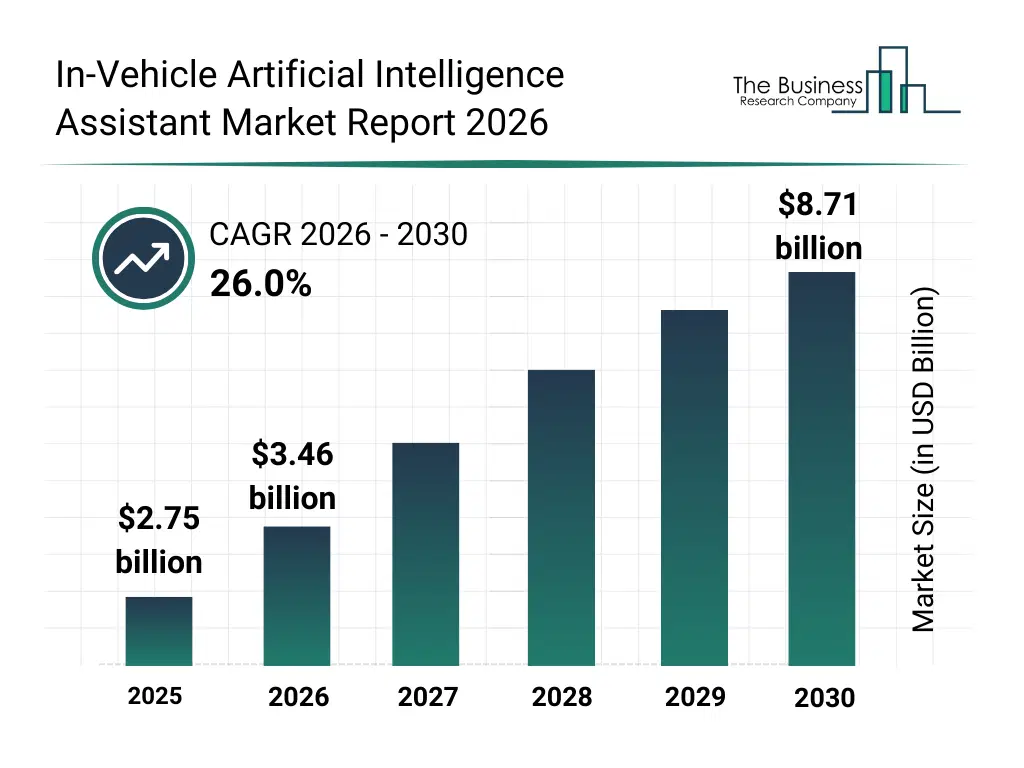
What Is The In-Vehicle Artificial Intelligence Assistant Market Size and Share 2026?
The in-vehicle artificial intelligence assistant market size has grown exponentially in recent years. It will grow from $2.75 billion in 2025 to $3.46 billion in 2026 at a compound annual growth rate (CAGR) of 25.7%. The growth in the historic period can be attributed to increasing adoption of connected vehicle technologies, early integration of voice recognition systems, rising consumer demand for in-car infotainment, expansion of embedded vehicle sensors, growth of Automotive Software platforms.What Is The In-Vehicle Artificial Intelligence Assistant Market Growth Forecast?
The in-vehicle artificial intelligence assistant market size is expected to see exponential growth in the next few years. It will grow to $8.71 billion in 2030 at a compound annual growth rate (CAGR) of 26.0%. The growth in the forecast period can be attributed to expansion of autonomous and semi-Autonomous Vehicles, rising demand for seamless human-machine interfaces, increasing investments in software-defined vehicles, growing focus on driver safety and distraction reduction, expansion of AI-powered mobility services. Major trends in the forecast period include increasing integration of conversational AI in vehicles, rising deployment of driver monitoring systems, growing use of context-aware navigation assistants, expansion of cloud-connected infotainment platforms, enhanced personalization of in-car user experiences.
Global In-Vehicle Artificial Intelligence Assistant Market Segmentation
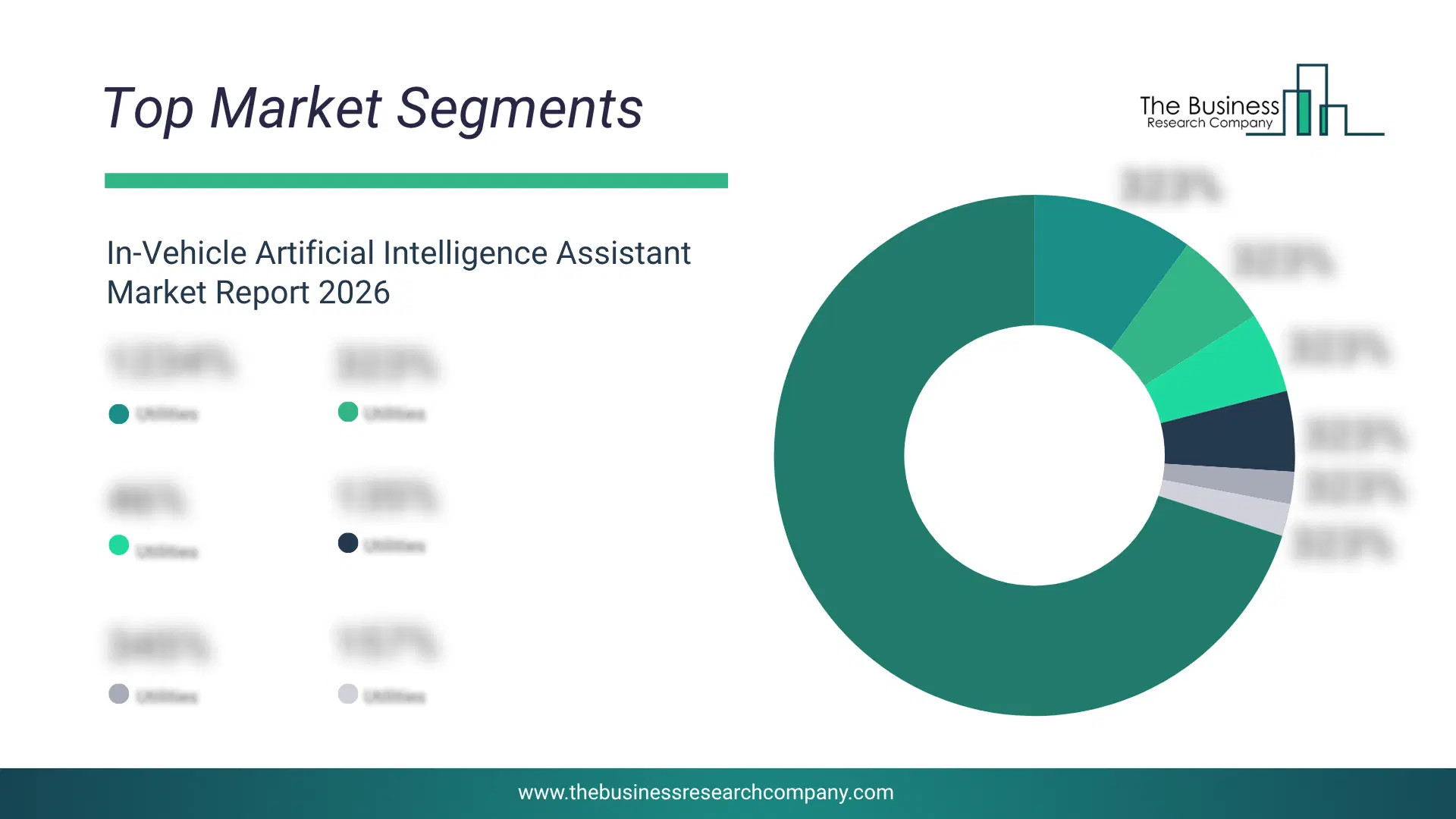
1) By Component: Software; Hardware; Services 2) By Technology: Speech Recognition; Natural Language Processing; Machine Learning; Computer Vision; Other Technologies 3) By Deployment Mode: Cloud; On Premises 4) By Application: Navigation; Voice Assistance; Driver Monitoring; Infotainment; Safety And Security; Other Applications 5) By End User: Original Equipment Manufacturers; Fleet Operators; Ride Hailing Service Providers; Individual Vehicle Owners Subsegments: 1) By Software: Voice Recognition; Navigation Systems; Driver Assistance Algorithms; Infotainment Applications 2) By Hardware: Sensors; Processors; Cameras; Microphones 3) By Services: Installation Services; Maintenance Services; Software Updates; Customer SupportWhat Is The Driver Of The In-Vehicle Artificial Intelligence Assistant Market?
The increasing demand for automated vehicles is expected to propel the growth of the in-vehicle artificial intelligence assistant market going forward. Automated vehicles are vehicles equipped with advanced technologies that enable partial or full automation of driving tasks, allowing the system to assist or control steering, acceleration, and braking with reduced or no human intervention. Automated vehicles are increasing due to rapid advancements in artificial intelligence and sensor technologies that enable more reliable and safe vehicle automation. In-vehicle artificial intelligence assistants help automated vehicles by enabling intuitive human–machine interaction, providing real-time guidance, managing handover between automated and manual driving, and enhancing user trust and situational awareness. For instance, in December 2023, according to the Insurance Institute for Highway Safety (IIHS), a US-based non-profit organization, it is projected that there are approximately 3.5 billion autonomous vehicle connections globally by 2025, increasing to 4.5 billion by 2030. Therefore, the increasing demand for automated vehicles is expected to drive the growth of the in-vehicle artificial intelligence assistant industryKey Players In The Global In-Vehicle Artificial Intelligence Assistant Market
Major companies operating in the in-vehicle artificial intelligence assistant market are Toyota Motor Corporation, Stellantis N.V., Ford Motor Company, General Motors Company, Bayerische Motoren Werke AG, Mercedes-Benz Group AG, HyundAI Motor Company, Tesla Inc., Baidu Inc., Harman International Industries Incorporated, NIO Inc., Automobiles Citroën S.A., Robert Bosch GmbH, Nuance Communications Inc., Opel Automobile GmbH, Alfa Romeo S.p.A., Lucid Group Inc., Cerence Inc., Peugeot S.A., SoundHound AI Inc., Mihup Communications Private Limited.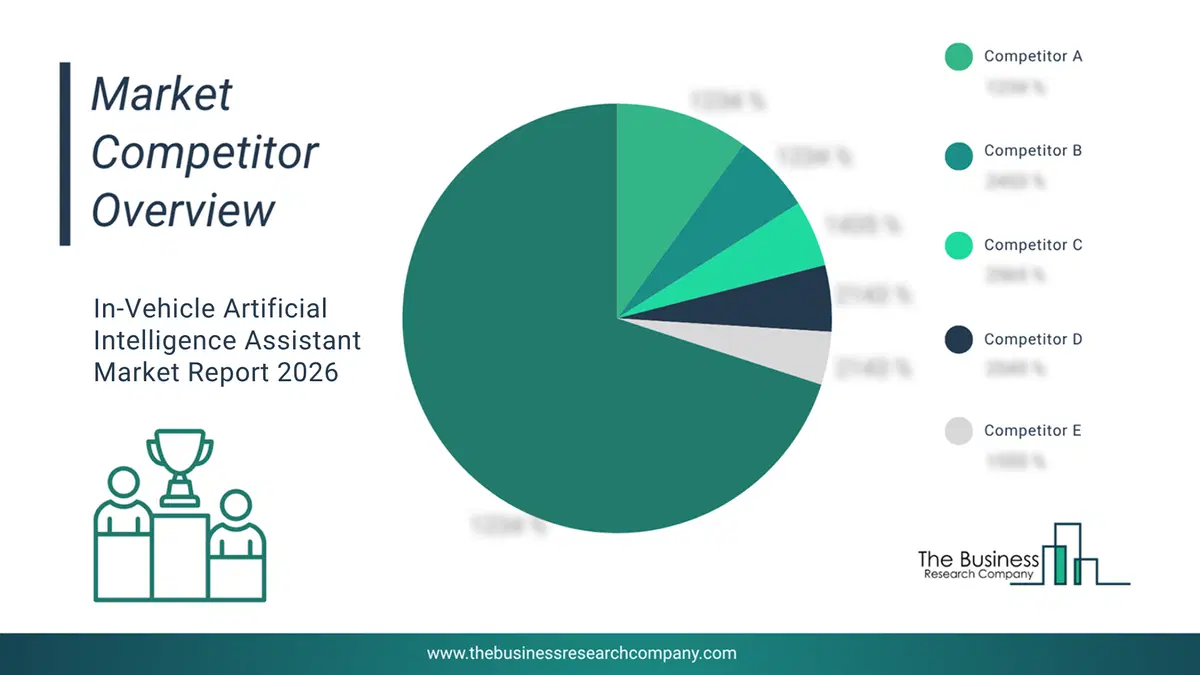
This chart is for illustrative purposes; the full report includes a detailed competitor analysis and comprehensive overview of the top 10 companies in the market.
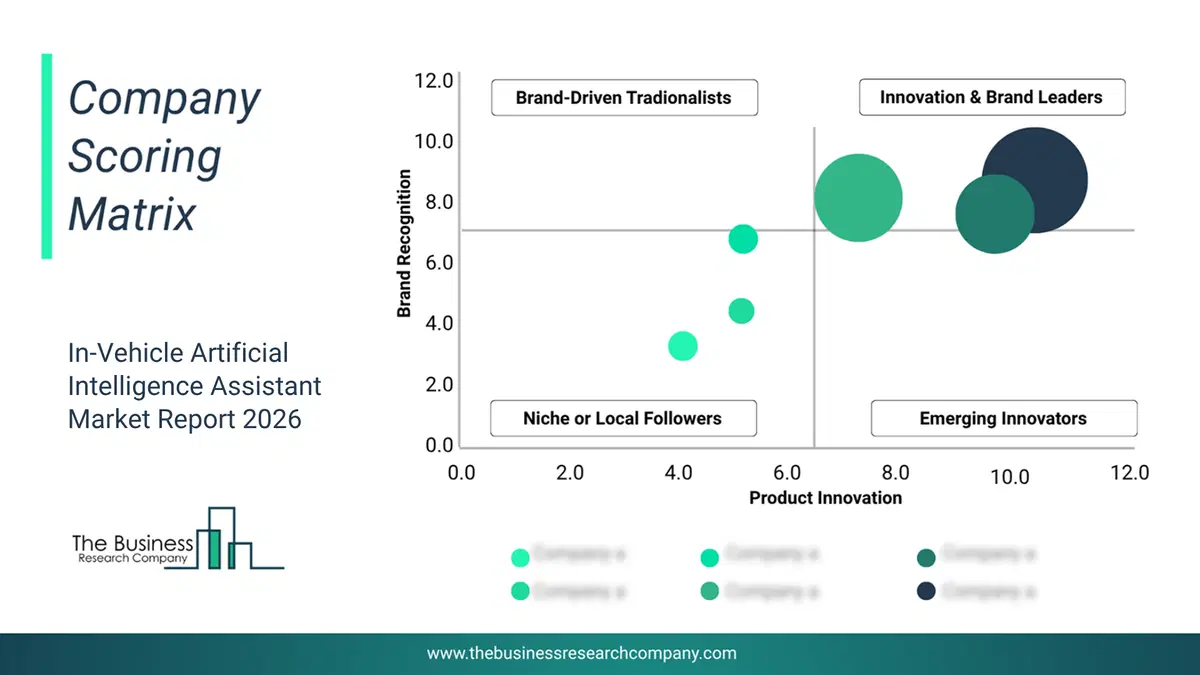
This chart maps companies by product innovation and brand strength, with bubble size indicating relative revenue, helping identify market leaders, challengers, and niche players. This is an illustrative chart; the full report provides a complete and accurate competitive analysis.
Global In-Vehicle Artificial Intelligence Assistant Market Trends and Insights
Major companies operating in the in-vehicle artificial intelligence assistant market are focusing on developing innovative technologies, such as generative conversational AI integration, to enable natural, hands-free interactions, personalized assistance, and safer driver engagement within connected and automated vehicles. Generative conversational AI integration refers to in-car systems that use advanced language models to understand and respond to driver and passenger requests in conversational language for navigation, vehicle controls, information retrieval, and assistance. For instance, in April 2023, SoundHound AI Inc., a US-based voice artificial intelligence company, launched SoundHound Chat AI to deliver generative, conversational voice assistance for in-vehicle interactions and driver support. The solution enables natural, conversational voice interactions that allow drivers to ask complex, multi-part questions and receive real-time, context-aware responses without relying on rigid command structures. It integrates generative AI with real-time data sources, which lets drivers access navigation details, vehicle functions, weather, news, and general knowledge through a single voice interface. The platform supports on-device and cloud-based processing, which improves response speed and reliability while addressing automotive latency and connectivity constraints.What Are Latest Mergers And Acquisitions In The In-Vehicle Artificial Intelligence Assistant Market?
In January 2024, Stellantis NV, a Netherlands-based automotive manufacturing company, acquired CloudMade for an undisclosed amount. With this acquisition, Stellantis aimed to strengthen its in-vehicle artificial intelligence assistant and personalized cockpit capabilities by integrating CloudMade’s AI-driven software and development kit into its STLA SmartCockpit platform to deliver predictive features, voice interaction improvements, and enhanced in-car user experiences. CloudMade Ltd. is a UK-based company that provides software tools to analyze vehicle data and power predictive, personalized, voice-enabled in-vehicle assistants.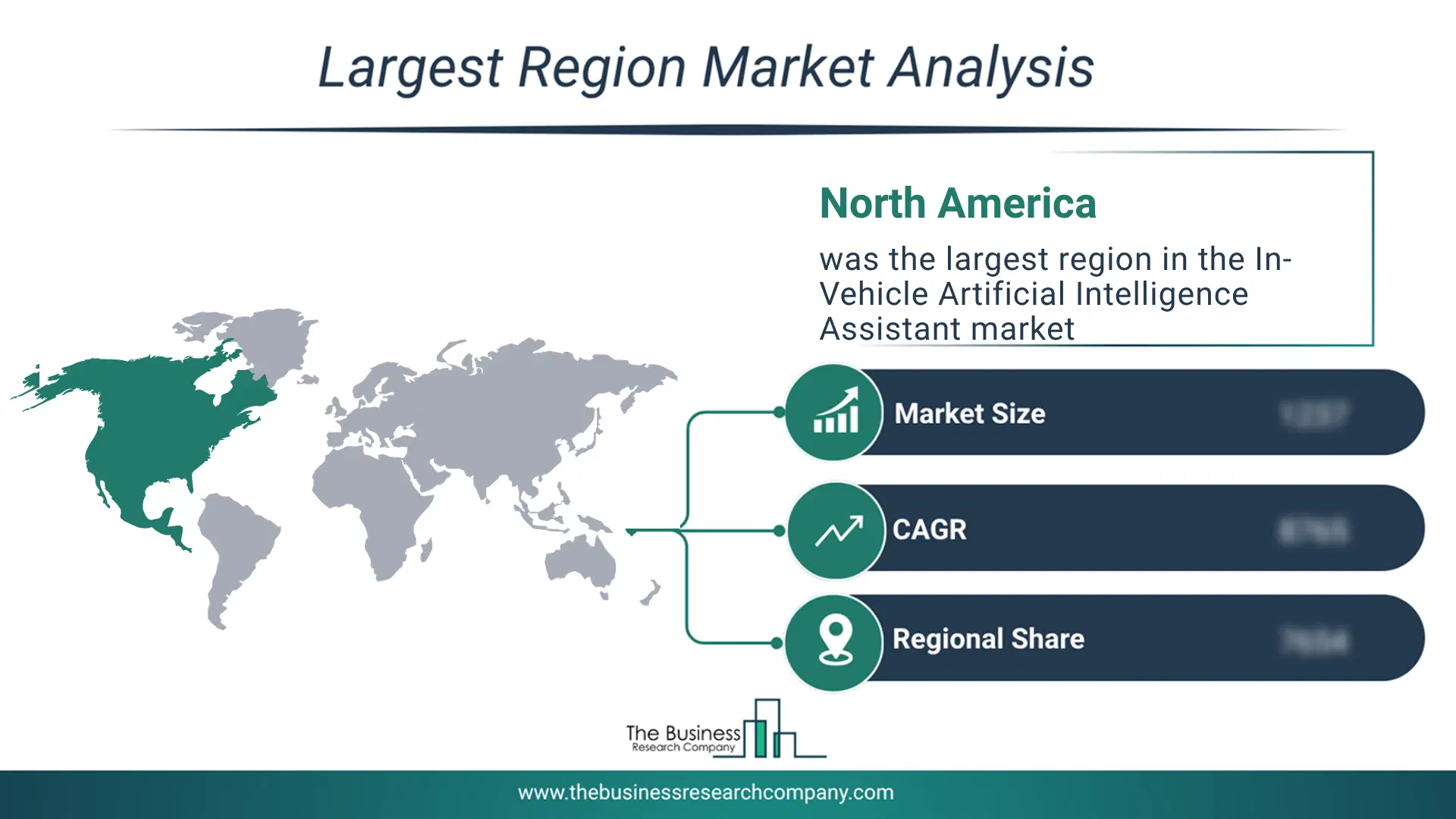
Regional Insights
North America was the largest region in the in-vehicle artificial intelligence assistant market in 2025. Asia-Pacific is expected to be the fastest-growing region in the forecast period. The regions covered in this market report are Asia-Pacific, South East Asia, Western Europe, Eastern Europe, North America, South America, Middle East, Africa. The countries covered in this market report are Australia, Brazil, China, France, Germany, India, Indonesia, Japan, Taiwan, Russia, South Korea, UK, USA, Canada, Italy, Spain.What Defines the In-Vehicle Artificial Intelligence Assistant Market?
The in-vehicle artificial intelligence assistant market consists of revenues earned by entities by providing services such as voice recognition and natural language processing, conversational AI and virtual assistant integration, navigation and route guidance, and driver monitoring and personalization. The market value includes the value of related goods sold by the service provider or included within the service offering. The in-vehicle artificial intelligence assistant market includes sales of voice recognition modules, natural language processing engines, navigation and route optimization systems, driver monitoring systems, and infotainment integration platforms. Values in this market are ‘factory gate’ values, that is the value of goods sold by the manufacturers or creators of the goods, whether to other entities (including downstream manufacturers, wholesalers, distributors and retailers) or directly to end customers. The value of goods in this market includes related services sold by the creators of the goods.How is Market Value Defined and Measured?
The market value is defined as the revenues that enterprises gain from the sale of goods and/or services within the specified market and geography through sales, grants, or donations in terms of the currency (in USD unless otherwise specified). The revenues for a specified geography are consumption values that are revenues generated by organizations in the specified geography within the market, irrespective of where they are produced. It does not include revenues from resales along the supply chain, either further along the supply chain or as part of other products.
This chart presents market attractiveness based on a quantitative evaluation of growth, competition, strategic alignment, and risk, offering a clear view of opportunity areas for decision-making. This chart is for illustrative purposes; the full report contains the complete analysis.

This chart highlights the Total Addressable Market (TAM) by estimating the maximum revenue opportunity using an assumption-driven approach, supporting strategic planning and opportunity sizing across markets. The chart is illustrative; the full report provides a more comprehensive analysis.
What Key Data and Analysis Are Included in the In-Vehicle Artificial Intelligence Assistant Market Report 2026?
The in-vehicle artificial intelligence assistant market research report is one of a series of new reports from The Business Research Company that provides market statistics, including industry global market size, regional shares, competitors with the market share, detailed market segments, market trends and opportunities, and any further data you may need to thrive in the in-vehicle artificial intelligence assistant industry. The market research report delivers a complete perspective of everything you need, with an in-depth analysis of the current and future state of the industry.In-Vehicle Artificial Intelligence Assistant Market Report Forecast Analysis
| Report Attribute | Details |
|---|---|
| Market Size Value In 2026 | $3.46 billion |
| Revenue Forecast In 2030 | $8.71 billion |
| Growth Rate | CAGR of 26% from 2026 to 2030 |
| Base Year For Estimation | 2025 |
| Actual Estimates/Historical Data | 2020-2025 |
| Forecast Period | 2026 - 2030 |
| Market Representation | Revenue in USD Billion and CAGR from 2026 to 2030 |
| Segments Covered | Component, Technology, Deployment Mode, Application, End User |
| Regional Scope | Asia-Pacific, Western Europe, Eastern Europe, North America, South America, Middle East, Africa |
| Country Scope | The Countries Covered In This Market Report Are Australia, Brazil, China, France, Germany, India, Indonesia, Japan, Taiwan, Russia, South Korea, Uk, Usa, Canada, Italy, Spain. |
| Key Companies Profiled | Toyota Motor Corporation, Stellantis N.V., Ford Motor Company, General Motors Company, Bayerische Motoren Werke AG, Mercedes-Benz Group AG, HyundAI Motor Company, Tesla Inc., Baidu Inc., Harman International Industries Incorporated, NIO Inc., Automobiles Citroën S.A., Robert Bosch GmbH, Nuance Communications Inc., Opel Automobile GmbH, Alfa Romeo S.p.A., Lucid Group Inc., Cerence Inc., Peugeot S.A., SoundHound AI Inc., Mihup Communications Private Limited. |
| Customization Scope | Request for Customization |
| Pricing And Purchase Options | Explore Purchase Options |