

Indoor Air Quality Solutions Market Report 2026
Global Outlook – By Product Type (Air Purifiers, Ventilation Systems, Humidifiers Or Dehumidifiers, Sensors And Monitors, Other Product Types), By Technology (High Efficiency Particulate Air (HEPA) Filtration, Activated Carbon Filtration, Ultraviolet (UV) Light Technology, Ionization, Nano Filtration, Photocatalytic Oxidation), By Application (Single-Family Homes, Multi-Family Apartments), By Distribution Channel (Online, Offline), By End-User (Home Owners, Facility Managers, Health Professionals, School Administrators, Business Owners) – Market Size, Trends, Strategies, and Forecast to 2030
Indoor Air Quality Solutions Market Overview
• Indoor Air Quality Solutions market size has reached to $20.87 billion in 2025 • Expected to grow to $30.78 billion in 2030 at a compound annual growth rate (CAGR) of 8.1% • Growth Driver: Rising Asthma Prevalence Fueling The Growth Of The Market Due To Increasing Demand For Healthier Indoor Environments • Market Trend: Advancements In AI-Powered Real-Time Sensor Networks Enhancing Proactive Indoor Air Quality Management • Asia-Pacific was the largest region and fastest growing region.What Is Covered Under Indoor Air Quality Solutions Market?
Indoor air quality solutions refer to systems, technologies, and products designed to monitor, control, and improve the air quality within indoor environments. These solutions help regulate humidity, control odors, and minimize the spread of airborne contaminants. They are used to create healthier and safer indoor spaces by maintaining clean air, enhancing occupant comfort, supporting productivity, and ensuring compliance with indoor air quality standards. The main product types of indoor air quality solutions include Air Purifiers, ventilation systems, humidifiers or dehumidifiers, sensors and monitors, and other product types. Air purifiers refer to devices designed to remove airborne pollutants, allergens, and contaminants, improving indoor air quality for residential and commercial spaces. These solutions utilize technologies such as high efficiency particulate air filtration, activated carbon filtration, ultraviolet light technology, ionization, nano filtration, and photocatalytic oxidation. They are applied in single-family homes and multi-family apartments and are distributed through online and offline channels. These solutions are used by several end users such as homeowners, facility managers, health professionals, school administrators, and business owners.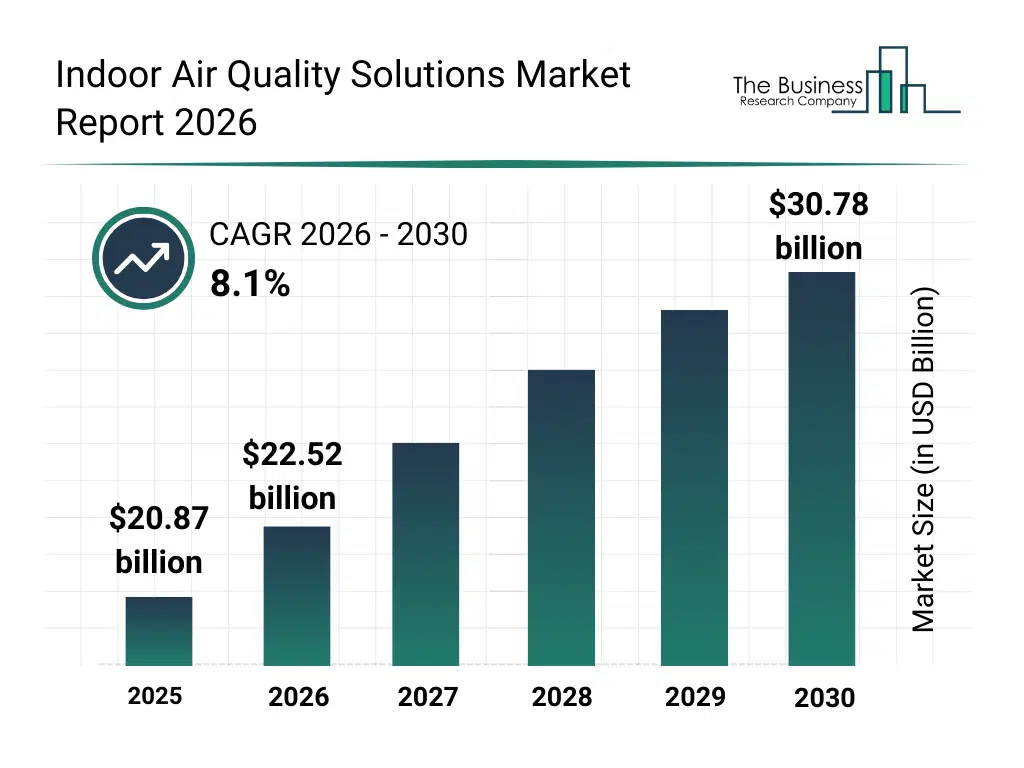
What Is The Indoor Air Quality Solutions Market Size and Share 2026?
The indoor air quality solutions market size has grown strongly in recent years. It will grow from $20.87 billion in 2025 to $22.52 billion in 2026 at a compound annual growth rate (CAGR) of 7.9%. The growth in the historic period can be attributed to rising awareness of indoor air pollution, increasing prevalence of respiratory diseases, adoption of residential air purifiers, growth of commercial building management systems, early innovations in hepa and activated carbon filtration.What Is The Indoor Air Quality Solutions Market Growth Forecast?
The indoor air quality solutions market size is expected to see strong growth in the next few years. It will grow to $30.78 billion in 2030 at a compound annual growth rate (CAGR) of 8.1%. The growth in the forecast period can be attributed to integration of iot-enabled sensors, growing demand for smart ventilation solutions, stricter indoor air quality regulations, rising adoption of uv and photocatalytic oxidation technologies, increased investment in commercial and educational facilities for air quality management. Major trends in the forecast period include smart indoor air quality monitoring, advanced filtration and purification, ventilation optimization systems, humidity and odor control solutions, integrated air quality management platforms.
Global Indoor Air Quality Solutions Market Segmentation
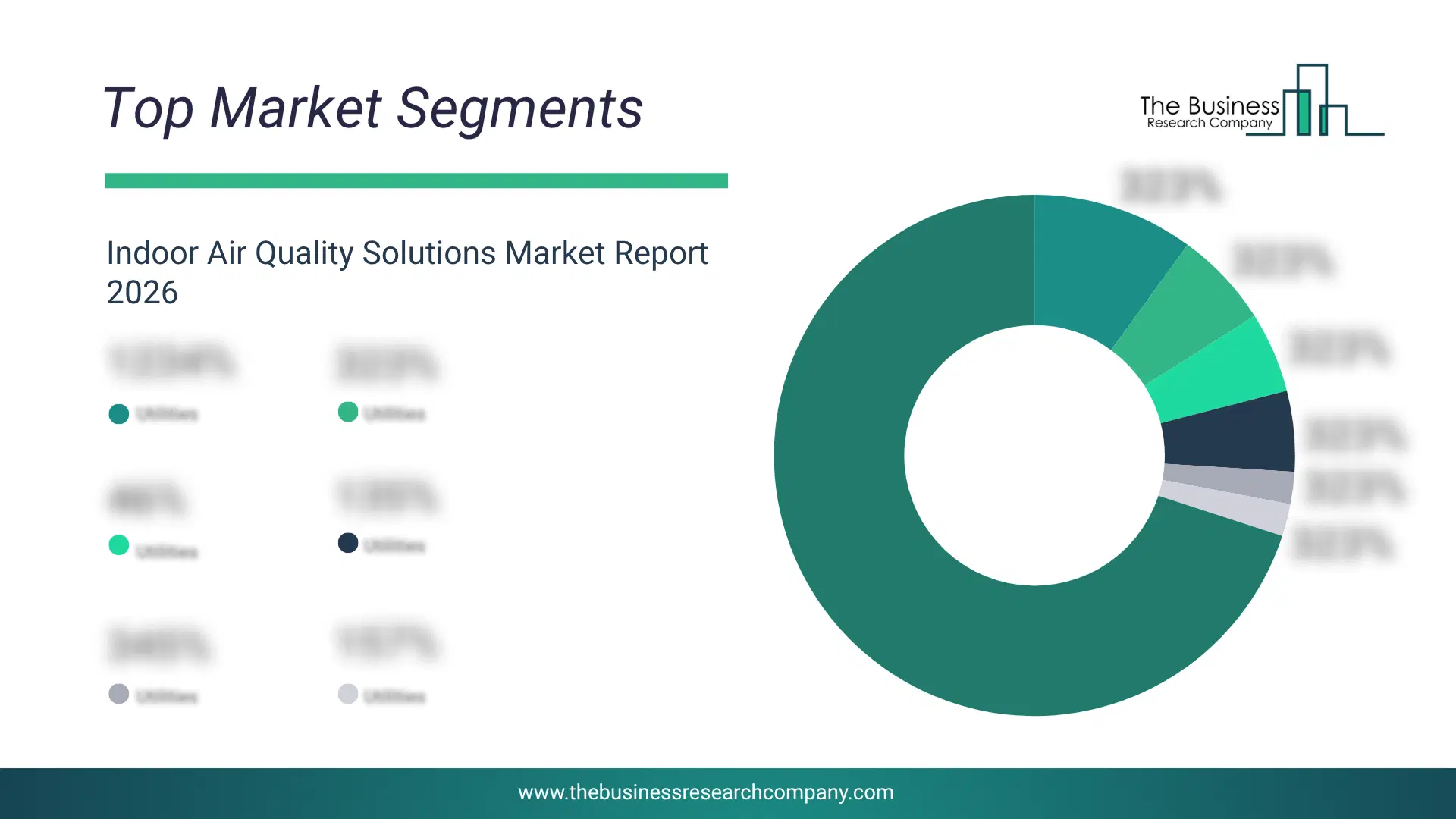
1) By Product Type: Air Purifiers, Ventilation Systems, Humidifiers Or Dehumidifiers, Sensors And Monitors, Other Product Types 2) By Technology: High Efficiency Particulate Air (HEPA) Filtration, Activated Carbon Filtration, Ultraviolet (UV) Light Technology, Ionization, Nano Filtration, Photocatalytic Oxidation 3) By Application: Single-Family Homes, Multi-Family Apartments 4) By Distribution Channel: Online, Offline 5) By End-User: Home Owners, Facility Managers, Health Professionals, School Administrators, Business Owners Subsegments: 1) By Air Purifiers: Portable Air Purifiers, Whole House Air Purifiers, Room Based Air Purifiers, Commercial Grade Air Purifiers 2) By Ventilation Systems: Mechanical Ventilation Systems, Natural Ventilation Systems, Balanced Ventilation Systems, Demand Controlled Ventilation Systems 3) By Humidifiers Or Dehumidifiers: Central Humidity Control Systems, Portable Humidifier Units, Portable Dehumidifier Units, Industrial Humidity Control Systems 4) By Sensors And Monitors: Particulate Matter Sensors, Gas Detection Sensors, Temperature And Humidity Monitors, Integrated Air Quality Monitoring Systems 5) By Other Product Types: Air Quality Control Software, Air Freshening Systems, Source Control Solutions, Air Duct Cleaning EquipmentWhat Is The Driver Of The Indoor Air Quality Solutions Market?
The rising prevalence of asthma is expected to propel the growth of the indoor air quality solutions market going forward. Asthma refers to a chronic respiratory condition characterized by airway inflammation and narrowing, leading to recurrent episodes of wheezing, breathlessness, chest tightness, and coughing. Factors contributing to asthma include exposure to allergens such as dust mites, pollen, and pet dander. Increasing exposure to indoor allergens, including dust mites, mold, and pet dander, is elevating the prevalence of respiratory conditions like asthma, thereby driving demand for indoor air quality solutions that monitor, filter, and manage airborne pollutants to create healthier indoor environments. For instance, in July 2025, according to the Centers for Disease Control and Prevention (CDC), a US-based government agency, 8.6% of adults aged 18 years and older and 6.5% of children younger than 18 years were reported to currently have asthma. Therefore, the rising prevalence of asthma is driving the growth of the indoor air quality solutions industry.Key Players In The Global Indoor Air Quality Solutions Market
Major companies operating in the indoor air quality solutions market are Siemens AG, LG Electronics Inc., Panasonic Holdings Corporation, Honeywell International Inc., Mitsubishi Electric Corporation, Daikin Industries Ltd., 3M Company, Johnson Controls International plc, Carrier Global Corporation, Trane Technologies plc, Philips Electronics N.V., Dyson Technology Limited, Camfil AB, TSI Incorporated, Blueair AB, QleanAir AB, Sharp Corporation, Airthings AS, Aircuity Inc., IQAir AG, Aeroqual Limited.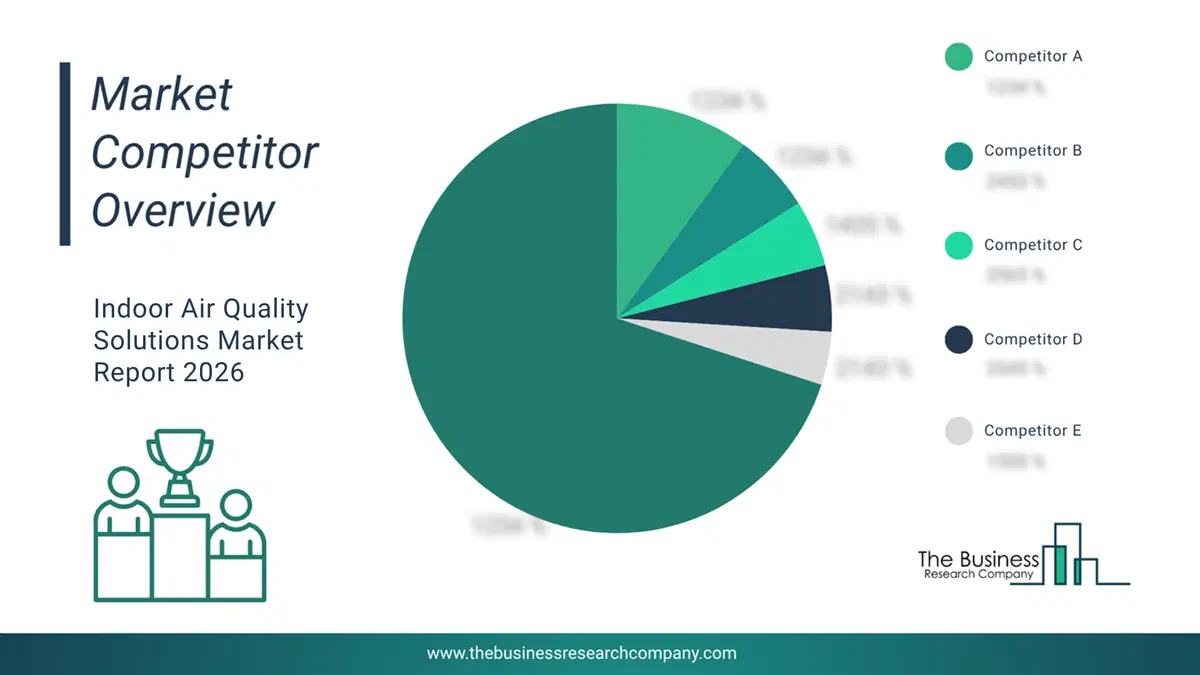
This chart is for illustrative purposes; the full report includes a detailed competitor analysis and comprehensive overview of the top 10 companies in the market.
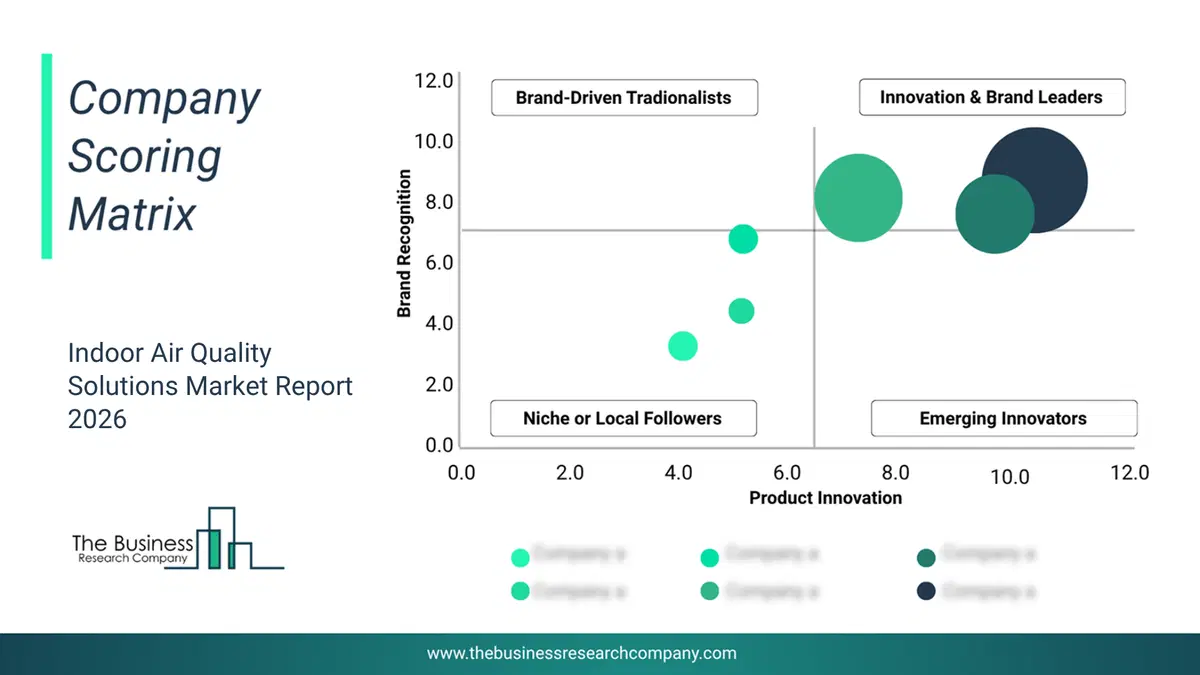
This chart maps companies by product innovation and brand strength, with bubble size indicating relative revenue, helping identify market leaders, challengers, and niche players. This is an illustrative chart; the full report provides a complete and accurate competitive analysis.
Global Indoor Air Quality Solutions Market Trends and Insights
Major companies operating in the indoor air quality solutions market are focusing on developing innovative products, such as AI-based real-time sensor networks, to enable continuous monitoring and advanced analysis of indoor pollutants for improved preventive health management and occupant well-being across diverse indoor environments. AI-based real-time sensor networks refer to integrated systems that combine high-precision environmental sensors with artificial intelligence and advanced analytics to continuously measure, analyze, and interpret indoor air quality parameters, delivering instant and actionable insights. For instance, in December 2025, the Abu Dhabi Public Health Centre, a United Arab Emirates–based public health authority, launched the Indoor Air Quality Observatory (HawAQM). The HawAQM observatory integrates cutting-edge monitoring technologies, high-precision sensors, and advanced analytics to provide real-time indoor air quality data across schools, homes, and public facilities. Its digital dashboard visualizes continuous pollutant measurements and trends, enabling specialists and decision-makers to implement timely, data-driven interventions. This innovation supports the indoor air quality solutions market by shifting air quality management from reactive assessments to proactive, intelligence-driven monitoring that strengthens indoor environmental health management at scale.What Are Latest Mergers And Acquisitions In The Indoor Air Quality Solutions Market?
In January 2025, WellStat, a US-based provider of connected health, wellness, and environmental monitoring solutions, acquired Iknaia for an undisclosed amount. With this acquisition, WellStat aims to expand its global footprint and strengthen its indoor and outdoor air quality monitoring capabilities by integrating Iknaia’s advanced sensing technologies and regional market expertise. Iknaia is a UK-based provider of indoor air quality monitoring solutions.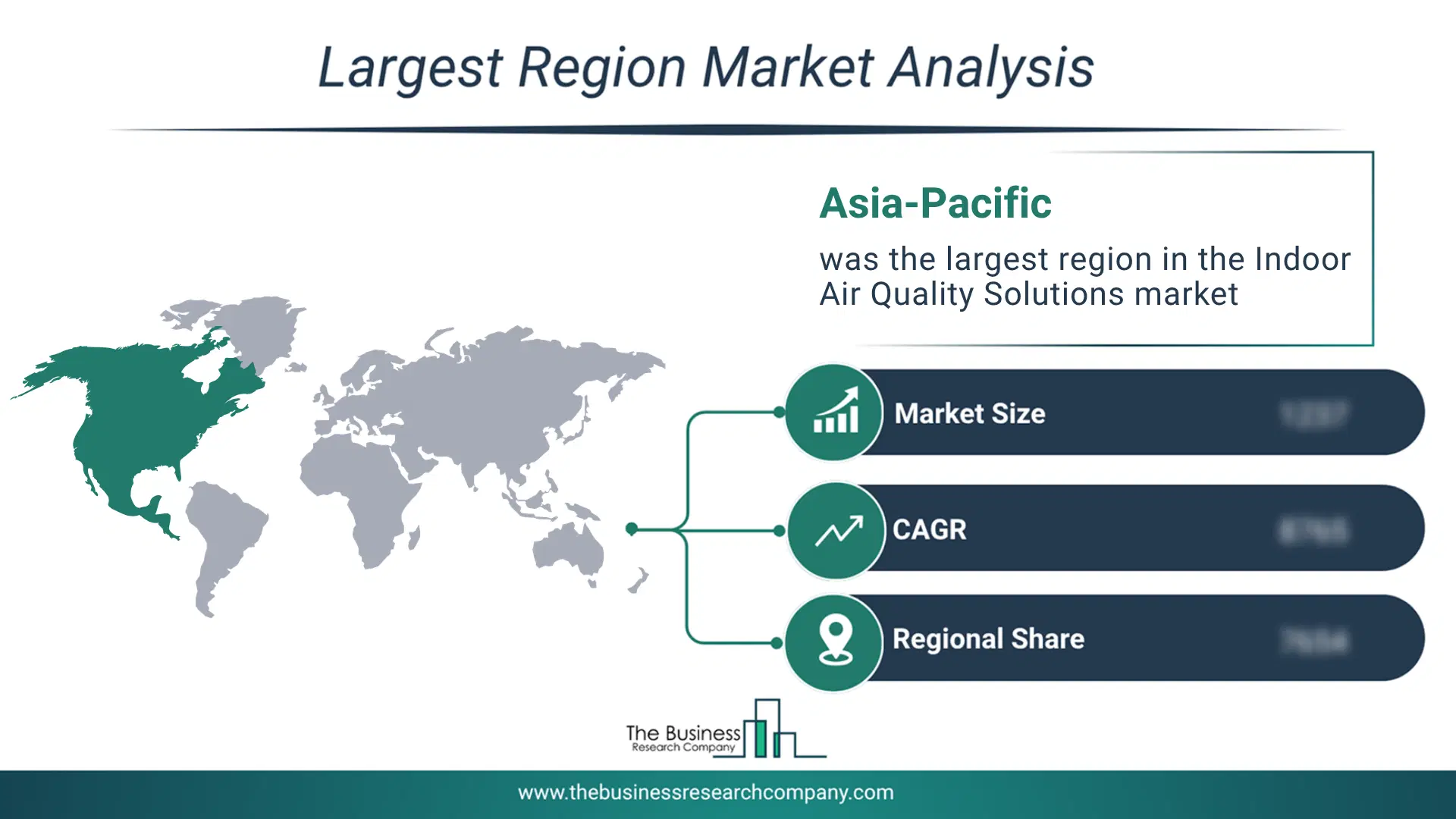
Regional Outlook
Asia-Pacific was the largest region in the indoor air quality solutions market in 2025. Asia-Pacific is expected to be the fastest-growing region in the forecast period. The regions covered in this market report are Asia-Pacific, South East Asia, Western Europe, Eastern Europe, North America, South America, Middle East, Africa. The countries covered in this market report are Australia, Brazil, China, France, Germany, India, Indonesia, Japan, Taiwan, Russia, South Korea, UK, USA, Canada, Italy, Spain.What Defines the Indoor Air Quality Solutions Market?
The indoor air quality solutions market consists of revenues earned by entities by providing services such as air quality monitoring, indoor air quality solutions (IAQ) assessment, filtration, purification, and ventilation optimization services. The market value includes the value of related goods sold by the service provider or included within the service offering. The indoor air quality solutions market also includes sales of air quality monitors and sensors, air sterilization and disinfection systems, dust and allergen control devices, gas and odor removal systems, and smart indoor air quality management solutions. Values in this market are ‘factory gate’ values, that is the value of goods sold by the manufacturers or creators of the goods, whether to other entities (including downstream manufacturers, wholesalers, distributors and retailers) or directly to end customers. The value of goods in this market includes related services sold by the creators of the goods.How is Market Value Defined and Measured?
The market value is defined as the revenues that enterprises gain from the sale of goods and/or services within the specified market and geography through sales, grants, or donations in terms of the currency (in USD unless otherwise specified). The revenues for a specified geography are consumption values that are revenues generated by organizations in the specified geography within the market, irrespective of where they are produced. It does not include revenues from resales along the supply chain, either further along the supply chain or as part of other products.
This chart presents market attractiveness based on a quantitative evaluation of growth, competition, strategic alignment, and risk, offering a clear view of opportunity areas for decision-making. This chart is for illustrative purposes; the full report contains the complete analysis.

This chart highlights the Total Addressable Market (TAM) by estimating the maximum revenue opportunity using an assumption-driven approach, supporting strategic planning and opportunity sizing across markets. The chart is illustrative; the full report provides a more comprehensive analysis.
What Key Data and Analysis Are Included in the Indoor Air Quality Solutions Market Report 2026?
The indoor air quality solutions market research report is one of a series of new reports from The Business Research Company that provides market statistics, including industry global market size, regional shares, competitors with the market share, detailed market segments, market trends and opportunities, and any further data you may need to thrive in the indoor air quality solutions industry. The market research report delivers a complete perspective of everything you need, with an in-depth analysis of the current and future state of the industry.Indoor Air Quality Solutions Market Report Forecast Analysis
| Report Attribute | Details |
|---|---|
| Market Size Value In 2026 | $22.52 billion |
| Revenue Forecast In 2030 | $30.78 billion |
| Growth Rate | CAGR of 8.1% from 2026 to 2030 |
| Base Year For Estimation | 2025 |
| Actual Estimates/Historical Data | 2020-2025 |
| Forecast Period | 2026 - 2030 |
| Market Representation | Revenue in USD Billion and CAGR from 2026 to 2030 |
| Segments Covered | Product Type, Technology, Application, Distribution Channel, End-User |
| Regional Scope | Asia-Pacific, Western Europe, Eastern Europe, North America, South America, Middle East, Africa |
| Country Scope | The countries covered in the report are Australia, Brazil, China, France, Germany, India, Indonesia, Japan, Taiwan, Russia, South Korea, UK, USA, Canada, Italy, Spain |
| Key Companies Profiled | Siemens AG, LG Electronics Inc., Panasonic Holdings Corporation, Honeywell International Inc., Mitsubishi Electric Corporation, Daikin Industries Ltd., 3M Company, Johnson Controls International plc, Carrier Global Corporation, Trane Technologies plc, Philips Electronics N.V., Dyson Technology Limited, Camfil AB, TSI Incorporated, Blueair AB, QleanAir AB, Sharp Corporation, Airthings AS, Aircuity Inc., IQAir AG, Aeroqual Limited. |
| Customization Scope | Request for Customization |
| Pricing And Purchase Options | Explore Purchase Options |