
Infra-Red Communications Market Report 2026
Global Outlook – By Component (Infrared Light Emitting Diodes, Infrared Photodiodes, Infrared Transceivers, Infrared Sensors, Infrared Receivers, Other Components), By Technology (Near Infrared Communication, Mid Infrared Communication, Far Infrared Communication), By Wavelength Range (Short Wavelength Infrared, Medium Wavelength Infrared, Long Wavelength Infrared), By End User (Consumer Electronics Manufacturers, Automotive Industry, Industrial Manufacturing, Healthcare Industry, Defense And Military, Commercial Sector) – Market Size, Trends, Strategies, and Forecast to 2030
Infra-Red Communications Market Overview
• Infra-Red Communications market size has reached to $1.92 billion in 2025 • Expected to grow to $2.19 billion in 2030 at a compound annual growth rate (CAGR) of 14.2% • Growth Driver: Expansion Of Consumer Electronics Manufacturing Fueling The Growth Of The Market Due To Rising Demand For Smart, Connected, And Energy-Efficient Devices • North America was the largest region in 2025 and Asia-Pacific is the fastest growing region.What Is Covered Under Infra-Red Communications Market?
Infra-red communications is a wireless data transmission technology that uses infrared light waves to exchange information over short distances between devices. It operates through line-of-sight or reflective optical signaling, enabling secure, low-interference communication for control, sensing, and data transfer applications. They are used to provide simple, reliable, and cost-effective short-range communication between electronic devices without relying on radio frequency signals. The main components of the infra-red communications are infrared light emitting diodes, infrared photodiodes, infrared transceivers, infrared sensors, infrared receivers, and other components. Infrared light emitting diodes refer to semiconductor devices that emit infrared radiation used for transmitting data over short-range communication channels. These solutions are based on different technologies, including near infrared communication, mid infrared communication, and far infrared communication, and operate across various wavelength ranges, such as short wavelength infrared, medium wavelength infrared, and long wavelength infrared. They are used by multiple end users, including consumer electronics manufacturers, automotive industry, industrial manufacturing, healthcare industry, defense and military, and commercial sector.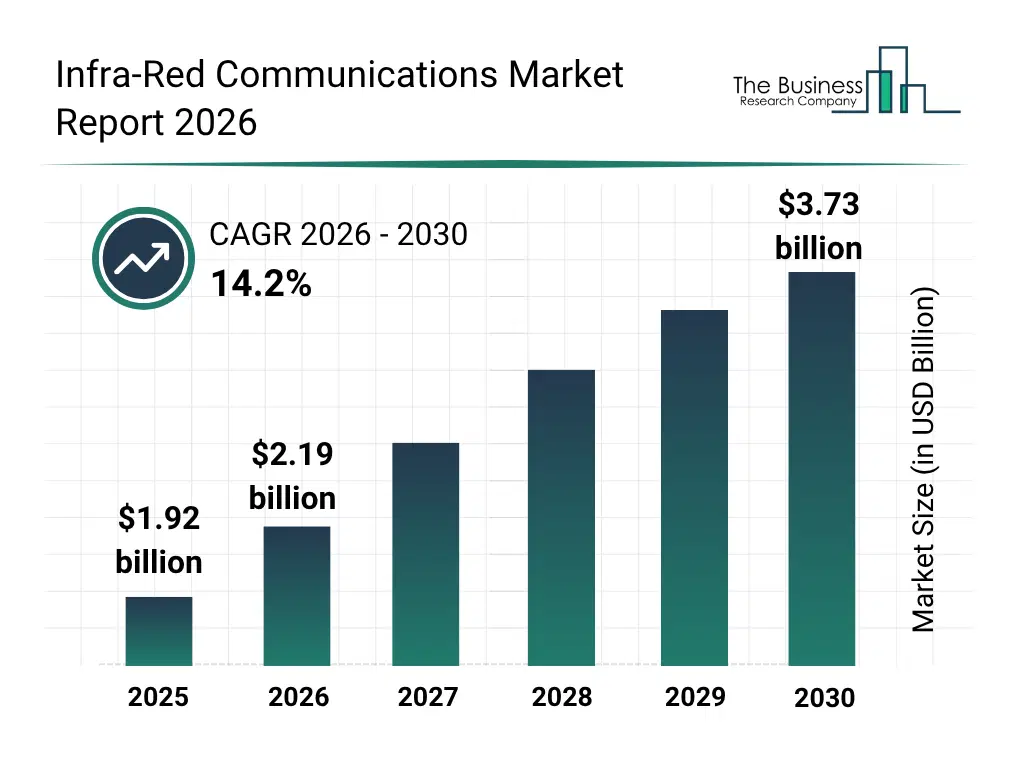
What Is The Infra-Red Communications Market Size and Share 2026?
The infra-red communications market size has grown rapidly in recent years. It will grow from $1.92 billion in 2025 to $2.19 billion in 2026 at a compound annual growth rate (CAGR) of 14.0%. The growth in the historic period can be attributed to early adoption of remote control systems, demand for low cost short range communication, growth of consumer electronics devices, development of line of sight optical communication, expansion of industrial automation control systems.What Is The Infra-Red Communications Market Growth Forecast?
The infra-red communications market size is expected to see rapid growth in the next few years. It will grow to $3.73 billion by 2030 at a compound annual growth rate (CAGR) of 14.2%. The growth in the forecast period can be attributed to increasing integration of iot enabled devices, rising demand for secure short range communication, growth in smart home ecosystems, miniaturization of infrared components, expansion of automotive sensing and control applications. Major trends in the forecast period include low power infrared communication modules, smart remote control and gesture-based ir systems, ir-based iot device pairing and connectivity, short range secure device authentication using ir, miniaturized infrared sensors for consumer electronics.
Global Infra-Red Communications Market Segmentation
1) By Component: Infrared Light Emitting Diodes, Infrared Photodiodes, Infrared Transceivers, Infrared Sensors, Infrared Receivers, Other Components 2) By Technology: Near Infrared Communication, Mid Infrared Communication, Far Infrared Communication 3) By Wavelength Range: Short Wavelength Infrared, Medium Wavelength Infrared, Long Wavelength Infrared 4) By End User: Consumer Electronics Manufacturers, Automotive Industry, Industrial Manufacturing, Healthcare Industry, Defense And Military, Commercial Sector Subsegments: 1) By Infrared Light Emitting Diodes: Near Infrared Light Emitting Diodes, High Power Infrared Light Emitting Diodes, Surface Mount Infrared Light Emitting Diodes, Through Hole Infrared Light Emitting Diodes, Multi Chip Infrared Light Emitting Diodes 2) By Infrared Photodiodes: Silicon Infrared Photodiodes, Indium Gallium Arsenide Infrared Photodiodes, Avalanche Infrared Photodiodes, Planar Infrared Photodiodes, High Sensitivity Infrared Photodiodes 3) By Infrared Transceivers: Short Range Infrared Transceivers, High Speed Infrared Transceivers, Integrated Infrared Transceiver Modules, Low Power Infrared Transceivers, Long Distance Infrared Transceivers 4) By Infrared Sensors: Passive Infrared Sensors, Active Infrared Sensors, Thermal Infrared Sensors, Motion Detection Infrared Sensors, Temperature Sensing Infrared Sensors 5) By Infrared Receivers: Integrated Infrared Receivers, High Sensitivity Infrared Receivers, Remote Control Infrared Receivers, Surface Mount Infrared Receivers, Low Noise Infrared Receivers 6) By Other Components: Infrared Communication Modules, Infrared Signal Processors, Infrared Control Units, Infrared Interface Modules, Infrared Detection ModulesWhat Are The Drivers Of The Infra-Red Communications Market?
The expansion of consumer electronics manufacturing is expected to propel the growth of the infra-red communications market going forward. Consumer electronics manufacturing refers to the large-scale production of electronic devices such as televisions, smartphones, gaming systems, and smart home equipment for everyday consumer use. The expansion of consumer electronics manufacturing is increasing due to rising global demand for smart, connected, and energy-efficient devices, driven by rapid digitalization and widespread adoption of IoT-enabled home and personal electronics. Infrared communications support consumer electronics manufacturing by enabling short-range, low-power wireless connectivity in devices such as remotes and sensors, improving efficiency, functionality, and interoperability across electronic systems. For instance, in January 2024, according to the Consumer Technology Association, a United States technology trade association, the United States consumer technology industry's retail revenues reached $512 billion in 2024, up from $505 billion in 2023. Therefore, the expansion of consumer electronics manufacturing is driving the growth of the infra-red communications industry. The increasing industrial automation is expected to propel the growth of the infra-red communications market going forward. Industrial automation refers to the use of control systems, such as computers, robots, and information technologies, to operate and monitor industrial processes with minimal human intervention. Increasing industrial automation is due to rising labor costs, as companies adopt automated systems to reduce dependence on expensive human labor, improve efficiency, and maintain consistent production quality. Infra-red communications enhance industrial automation by enabling fast, interference-free wireless data transfer between machines, reducing cabling needs and improving efficiency, flexibility, and real-time control. For instance, in September 2024, according to the World Robotics 2024 report released by the International Federation of Robotics, a Germany-based non-profit organization, the operational stock of industrial robots reached 4,281,585 units in factories worldwide, representing a 10% year-on-year increase, while annual installations exceeded 500,000 units for the third consecutive year. Therefore, increasing industrial automation drives the growth of the infra-red communications industry. The growing automotive production is expected to propel the growth of the infra-red communications market going forward. Automotive production refers to the process of manufacturing motor vehicles, including cars, trucks, and buses, along with their essential components, at factories and assembly plants. Automotive production is rising due to strong recovery from pandemic-related disruptions, as factories and assembly lines have resumed full operations to meet the increasing demand for vehicles. Infra-red communications enhance automotive production by enabling fast, reliable wireless data exchange between machines and systems, reducing wiring complexity and improving production efficiency, precision, and real-time coordination. For instance, in March 2024, according to the European Automobile Manufacturers' Association (ACEA), a Belgium-based trade association, car production worldwide reached approximately 76 million units in 2023, reflecting a notable 10.2% increase compared to 2022. Therefore, the growing automotive production is driving the growth of the infra-red communications industry.Key Players In The Global Infra-Red Communications Market
Major companies operating in the infra-red communications market are Raytheon Technologies Corporation; Broadcom Inc.; Texas Instruments Incorporated; STMicroelectronics N.V.; NXP Semiconductors N.V.; Murata Manufacturing Co Ltd.; Renesas Electronics Corporation; ON Semiconductor Corporation (onsemi); Omron Corporation; Teledyne Technologies Incorporated; Melexis N.V.; Vishay Intertechnology Inc.; Nippon Ceramic Co Ltd.; Lynred SA; Sensirion AG; Hamamatsu Photonics K.K.; InfraTec GmbH; Laser Components GmbH; Semiconductor Devices Inc.; Senba Sensing Technology Co Ltd.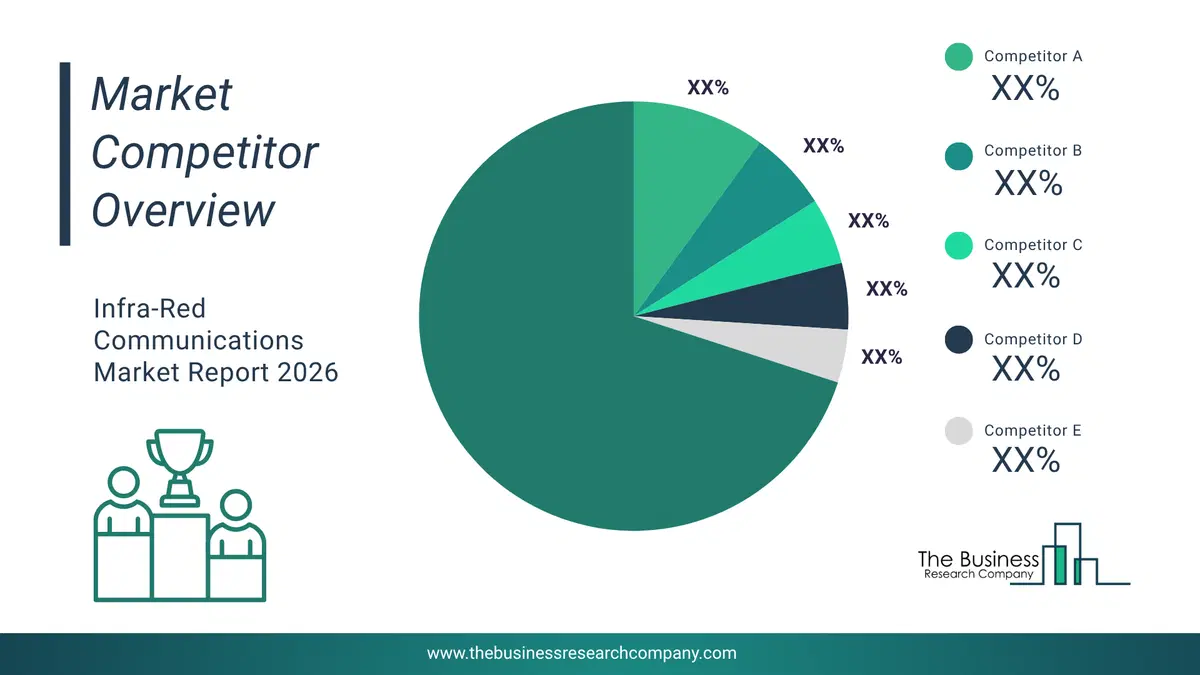
This chart is for illustrative purposes; the full report includes a detailed competitor analysis and comprehensive overview of the top 10 companies in the market.
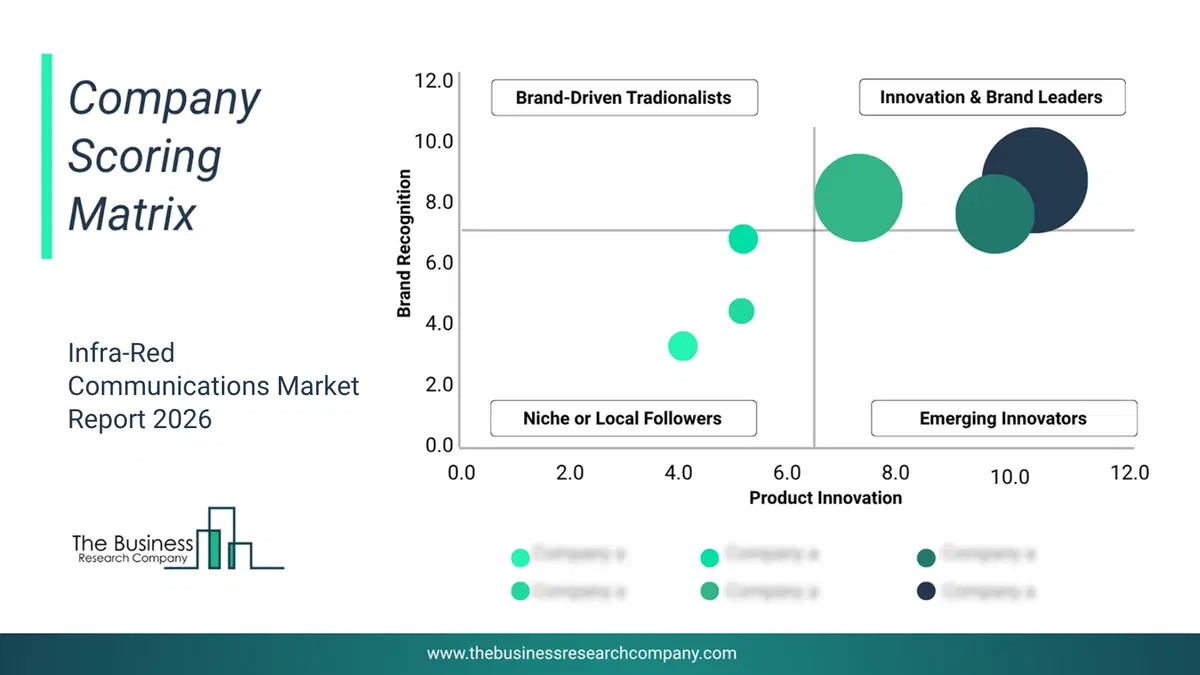
This chart maps companies by product innovation and brand strength, with bubble size indicating relative revenue, helping identify market leaders, challengers, and niche players. This is an illustrative chart; the full report provides a complete and accurate competitive analysis.
Regional Insights
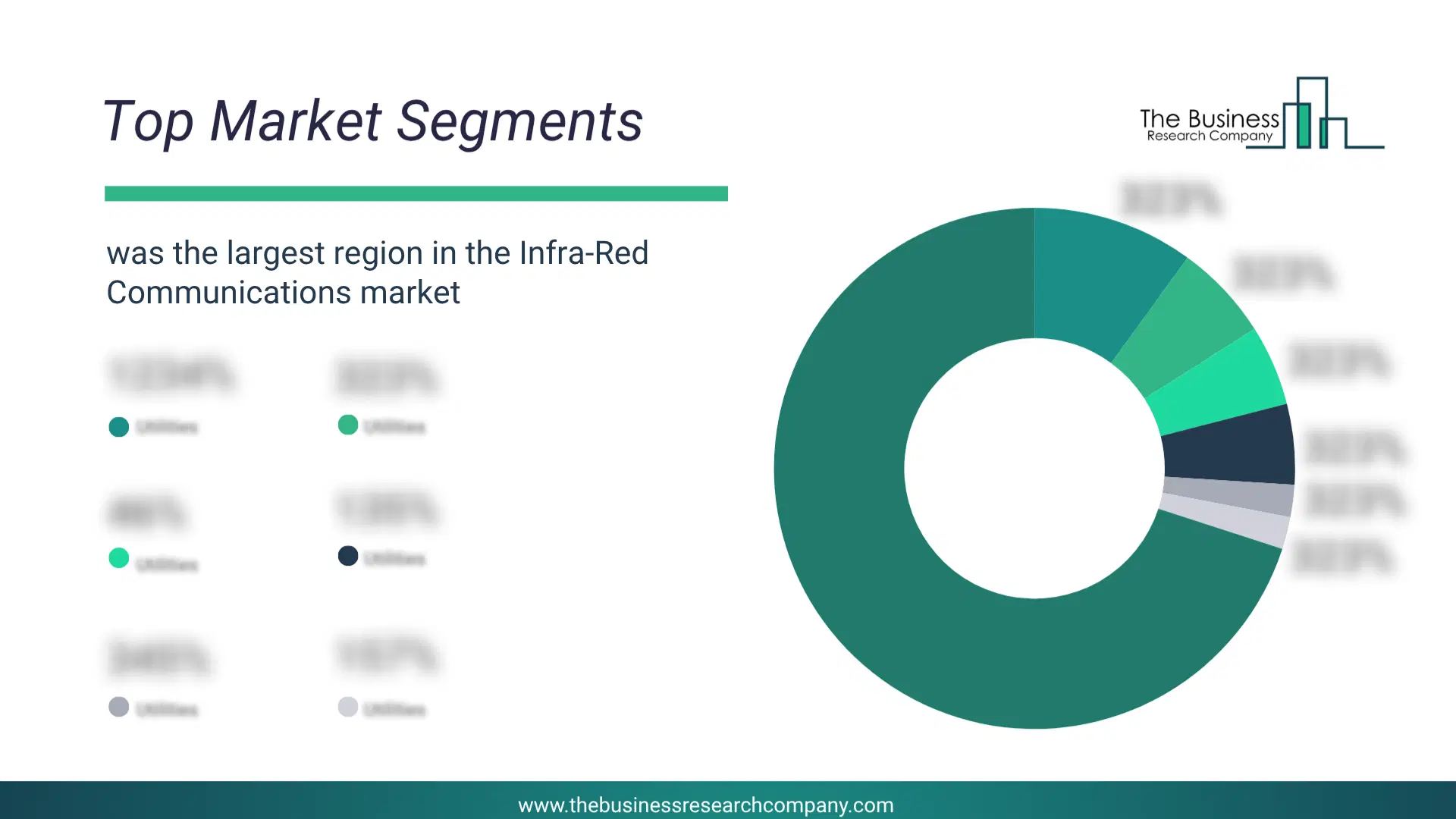
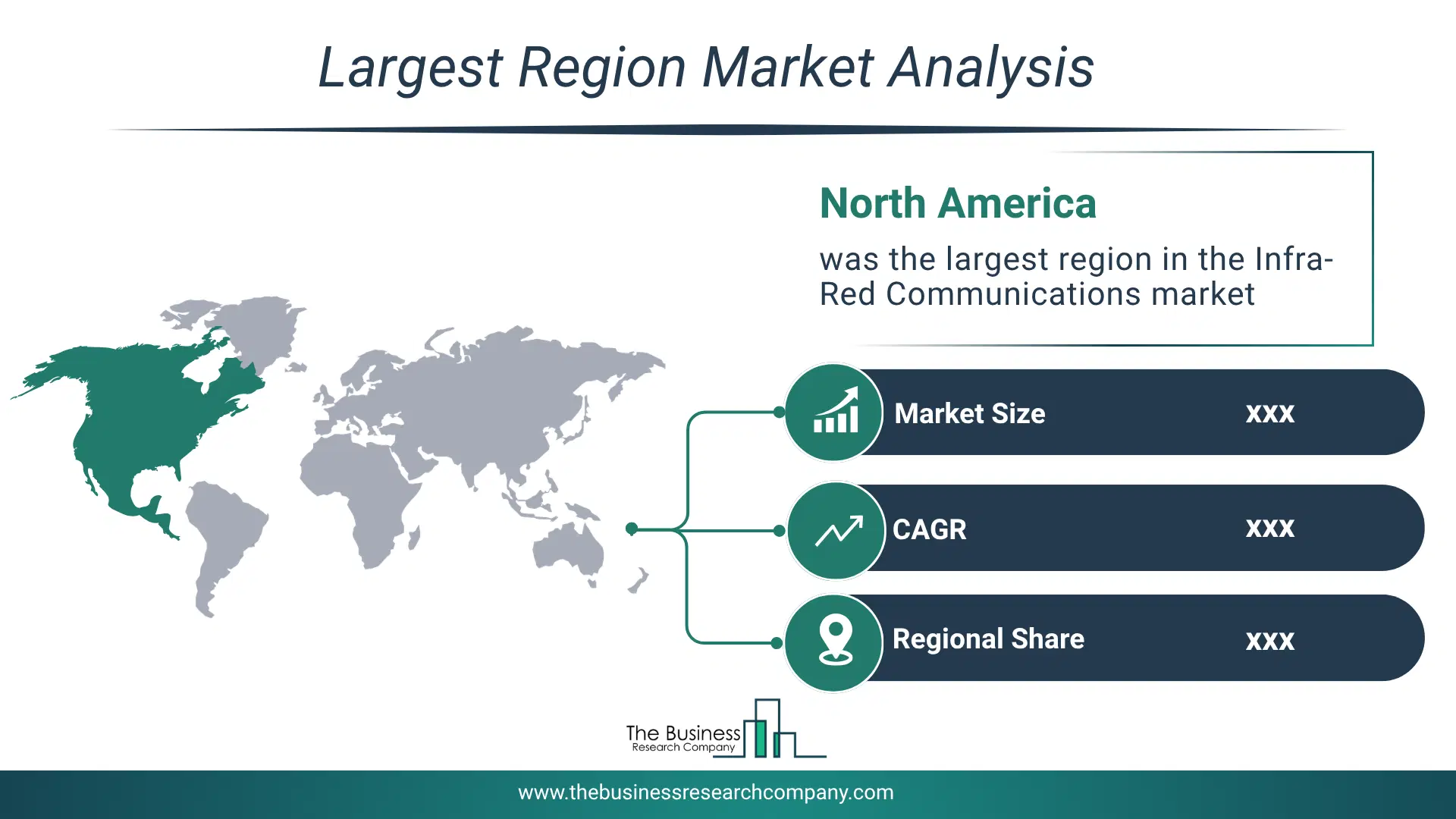
North America was the largest region in the infra-red communications market in 2025. Asia-Pacific is expected to be the fastest-growing region in the forecast period. The regions covered in this market report are Asia-Pacific, South East Asia, Western Europe, Eastern Europe, North America, South America, Middle East, Africa. The countries covered in this market report are Australia, Brazil, China, France, Germany, India, Indonesia, Japan, Taiwan, Russia, South Korea, UK, USA, Canada, Italy, Spain.What Defines the Infra-Red Communications Market?
The infra-red communications market consists of revenues earned by entities by providing services such as short-range infrared data communication services, infrared remote control signal transmission services, secure point-to-point infrared communication services, secure point-to-point infrared communication services, infrared-based device pairing and data transfer services, and industrial infrared monitoring and communication services. The market value includes the value of related goods sold by the service provider or included within the service offering. The infra-red communications market also includes sales of infrared light emitting diodes, photodiodes, infrared transceivers, remote control systems, optical communication components, and associated semiconductor devices. Values in this market are ‘factory gate’ values, that is, the value of goods sold by the manufacturers or creators of the goods, whether to other entities (including downstream manufacturers, wholesalers, distributors, and retailers) or directly to end customers. The value of goods in this market includes related services sold by the creators of the goods.How is Market Value Defined and Measured?
The market value is defined as the revenues that enterprises gain from the sale of goods and/or services within the specified market and geography through sales, grants, or donations in terms of the currency (in USD unless otherwise specified). The revenues for a specified geography are consumption values that are revenues generated by organizations in the specified geography within the market, irrespective of where they are produced. It does not include revenues from resales along the supply chain, either further along the supply chain or as part of other products.
This chart presents market attractiveness based on a quantitative evaluation of growth, competition, strategic alignment, and risk, offering a clear view of opportunity areas for decision-making. This chart is for illustrative purposes; the full report contains the complete analysis.

This chart highlights the Total Addressable Market (TAM) by estimating the maximum revenue opportunity using an assumption-driven approach, supporting strategic planning and opportunity sizing across markets. The chart is illustrative; the full report provides a more comprehensive analysis.
What Key Data and Analysis Are Included in the Infra-Red Communications Market Report 2026?
The infra-red communications market research report is one of a series of new reports from The Business Research Company that provides market statistics, including industry global market size, regional shares, competitors with the market share, detailed market segments, market trends and opportunities, and any further data you may need to thrive in the infra-red communications industry. The market research report delivers a complete perspective of everything you need, with an in-depth analysis of the current and future state of the industry.Infra-Red Communications Market Report Forecast Analysis
| Report Attribute | Details |
|---|---|
| Market Size Value In 2026 | $2.19 billion |
| Revenue Forecast In 2030 | $3.73 billion |
| Growth Rate | CAGR of 14.20% from 2026 to 2030 |
| Base Year For Estimation | 2025 |
| Actual Estimates/Historical Data | 2020-2025 |
| Forecast Period | 2026 - 2030 |
| Market Representation | Revenue in USD Billion and CAGR from 2026 to 2030 |
| Segments Covered | Component, Technology, Wavelength Range, End User |
| Regional Scope | Asia-Pacific, Western Europe, Eastern Europe, North America, South America, Middle East, Africa |
| Country Scope | The countries covered in the report are Australia, Brazil, China, France, Germany, India, Indonesia, Japan, Taiwan, Russia, South Korea, UK, USA, Canada, Italy, Spain. |
| Key Companies Profiled | Raytheon Technologies Corporation; Broadcom Inc.; Texas Instruments Incorporated; STMicroelectronics N.V.; NXP Semiconductors N.V.; Murata Manufacturing Co Ltd.; Renesas Electronics Corporation; ON Semiconductor Corporation (onsemi); Omron Corporation; Teledyne Technologies Incorporated; Melexis N.V.; Vishay Intertechnology Inc.; Nippon Ceramic Co Ltd.; Lynred SA; Sensirion AG; Hamamatsu Photonics K.K.; InfraTec GmbH; Laser Components GmbH; Semiconductor Devices Inc.; Senba Sensing Technology Co Ltd. |
| Customization Scope | Request for Customization |
| Pricing And Purchase Options | Explore Purchase Options |