
Interplanetary Communication Market Report 2026
Global Outlook – By Component (Hardware, Software, Services), By Technology (Radio Frequency, Optical Communication, Quantum Communication), By Application (Space Exploration, Satellite Communication, Deep Space Missions, Other Applications), By End-User (Government And Defense, Commercial, Research And Development) – Market Size, Trends, Strategies, and Forecast to 2030
Interplanetary Communication Market Overview
• Interplanetary Communication market size has reached to $3.67 billion in 2025 • Expected to grow to $7.02 billion in 2030 at a compound annual growth rate (CAGR) of 13.8% • Growth Driver: Rising Investment In Space Exploration Fueling The Growth Of The Market Due To Increasing Need For Deep Space Data Transmission • Market Trend: Advancements In Miniaturized Deep-Space Communication Systems Enhancing Autonomous Interplanetary Connectivity • North America was the largest region in 2025.What Is Covered Under Interplanetary Communication Market?
Interplanetary communication refers to the exchange of information between spacecraft or stations located on different planets or celestial bodies within the solar system. It involves transmitting data over vast distances using radio waves or lasers. Due to the huge distances involved, signals can take minutes or even hours to travel, causing delays. This type of communication is crucial for controlling space missions, sending scientific data, and ensuring astronaut safety. The main components of interplanetary communication include hardware, software, and services. Hardware in interplanetary communication consists of essential physical devices such as antennas, transmitters, receivers, lasers, and photodetectors. It uses various technologies such as radio frequency, optical communication, and quantum communication and is applied for space exploration, satellite communication, deep space missions, and others. It is used by various end-users, including government and defense, commercial, and research and development.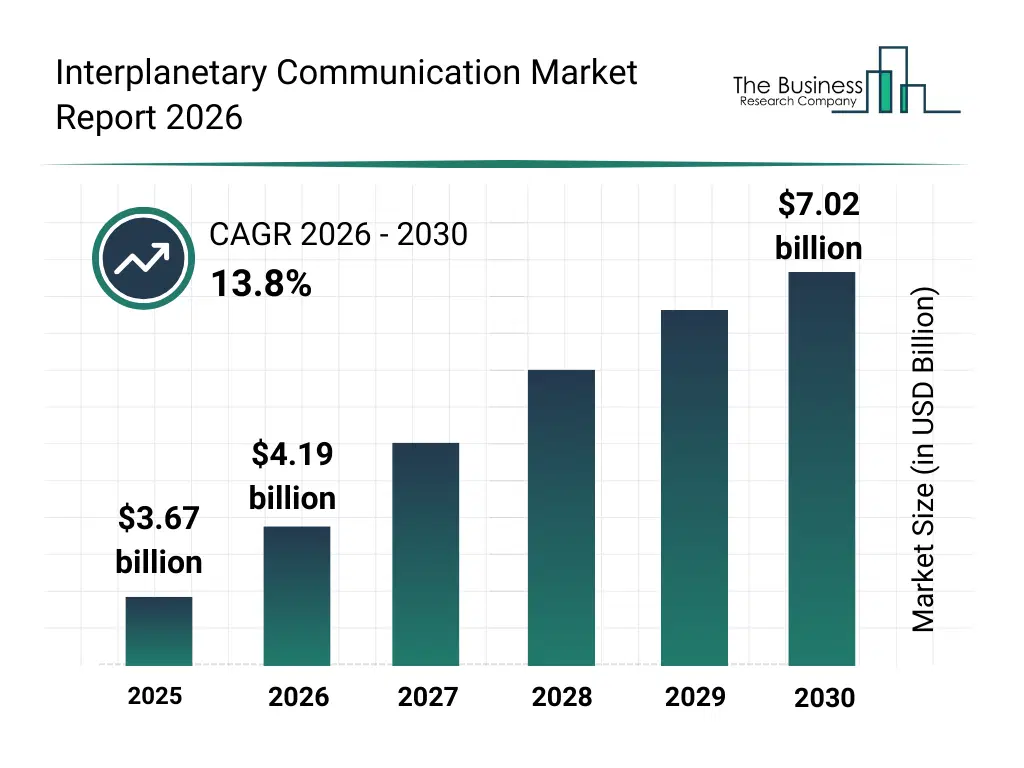
What Is The Interplanetary Communication Market Size and Share 2026?
The interplanetary communication market size has grown rapidly in recent years. It will grow from $3.67 billion in 2025 to $4.19 billion in 2026 at a compound annual growth rate (CAGR) of 14.2%. The growth in the historic period can be attributed to early development of deep-space radio communication networks, increasing deployment of high-gain antennas for long-distance spacecraft links, advancements in space-grade transceivers and signal amplifiers, growth in planetary exploration missions requiring reliable data relay, initial experimentation with laser communication for deep-space applications.What Is The Interplanetary Communication Market Growth Forecast?
The interplanetary communication market size is expected to see rapid growth in the next few years. It will grow to $7.02 billion in 2030 at a compound annual growth rate (CAGR) of 13.8%. The growth in the forecast period can be attributed to rising adoption of laser communication terminals for higher-bandwidth interplanetary links, expansion of autonomous relay satellites to support multi-planet missions, increasing investment in advanced signal processing to reduce latency impacts, development of scalable ground station networks for continuous deep-space coverage, growing demand for robust communication infrastructure to support future crewed interplanetary missions. Major trends in the forecast period include expansion of lunar and mars communication infrastructure, rising demand for deep space relay satellites and ground stations, standardization of interplanetary communication protocols and delay-tolerant networking, integration of laser communication terminals in interplanetary missions, growing public–private partnerships for interplanetary mission support.
Global Interplanetary Communication Market Segmentation
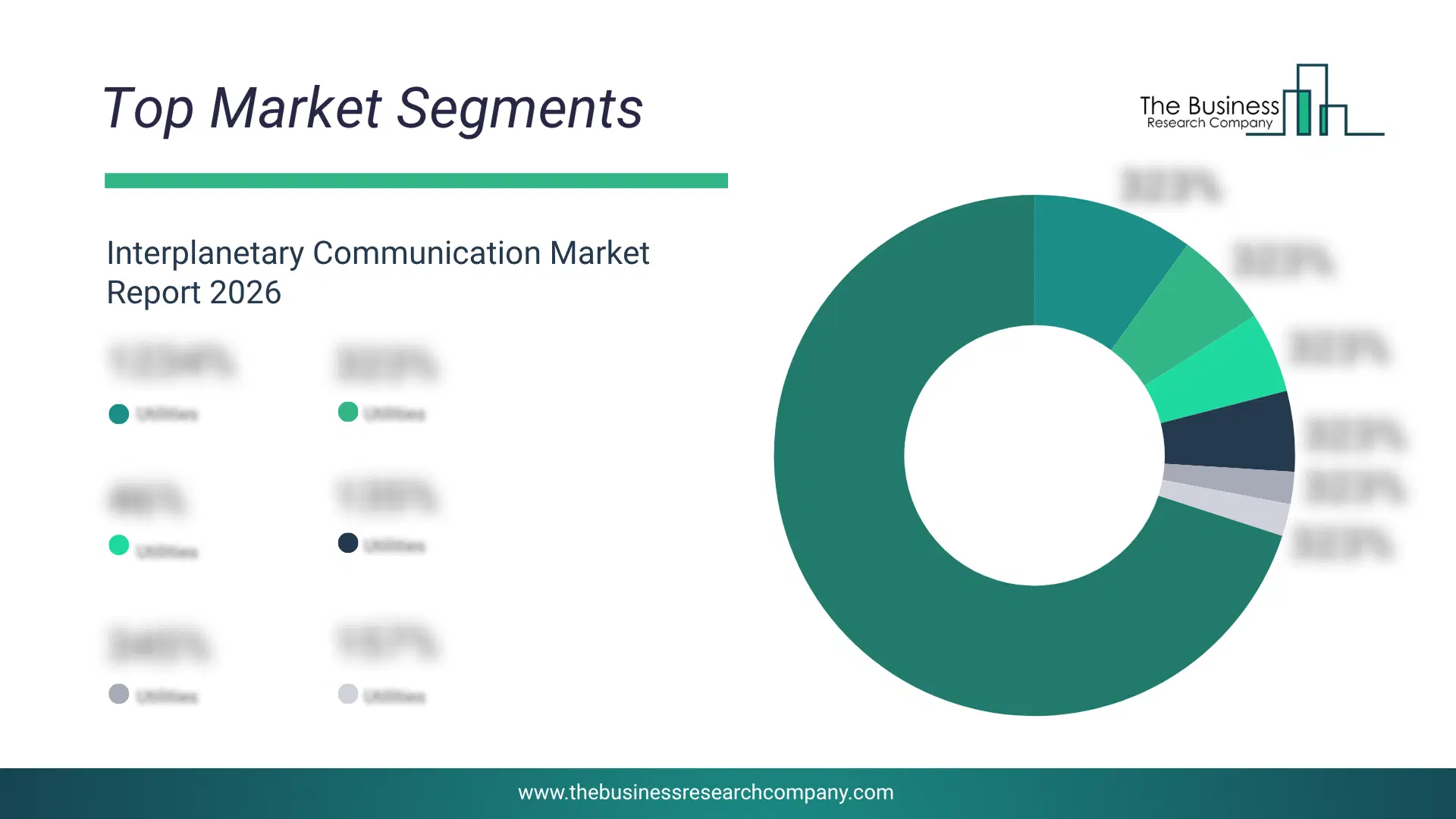
1) By Component: Hardware, Software, Services 2) By Technology: Radio Frequency, Optical Communication, Quantum Communication 3) By Application: Space Exploration, Satellite Communication, Deep Space Missions, Other Applications 4) By End-User: Government And Defense, Commercial, Research And Development Subsegments: 1) By Hardware: Transceivers, Antennas, Modems, Satellites, Ground Stations 2) By Software: Communication Protocols, Network Management Software, Data Compression Algorithms, Signal Processing Software 3) By Services: System Integration, Maintenance And Support, Consulting, Managed Network ServicesWhat Is Driver Of The Interplanetary Communication Market?
The increasing investment in space exploration is projected to fuel the growth of the interplanetary communication market in the coming years. Space exploration refers to the scientific investigation and discovery of outer space using advanced technology to study celestial objects and cosmic phenomena beyond Earth. Investment in space exploration is rising due to growing commercial opportunities, as private companies increasingly see space-based technologies and services as profitable ventures with long-term returns. Increasing investment in space exploration supports the demand for interplanetary communication as it leads to the development of more deep space missions, which require reliable, high-bandwidth communication systems to transmit data between Earth and distant spacecraft.For instance, in July 2024, according to the UK Space Agency, a UK-based government agency, in 2023–24, the Agency allocated £642 million ($ 23.53 million) in funding to the sector and successfully achieved 78% (51 out of 65) of its planned milestones. Therefore, the increasing investment in space exploration will boost the growth of the interplanetary communication industry.Key Players In The Global Interplanetary Communication Market
Major companies operating in the interplanetary communication market are Raytheon Technologies, The Boeing Company, Lockheed Martin Corp., Airbus SE, Northrop Grumman Corp., Honeywell International Inc., National Aeronautics and Space Administration, Thales Group, SpaceX Corp., General Atomics Electromagnetic Systems, Blue Origin LLC, European Space Agency, DLR, Viasat Inc., SES S.A., Eutelsat Communications SA, Japan Aerospace Exploration Agency, Roscosmos, ISRO, CNSA.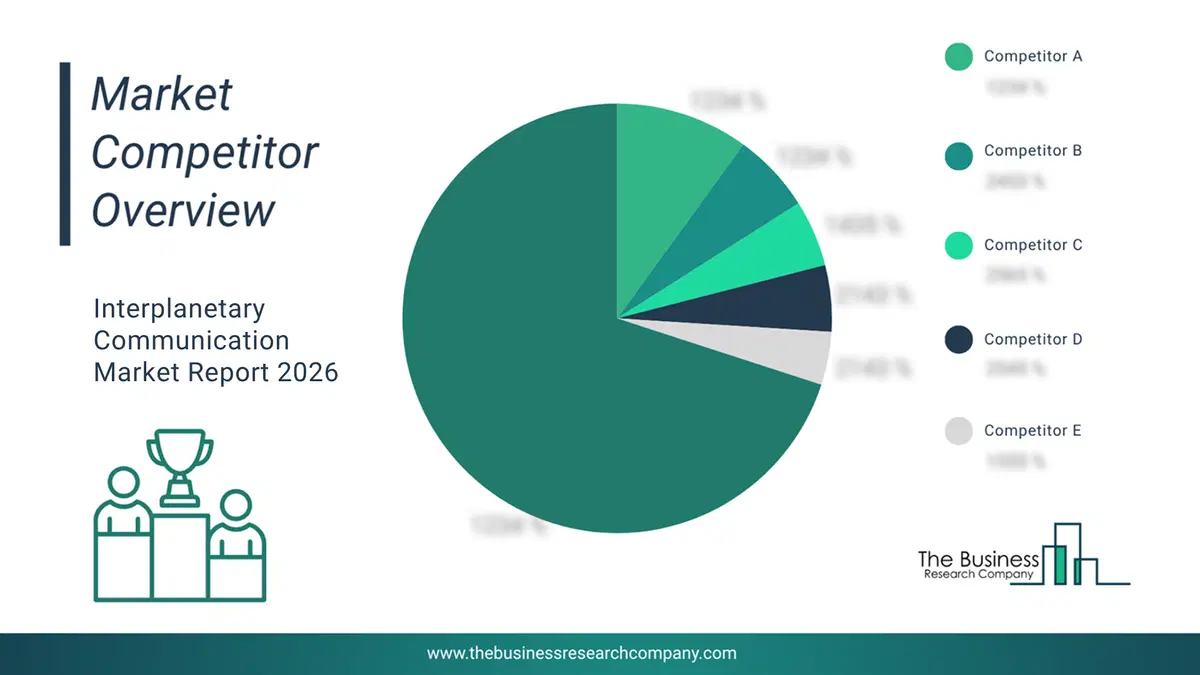
This chart is for illustrative purposes; the full report includes a detailed competitor analysis and comprehensive overview of the top 10 companies in the market.
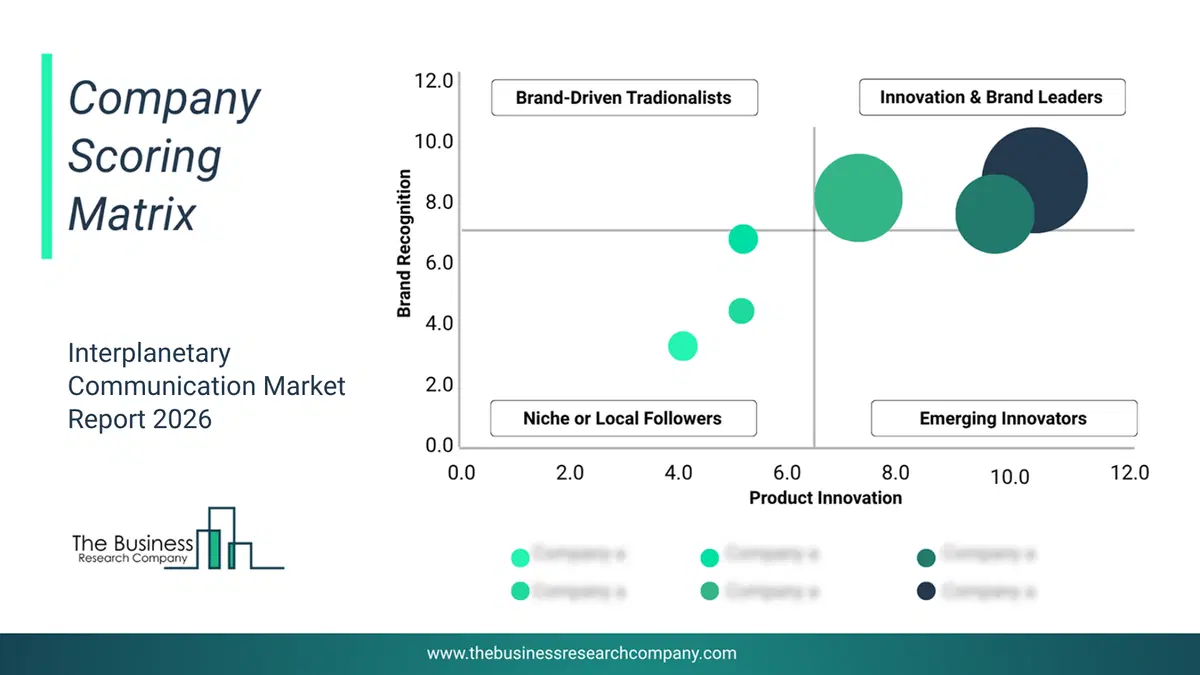
This chart maps companies by product innovation and brand strength, with bubble size indicating relative revenue, helping identify market leaders, challengers, and niche players. This is an illustrative chart; the full report provides a complete and accurate competitive analysis.
Global Interplanetary Communication Market Trends and Insights
Major companies operating in the interplanetary communication market are focusing on developing advanced solutions such as miniaturized deep-space transponders to enhance long-distance autonomy and warning capabilities. A miniaturized deep-space transponder is a compact communication system designed to enable small spacecraft to establish robust links with Earth’s ground stations, allowing them to independently transmit data and receive commands over interplanetary distances without reliance on a larger host spacecraft. For instance, in October 2025, the European Space Agency (ESA), a France-based international organization, plans to launch the HENON CubeSat featuring its new miniaturized deep-space transponder and an electric-propulsion maneuver capability. The mission’s key features include stand-alone communications via ESA’s Estrack network rather than via a mother craft; a tailor-made electric propulsion system using charged xenon gas atoms powered by solar panels to reach a distant retrograde orbit extending up to 24 million km from Earth; an orbit that positions the spacecraft sunward to enable 3-6 hour warning of solar storms (versus the typical 15-60 minutes today); and an innovative configuration with three payloads and a power conditioning/distribution unit (“Curie Power Suite” and advanced PCDU) designed to withstand deep-space vibration, vacuum, radiation, and temperature extremes.What Are Latest Mergers And Acquisitions In The Interplanetary Communication Market? SpaceX Strengthens Partnership With Filtronic To Advance High-Frequency Space Communication Systems
In September 2024, Filtronic, a UK-based manufacturer of mission-critical communication networks, partnered with SpaceX to develop space communications infrastructure. As a result of the partnership, SpaceX’s renewed order reflects its strong confidence in Filtronic’s technological capabilities and past project performance. This ongoing collaboration is expected to contribute significantly to the development of advanced high-frequency communication systems for future space networks. SpaceX is a US-based provider of interplanetary communication solutions.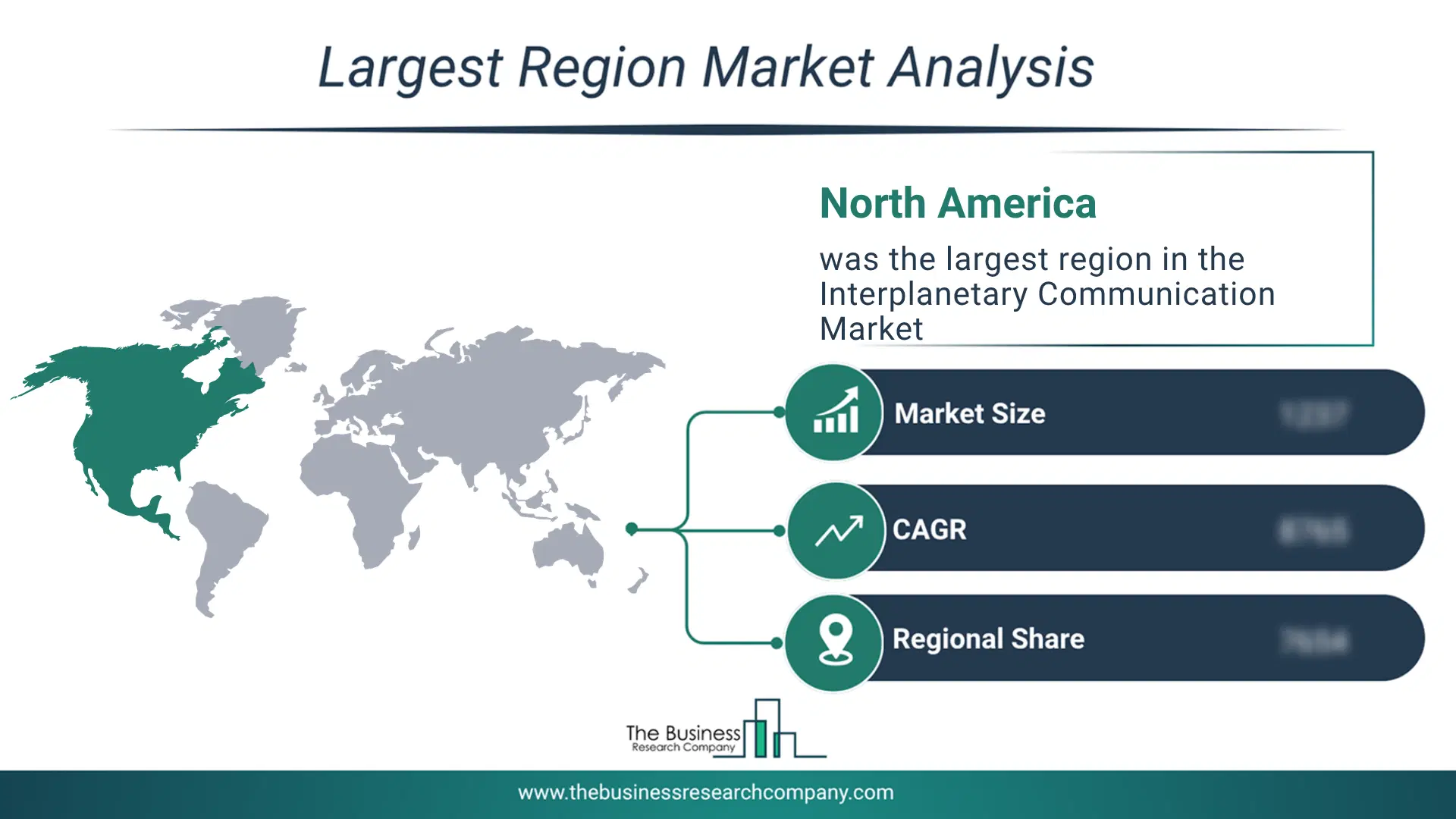
Regional Insights
North America was the largest region in the interplanetary communication market in 2025. The regions covered in this market report are Asia-Pacific, South East Asia, Western Europe, Eastern Europe, North America, South America, Middle East, Africa. The countries covered in this market report are Australia, Brazil, China, France, Germany, India, Indonesia, Japan, Taiwan, Russia, South Korea, UK, USA, Canada, Italy, SpainWhat Defines the Interplanetary Communication Market?
The interplanetary communication market consists of revenues earned by entities by providing services such as data transmission, relay services, ground station operations, and advanced signal processing. The market value includes the value of related goods sold by the service provider or included within the service offering. The interplanetary communication market also includes sales of high-gain antennas, transceivers, signal amplifiers, laser communication terminals, and space-grade communication satellites. Values in this market are ‘factory gate’ values, that is, the value of goods sold by the manufacturers or creators of the goods, whether to other entities (including downstream manufacturers, wholesalers, distributors, and retailers) or directly to end customers. The value of goods in this market includes related services sold by the creators of the goods.How is Market Value Defined and Measured?
The market value is defined as the revenues that enterprises gain from the sale of goods and/or services within the specified market and geography through sales, grants, or donations in terms of the currency (in USD unless otherwise specified). The revenues for a specified geography are consumption values that are revenues generated by organizations in the specified geography within the market, irrespective of where they are produced. It does not include revenues from resales along the supply chain, either further along the supply chain or as part of other products.
This chart presents market attractiveness based on a quantitative evaluation of growth, competition, strategic alignment, and risk, offering a clear view of opportunity areas for decision-making. This chart is for illustrative purposes; the full report contains the complete analysis.

This chart highlights the Total Addressable Market (TAM) by estimating the maximum revenue opportunity using an assumption-driven approach, supporting strategic planning and opportunity sizing across markets. The chart is illustrative; the full report provides a more comprehensive analysis.
What Key Data and Analysis Are Included in the Interplanetary Communication Market Report 2026?
The interplanetary communication market research report is one of a series of new reports from The Business Research Company that provides market statistics, including industry global market size, regional shares, competitors with the market share, detailed market segments, market trends and opportunities, and any further data you may need to thrive in the interplanetary communication industry. The market research report delivers a complete perspective of everything you need, with an in-depth analysis of the current and future state of the industry.Interplanetary Communication Market Report Forecast Analysis
| Report Attribute | Details |
|---|---|
| Market Size Value In 2026 | $4.19 billion |
| Revenue Forecast In 2030 | $7.02 billion |
| Growth Rate | CAGR of 13.8% from 2026 to 2030 |
| Base Year For Estimation | 2025 |
| Actual Estimates/Historical Data | 2020-2025 |
| Forecast Period | 2026 - 2030 |
| Market Representation | Revenue in USD Billion and CAGR from 2026 to 2030 |
| Segments Covered | Component, Technology, Application, End-User |
| Regional Scope | Asia-Pacific, Western Europe, Eastern Europe, North America, South America, Middle East, Africa |
| Country Scope | The countries covered in the interplanetary communication market report are Australia, Brazil, China, France, Germany, India, Indonesia, Japan, Taiwan, Russia, South Korea, UK, USA, Canada, Italy, Spain |
| Key Companies Profiled | Raytheon Technologies, The Boeing Company, Lockheed Martin Corp., Airbus SE, Northrop Grumman Corp., Honeywell International Inc., National Aeronautics and Space Administration, Thales Group, SpaceX Corp., General Atomics Electromagnetic Systems, Blue Origin LLC, European Space Agency, DLR, Viasat Inc., SES S.A., Eutelsat Communications SA, Japan Aerospace Exploration Agency, Roscosmos, ISRO, CNSA. |
| Customization Scope | Request for Customization |
| Pricing And Purchase Options | Explore Purchase Options |