
Intrapartum Monitoring Devices Market Report 2026
Global Outlook – By Product Type (Monitors, Electrodes), By Method (Invasive, Non-invasive), By End User (Hospitals, Maternity Centers, Other End Users) – Market Size, Trends, Strategies, and Forecast to 2030
Intrapartum Monitoring Devices Market Overview
• Intrapartum Monitoring Devices market size has reached to $2.31 billion in 2025 • Expected to grow to $3.19 billion in 2030 at a compound annual growth rate (CAGR) of 6.6% • Growth Driver: Rising Prevalence Of Gynecological Diabetes Drives Growth In Intrapartum Monitoring Device Market • Market Trend: Innovative Wireless And Belt-Free Intrapartum Monitoring Devices • North America was the largest region in 2025 and Asia-Pacific is the fastest growing region.What Is Covered Under Intrapartum Monitoring Devices Market?
Intrapartum monitoring devices are specialized medical tools used to continuously monitor the well-being of the mother and fetus during labor and delivery. These devices ensure the safety of both mother and child by providing real-time data that helps healthcare providers make informed decisions. The main types of intrapartum monitoring devices are monitors and electrodes. Monitors refer to devices used during labor and delivery to continuously track the heart rate of the fetus and the contractions of the uterus. The different methods involve invasive and non-invasive and are used by different end users such as hospitals, maternity centers, and others.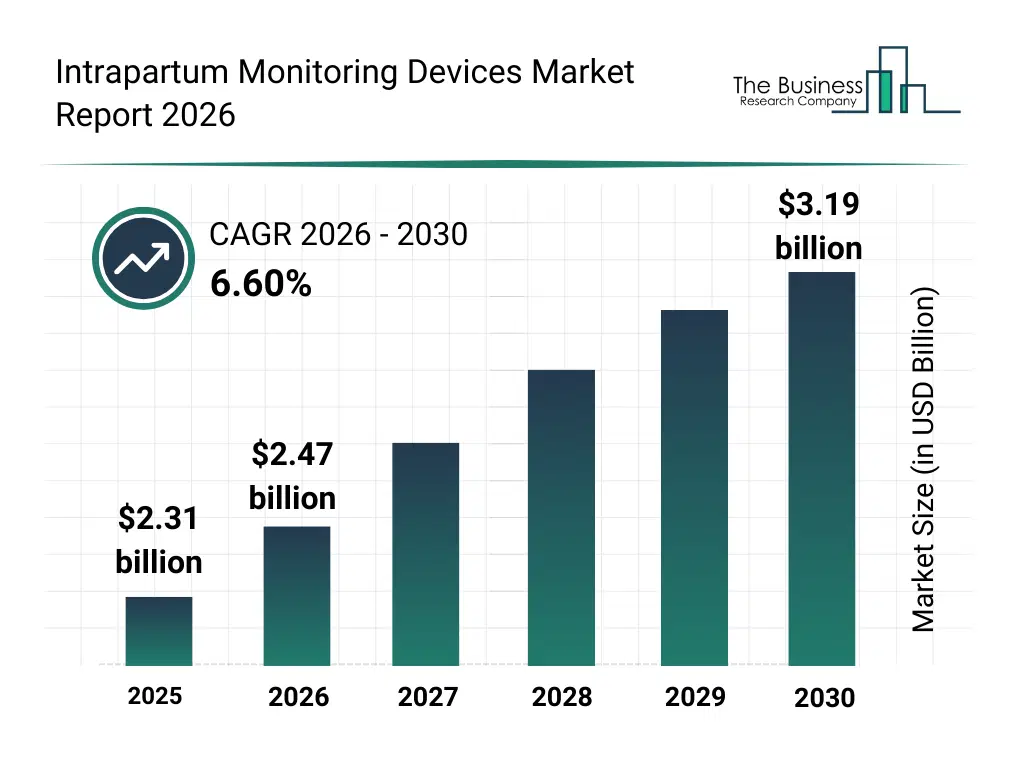
What Is The Intrapartum Monitoring Devices Market Size and Share 2026?
The intrapartum monitoring devices market size has grown strongly in recent years. It will grow from $2.31 billion in 2025 to $2.47 billion in 2026 at a compound annual growth rate (CAGR) of 6.7%. The growth in the historic period can be attributed to rising institutional childbirth rates, increasing awareness of maternal and fetal safety, expansion of hospital maternity infrastructure, growing prevalence of high-risk pregnancies, rising adoption of electronic fetal monitoring.What Is The Intrapartum Monitoring Devices Market Growth Forecast?
The intrapartum monitoring devices market size is expected to see strong growth in the next few years. It will grow to $3.19 billion in 2030 at a compound annual growth rate (CAGR) of 6.6%. The growth in the forecast period can be attributed to increasing demand for advanced maternity care, growing focus on reducing maternal and neonatal mortality, rising preference for continuous labor monitoring, expanding access to skilled birth facilities, increasing healthcare investment in obstetric care. Major trends in the forecast period include growing adoption of continuous fetal and maternal monitoring, increasing preference for non-invasive intrapartum monitoring methods, rising use of integrated fetal and maternal monitoring systems, expansion of intrapartum monitoring in high-risk pregnancies, growing focus on real-time labor monitoring for improved outcomes.
Global Intrapartum Monitoring Devices Market Segmentation
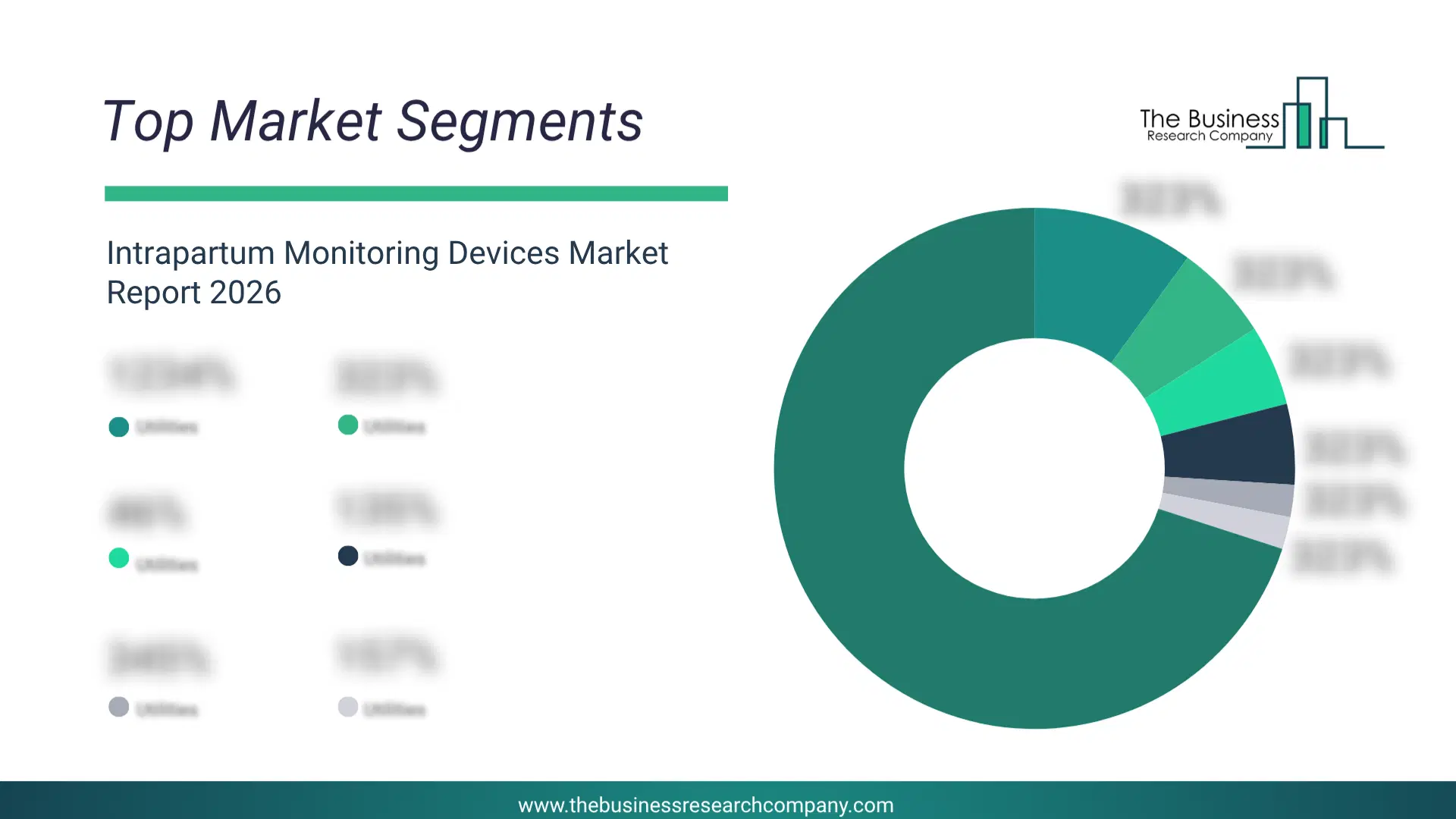
1) By Product Type: Monitors, Electrodes 2) By Method: Invasive, Non-invasive 3) By End User: Hospitals, Maternity Centers, Other End Users Subsegments: 1) By Monitors: Fetal Heart Rate Monitors, Uterine Contraction Monitors, Maternal Vital Sign Monitors, Integrated Fetal or Maternal Monitoring Systems (Integrated Systems) 2) By Electrodes: Fetal Electrodes (Scalp Electrodes), Maternal Electrodes (For Ecg Monitoring), Disposable Electrodes, Reusable ElectrodesWhat Are The Drivers Of The Intrapartum Monitoring Devices Market?
The rising prevalence of gynecological diabetes is expected to propel the growth of the intrapartum monitoring device market going forward. Gynecological diabetes, also known as gestational diabetes mellitus (GDM), is a condition characterized by high blood sugar (glucose) levels that develop during pregnancy and typically resolve after giving birth. The prevalence of gynecological diabetes is growing due to increasing rates of obesity and sedentary lifestyles. Intrapartum monitoring devices are used in gynecological diabetes to continuously monitor the fetal heart rate and uterine contractions, ensuring the timely detection and management of potential complications during labor and delivery.For instance, in March 2024, according to a report by the Government of the United Kingdom, a UK-based information website, in March 2023, the percentage of people with type 1 diabetes in England receiving 8 care processes at GP practices participating in the NDA rose to 43.8%, up from 35.2% the previous year. Therefore, the rising prevalence of gynecological diabetes is driving the growth of the intrapartum monitoring device industry. Increasing healthcare expenditure is expected to propel the growth of the intrapartum monitoring devices market going forward. Healthcare expenditure refers to the total amount of money spent on medical services, treatments, and health-related resources within a given period. Healthcare expenditure is rising significantly as the aging population grows, leading to a higher demand for medical services, long-term care, and age-related treatments, which collectively place a greater financial burden on healthcare systems. Intrapartum monitoring devices support rising healthcare expenditure by enabling continuous fetal and maternal monitoring during labor, reducing complications, improving patient outcomes, and optimizing resource use, which drives investment in advanced perinatal care technologies. For instance, in April 2025, according to the American Medical Association, a US-based professional association, in 2023, health spending in the U.S. rose by 7.5%, reaching $4.9 trillion, or $14,570 per person, marking a notable increase compared to the 4.6% growth recorded in 2022. Therefore, the increasing healthcare expenditure is driving the growth of the intrapartum monitoring devices industry.Key Players In The Global Intrapartum Monitoring Devices Market
Major companies operating in the intrapartum monitoring devices market are Cardinal Health Inc, Medtronic PLC, Fujifilm Holdings Corporation, Philips Healthcare, GE HealthCare Technologies Inc., Shenzhen Mindray Bio-Medical Electronics Co. Ltd, Drägerwerk AG & Co. KGaA, CooperSurgical Inc., Spacelabs Healthcare, Nihon Kohden Corporation, Contec Medical Systems Co Ltd., Mediana Co Ltd., Natus Medical Incorporated, EDAN Instruments Inc., Guangdong Biolight Meditech Co. Ltd, Dixion Vertrieb medizinischer Geräte GmbH, Bionet America Inc., Shenzhen Bestman Instrument Co Ltd., Huntleigh Healthcare Limited, Neoventa Medical AB, Trismed Co Ltd.
This chart is for illustrative purposes; the full report includes a detailed competitor analysis and comprehensive overview of the top 10 companies in the market.
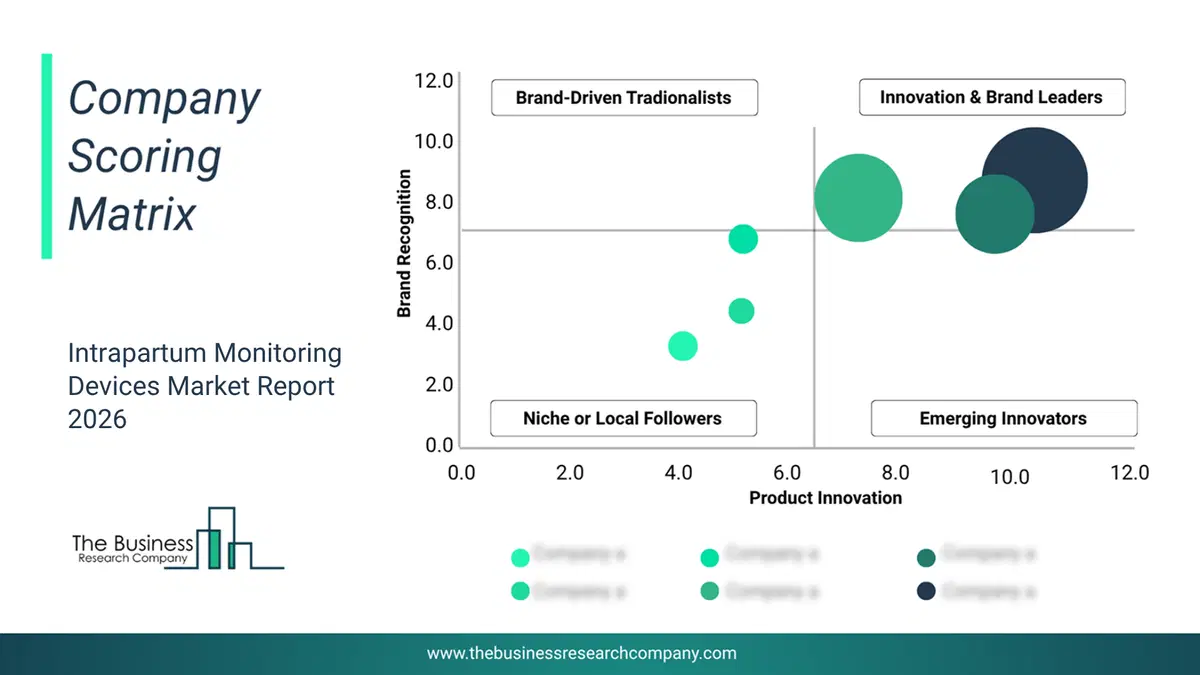
This chart maps companies by product innovation and brand strength, with bubble size indicating relative revenue, helping identify market leaders, challengers, and niche players. This is an illustrative chart; the full report provides a complete and accurate competitive analysis.
Global Intrapartum Monitoring Devices Market Trends and Insights
Major companies operating in the intrapartum monitoring device market are increasing their focus on developing innovative products such as wireless and belt-free designs to sustain their position in the market. Wireless and belt-free designs in intrapartum monitoring devices allow for unobstructed movement and increased comfort for the mother while ensuring continuous monitoring of fetal heart rate and uterine contractions. For instance, in February 2024, GE HealthCare Technologies Inc., a US-based medical technology company, obtained clearance for its Novii+ Wireless Maternal and Fetal Monitoring Solution. This clearance allows the device to monitor approximately 95% of all eligible births in the United States. The Novii+ system is designed for pregnant patients at or beyond 34 weeks and offers noninvasive monitoring of fetal heart rate, maternal heart rate, and uterine activity. It features a wireless and belt-free design, enhancing mobility and potentially improving the comfort and experience of expectant mothers during labor. The device incorporates an advanced algorithm called cross-check artifact reduction, which improves the accuracy and reliability of the collected data.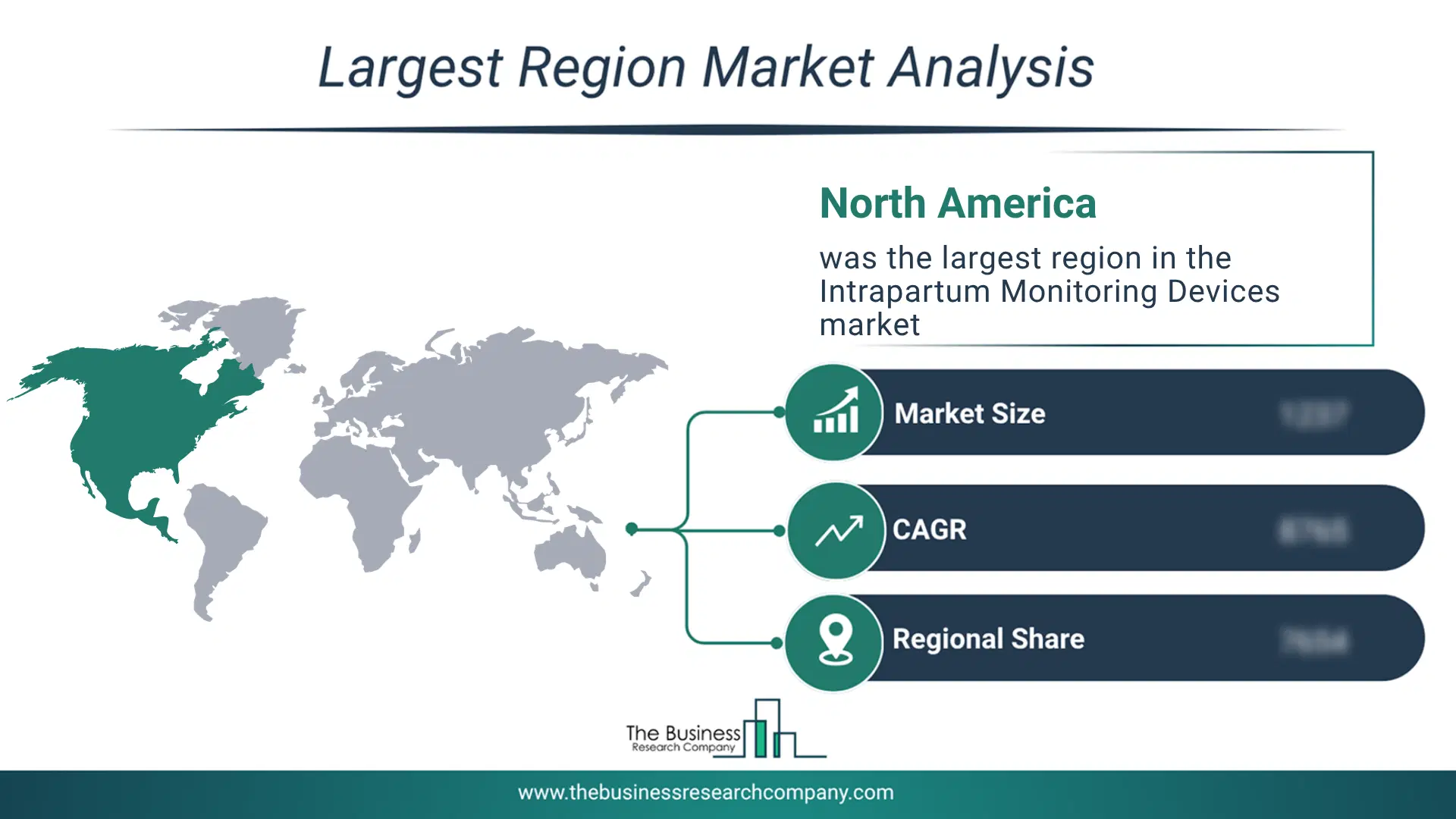
Regional Outlook
North America was the largest region in the intrapartum monitoring devices market in 2025. Asia-Pacific is expected to be the fastest-growing region in the forecast period. The regions covered in this market report are Asia-Pacific, South East Asia, Western Europe, Eastern Europe, North America, South America, Middle East, Africa. The countries covered in this market report are Australia, Brazil, China, France, Germany, India, Indonesia, Japan, Taiwan, Russia, South Korea, UK, USA, Canada, Italy, SpainWhat Defines the Intrapartum Monitoring Devices Market?
The intrapartum monitoring devices market consists of sales of electronic fetal monitors (EFMs), tocodynamometers, doppler ultrasound devices, and telemetry systems. Values in this market are ‘factory gate’ values, that is, the value of goods sold by the manufacturers or creators of the goods, whether to other entities (including downstream manufacturers, wholesalers, distributors, and retailers) or directly to end customers. The value of goods in this market includes related services sold by the creators of the goods.How is Market Value Defined and Measured?
The market value is defined as the revenues that enterprises gain from the sale of goods and/or services within the specified market and geography through sales, grants, or donations in terms of the currency (in USD unless otherwise specified). The revenues for a specified geography are consumption values that are revenues generated by organizations in the specified geography within the market, irrespective of where they are produced. It does not include revenues from resales along the supply chain, either further along the supply chain or as part of other products.
This chart presents market attractiveness based on a quantitative evaluation of growth, competition, strategic alignment, and risk, offering a clear view of opportunity areas for decision-making. This chart is for illustrative purposes; the full report contains the complete analysis.

This chart highlights the Total Addressable Market (TAM) by estimating the maximum revenue opportunity using an assumption-driven approach, supporting strategic planning and opportunity sizing across markets. The chart is illustrative; the full report provides a more comprehensive analysis.
What Key Data and Analysis Are Included in the Intrapartum Monitoring Devices Market Report 2026?
The intrapartum monitoring devices market research report is one of a series of new reports from The Business Research Company that provides market statistics, including industry global market size, regional shares, competitors with the market share, detailed market segments, market trends and opportunities, and any further data you may need to thrive in the intrapartum monitoring devices industry. The market research report delivers a complete perspective of everything you need, with an in-depth analysis of the current and future state of the industry.Intrapartum Monitoring Devices Market Report Forecast Analysis
| Report Attribute | Details |
|---|---|
| Market Size Value In 2026 | $2.47 billion |
| Revenue Forecast In 2030 | $3.19 billion |
| Growth Rate | CAGR of 6.6% from 2026 to 2030 |
| Base Year For Estimation | 2025 |
| Actual Estimates/Historical Data | 2020-2025 |
| Forecast Period | 2026 - 2030 |
| Market Representation | Revenue in USD Billion and CAGR from 2026 to 2030 |
| Segments Covered | Product Type, Method, End User |
| Regional Scope | Asia-Pacific, Western Europe, Eastern Europe, North America, South America, Middle East, Africa |
| Country Scope | The countries covered in the report are Australia, Brazil, China, France, Germany, India, Indonesia, Japan, Taiwan, Russia, South Korea, UK, USA, Canada, Italy, Spain. |
| Key Companies Profiled | Cardinal Health Inc, Medtronic PLC, Fujifilm Holdings Corporation, Philips Healthcare, GE HealthCare Technologies Inc., Shenzhen Mindray Bio-Medical Electronics Co. Ltd, Drägerwerk AG & Co. KGaA, CooperSurgical Inc., Spacelabs Healthcare, Nihon Kohden Corporation, Contec Medical Systems Co Ltd., Mediana Co Ltd., Natus Medical Incorporated, EDAN Instruments Inc., Guangdong Biolight Meditech Co. Ltd, Dixion Vertrieb medizinischer Geräte GmbH, Bionet America Inc., Shenzhen Bestman Instrument Co Ltd., Huntleigh Healthcare Limited, Neoventa Medical AB, Trismed Co Ltd. |
| Customization Scope | Request for Customization |
| Pricing And Purchase Options | Explore Purchase Options |