
Intravascular Microaxial LVAD Devices Market Report 2026
Global Outlook – By Product Type (Low Flow Devices Less Than 3 Liters Per Minute, Mid Flow Devices 3 To 4 Liters Per Minute, High Flow Devices Greater Than Or Equal To 4 Liters Per Minute), By Duration Of Support (Ultra Short Term Less Than 24 Hours, Short Term 1 To 3 Days, Prolonged More Than 3 Days Up To 14 Days), By Patient Type (Adult, Pediatric), By Application (Bridge To Transplant, Bridge To Recovery, Destination Therapy, High Risk Percutaneous Coronary Intervention), By End User (Tertiary Care Hospitals, Specialized Heart And Vascular Centers, Academic And Research Hospitals) – Market Size, Trends, Strategies, and Forecast to 2035
Intravascular Microaxial LVAD Devices Market Overview
• Intravascular Microaxial LVAD Devices market size has reached to $0.45 billion in 2025 • Expected to grow to $1.02 billion in 2030 at a compound annual growth rate (CAGR) of 17.7% • Growth Driver: Increasing Prevalence Of Cardiovascular Diseases Driving The Growth Of The Market Due To Rising Demand For Advanced Circulatory Support Solutions • Market Trend: Next-Generation Impella CP Driving Improvements In Hemodynamic Support • North America was the largest region in 2025 and Asia-Pacific is the fastest growing region.What Is Covered Under Intravascular Microaxial LVAD Devices Market?
The intravascular microaxial LVAD devices are minimally invasive mechanical circulatory support systems designed to assist the left ventricle in pumping blood through the body. These devices use a small axial flow pump inserted through blood vessels to help maintain cardiac output during severe heart failure or high-risk cardiac procedures. They provide temporary hemodynamic support by improving blood circulation and reducing the workload on the weakened heart. The main product types of intravascular microaxial LVAD devices include low flow devices less than 3 liters per minute, mid flow devices 3 to 4 liters per minute, and high flow devices greater than or equal to 4 liters per minute. Low flow devices less than 3 liters per minute refer to cardiac assist systems designed to provide limited circulatory support in less severe or early-stage cardiac conditions. These devices are categorized by duration of support including ultra short term less than 24 hours, short term 1 to 3 days, and prolonged more than 3 days up to 14 days, and are used across patient types including adult and pediatric populations. The key applications of bridge to transplant, bridge to recovery, destination therapy, and high risk percutaneous coronary intervention, while the end-use includes tertiary care hospitals, specialized heart and vascular centers, and academic and research hospitals.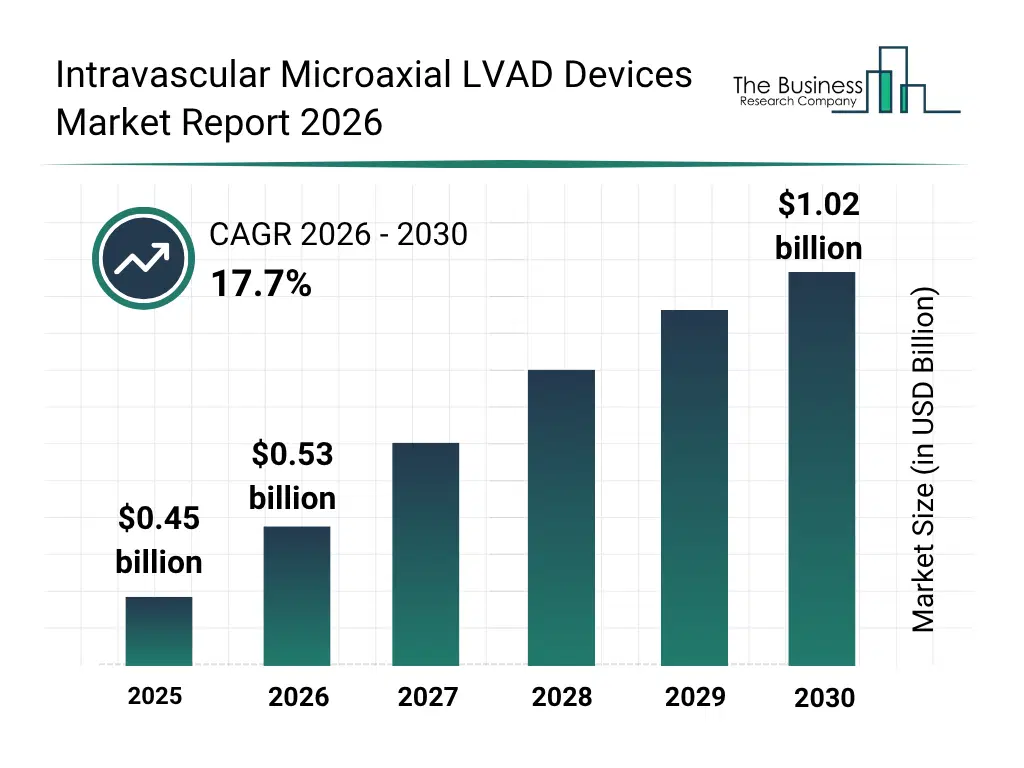
What Is The Intravascular Microaxial LVAD Devices Market Size and Share 2026?
The intravascular microaxial LVAD devices market size has grown rapidly in recent years.It will grow from $0.45 billion in 2025 to $0.53 billion in 2026 at a compound annual growth rate (CAGR) of 17.5%. The growth in the historic period can be attributed to rising prevalence of advanced heart failure cases, limited donor heart availability for transplantation, increasing adoption of temporary mechanical circulatory support, growing use of percutaneous coronary intervention procedures, expansion of cardiac catheterization laboratory infrastructure.What Is The Intravascular Microaxial LVAD Devices Market Growth Forecast?
The intravascular microaxial LVAD devices market size is expected to see rapid growth in the next few years.It will grow to $1.02 billion by 2030 at a compound annual growth rate (CAGR) of 17.7%. The growth in the forecast period can be attributed to increasing demand for minimally invasive cardiac support solutions, rising geriatric population with cardiovascular disorders, advancement in short term ventricular assist technologies, growing clinical preference for bridge to recovery therapies, expansion of specialized cardiac care centers globally.Major trends in the forecast period include minimally invasive percutaneous ventricular support adoption, hemocompatible blood pump material innovation, ultra-compact axial flow pump miniaturization, extended duration mechanical circulatory support optimization, catheter based cardiac intervention workflow integration.
Global Intravascular Microaxial LVAD Devices Market Segmentation
1) By Product Type: Low Flow Devices Less Than 3 Liters Per Minute, Mid Flow Devices 3 To 4 Liters Per Minute, High Flow Devices Greater Than Or Equal To 4 Liters Per Minute 2) By Duration Of Support: Ultra Short Term Less Than 24 Hours, Short Term 1 To 3 Days, Prolonged More Than 3 Days Up To 14 Days 3) By Patient Type: Adult, Pediatric 4) By Application: Bridge To Transplant, Bridge To Recovery, Destination Therapy, High Risk Percutaneous Coronary Intervention 5) By End User: Tertiary Care Hospitals, Specialized Heart And Vascular Centers, Academic And Research Hospitals Subsegments: 1) By Low Flow Devices Less Than 3 Liters Per Minute: Percutaneous Left Ventricular Assist Devices, Miniaturized Flow Left Ventricular Assist Devices, Hemocompatible Low Flow Devices, Temporary Support Left Ventricular Assist Devices, Wearable Low Flow Circulatory Support Devices 2) By Mid Flow Devices 3 To 4 Liters Per Minute: Percutaneous Mid Flow Left Ventricular Assist Devices, Intermediate Flow Circulatory Support Devices, Compact Mid Flow Heart Pump Devices, Hemocompatible Mid Flow Left Ventricular Assist Devices, Transcatheter Mid Flow Ventricular Support Devices 3) By High Flow Devices Greater Than Or Equal To 4 Liters Per Minute: Surgical High Flow Left Ventricular Assist Devices, Long Term High Flow Circulatory Support Devices, High Capacity Hemocompatible Left Ventricular Assist Devices, Wearable High Flow Heart Pump Devices, Transcatheter High Flow Ventricular Assist DevicesWhat Are The Drivers Of The Intravascular Microaxial LVAD Devices Market?
The increasing prevalence of cardiovascular diseases is expected to propel the growth of the intravascular microaxial LVAD devices industry going forward.Cardiovascular diseases refer to disorders of the heart and blood vessels, including coronary artery disease, heart failure, stroke, and hypertension, that impair cardiovascular function and require ongoing clinical management.The rise in cardiovascular diseases is driven mainly by aging populations and increasing prevalence of risk factors in developed economies.Intravascular microaxial LVAD devices supports this trend by providing advanced circulatory support solutions that stabilize hemodynamics and bridge patients to recovery, transplant, or chronic support in cases of severe heart failure.For instance, in January 2024, according to the American Heart Association, a US-based non-profit organization, the age-adjusted death rate from cardiovascular disease increased to 233.3 per 100,000 in 2024 up 4.0% from 224.4 per 100,000 in 2023.Therefore, the increasing prevalence of cardiovascular diseases is driving the growth of the intravascular microaxial LVAD devices industry. The rising healthcare expenditure is expected to propel the growth of the intravascular microaxial LVAD devices industry going forward.Healthcare expenditure refers to the total amount of financial resources spent on health services, including hospital care, medical devices, physician services, and preventive care, to improve health outcomes.The increase in healthcare expenditure is driven by factors such as the growing prevalence of cardiovascular diseases and advancements in medical technologies that require higher investment.Intravascular microaxial LVAD devices are used to provide temporary mechanical circulatory support in patients with severe cardiac conditions, improving cardiac output and stabilizing hemodynamics during high-risk procedures or acute heart failure.Increased healthcare spending enables greater access to advanced cardiac care technologies, supports hospital adoption of innovative devices, and enhances patient affordability for life-saving treatments.For instance, in May 2024, according to the Office for National Statistics, a UK-based government department, total healthcare expenditure experienced a significant rise of 5.6% in nominal terms from 2022 to 2023, marking a notable acceleration from the 0.9% growth recorded in 2022.Therefore, the rising healthcare expenditure is driving the growth of the intravascular microaxial LVAD devices industry.Key Players In The Global Intravascular Microaxial LVAD Devices Market
Major companies operating in the intravascular microaxial lvad devices market are Johnson & Johnson, Abbott Laboratories, Medtronic Plc, Supira Medical Inc., Magenta Medical Ltd., Jarvik Heart Inc., Windmill Cardiovascular Systems Inc., PulseCath B. V.Global Intravascular Microaxial LVAD Devices Market Trends and Insights
Major companies operating in the intravascular microaxial LVAD devices market are focusing on advancing precision cardiac support technologies, such as the ninth-generation Impella CP intravascular microaxial flow pump, to enhance hemodynamic support, improve patient survival outcomes, enable minimally invasive high-risk cardiac interventions, and optimize real-time cardiac performance monitoring. The ninth-generation Impella CP intravascular microaxial flow pump refers to an advanced catheter-based mechanical circulatory support device designed to provide enhanced left ventricular unloading and improved hemodynamic support through a miniaturized, high-efficiency axial flow pump inserted percutaneously into the heart. For instance, in October 2025, Johnson & Johnson MedTech, a US‑based medical technology company, highlighted the newest Impella CP and long‑term survival data at the Transcatheter Cardiovascular Therapeutics (TCT) 2025 conference. The newest Impella CP features optimized pump functionality for enhanced hemodynamic support, design updates that improve ease of use for clinicians, and upgraded evidence showing improved long‑term survival outcomes. These innovations align with updated clinical guidelines recommending Impella for cardiogenic shock and high‑risk percutaneous procedures, expanding its applicability. While cost and training requirements remain considerations, these device advancements strengthen acute cardiac support capabilities.Regional Insights
North America was the largest region in the intravascular microaxial LVAD devices market in 2025. Asia-Pacific is expected to be the fastest-growing region in the forecast period. The regions covered in this market report are Asia-Pacific, South East Asia, Western Europe, Eastern Europe, North America, South America, Middle East and Africa. The countries covered in this market report are Australia, Brazil, China, France, Germany, India, Indonesia, Japan, Taiwan, Russia, South Korea, UK, USA, Canada, Italy, Spain.What Defines the Intravascular Microaxial LVAD Devices Market?
The intravascular microaxial LVAD devices market consists of sales of catheter-based microaxial blood pumps, percutaneous ventricular assist devices, pump controllers and consoles, and related monitoring and support components. Values in this market are ‘factory gate’ values, that is, the value of goods sold by the manufacturers or creators of the goods, whether to other entities (including downstream manufacturers, wholesalers, distributors, and retailers) or directly to end customers. The value of goods in this market includes related services sold by the creators of the goods.What is the Market Assessment and Strategic Outlook for the Intravascular Microaxial LVAD Devices Industry?
The intravascular microaxial lvad devices market research report is one of a series of new reports from The Business Research Company that provides market statistics, including industry global market size, regional shares, competitors with the market share, detailed market segments, market trends and opportunities, and any further data you may need to thrive in the intravascular microaxial lvad devices industry. The market research report delivers a complete perspective of everything you need, with an in-depth analysis of the current and future state of the industry.What is the Market Assessment and Strategic Outlook for the Intravascular Microaxial LVAD Devices Market Report 2026?
The intravascular microaxial LVAD devices market research report is one of a series of new reports from The Business Research Company that provides intravascular microaxial LVAD devices market statistics, including intravascular microaxial LVAD devices industry global market size, regional shares, competitors with a intravascular microaxial LVAD devices market share, detailed intravascular microaxial LVAD devices market segments, market trends and opportunities, and any further data you may need to thrive in the intravascular microaxial LVAD devices industry. This intravascular microaxial LVAD devices market research report delivers a complete perspective of everything you need, with an in-depth analysis of the current and future scenario of the industry.Intravascular Microaxial LVAD Devices Market Report Forecast Analysis
| Report Attribute | Details |
|---|---|
| Market Size Value In 2026 | $0.53 billion |
| Revenue Forecast In 2035 | $1.02 billion |
| Growth Rate | CAGR of 17.7% from 2026 to 2035 |
| Base Year For Estimation | 2025 |
| Actual Estimates/Historical Data | 2020-2025 |
| Forecast Period | 2026 - 2030 - 2035 |
| Market Representation | Revenue in USD Billion and CAGR from 2026 to 2035 |
| Segments Covered | Product Type, Duration Of Support, Patient Type, Application, End User |
| Regional Scope | Asia-Pacific, Western Europe, Eastern Europe, North America, South America, Middle East, Africa |
| Country Scope | The countries covered in the report are Australia, Brazil, China, France, Germany, India, Indonesia, Japan, Taiwan, Russia, South Korea, UK, USA, Canada, Italy, Spain. |
| Key Companies Profiled | Johnson & Johnson, Abbott Laboratories, Medtronic Plc, Supira Medical Inc., Magenta Medical Ltd., Jarvik Heart Inc., Windmill Cardiovascular Systems Inc., PulseCath B. V. |
| Customization Scope | Request for Customization |
| Pricing And Purchase Options | Explore Purchase Options |