
Large Language Models (LLMs) In Robotics Market Report 2026
Global Outlook – By Functionality (Natural Language Understanding, Natural Language Generation, Speech Recognition And Synthesis, Computer Vision Integration, Multimodal Processing), By Deployment Mode (Cloud-Based Large Language Models (LLMs), On-Premises Large Language Models (LLMs)), By Enterprise Size (Large Enterprises, Small And Medium Enterprises), By Application (Industrial Robotics, Service Robotics, Autonomous Vehicles, Humanoid Robots, Drone Technology, Other Applications), By Industry (Healthcare, Manufacturing, Retail And E-Commerce, Banking, Financial Services, And Insurance, Defense And Security, Other Industries) – Market Size, Trends, Strategies, and Forecast to 2030
Large Language Models (LLMs) In Robotics Market Overview
• Large Language Models (LLMs) In Robotics market size has reached to $4.29 billion in 2025 • Expected to grow to $24.29 billion in 2030 at a compound annual growth rate (CAGR) of 41.3% • Growth Driver: Growing Demand For Automation Fueling The Growth Of The Market Due To Operational Efficiency And Cost Reduction • Market Trend: Advanced Artificial Intelligence (AI) Models Boost Robot Autonomy And Adaptability • North America was the largest region in 2025 and Asia-Pacific is the fastest growing region.What Is Covered Under Large Language Models (LLMs) In Robotics Market?
Large language models (LLMs) in robotics are artificial intelligence (AI) systems that enable robots to understand and generate human-like language, reason through tasks, and interact more naturally with people. They serve as a high-level cognitive layer for interpreting instructions, planning actions, and connecting language to perception and control. The primary purpose is to make robots more intelligent, adaptable, and user-friendly by allowing control and learning through natural language. The main functionalities in the large language models (LLMs) in robotics are natural language understanding, natural language generation, speech recognition and synthesis, computer vision integration and multimodal processing. Natural language understanding (NLU) refers to a subfield of artificial intelligence (AI) and natural language processing (NLP) that focuses on a machine’s ability to comprehend, interpret, and derive meaning from human language in a way that's both useful and context-aware. The various deployment modes include cloud-based and on-premises solutions. These models are utilized across large enterprises as well as small and medium-sized enterprises (SMEs). Key industry sectors include healthcare, manufacturing, retail and e-commerce, banking, financial services, and insurance (BFSI), defense and security, and several other industries. The range of applications spans industrial robotics, service robotics, autonomous vehicles, humanoid robots, drone technology and a variety of additional use cases.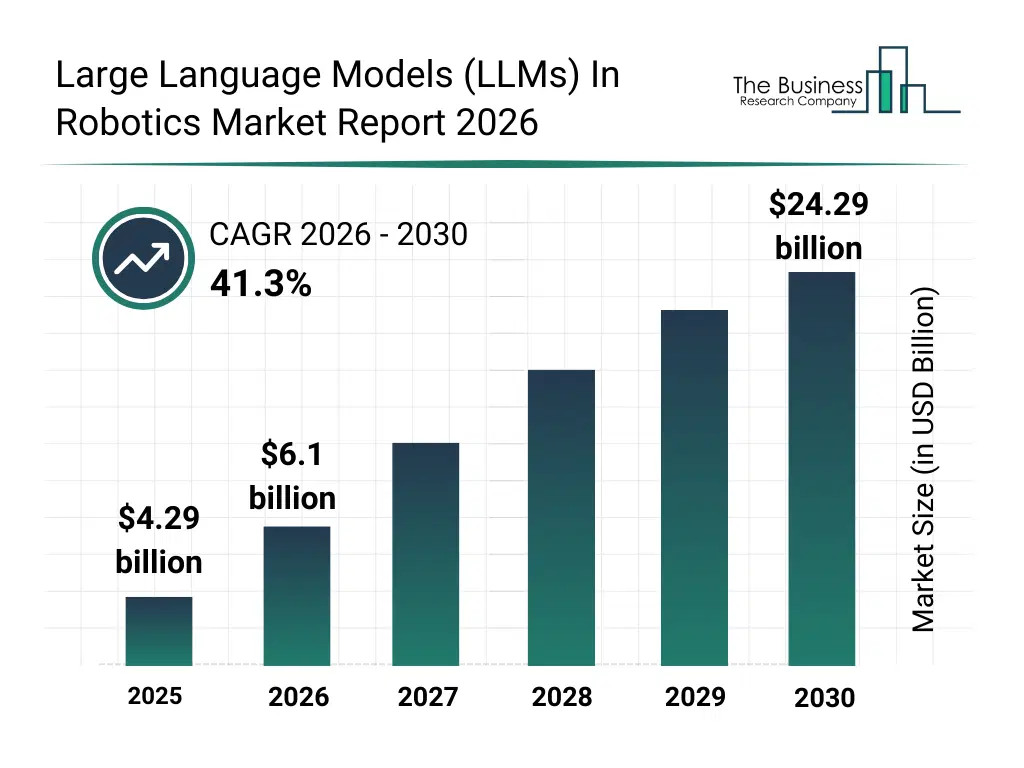
What Is The Large Language Models (LLMs) In Robotics Market Size and Share 2026?
The large language models (llms) in robotics market size has grown exponentially in recent years. It will grow from $4.29 billion in 2025 to $6.1 billion in 2026 at a compound annual growth rate (CAGR) of 42.0%. The growth in the historic period can be attributed to early robotics automation adoption, advances in machine learning models, growth of industrial robotics, demand for intuitive robot interfaces, expansion of service robotics.What Is The Large Language Models (LLMs) In Robotics Market Growth Forecast?
The large language models (llms) in robotics market size is expected to see exponential growth in the next few years. It will grow to $24.29 billion in 2030 at a compound annual growth rate (CAGR) of 41.3%. The growth in the forecast period can be attributed to integration of llms into autonomous systems, rising demand for collaborative robots, advancements in multimodal AI models, growth of humanoid and service robots, increasing investment in intelligent automation. Major trends in the forecast period include natural language robot control, cognitive robotics task planning, human robot interaction enhancement, multimodal perception and reasoning, adaptive robot learning systems.
Global Large Language Models (LLMs) In Robotics Market Segmentation
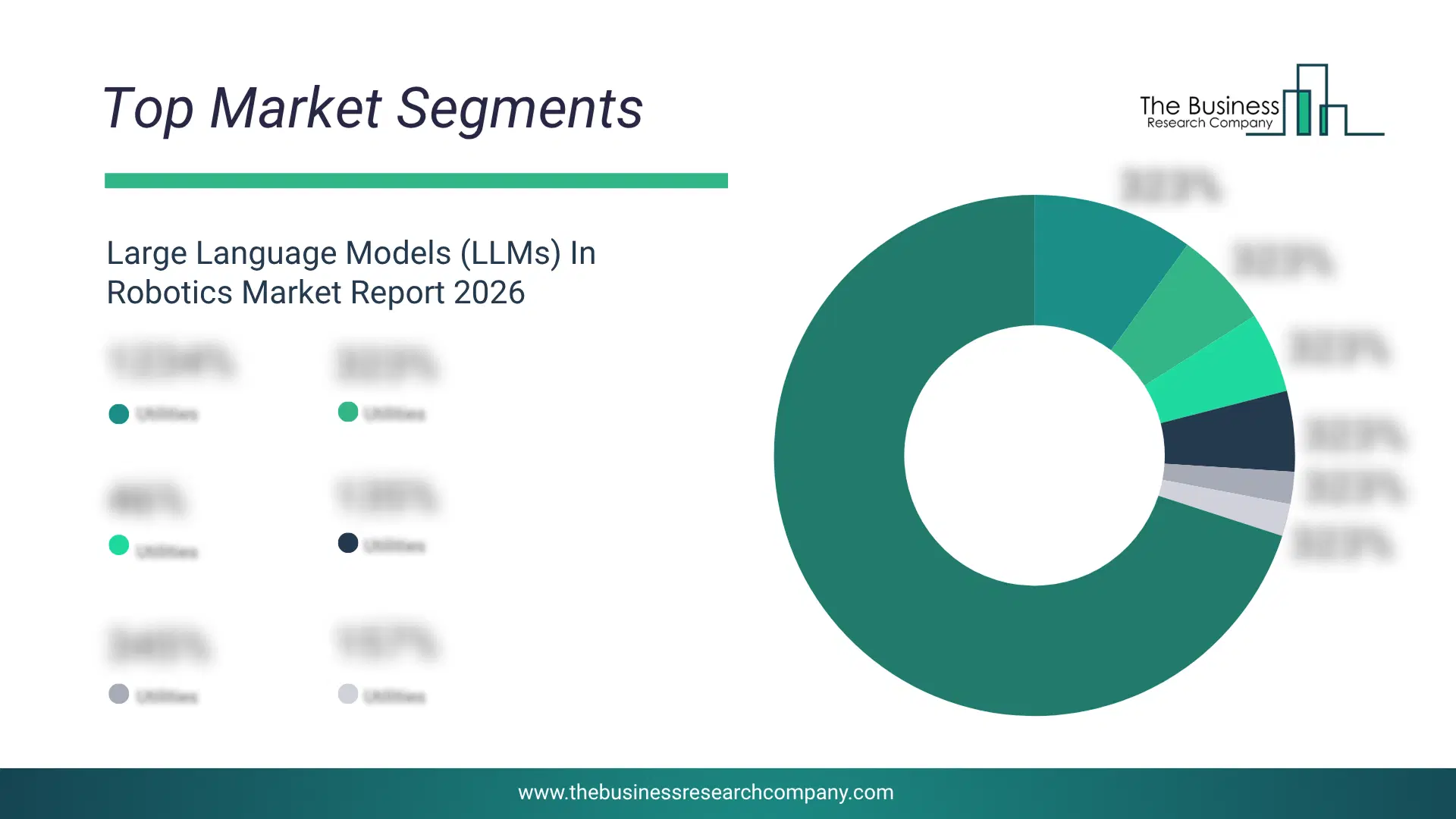
1) By Functionality: Natural Language Understanding, Natural Language Generation, Speech Recognition And Synthesis, Computer Vision Integration, Multimodal Processing 2) By Deployment Mode: Cloud-Based Large Language Models (LLMs), On-Premises Large Language Models (LLMs) 3) By Enterprise Size: Large Enterprises, Small And Medium Enterprises 4) By Application: Industrial Robotics, Service Robotics, Autonomous Vehicles, Humanoid Robots, Drone Technology, Other Applications 5) By Industry: Healthcare, Manufacturing, Retail And E-Commerce, Banking, Financial Services, And Insurance, Defense And Security, Other Industries Subsegments: 1) By Natural Language Understanding: Sentiment Analysis, Semantic Parsing, Named Entity Recognition (NER), Language Classification, Intent Recognition 2) By Natural Language Generation: Text Generation, Report Generation, Summarization, Dialogue Systems, Machine Translation 3) By Speech Recognition And Synthesis: Speech-To-Text, Speaker Identification, Text-To-Speech (TTS), Speech Emotion Recognition, Voice Command Systems 4) By Computer Vision Integration: Object Detection, Visual Simultaneous Localization And Mapping, Image Classification, Scene Understanding, Facial Recognition 5) By Multimodal Processing: Text-Image Integration, Multimodal Sentiment Analysis, Audio-Visual Processing, Video Understanding, Text-Speech IntegrationWhat Is The Driver Of The Large Language Models (LLMs) In Robotics Market?
The rising demand for automation is expected to propel the growth of the large language models (LLMs) in robotics market going forward. Automation is the use of technology to perform tasks with minimal human input, increasing efficiency and accuracy. The demand for automation is increasing due to the need for operational efficiency and cost reduction, as it enables faster task execution, reduces errors, and lowers reliance on manual labour. Large language models (LLMs) in robotics enhance automation by enabling intelligent language-based control, making them ideal for dynamic and unstructured environments. They reduce the need for manual programming by allowing robots to interpret and execute tasks from natural language commands, improving operational efficiency and flexibility. For instance, in September 2024, according to the International Federation of Robotics, a Germany-based non-profit organization, there were 4,281,585 robotic units operating in factories globally in 2023, marking a 10% increase from 3,904,000 units in 2022. Therefore, the rising demand for automation is driving the growth of the large language models (LLMs) in robotics industry.Key Players In The Global Large Language Models (LLMs) In Robotics Market
Major companies operating in the large language models (llms) in robotics market are Microsoft Corporation, Meta Platforms Inc., Amazon Web Services Inc., Tesla Inc., Hitachi Ltd., Midea Group, NVIDIA Corporation, UiPath Inc., Google DeepMind Technologies Limited, United Robotics Group, UBTech Robotics Corp Ltd., PAL Robotics S.L., Agility Robotics Inc., Figure AI Inc., Sanctuary Cognitive Systems Corporation, Xandex Inc., OrionStar Technology Co. Ltd, Sereact GmbH, Physical Intelligence Inc, Intrinsic Innovation LLC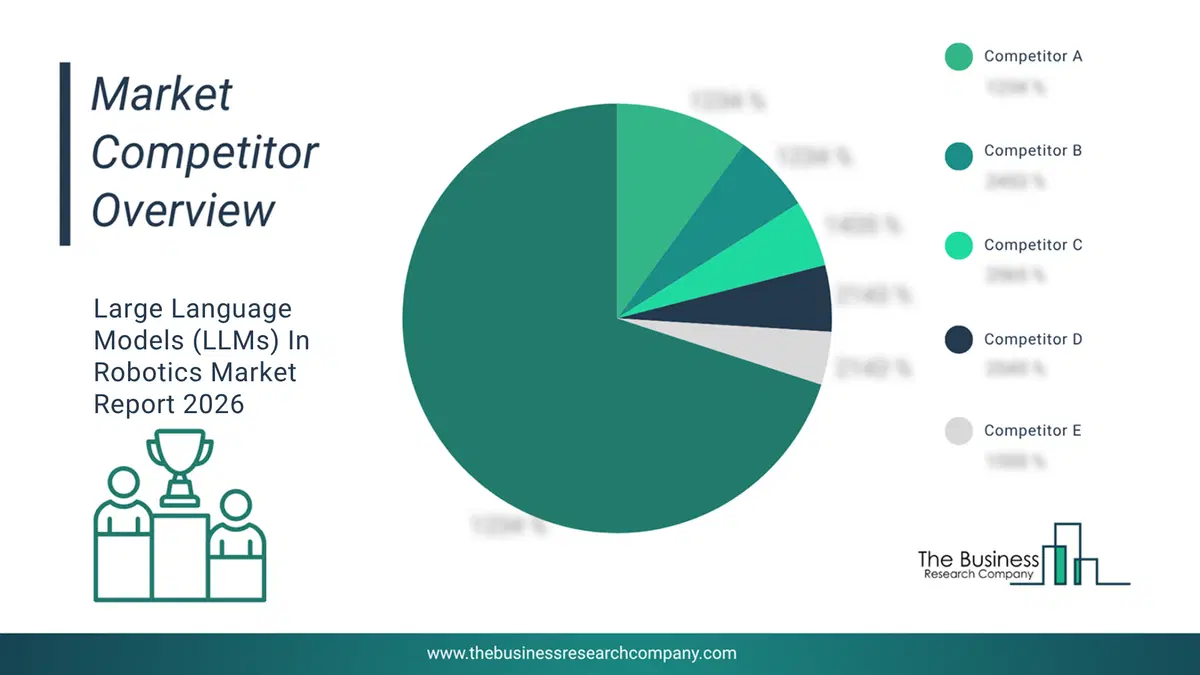
This chart is for illustrative purposes; the full report includes a detailed competitor analysis and comprehensive overview of the top 10 companies in the market.
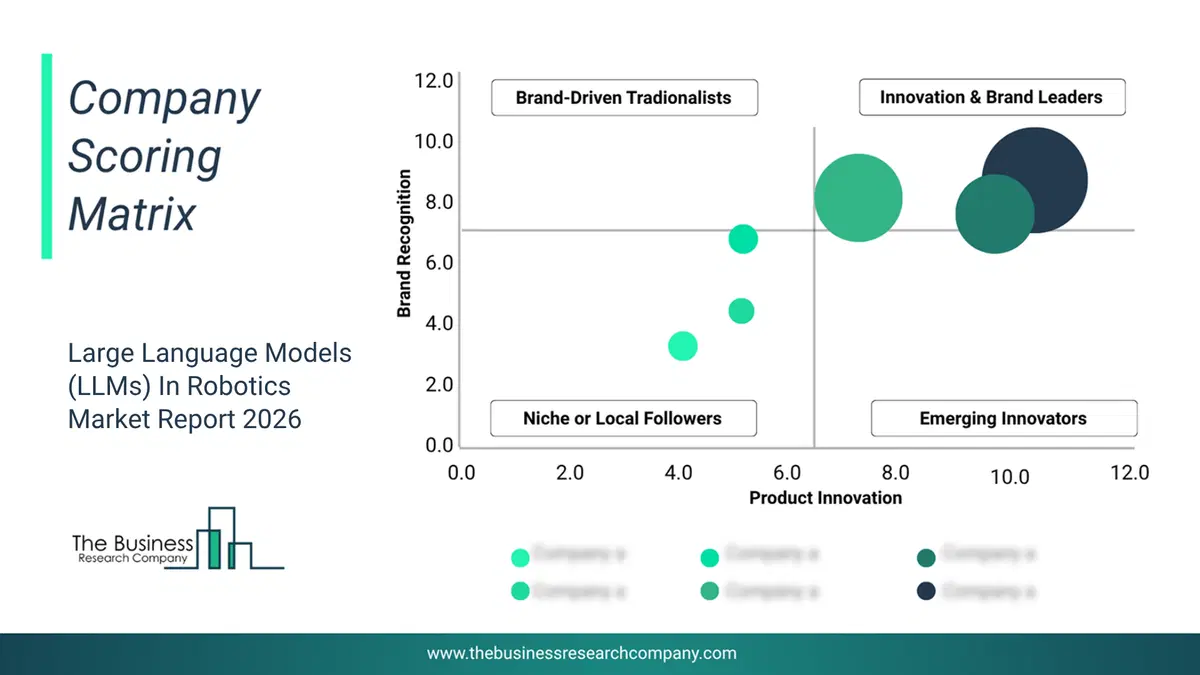
This chart maps companies by product innovation and brand strength, with bubble size indicating relative revenue, helping identify market leaders, challengers, and niche players. This is an illustrative chart; the full report provides a complete and accurate competitive analysis.
Global Large Language Models (LLMs) In Robotics Market Trends and Insights
Major companies operating in the large language models (LLMs) in robotics market are focusing on developing innovative solutions, such as advanced artificial intelligence (AI) model to enhance robot autonomy, improve human-robot interaction and optimize task execution. An advanced artificial intelligence (AI) model refers to highly developed machine learning or deep learning systems such as large language models, neural networks, or reinforcement learning algorithms that empower robots to independently analyze complex data, adapt to their surroundings, and carry out tasks with a high degree of flexibility and intelligence. For instance, in March 2025, DeepMind Technologies Limited, a UK-based software company, launched a Gemini Robotics AI model. It integrates advanced vision-language-action (VLA) capabilities to enable robots to perceive, adapt, and interact dynamically with their surroundings. Its advantages include generality for handling novel tasks, interactivity for real-time adaptability, and dexterity for precise manipulation, making it ideal for applications in dynamic environments like factories and homes.What Are Latest Mergers And Acquisitions In The Large Language Models (LLMs) In Robotics Market?
In January 2025, 1X Technologies, a US-based AI and robotics company, acquired Kind Humanoid Inc. for an undisclosed amount. With this acquisition, 1X aims to accelerate the development of intelligent humanoid robots by integrating Kind’s advanced bio-inspired designs and large language model capabilities, enhancing human-robot interaction and expanding their presence in the consumer and healthcare robotics markets. Kind Humanoid Inc. is a US-based company that uses large language models (LLMs) in robotics.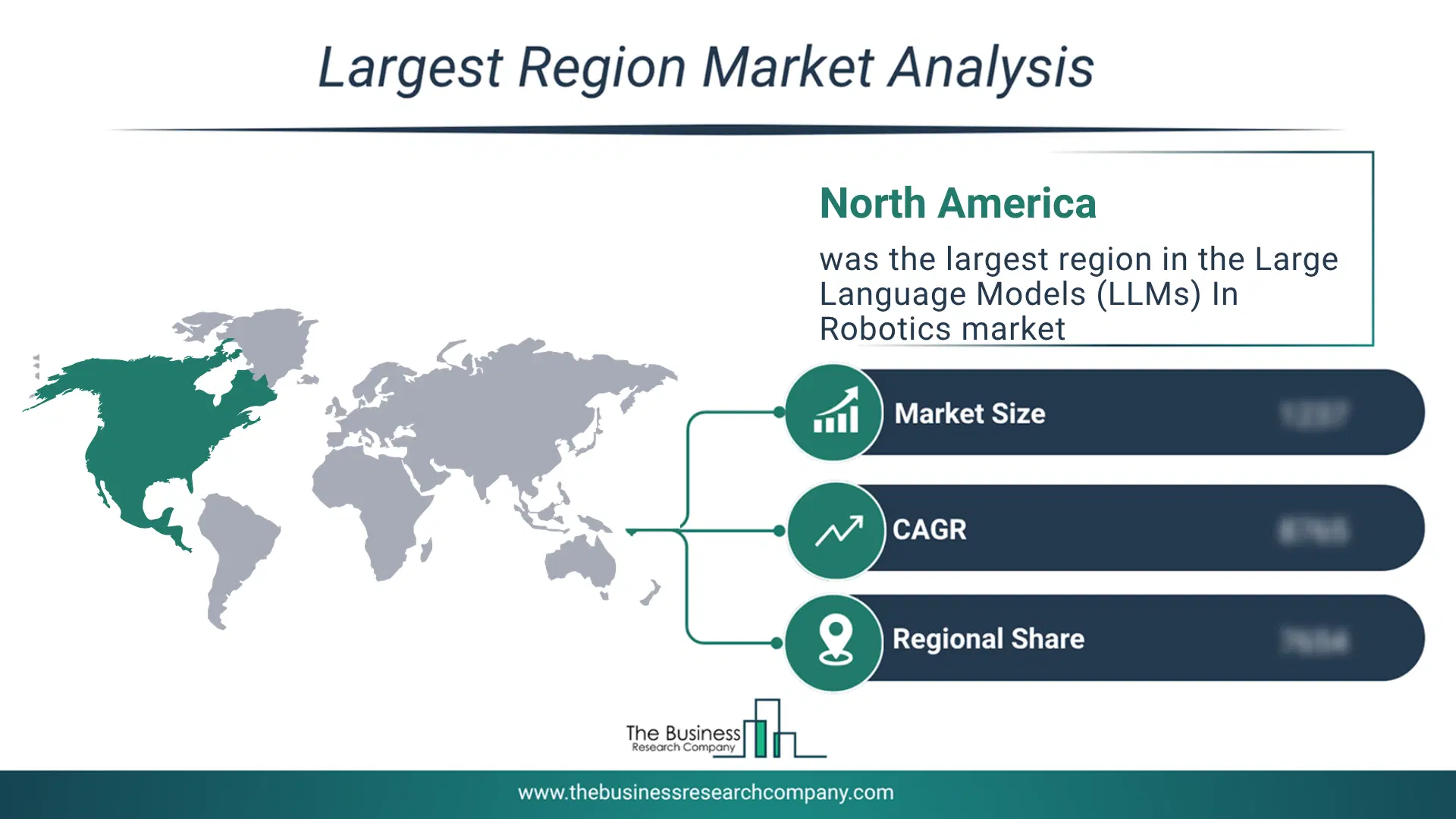
Regional Insights
North America was the largest region in the large language models (LLMs) in robotics market in 2025. Asia-Pacific is expected to be the fastest-growing region in the forecast period. The regions covered in this market report are Asia-Pacific, South East Asia, Western Europe, Eastern Europe, North America, South America, Middle East, Africa. The countries covered in this market report are Australia, Brazil, China, France, Germany, India, Indonesia, Japan, Taiwan, Russia, South Korea, UK, USA, Canada, Italy, Spain.What Defines the Large Language Models (LLMs) In Robotics Market?
The large language models (LLMs) in robotics market consists of revenues earned by entities by providing services such as natural language-based robot control, task planning and decision-making, human-robot interaction interfaces, multi-modal perception integration and code generation for robotic actions. The market value includes the value of related goods sold by the service provider or included within the service offering. The large language models (LLMs) in robotics market also consist of sales of humanoid robots, AI-powered assistants, autonomous service robots, vision-language sensor systems, cloud-based robotic control solutions and artificial intelligence (AI) chatbots in robotics. Values in this market are ‘factory gate’ values, that is, the value of goods sold by the manufacturers or creators of the goods, whether to other entities (including downstream manufacturers, wholesalers, distributors, and retailers) or directly to end customers. The value of goods in this market includes related services sold by the creators of the goods.How is Market Value Defined and Measured?
The market value is defined as the revenues that enterprises gain from the sale of goods and/or services within the specified market and geography through sales, grants, or donations in terms of the currency (in USD unless otherwise specified). The revenues for a specified geography are consumption values that are revenues generated by organizations in the specified geography within the market, irrespective of where they are produced. It does not include revenues from resales along the supply chain, either further along the supply chain or as part of other products.
This chart presents market attractiveness based on a quantitative evaluation of growth, competition, strategic alignment, and risk, offering a clear view of opportunity areas for decision-making. This chart is for illustrative purposes; the full report contains the complete analysis.

This chart highlights the Total Addressable Market (TAM) by estimating the maximum revenue opportunity using an assumption-driven approach, supporting strategic planning and opportunity sizing across markets. The chart is illustrative; the full report provides a more comprehensive analysis.
What Key Data and Analysis Are Included in the Large Language Models (LLMs) In Robotics Market Report 2026?
The large language models (llms) in robotics market research report is one of a series of new reports from The Business Research Company that provides market statistics, including industry global market size, regional shares, competitors with the market share, detailed market segments, market trends and opportunities, and any further data you may need to thrive in the large language models (llms) in robotics industry. The market research report delivers a complete perspective of everything you need, with an in-depth analysis of the current and future state of the industry.Large Language Models (LLMs) In Robotics Market Report Forecast Analysis
| Report Attribute | Details |
|---|---|
| Market Size Value In 2026 | $6.1 billion |
| Revenue Forecast In 2030 | $24.29 billion |
| Growth Rate | CAGR of 41.3% from 2026 to 2030 |
| Base Year For Estimation | 2025 |
| Actual Estimates/Historical Data | 2020-2025 |
| Forecast Period | 2026 - 2030 |
| Market Representation | Revenue in USD Billion and CAGR from 2026 to 2030 |
| Segments Covered | Functionality, Deployment Mode, Enterprise Size, Application, Industry |
| Regional Scope | Asia-Pacific, Western Europe, Eastern Europe, North America, South America, Middle East, Africa |
| Country Scope | The Countries Covered In This Market Report Are Australia, Brazil, China, France, Germany, India, Indonesia, Japan, Taiwan, Russia, South Korea, Uk, Usa, Canada, Italy, Spain. |
| Key Companies Profiled | Microsoft Corporation, Meta Platforms Inc., Amazon Web Services Inc., Tesla Inc., Hitachi Ltd., Midea Group, NVIDIA Corporation, UiPath Inc., Google DeepMind Technologies Limited, United Robotics Group, UBTech Robotics Corp Ltd., PAL Robotics S.L., Agility Robotics Inc., Figure AI Inc., Sanctuary Cognitive Systems Corporation, Xandex Inc., OrionStar Technology Co. Ltd, Sereact GmbH, Physical Intelligence Inc, Intrinsic Innovation LLC |
| Customization Scope | Request for Customization |
| Pricing And Purchase Options | Explore Purchase Options |