
Last Mile Delivery Market Report 2026
Global Outlook – By Delivery Mode (Regular Delivery; Same-Day Delivery Or Express Delivery), By Technology (Autonomous; Non-Autonomous), By Service Type (Business-To-Business (B2B); Business-To-Consumer (B2C); Customer-To-Customer (C2C)), By Destination (Domestic; International), By Application (Food And Beverages; Retail And E-commerce; Healthcare; Other Applications) – Market Size, Trends, Strategies, and Forecast to 2030
Last Mile Delivery Market Overview
• Last Mile Delivery market size has reached to $184.2 billion in 2025 • Expected to grow to $277.76 billion in 2030 at a compound annual growth rate (CAGR) of 8.6% • Growth Driver: Impact Of E-Commerce Growth On The Last Mile Delivery Market • Market Trend: Autonomous Drone-Based Last-Mile Delivery Technology • North America was the largest region in 2025 and Asia-Pacific is the fastest growing region.Market Gains By 2030 – Top Opportunities By Segment
Market Gain identifies the most promising market opportunities by highlighting the segments or products expected to generate the highest incremental revenue growth over the next five years.
What Is Covered Under Last Mile Delivery Market?
Last mile delivery refers to the final stage of the logistics process where goods are transported from a distribution center, warehouse, or retailer's location to the end customer's doorstep or preferred delivery location. This service is essential for ensuring that products reach customers in a timely, efficient, and satisfactory manner, meeting their expectations for convenience and reliability. The main types of last-mile delivery modes include regular delivery, same-day delivery, or express delivery. Regular delivery typically refers to standard shipping or delivery services offered by logistics companies or retailers, where goods are transported from a seller to a buyer using standard shipping methods and timeframes. Various technologies are used, such as autonomous and non-autonomous, to provide several types of services, including business-to-business (B2B), business-to-consumer (B2C), and customer-to-customer (C2C). It is used for domestic and international destinations and for several applications, including food and beverages, retail and e-commerce, healthcare, and others.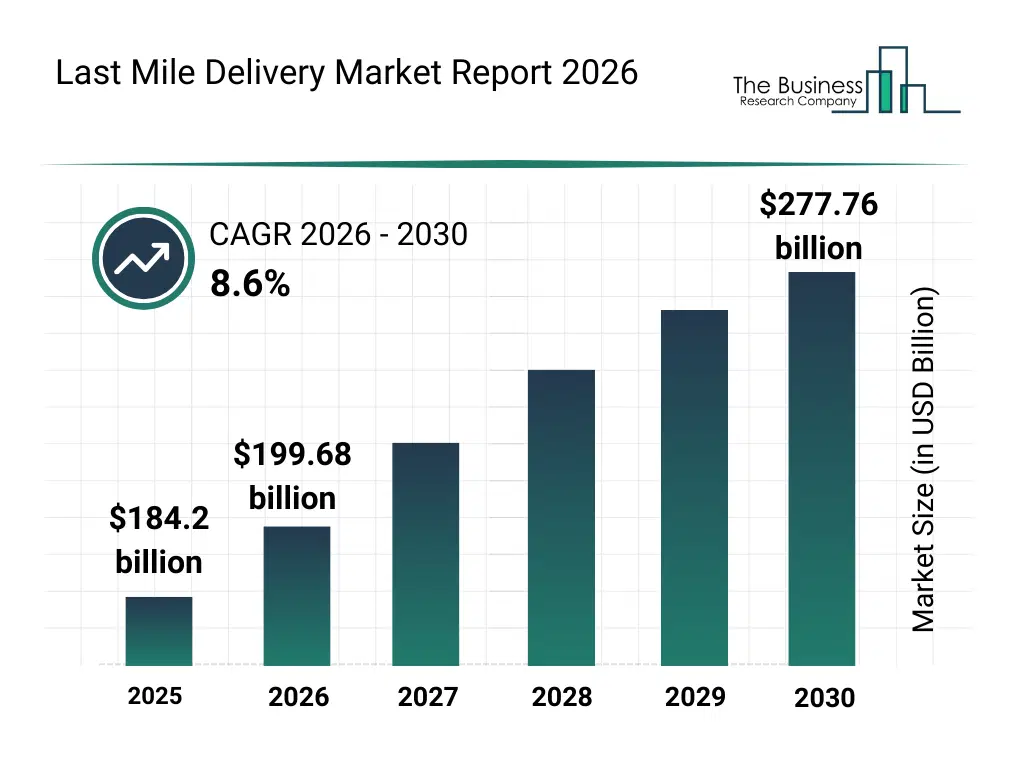
What Is The Last Mile Delivery Market Size and Share 2026?
The last mile delivery market size has grown strongly in recent years. It will grow from $184.2 billion in 2025 to $199.68 billion in 2026 at a compound annual growth rate (CAGR) of 8.4%. The growth in the historic period can be attributed to growth of e-commerce platforms, rising consumer demand for fast deliveries, expansion of urban distribution networks, increasing use of mobile tracking solutions, growth of third-party logistics providers.What Is The Last Mile Delivery Market Growth Forecast?
The last mile delivery market size is expected to see strong growth in the next few years. It will grow to $277.76 billion in 2030 at a compound annual growth rate (CAGR) of 8.6%. The growth in the forecast period can be attributed to expansion of same-day and instant delivery services, rising investments in autonomous delivery technologies, growing adoption of electric last mile vehicles, increasing demand for sustainable delivery solutions, integration of ai-driven logistics platforms. Major trends in the forecast period include increasing deployment of autonomous delivery vehicles, rising adoption of real-time route optimization systems, growing use of micro-fulfillment centers, expansion of electric delivery fleets, enhanced focus on customer-centric delivery models.
Global Last Mile Delivery Market Segmentation
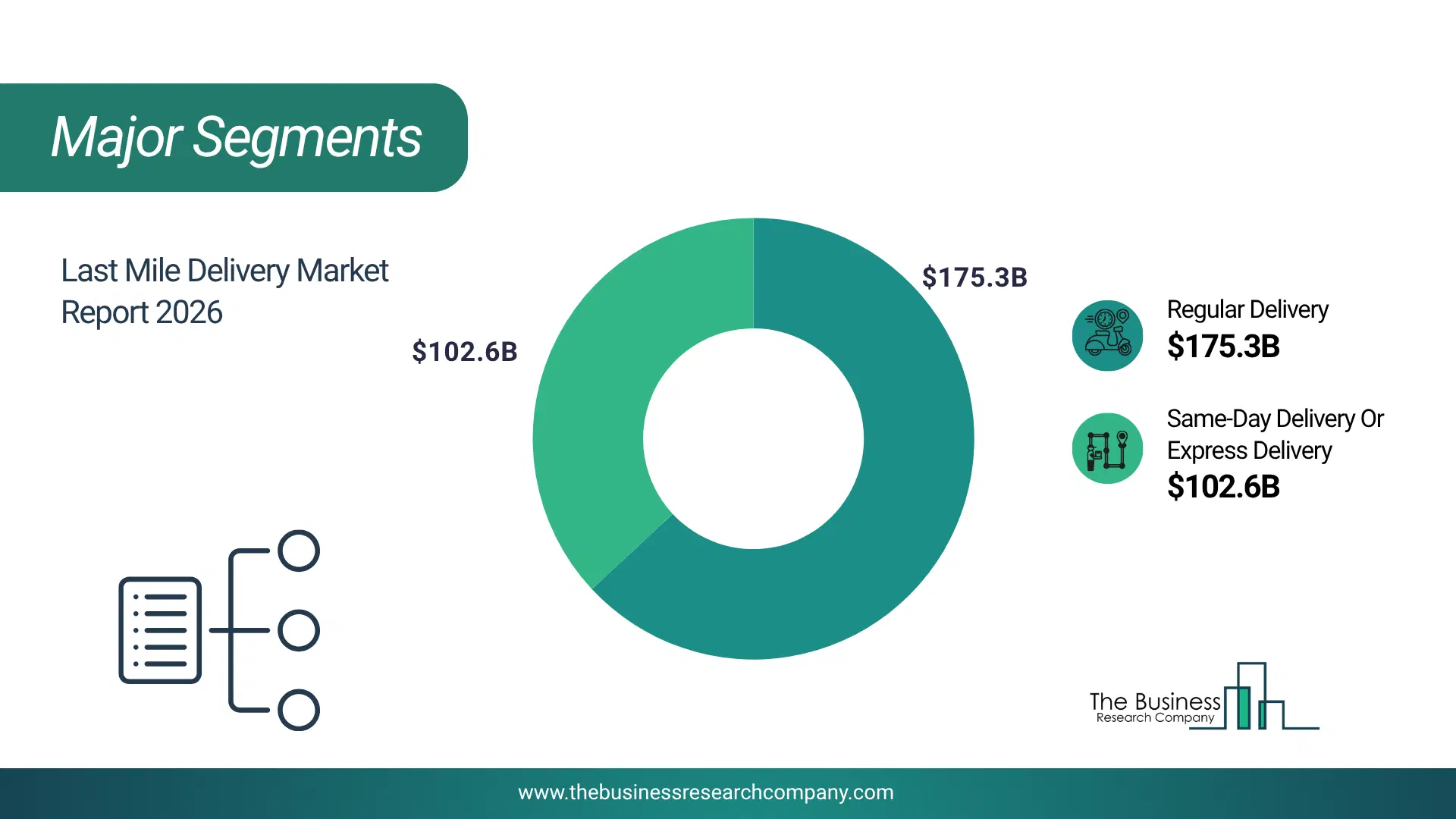
1) By Delivery Mode: Regular Delivery, Same-Day Delivery Or Express Delivery 2) By Technology: Autonomous, Non-Autonomous 3) By Service Type: Business-To-Business (B2B), Business-To-Consumer (B2C), Customer-To-Customer (C2C) 4) By Destination: Domestic, International 5) By Application: Food And Beverages, Retail And E-commerce, Healthcare, Other Applications Subsegments: 1) By Regular Delivery: Standard Delivery, Scheduled Delivery 2) By Same-Day Delivery Or Express Delivery: Morning Delivery, Afternoon Delivery, 1-Hour Delivery, 2-Hour Delivery, 3-Hour Delivery The top segments in the last mile delivery market will be: • Regular Delivery will reach $175.26 billion by 2030. • Same-Day Delivery Or Express Delivery will reach $102.5 billion by 2030.What Is The Driver Of The Last Mile Delivery Market?
The rapid growth of e-commerce is expected to propel the growth of the last mile delivery market going forward. E-commerce, short for electronic commerce, refers to the buying and selling of goods or services over the Internet or other electronic networks. The ongoing expansion of e-commerce adoption is due to several factors, including the combination of technological innovation, changing consumer behaviors, and evolving business models worldwide. Last mile delivery in e-commerce is used to ensure efficient, timely, and cost-effective delivery of products to customers' doorsteps, marking the final leg of the delivery process. It plays a vital role in the success of e-commerce businesses by enhancing customer satisfaction and fostering brand loyalty. For instance, in February 2024, according to the United States Census Bureau, a US-based government agency, e-commerce sales in the United States surged to approximately $1,118.7 billion in 2023, marking a 7.6% increase compared to the preceding year. Therefore, the rapid growth of e-commerce is driving the growth of the last mile delivery industry.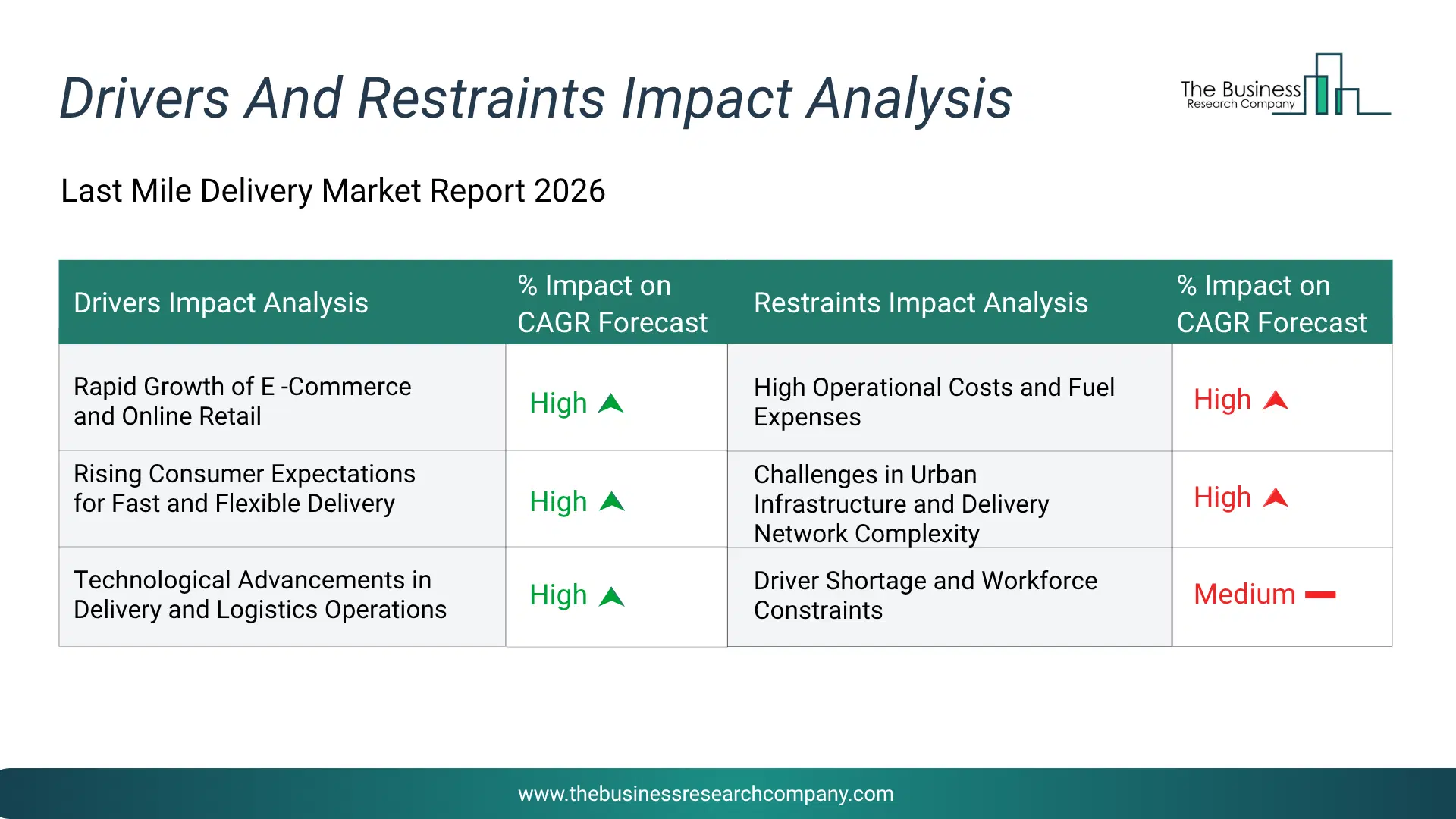
Infographic Chart Showing Key Market Drivers Analysis And Restraints For Last Mile Delivery Market
The chart presents an impact analysis of key drivers and restraints, quantifying their relative influence on the market's growth rate and helping assess the balance between growth enablers and limiting factors. This chart offers a high-level perspective; the full report contains more detailed insights.
How Will The Drivers Impact Growth In The Global Last Mile Delivery Market?
• Rapid Growth of E -Commerce and Online Retail (High) – During the forecast period, the rapid growth of e -commerce and online retail is expected to become a key growth driver for the last mile delivery market by 2030. The surge in e -commerce, driven by changing consumer shopping behaviors and the convenience of online retail, is a key driver for the last mile delivery market. As online orders increase in volume and frequency, businesses face growing pressure to ensure fast, reliable, and flexible delivery options to meet customer expectations. Last mile delivery solutions including route optimization, real -time tracking, and contactless delivery help retailers and logistics providers reduce delivery time, improve customer satisfaction, and handle higher order volumes efficiently. The continued expansion of online retail, especially in urban areas and emerging markets, is expected to sustain strong demand for last mile delivery services and technologies. • Rising Consumer Expectations for Fast and Flexible Delivery (High) – During the forecast period, the rising consumer expectations for fast and flexible delivery is expected to emerge as a major factor driving the expansion of the last mile delivery market by 2030. Modern consumers increasingly demand same-day, next-day, and time-slot-specific deliveries, creating a strong need for efficient last mile logistics. Businesses are adopting advanced delivery management solutions, including ai-powered route planning, autonomous vehicles, drones, and real-time tracking, to meet these expectations. High service quality and timely delivery directly impact customer loyalty and brand reputation, driving companies to invest heavily in last mile delivery capabilities. This growing focus on meeting customer expectations continues to propel market growth across retail, e-commerce, and food delivery segments. • Technological Advancements in Delivery and Logistics Operations (High) – During the forecast period, the technological advancements in delivery and logistics operations are expected to act as a key growth catalyst for the last mile delivery market by 2030. The integration of emerging technologies such as ai, iot, route optimization software, robotics, and autonomous delivery vehicles is transforming last mile delivery operations. These innovations enable cost reduction, faster delivery times, improved route efficiency, and predictive demand management. Additionally, cloud-based logistics platforms and mobile apps allow real-time tracking, seamless communication, and operational transparency. The adoption of such technologies by logistics providers and e-commerce companies is a strong driver, improving service reliability and scalability, especially in densely populated urban areas.How Will The Restraints Impact Growth In The Global Last Mile Delivery Market?
• High Operational Costs and Fuel Expenses (High) – During the forecast period, the last mile delivery is often the most expensive segment of the supply chain, due to high labor costs, fuel expenses, and vehicle maintenance. In urban areas with traffic congestion, inefficient routes can further increase costs, affecting profitability. Small and medium logistics providers may struggle to absorb these costs, leading to slower market growth or limited service coverage. High operational expenses, including investments in technology and fleet management, remain a key restraint for market expansion. • Challenges in Urban Infrastructure and Delivery Network Complexity (High) – During the forecast period, the densely populated cities, narrow streets, traffic congestion, and inadequate infrastructure create significant challenges for last mile delivery operations. Inefficient delivery routes, failed deliveries, and limited parking space increase delivery time and reduce efficiency. Moreover, coordinating multiple deliveries, handling returns, and managing customer preferences adds operational complexity. These urban logistics challenges act as a key restraint, particularly in developing regions where infrastructure and regulatory support are limited. • Driver Shortage and Workforce Constraints (Medium) – During the forecast period, the driver shortage and workforce constraints act as a restraint for the last mile delivery market by limiting the availability of skilled and reliable delivery personnel required to meet rising e-commerce demand. High employee turnover, long working hours, and physically demanding job roles make it difficult for companies to retain drivers. This leads to increased hiring and training costs while also affecting delivery timelines and service quality. In many regions, especially urban centers, the gap between demand and available workforce continues to widen, restricting operational scalability and market growth.Key Players In The Global Last Mile Delivery Market
Major companies operating in the last mile delivery market are Amazon.com Inc., United Parcel Service Inc., DHL International GmbH, FedEx Corporation, La Poste Group, SF Holding Co. Ltd., Uber Technologies Inc., DB Schenker, Poste Italiane S.p.A., DPD Group, DSV Panalpina AS, Royal Mail plc, Yamato Holdings Co. Ltd., Australia Post, DoorDash Inc., XPO Logistics Inc., Grubhub Inc., Deliveroo, Aramex PJSC, Zomato Pvt. Ltd., Postmates Inc., Correios, TNT Holdings B.V., Gopuff, Deliv Inc.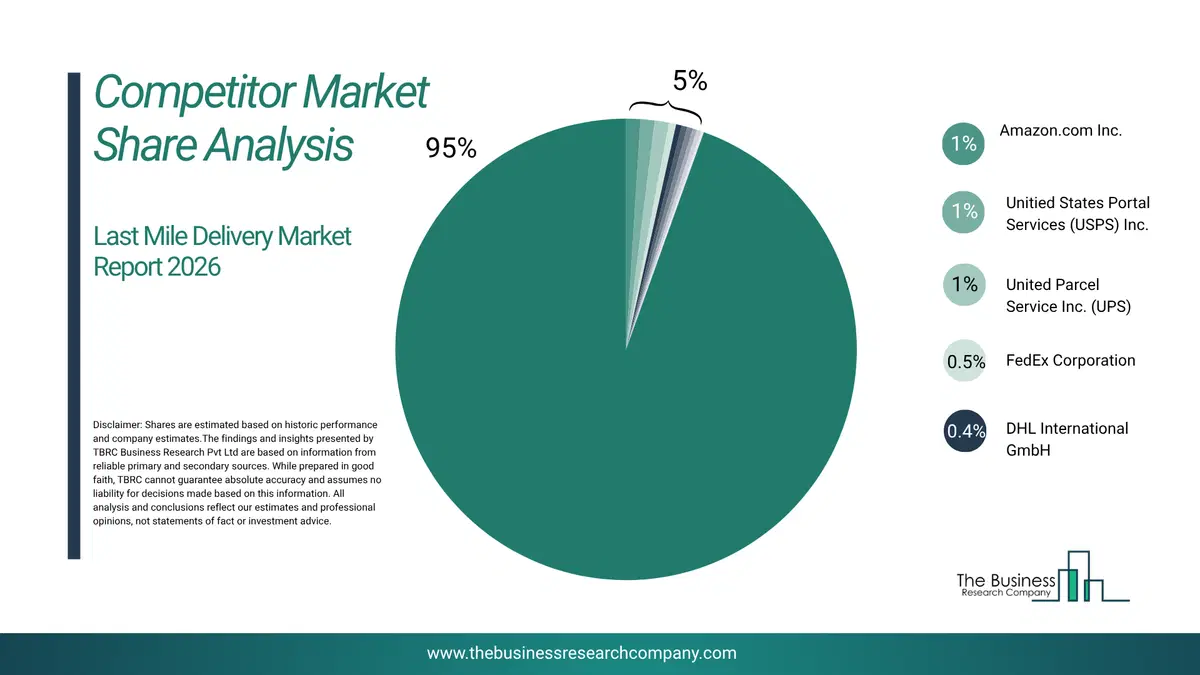
This chart is for illustrative purposes; the full report includes a detailed competitor analysis and comprehensive overview of the top 10 companies in the market.
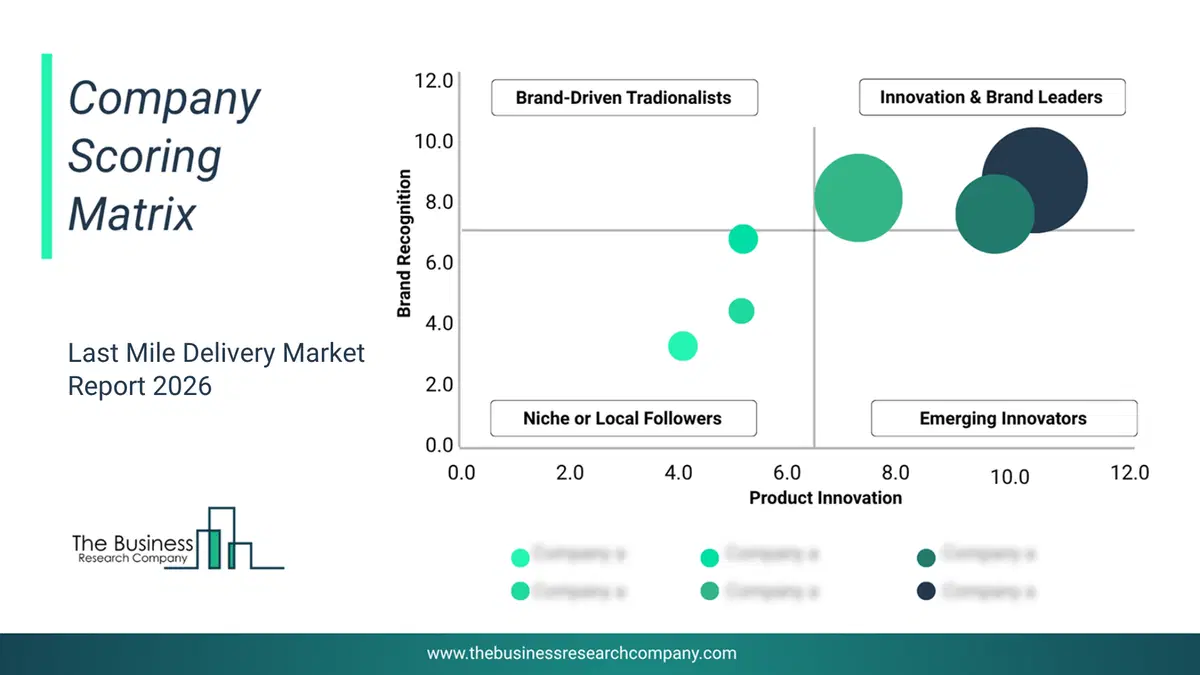
This chart maps companies by product innovation and brand strength, with bubble size indicating relative revenue, helping identify market leaders, challengers, and niche players. This is an illustrative chart; the full report provides a complete and accurate competitive analysis.
Global Last Mile Delivery Market Trends and Insights
Major companies operating in the last-mile delivery market are focusing on developing innovative products, such as autonomous drone delivery systems to significantly reduce delivery times, improve fulfillment efficiency, and enhance customer convenience. Autonomous drone delivery systems use unmanned aerial vehicles (UAVs) equipped with GPS navigation, automated flight control, and precision drop-off mechanisms to transport lightweight retail orders directly from stores to customers within minutes. For instance, in December 2025, Walmart, a US-based multinational retailer, launched a trial of drone-based last-mile delivery in Atlanta, Georgia, in partnership with Wing, Alphabet’s drone delivery subsidiary. Under the pilot, electric drones operate from selected Walmart Supercenters to deliver small grocery and household items at high speeds, bypassing road congestion and enabling near-instant fulfillment, while allowing customers to place and track orders digitally,highlighting Walmart’s strategy to integrate advanced automation into last-mile retail logistics.What Are Latest Mergers And Acquisitions In The Last Mile Delivery Market?
In September 2025, ADL Final Mile, a US-based provider of final-mile delivery, parcel delivery, customized logistics, fleet replacement, and warehousing services, acquired DMC Logistics LLC for an undisclosed amount. With this acquisition, ADL Final Mile aims to expand its geographic footprint in the Southwest U.S., broaden its service network across additional states, and enhance its capacity to serve new and existing customers with comprehensive last-mile logistics solutions. DMC Logistics LLC is a US-based logistics transportation company that specializes in providing last mile delivery.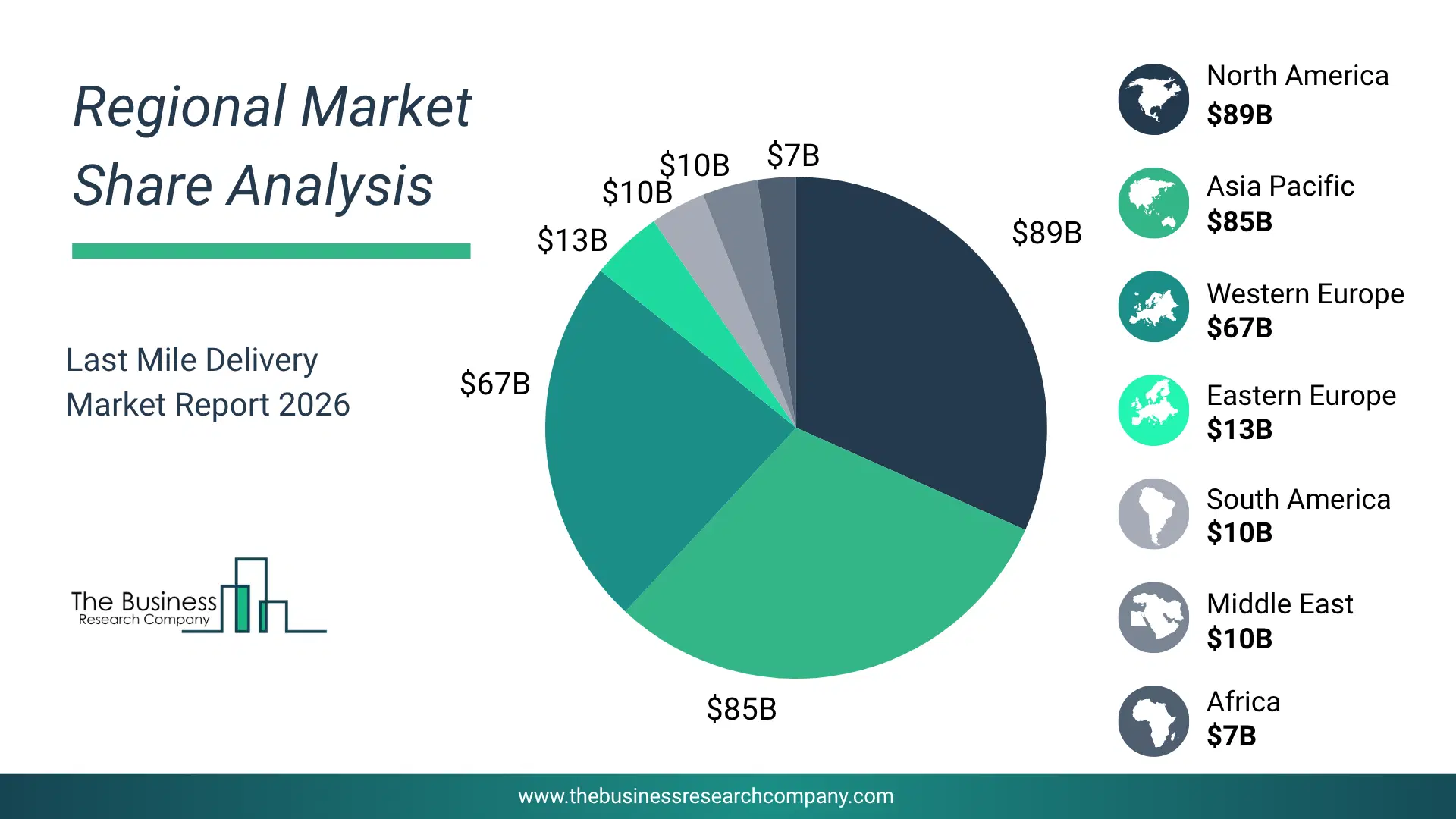
Regional Outlook
North America was the largest region in the last mile delivery market in 2025. Asia-Pacific is expected to be the fastest-growing region in the forecast period. The regions covered in this market report are Asia-Pacific, South East Asia, Western Europe, Eastern Europe, North America, South America, Middle East, Africa. The countries covered in this market report are Australia; Brazil; China; France; Germany; India; Indonesia; Japan; Taiwan; Russia; South Korea; UK; USA; Canada; Italy; Spain.What Defines the Last Mile Delivery Market?
The last mile delivery market includes revenues earned by entities by providing services such as last mile logistics consulting, route optimization, scheduled delivery, in-store pickup, and specialty item delivery. The market value includes the value of related goods sold by the service provider or included within the service offering. Only goods and services traded between entities or sold to end consumers are included.How is Market Value Defined and Measured?
The market value is defined as the revenues that enterprises gain from the sale of goods and/or services within the specified market and geography through sales, grants, or donations in terms of the currency (in USD unless otherwise specified). The revenues for a specified geography are consumption values that are revenues generated by organizations in the specified geography within the market, irrespective of where they are produced. It does not include revenues from resales along the supply chain, either further along the supply chain or as part of other products.
This chart presents market attractiveness based on a quantitative evaluation of growth, competition, strategic alignment, and risk, offering a clear view of opportunity areas for decision-making. This chart is for illustrative purposes; the full report contains the complete analysis.

This chart highlights the Total Addressable Market (TAM) by estimating the maximum revenue opportunity using an assumption-driven approach, supporting strategic planning and opportunity sizing across markets. The chart is illustrative; the full report provides a more comprehensive analysis.
What Key Data and Analysis Are Included in the Last Mile Delivery Market Report 2026?
The last mile delivery market research report is one of a series of new reports from The Business Research Company that provides market statistics, including Market Report 2026?global market size, regional shares, competitors with the market share, detailed market segments, market trends and opportunities, and any further data you may need to thrive in the last mile delivery Market Report 2026? The market research report delivers a complete perspective of everything you need, with an in-depth analysis of the current and future state of the Market Report 2026?Last Mile Delivery Market Report Forecast Analysis
| Report Attribute | Details |
|---|---|
| Market Size Value In 2026 | $199.68 billion |
| Revenue Forecast In 2030 | $277.76 billion |
| Growth Rate | CAGR of 8.6% from 2026 to 2030 |
| Base Year For Estimation | 2025 |
| Actual Estimates/Historical Data | 2020-2025 |
| Forecast Period | 2026 - 2030 |
| Market Representation | Revenue in USD Billion and CAGR from 2026 to 2030 |
| Segments Covered | Delivery Mode, Technology, Service Type, Destination, Application |
| Regional Scope | Asia-Pacific, Western Europe, Eastern Europe, North America, South America, Middle East, Africa |
| Country Scope | The countries covered in the report are Australia, Brazil, China, France, Germany, India, ... |
| Key Companies Profiled | Amazon.com Inc., United Parcel Service Inc., DHL International GmbH, FedEx Corporation, La Poste Group, SF Holding Co. Ltd., Uber Technologies Inc., DB Schenker, Poste Italiane S.p.A., DPD Group, DSV Panalpina AS, Royal Mail plc, Yamato Holdings Co. Ltd., Australia Post, DoorDash Inc., XPO Logistics Inc., Grubhub Inc., Deliveroo, Aramex PJSC, Zomato Pvt. Ltd., Postmates Inc., Correios, TNT Holdings B.V., Gopuff, Deliv Inc. |
| Customization Scope | Request for Customization |
| Pricing And Purchase Options | Explore Purchase Options |