

Express Delivery Market Report 2026
Global Outlook – By Service (Online, Offline), By Business Model (B2B, B2C, C2C), By Destination (Domestic, International), By End User (Services, Wholesale And Retail Trade, Manufacturing, Construction, And Utilities, Other End Users) – Market Size, Trends, Strategies, and Forecast to 2030
Express Delivery Market Overview
• Express Delivery market size has reached to $349.01 billion in 2025 • Expected to grow to $536.96 billion in 2030 at a compound annual growth rate (CAGR) of 8.9% • Growth Driver: Global Trade Surge Propels Express Delivery Market Growth • Market Trend: Advancements In Operational Models For Rapid Commerce • Asia-Pacific was the largest region in 2025 and North America is the fastest growing region.What Is Covered Under Express Delivery Market?
The express delivery provides the fastest form of shipping. Express delivery services assemble, transport, and distribute products in a timely manner while tracking and maintaining control of the goods along the service's supply chain. The main types of services in express delivery are online and offline. B2B orders are frequently in bulk orders that are shipped through freight or parcel for fewer orders. B2B also deals wholesale deals with express delivery. The different business models include B2B, B2C, and C2C and involve various destinations such as domestic and international. It is employed in several sectors, including services, wholesale and retail trade, manufacturing, construction, utilities, and others.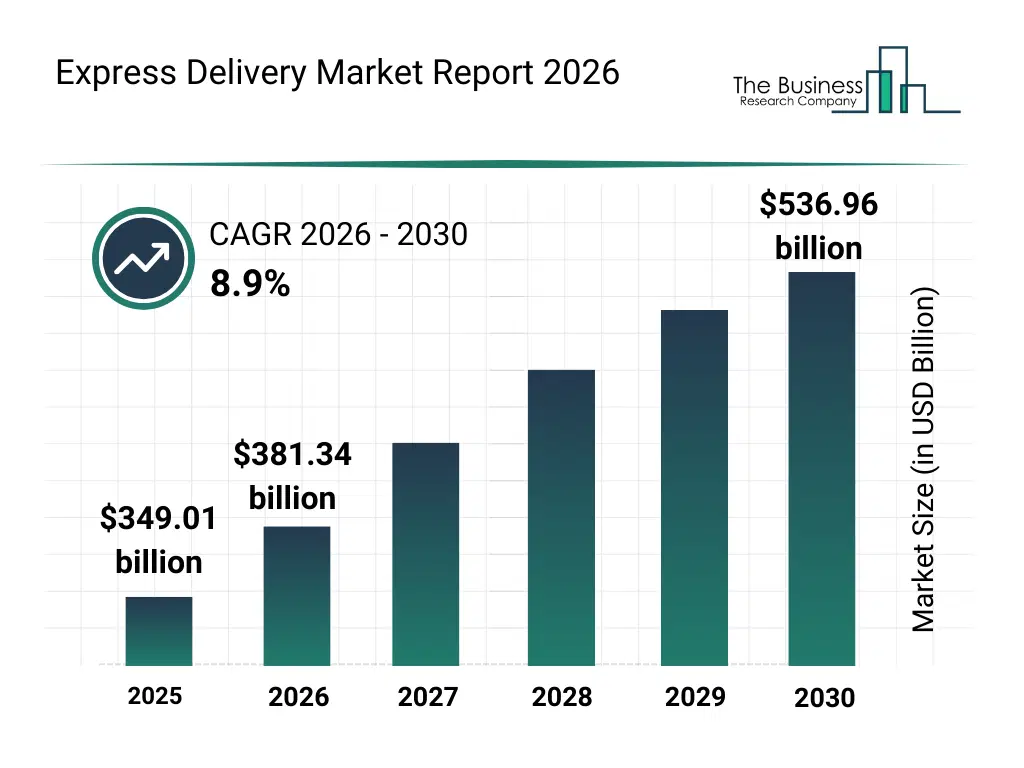
What Is The Express Delivery Market Size and Share 2026?
The express delivery market size has grown strongly in recent years. It will grow from $349.01 billion in 2025 to $381.34 billion in 2026 at a compound annual growth rate (CAGR) of 9.3%. The growth in the historic period can be attributed to e-commerce expansion, globalization of trade, courier network development, urbanization, demand for fast shipping.What Is The Express Delivery Market Growth Forecast?
The express delivery market size is expected to see strong growth in the next few years. It will grow to $536.96 billion in 2030 at a compound annual growth rate (CAGR) of 8.9%. The growth in the forecast period can be attributed to digital logistics platforms growth, autonomous delivery trials, smart warehousing adoption, sustainability-focused delivery models, cross-border trade growth. Major trends in the forecast period include growth of same-day and on-demand delivery, expansion of cross-border e-commerce logistics, adoption of real-time tracking systems, automation of sorting and fulfillment, focus on last-mile efficiency.
Global Express Delivery Market Segmentation
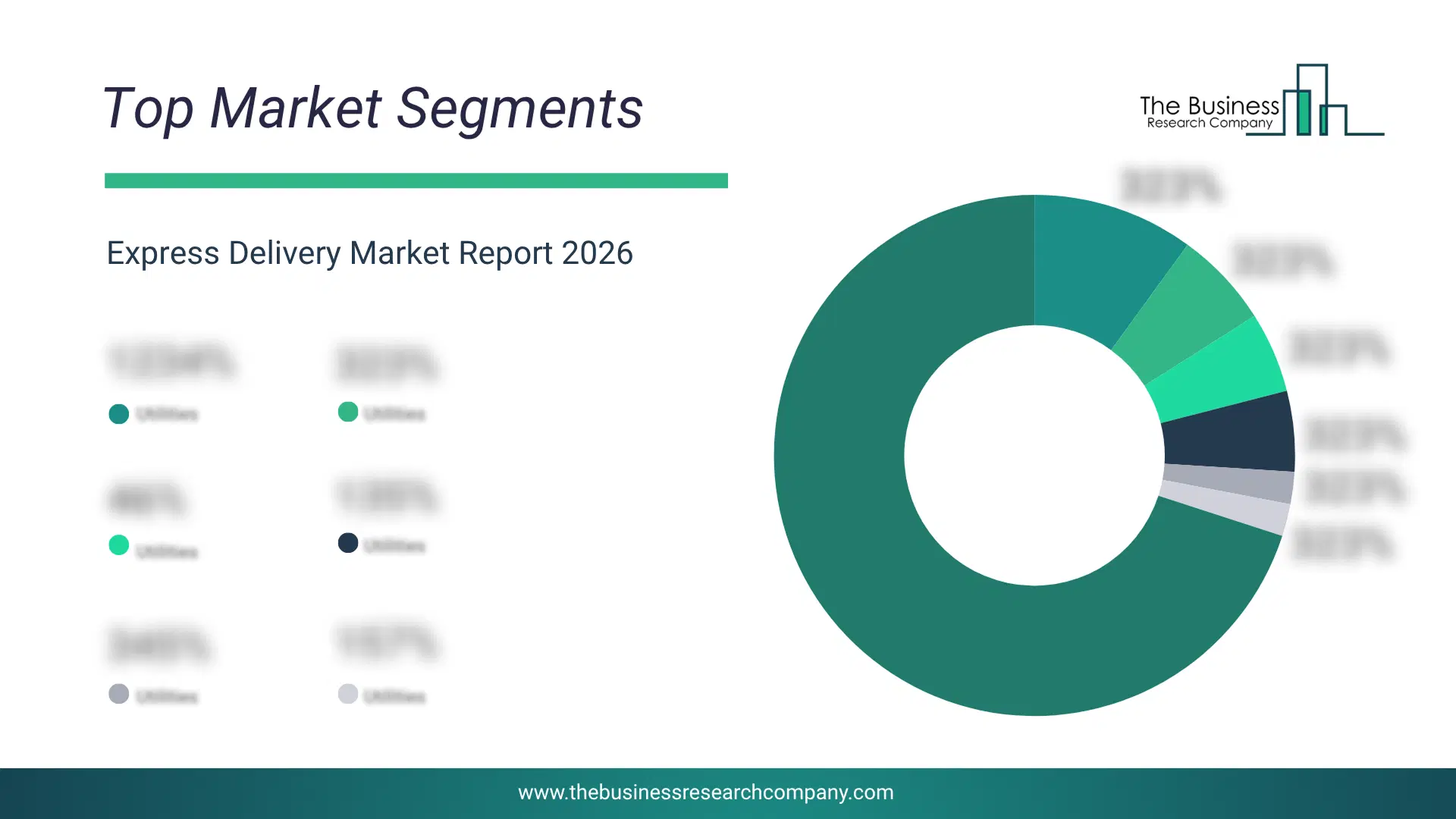
1) By Service: Online, Offline 2) By Business Model: B2B, B2C, C2C 3) By Destination: Domestic, International 4) By End User: Services, Wholesale And Retail Trade, Manufacturing, Construction, And Utilities, Other End Users Subsegments: 1) By Online: E-Commerce Delivery Services, Same-Day Delivery Options, Mobile App-Based Delivery Services 2) By Offline: In-Store Pickup Services, Traditional Courier Services, Scheduled Delivery ServicesWhat Is The Driver Of The Express Delivery Market?
The rapid growth in international trade is expected to propel the growth of the express delivery market in the coming years. International trade is the interchange of products, services, and money across national boundaries and entails countries purchasing and selling products and services, boosting economic cooperation and specialization. Express delivery plays a crucial role in facilitating and supporting global commerce by offering faster shipment times compared to traditional methods like sea freight, making them ideal for time-sensitive goods, urgent documents, and high-value items. For instance, in June 2023, according to the Australian Bureau of Statistics, an Australia-based self-governing legal agency charged with gathering and analyzing data and making fact-based recommendations to the federal, state, and territory governments, total goods and services exports rose by $149,786 million (29%) to $668,940 million. Total imports of goods and services grew by $127,754 million (33%) to $513,210 million. Therefore, the rapid growth in international trade is driving the express delivery industry.Key Players In The Global Express Delivery Market
Major companies operating in the express delivery market report include Deutsche Post AG, United Parcel Service Inc., FedEx Corporation, United States Postal Service, Shanghai YTO Express Co. Ltd., La Poste Group, SF Holding Co. Ltd., DSV Panalpina A/S, Emirates Post Group, C.H. Robinson Worldwide Inc., Nippon Express Co. Ltd., Geodis SA, Bolloré Logistics, ZTO Express Inc., STO Express Co. Ltd., PostNord AB, BEST Inc., LaserShip Inc., Spee-Dee Delivery Service Inc., Aramex PJSC, Pos Malaysia Berhad, Lone Star Overnight, La Poste SA, CEVA Logistics AG, Kerry Logistics Network Limited, Yamato Holdings Co. Ltd., Empresa Brasileira de Correios e Telégrafos, Posta Kenya
This chart is for illustrative purposes; the full report includes a detailed competitor analysis and comprehensive overview of the top 10 companies in the market.
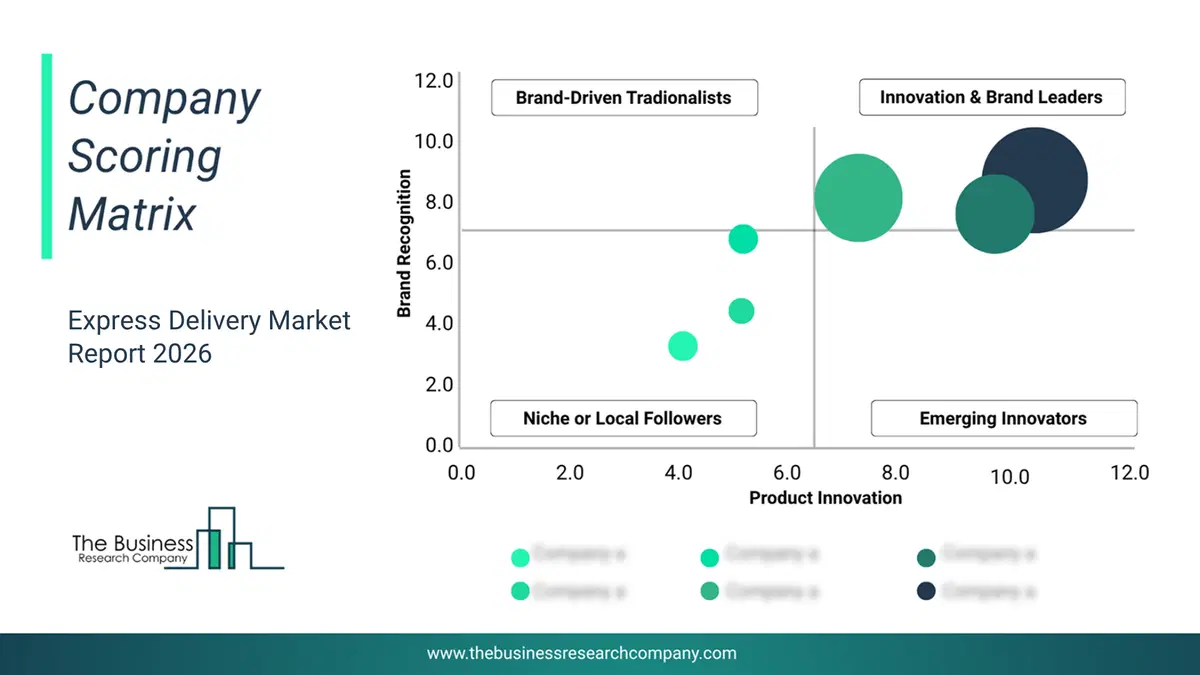
This chart maps companies by product innovation and brand strength, with bubble size indicating relative revenue, helping identify market leaders, challengers, and niche players. This is an illustrative chart; the full report provides a complete and accurate competitive analysis.
Global Express Delivery Market Trends and Insights
Major companies operating in the express delivery market are focusing on developing innovative solutions, such as rapid-commerce delivery platforms, to meet the rising demand for faster fulfillment and improved customer experience. Rapid-commerce delivery platforms are advanced logistics solutions designed to deliver products within extremely short timeframes, often under two hours, compared to traditional same-day or next-day delivery services. For instance, in January 2025, Delhivery Limited, an India-based integrated logistics and supply-chain company, launched Rapid Commerce, a sub-2-hour delivery service initially in Bengaluru for D2C brands, retailers, and e-commerce platforms. Rapid Commerce is built from a blend of city dark stores, a cloud orchestration layer that manages inventory and SLA-aware routing, and a purpose-built intracity delivery fleet; it functions by accepting brand orders via API or platform integration, assigning the nearest dark-store pick, and dispatching a rider for guaranteed delivery within two hours; unique features include rapid store networks, real-time order processing (300+ daily orders reported early in the rollout), and planned expansion to additional metros with a mix of owned and partner micro-fulfilment sites; applications cover beauty & personal care, apparel, electronics accessories and other fast-moving D2C categories, and benefits include dramatically shorter delivery times, improved customer satisfaction and conversion, reduced cart abandonment for merchants, and new revenue streams from premium delivery offerings.What Are Latest Mergers And Acquisitions In The Express Delivery Market?
In July 2024, UPS, an Atlanta-based logistics and package delivery company, announced its agreement to acquire Estafeta for an undisclosed amount. This acquisition underscores UPS's commitment to enhancing its logistics capabilities and expanding its footprint in the growing Mexican market, aiming to provide seamless access to global trade for businesses of all sizes. Estafeta is a Mexico-based privately owned logistics and express delivery company.
Regional Outlook
Asia-Pacific was the largest region in the express delivery market in 2025. North America is expected to be the fastest growing region in the forecast period. The regions covered in this market report include Asia-Pacific, South East Asia, Western Europe, Eastern Europe, North America, South America, Middle East, Africa. The countries covered in this market report include Australia, Brazil, China, France, Germany, India, Indonesia, Japan, Taiwan, Russia, South Korea, UK, USA, Canada, Italy, SpainWhat Defines the Express Delivery Market?
The express delivery market includes revenues earned by entities by overnight shipping, 2-day air, 3-day air, priority mail express, priority mail and first-class mail. The market value includes the value of related goods sold by the service provider or included within the service offering. Only goods and services traded between entities or sold to end consumers are included.How is Market Value Defined and Measured?
The market value is defined as the revenues that enterprises gain from the sale of goods and/or services within the specified market and geography through sales, grants, or donations in terms of the currency (in USD unless otherwise specified). The revenues for a specified geography are consumption values that are revenues generated by organizations in the specified geography within the market, irrespective of where they are produced. It does not include revenues from resales along the supply chain, either further along the supply chain or as part of other products.
This chart presents market attractiveness based on a quantitative evaluation of growth, competition, strategic alignment, and risk, offering a clear view of opportunity areas for decision-making. This chart is for illustrative purposes; the full report contains the complete analysis.

This chart highlights the Total Addressable Market (TAM) by estimating the maximum revenue opportunity using an assumption-driven approach, supporting strategic planning and opportunity sizing across markets. The chart is illustrative; the full report provides a more comprehensive analysis.
What Key Data and Analysis Are Included in the Express Delivery Market Report 2026?
The express delivery market research report is one of a series of new reports from The Business Research Company that provides market statistics, including industry global market size, regional shares, competitors with the market share, detailed market segments, market trends and opportunities, and any further data you may need to thrive in the express delivery industry. The market research report delivers a complete perspective of everything you need, with an in-depth analysis of the current and future state of the industry.Express Delivery Market Report Forecast Analysis
| Report Attribute | Details |
|---|---|
| Market Size Value In 2026 | $381.34 billion |
| Revenue Forecast In 2030 | $536.96 billion |
| Growth Rate | CAGR of 9.3% from 2026 to 2030 |
| Base Year For Estimation | 2025 |
| Actual Estimates/Historical Data | 2020-2025 |
| Forecast Period | 2026 - 2030 - 2030 |
| Market Representation | Revenue in USD Billion and CAGR from 2026 to 2030 |
| Segments Covered | Service, Business Model, Destination, End User |
| Regional Scope | Asia-Pacific, Western Europe, Eastern Europe, North America, South America, Middle East, Africa |
| Country Scope | The countries covered in the report are Australia, Brazil, China, France, Germany, India, Indonesia, Japan, Taiwan, Russia, South Korea, UK, USA, Canada, Italy, Spain. |
| Key Companies Profiled | Deutsche Post AG, United Parcel Service Inc., FedEx Corporation, United States Postal Service, Shanghai YTO Express Co. Ltd., La Poste Group, SF Holding Co. Ltd., DSV Panalpina A/S, Emirates Post Group, C.H. Robinson Worldwide Inc., Nippon Express Co. Ltd., Geodis SA, Bolloré Logistics, ZTO Express Inc., STO Express Co. Ltd., PostNord AB, BEST Inc., LaserShip Inc., Spee-Dee Delivery Service Inc., Aramex PJSC, Pos Malaysia Berhad, Lone Star Overnight, La Poste SA, CEVA Logistics AG, Kerry Logistics Network Limited, Yamato Holdings Co. Ltd., Empresa Brasileira de Correios e Telégrafos, Posta Kenya |
| Customization Scope | Request for Customization |
| Pricing And Purchase Options | Explore Purchase Options |