
Liquid Rocket Engine Market Report 2026
Global Outlook – By Engine Type (Monopropellant Engines, Bipropellant Engines), By Fuel Type (Kerosene-Based Fuels, Hydrogen-Based Fuels, Hypergolic Propellants), By Propulsion System (Cryogenic, Non‑Cryogenic), By Application (Aerospace Exploration, Satellite Launches, Defense And Military Applications, Space Tourism, Research And Development), By End-user (Government Space Agencies, Private Space Companies, Defense Contractors) – Market Size, Trends, Strategies, and Forecast to 2030
Liquid Rocket Engine Market Overview
• Liquid Rocket Engine market size has reached to $3.34 billion in 2025 • Expected to grow to $4.83 billion in 2030 at a compound annual growth rate (CAGR) of 7.7% • Growth Driver: The Increasing Demand For Satellite Launches Is Fueling The Market Growth Due To The Need For High-Thrust And Precise Propulsion Systems • Market Trend: Technological Innovation Driving The Market Growth With Storable Propulsion Systems For Defense Applications • North America was the largest region in 2025 and Asia-Pacific is the fastest growing region.What Is Covered Under Liquid Rocket Engine Market?
A liquid rocket engine is a rocket propulsion system that uses liquid propellants, typically a fuel and an oxidizer, which are stored separately and pumped into a combustion chamber where they chemically react (combust) to produce high-pressure, high-velocity exhaust gases. These gases are expelled through a nozzle, generating thrust according to Newton’s third law of motion. Liquid rocket engines offer precise thrust control, restart capability, and higher efficiency than solid rocket motors. The main types of liquid rocket engines include monopropellant engines, bipropellant engines, and hybrid engines. Monopropellant engines are propulsion systems that generate thrust using a single chemical propellant decomposed through a catalyst, without requiring a separate oxidizer. They use various fuel types such as kerosene-based fuels, hydrogen-based fuels, Rocket Propellant-1 (RP-1), liquid oxygen, and hypergolic propellants in different propulsion systems, which include cryogenic and non-cryogenic propulsion systems. They are used in various applications, including aerospace exploration, satellite launches, defense and military operations, space tourism, and research and development for varied end-users, including government space agencies, private space companies, defense contractors, and academic institutions.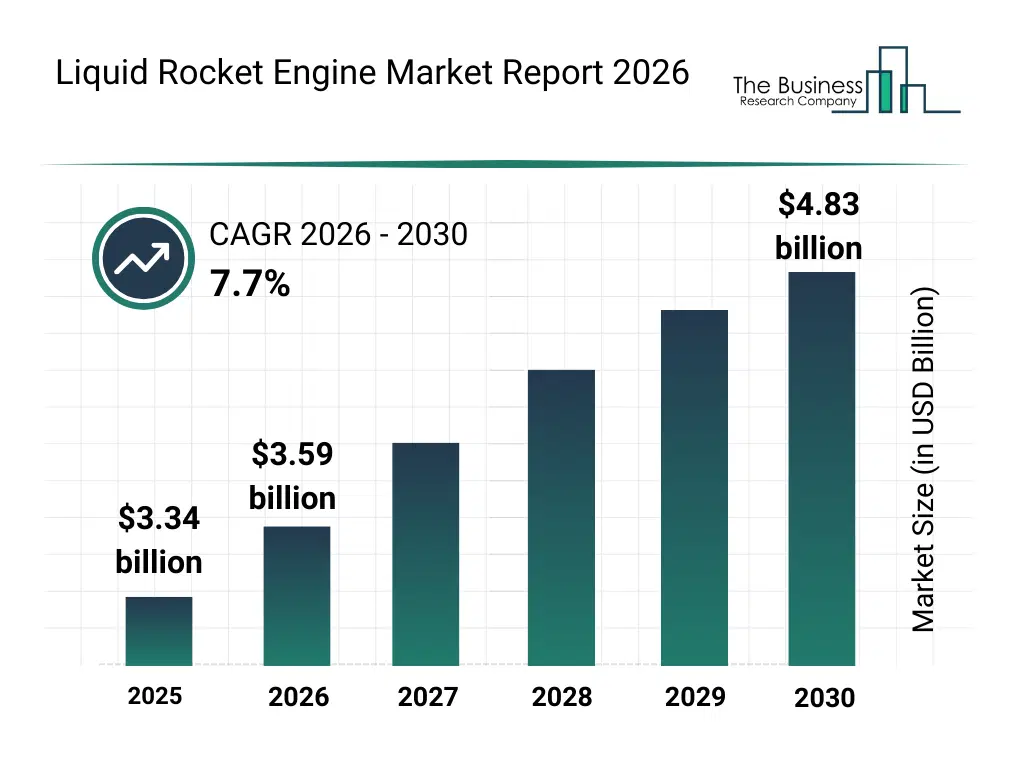
What Is The Liquid Rocket Engine Market Size and Share 2026?
The liquid rocket engine market size has grown strongly in recent years. It will grow from $3.34 billion in 2025 to $3.59 billion in 2026 at a compound annual growth rate (CAGR) of 7.5%. The growth in the historic period can be attributed to government space programs, cold war era propulsion development, satellite launch demand, military missile programs, investment in aerospace research.What Is The Liquid Rocket Engine Market Growth Forecast?
The liquid rocket engine market size is expected to see strong growth in the next few years. It will grow to $4.83 billion in 2030 at a compound annual growth rate (CAGR) of 7.7%. The growth in the forecast period can be attributed to growth of commercial spaceflight, expansion of space tourism, increasing satellite constellations, reusable launch vehicle adoption, defense modernization. Major trends in the forecast period include growing demand for reusable rocket engines, expansion of private space launch programs, increased use of cryogenic propulsion, rising adoption of green propellants, focus on high thrust efficiency.
Global Liquid Rocket Engine Market Segmentation
1) By Engine Type: Monopropellant Engines, Bipropellant Engines 2) By Fuel Type: Kerosene-Based Fuels, Hydrogen-Based Fuels, Hypergolic Propellants 3) By Propulsion System: Cryogenic, Non‑Cryogenic 4) By Application: Aerospace Exploration, Satellite Launches, Defense And Military Applications, Space Tourism, Research And Development 5) By End-user: Government Space Agencies, Private Space Companies, Defense Contractors Subsegments: 1) By Monopropellant Engines: Hydrazine-Based Engines, Hydrogen Peroxide-Based Engines, Green Propellant-Based Engines 2) By Bipropellant Engines: Hypergolic Propellant Engines, Cryogenic Propellant Engines, Semi-Cryogenic Propellant Engines, Storable Liquid Propellant EnginesWhat Is The Driver Of The Liquid Rocket Engine Market?
The increasing demand for satellite launches is expected to propel the growth of the liquid rocket engine market going forward. Satellite launches refer to sending artificial satellites into space using rocket vehicles. The demand for satellite launches is increasing primarily due to the growing need for earth observation, as satellites provide critical data for climate monitoring, natural disaster management, agriculture, and urban planning. Liquid rocket engines enable satellite launches by delivering the high thrust and precise control required to propel payloads into specific orbits beyond Earth's atmosphere, ensuring the reliable delivery of satellites for applications such as communication, earth observation, navigation, and scientific research. For instance, in May 2025, according to the report published by Satellite Industry Association (SIA), a U.S.-based trade association, the number of satellites operating in Earth orbit increased to approximately 11,539 in 2024, marking a significant rise compared to previous years and reflecting the growing global demand for satellite launches. Therefore, the increasing demand for satellite launches is driving the growth of the liquid rocket engine industry.Key Players In The Global Liquid Rocket Engine Market
Major companies operating in the liquid rocket engine market are Northrop Grumman Corporation, Mitsubishi Heavy Industries Ltd., Safran S.A., IHI Corporation, Space Exploration Technologies Corp., Blue Origin LLC, ArianeGroup SAS, United Launch Alliance LLC, Rocket Lab USA Inc., Relativity Space Inc., Beijing Landspace Technology Corporation Ltd., Firefly Aerospace Inc., Ursa Major Technologies Inc., Avio S.p.A., Astra Space Inc., Skyrora Limited, Reaction Engines Limited, Gilmour Space Technologies Pty Ltd., China Aerospace Science and Technology Corporation (CASC), China Aerospace Science and Industry Corporation (CASIC), Indian Space Research Organisation (ISRO), Korea Aerospace Industries Ltd.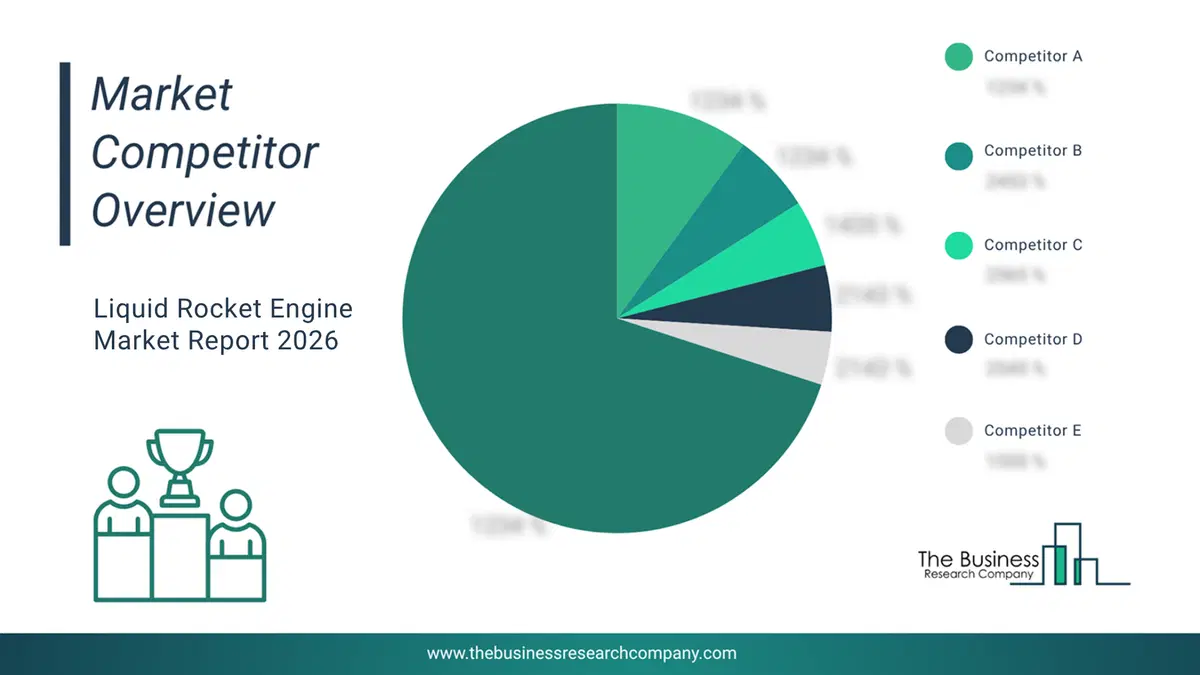
This chart is for illustrative purposes; the full report includes a detailed competitor analysis and comprehensive overview of the top 10 companies in the market.
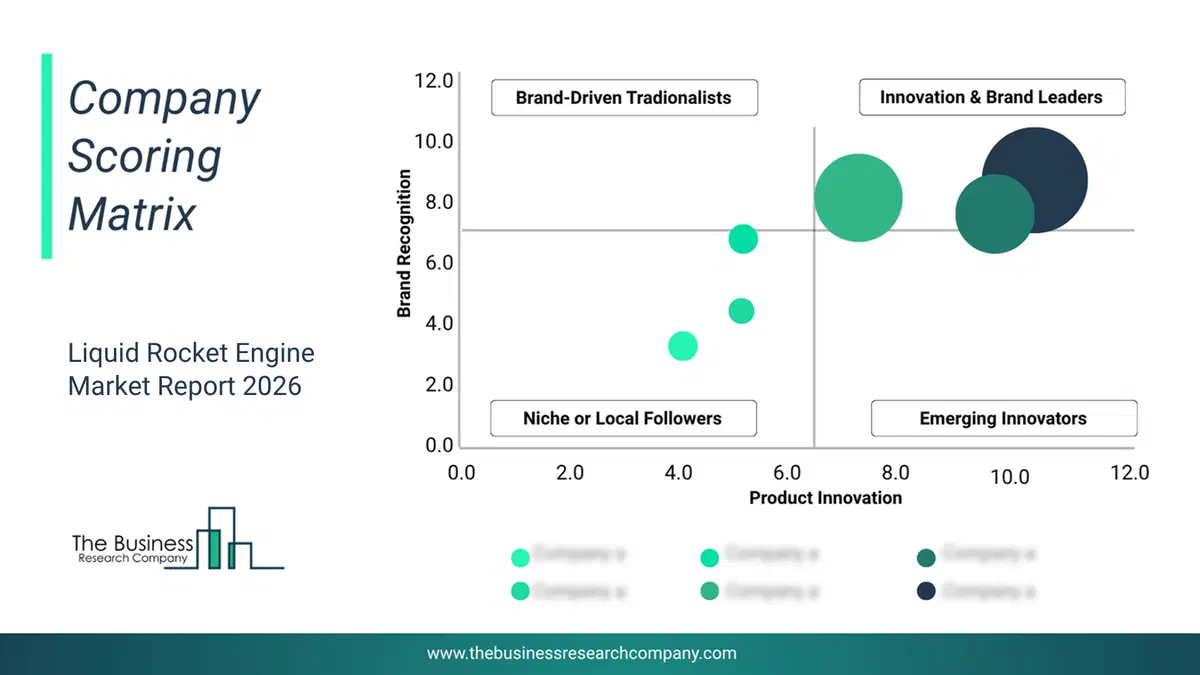
This chart maps companies by product innovation and brand strength, with bubble size indicating relative revenue, helping identify market leaders, challengers, and niche players. This is an illustrative chart; the full report provides a complete and accurate competitive analysis.
Global Liquid Rocket Engine Market Trends and Insights
Major companies operating in the liquid rocket engine market are focusing on developing innovative products, such as storable liquid rocket engines, to support rapid deployment and enhance mission flexibility. Storable liquid rocket engines are propulsion systems that use liquid propellants that can be stored at ambient temperatures for extended periods without degrading. These engines help by enabling rapid launch readiness, making them ideal for defense and emergency space missions. For instance, in May 2023, Ursa Major Technologies, Inc., a US-based aerospace company, launched Draper, a storable 4,000-pound-thrust liquid rocket engine designed for hypersonic defense applications. Draper operates on a closed catalyst cycle using hydrogen peroxide and kerosene propellants, allowing it to be stored at room temperature for years and launched on demand. The engine offers the maneuverability and active throttle control needed to counter evolving hypersonic threats, combining the responsiveness of a solid rocket motor with the precision of liquid propulsion.What Are Latest Mergers And Acquisitions In The Liquid Rocket Engine Market?
In July 2023, L3Harris Technologies, Inc., a US-based aerospace and defense technology company, acquired Aerojet Rocketdyne Holdings, Inc. for an undisclosed amount. With this acquisition, L3Harris aims to strengthen the defense industrial base, enhance competition, and accelerate innovation by leveraging Aerojet Rocketdyne’s expertise in propulsion and energetics technologies, enabling the delivery of advanced missile defense systems, hypersonic capabilities, and space launch solutions to meet the critical mission needs of the Department of Defense and civil space customers in the United States. Aerojet Rocketdyne Holdings, Inc. is a US-based aerospace and defense company specializing in developing and manufacturing liquid rocket engines.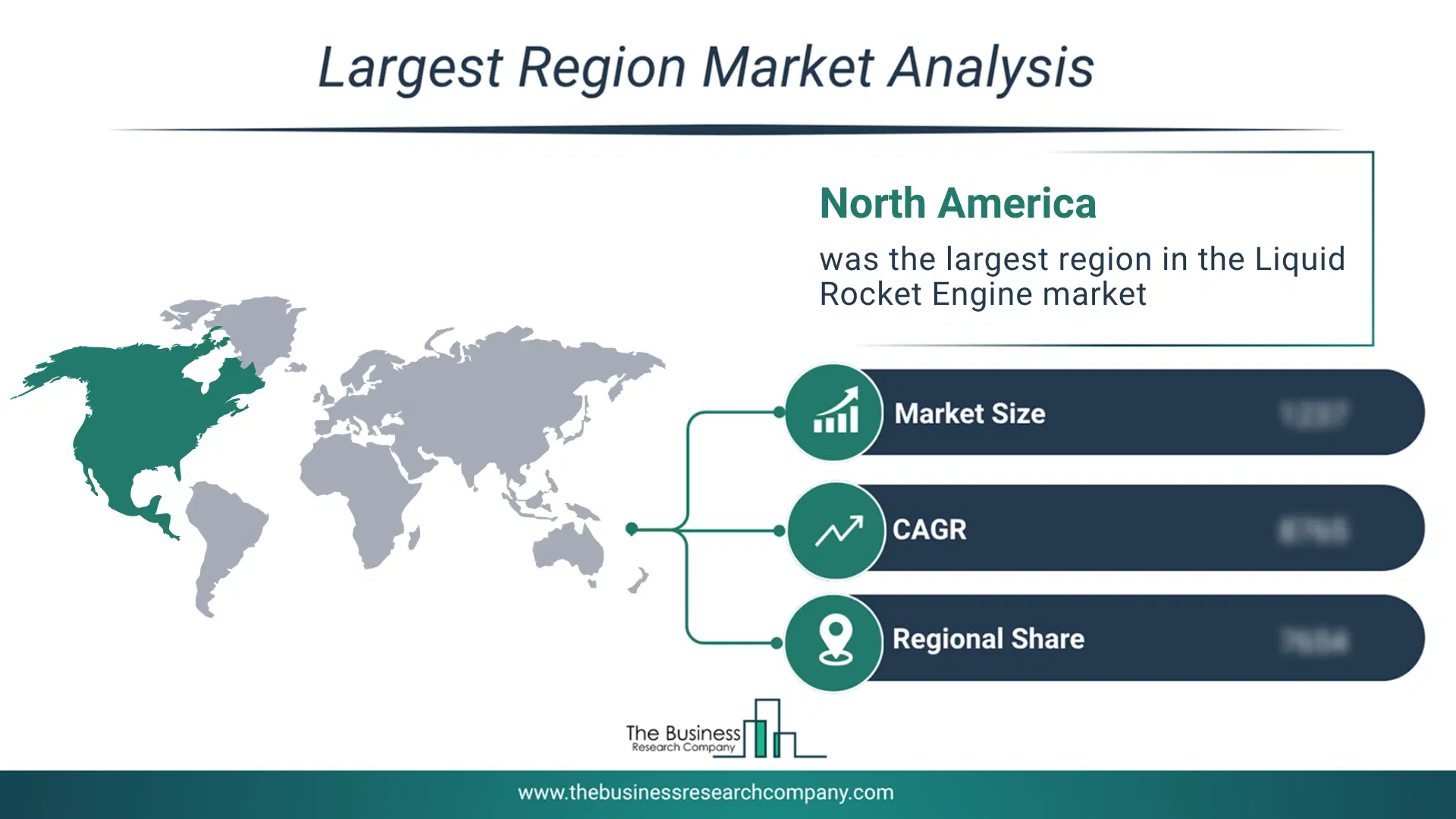
Regional Insights
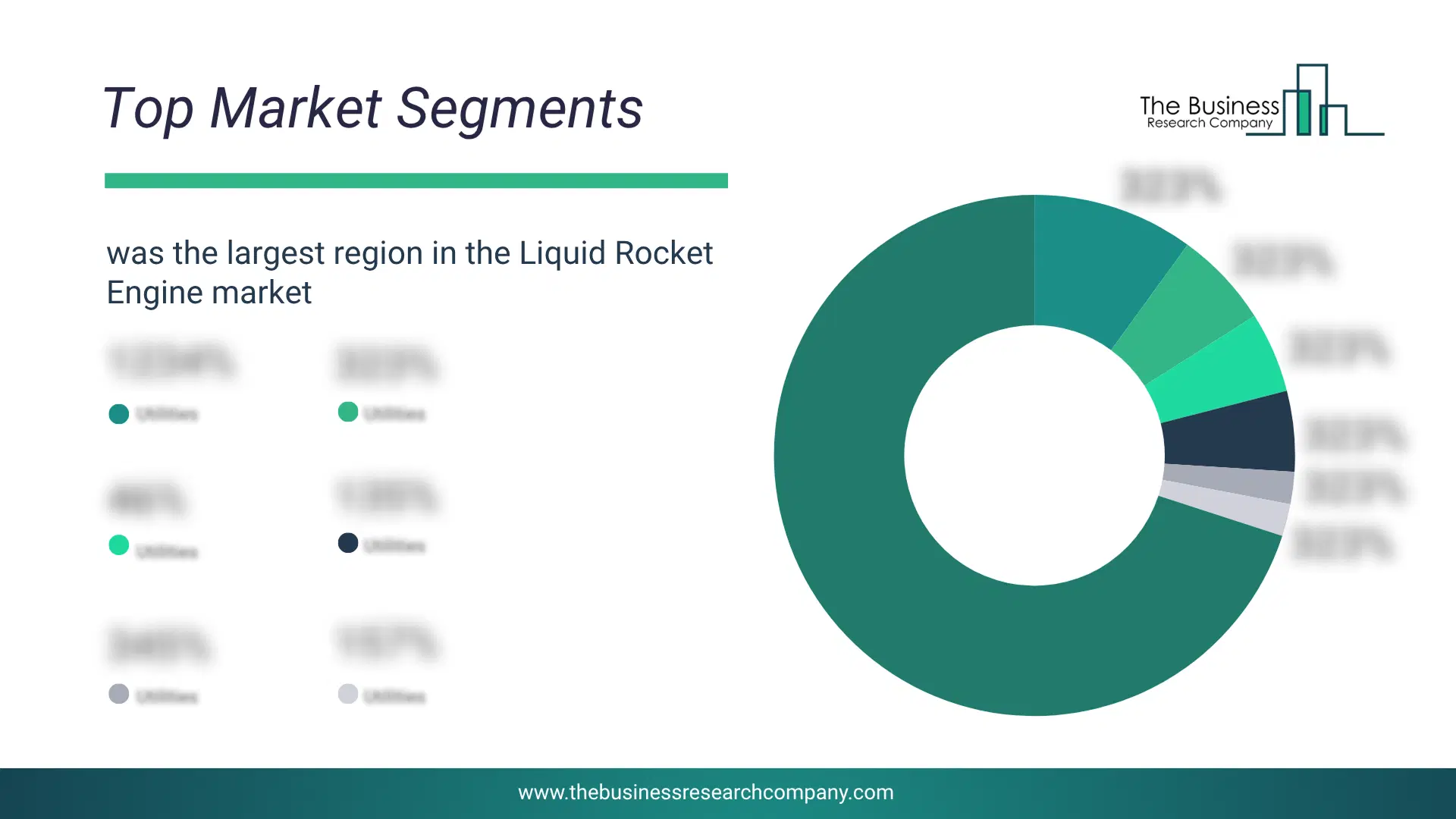
North America was the largest region in the liquid rocket engine market in 2025. Asia-Pacific is expected to be the fastest-growing region in the forecast period. The regions covered in this market report are Asia-Pacific, South East Asia, Western Europe, Eastern Europe, North America, South America, Middle East, Africa The countries covered in this market report are Australia, Brazil, China, France, Germany, India, Indonesia, Japan, Taiwan, Russia, South Korea, UK, USA, Canada, Italy, SpainWhat Defines the Liquid Rocket Engine Market?
The liquid rocket engine market consists of sales of liquid propulsion systems, propellant tanks, combustion chambers, turbopumps, nozzles, and related components. Values in this market are ‘factory gate’ values, that is, the value of goods sold by the manufacturers or creators of the goods, whether to other entities (including downstream manufacturers, wholesalers, distributors, and retailers) or directly to end customers. The value of goods in this market includes related services sold by the creators of the goods.How is Market Value Defined and Measured?
The market value is defined as the revenues that enterprises gain from the sale of goods and/or services within the specified market and geography through sales, grants, or donations in terms of the currency (in USD unless otherwise specified). The revenues for a specified geography are consumption values that are revenues generated by organizations in the specified geography within the market, irrespective of where they are produced. It does not include revenues from resales along the supply chain, either further along the supply chain or as part of other products.
This chart presents market attractiveness based on a quantitative evaluation of growth, competition, strategic alignment, and risk, offering a clear view of opportunity areas for decision-making. This chart is for illustrative purposes; the full report contains the complete analysis.

This chart highlights the Total Addressable Market (TAM) by estimating the maximum revenue opportunity using an assumption-driven approach, supporting strategic planning and opportunity sizing across markets. The chart is illustrative; the full report provides a more comprehensive analysis.
What Key Data and Analysis Are Included in the Liquid Rocket Engine Market Report 2026?
The liquid rocket engine market research report is one of a series of new reports from The Business Research Company that provides market statistics, including industry global market size, regional shares, competitors with the market share, detailed market segments, market trends and opportunities, and any further data you may need to thrive in the liquid rocket engine industry. The market research report delivers a complete perspective of everything you need, with an in-depth analysis of the current and future state of the industry.Liquid Rocket Engine Market Report Forecast Analysis
| Report Attribute | Details |
|---|---|
| Market Size Value In 2026 | $3.59 billion |
| Revenue Forecast In 2030 | $4.83 billion |
| Growth Rate | CAGR of 7.5% from 2026 to 2030 |
| Base Year For Estimation | 2025 |
| Actual Estimates/Historical Data | 2020-2025 |
| Forecast Period | 2026 - 2030 |
| Market Representation | Revenue in USD Billion and CAGR from 2026 to 2030 |
| Segments Covered | Engine Type, Fuel Type, Propulsion System, Application, End-user |
| Regional Scope | Asia-Pacific, Western Europe, Eastern Europe, North America, South America, Middle East, Africa |
| Country Scope | The countries covered in this market report are Australia, Brazil, China, France, Germany, India, Indonesia, Japan, Taiwan, Russia, South Korea, UK, USA, Canada, Italy, Spain |
| Key Companies Profiled | Northrop Grumman Corporation, Mitsubishi Heavy Industries Ltd., Safran S.A., IHI Corporation, Space Exploration Technologies Corp., Blue Origin LLC, ArianeGroup SAS, United Launch Alliance LLC, Rocket Lab USA Inc., Relativity Space Inc., Beijing Landspace Technology Corporation Ltd., Firefly Aerospace Inc., Ursa Major Technologies Inc., Avio S.p.A., Astra Space Inc., Skyrora Limited, Reaction Engines Limited, Gilmour Space Technologies Pty Ltd., China Aerospace Science and Technology Corporation (CASC), China Aerospace Science and Industry Corporation (CASIC), Indian Space Research Organisation (ISRO), Korea Aerospace Industries Ltd. |
| Customization Scope | Request for Customization |
| Pricing And Purchase Options | Explore Purchase Options |