

Load Balancer As A Service Market Report 2026
Global Outlook – By Component (Software, Hardware, Services), By Deployment Mode (Public Cloud, Private Cloud, Hybrid Cloud), By Enterprise Size (Small And Medium Enterprises, Large Enterprises), By End-User (Banking, Financial Services, And Insurance (BFSI), Information Technology (IT) And Telecommunications, Healthcare, Retail, Government, Media And Entertainment, Other End-Users) – Market Size, Trends, Strategies, and Forecast to 2030
Load Balancer As A Service Market Overview
• Load Balancer As A Service market size has reached to $2.23 billion in 2025 • Expected to grow to $6.84 billion in 2030 at a compound annual growth rate (CAGR) of 25.1% • Growth Driver: Rising Adoption Of Cloud Computing Fueling The Growth Of The Market Due To Increasing Demand For Scalable And Reliable Infrastructure • Market Trend: Automated Traffic Management Enhancing Scalability And Reliability • North America was the largest region in 2025 and Asia-Pacific is the fastest growing region.What Is Covered Under Load Balancer As A Service Market?
Load balancer as a service is a cloud-based service model that automatically distributes incoming network or application traffic across multiple servers to ensure high availability, reliability, and optimal resource utilization. It helps prevent server overload, improves performance, and provides scalability without requiring users to manage the underlying hardware or software. The main components of load balancer as a service are software, hardware, and services. Software refers to the virtual component that handles traffic distribution, health checks, routing, and configuration essentially performing the load balancing functions without dedicated hardware. It is deployed through modes such as public cloud, private cloud, or hybrid cloud and serves enterprise sizes, including small and medium enterprises and large enterprises. It is used by banking, financial services and insurance (BFSI), information technology and telecommunications, healthcare, retail, government, media and entertainment, and others.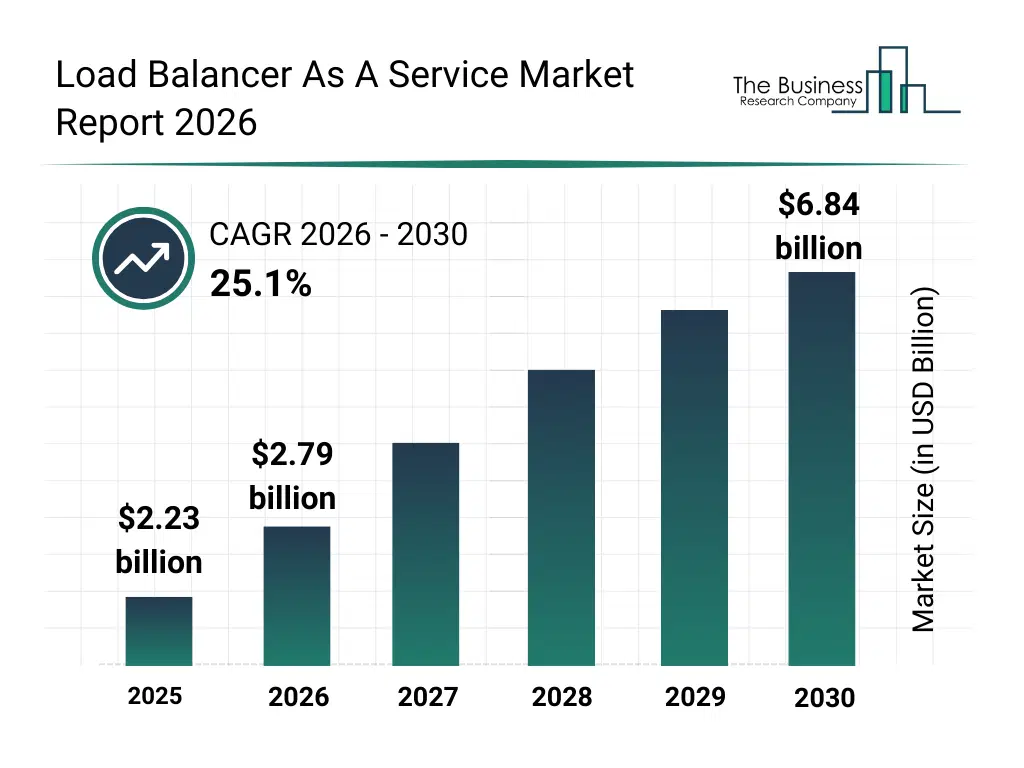
What Is The Load Balancer As A Service Market Size and Share 2026?
The load balancer as a service market size has grown exponentially in recent years. It will grow from $2.23 billion in 2025 to $2.79 billion in 2026 at a compound annual growth rate (CAGR) of 25.4%. The growth in the historic period can be attributed to growth of cloud-native applications, rising web traffic and user experience expectations, adoption of microservices and containers, increased ddos attacks and security needs, expansion of multi-region deployments.What Is The Load Balancer As A Service Market Growth Forecast?
The load balancer as a service market size is expected to see exponential growth in the next few years. It will grow to $6.84 billion in 2030 at a compound annual growth rate (CAGR) of 25.1%. The growth in the forecast period can be attributed to AI-assisted traffic routing optimization, deeper integration with zero trust security, demand for low-latency edge delivery, increasing adoption of service mesh and ingress controllers, shift toward consumption-based networking services. Major trends in the forecast period include cloud-native application delivery controllers, global traffic management and anycast routing, integrated waf and ddos protection, api gateway and edge load balancing, observability-driven traffic steering.
Global Load Balancer As A Service Market Segmentation
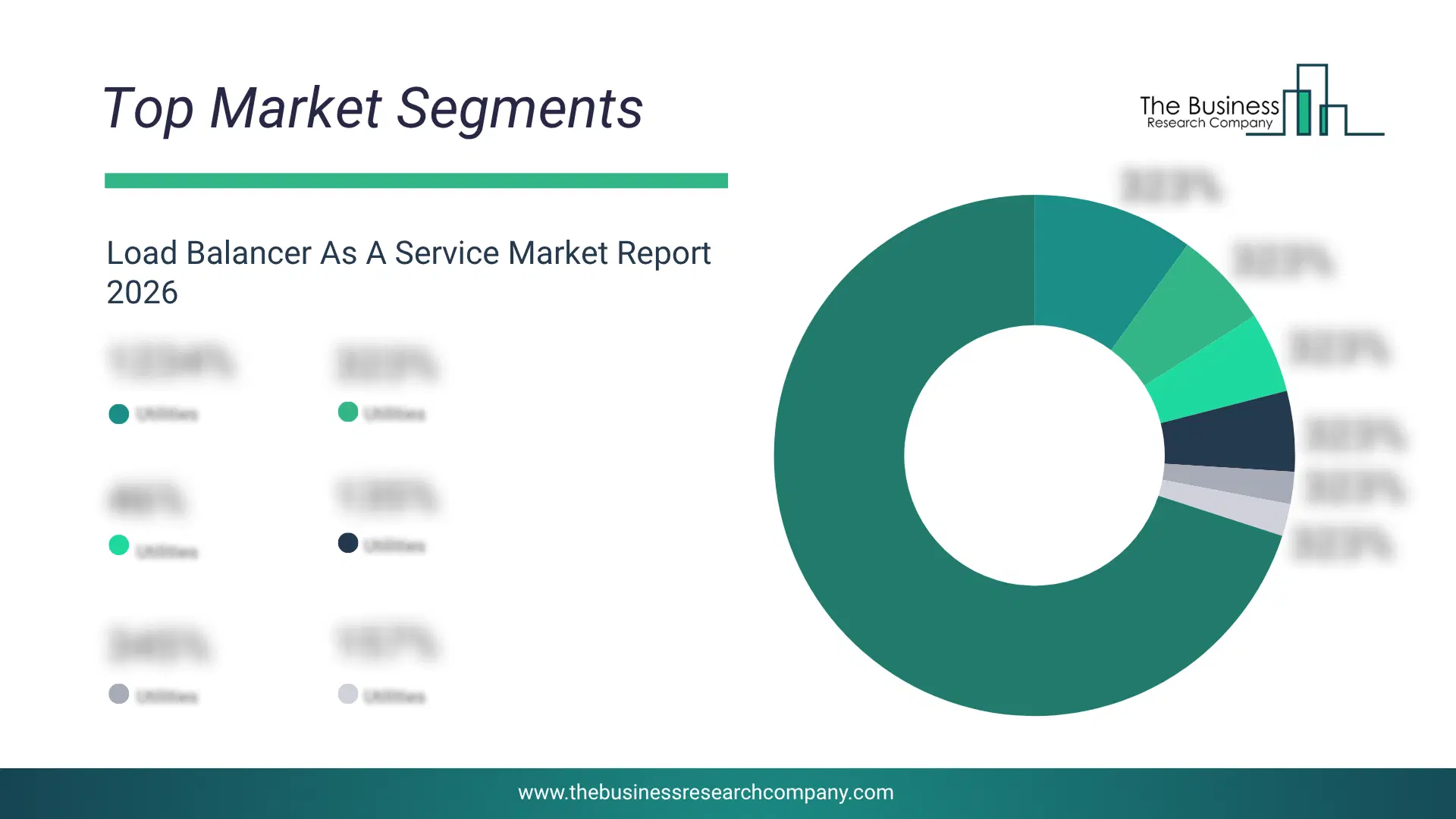
1) By Component: Software, Hardware, Services 2) By Deployment Mode: Public Cloud, Private Cloud, Hybrid Cloud 3) By Enterprise Size: Small And Medium Enterprises, Large Enterprises 4) By End-User: Banking, Financial Services, And Insurance (BFSI), Information Technology (IT) And Telecommunications, Healthcare, Retail, Government, Media And Entertainment, Other End-Users Subsegments: 1) By Software: Virtual Load Balancers, Cloud-Native Or Load-Balancer-As-Software, Application Delivery Controller (ADC) Software, Open-Source Or Load Balancer Projects, API Gateway And Edge-Proxy Software, SSL Or TLS Offload And Crypto Acceleration Modules, DNS-Based Load Balancing Software. 2) By Hardware: Dedicated Hardware Load Balancer Appliances (ADC Appliances), SSL Or TLS Hardware Off loaders, Application Acceleration Appliances, DDoS Mitigation Appliances, High-Throughput Ethernet Or ASIC-Accelerated Load Balancers, Edge Or Edge-Gateway Hardware Devices. 3) By Services: Managed LBaaS (Fully Managed Load Balancer Operations), Professional Services, Integration And Implementation Services, Support And Maintenance Services (SLA, Patching), Monitoring And Performance Tuning Services, Migration And Deployment Services, Security ServicesWhat Is The Driver Of The Load Balancer As A Service Market?
The increasing adoption of cloud computing is expected to propel the growth of the load balancer as a service market going forward. Cloud computing refers to the delivery of computing resources such as servers, storage, databases, networking, software, and analytics over the internet to offer faster innovation, flexible resources, and economies of scale. The adoption of cloud computing is driven by scalability, as they allow businesses to easily adjust computing resources based on demand and reduce infrastructure costs. Load balancer as a service enhances cloud computing ecosystems by providing automated traffic distribution and scalability, making it ideal for applications with variable workloads. It reduces downtime and performance bottlenecks by efficiently managing network traffic, improving reliability and user experience. For instance, in December 2023, according to Eurostat, a Luxembourg-based government organization, 45.2% of enterprises across the European Union purchased cloud computing services, with 77.6% of large enterprises, 59% of medium-sized enterprises, and 41.7% of small businesses adopting cloud services. Therefore, the increasing adoption of cloud computing is driving the growth of the load balancer as a service industry.Key Players In The Global Load Balancer As A Service Market
Major companies operating in the load balancer as a service market are Amazon.com Inc., Google LLC, Microsoft Corporation, Alibaba Cloud Computing Ltd., Huawei Technologies Co. Ltd., Tencent Cloud Computing (Beijing) Co. Ltd., International Business Machines Corporation (IBM), Oracle Corporation, Fortinet Inc., AkamAI Technologies Inc., Citrix Systems Inc., F5 Inc., Cloudflare Inc., DigitalOcean Holdings Inc., OVH Groupe SA, Radware Ltd., A10 Networks Inc., Array Networks Inc., Progress Software Corporation, HAProxy Technologies LLC, Loadbalancer.org Ltd.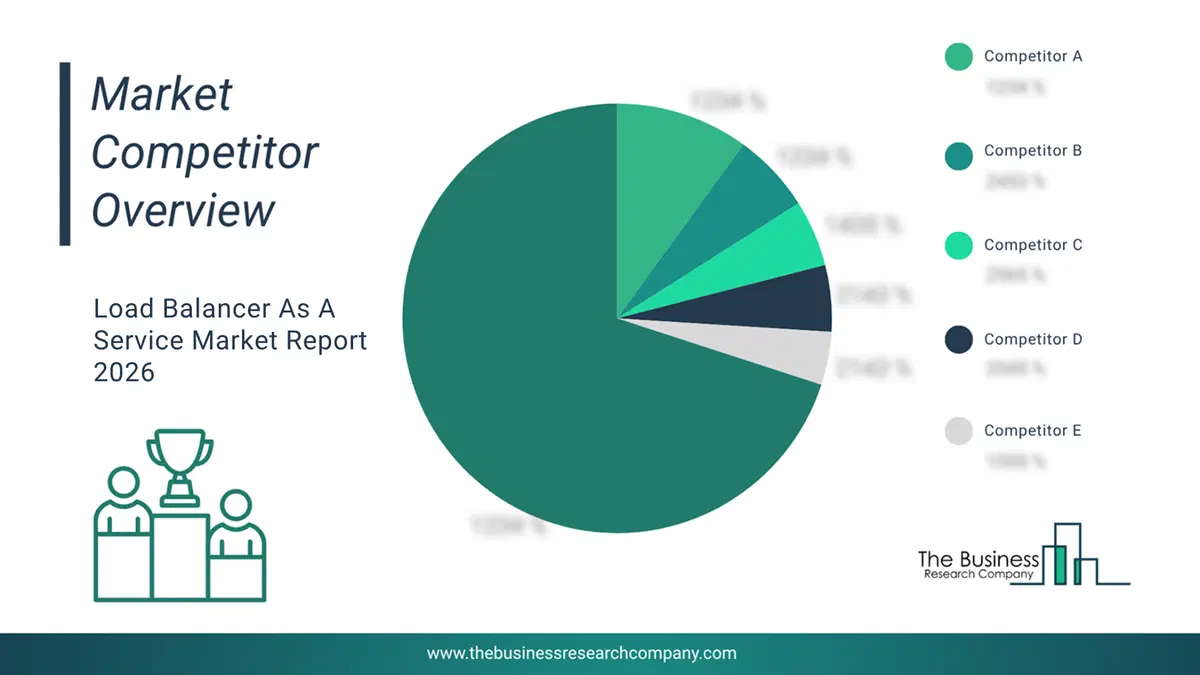
This chart is for illustrative purposes; the full report includes a detailed competitor analysis and comprehensive overview of the top 10 companies in the market.
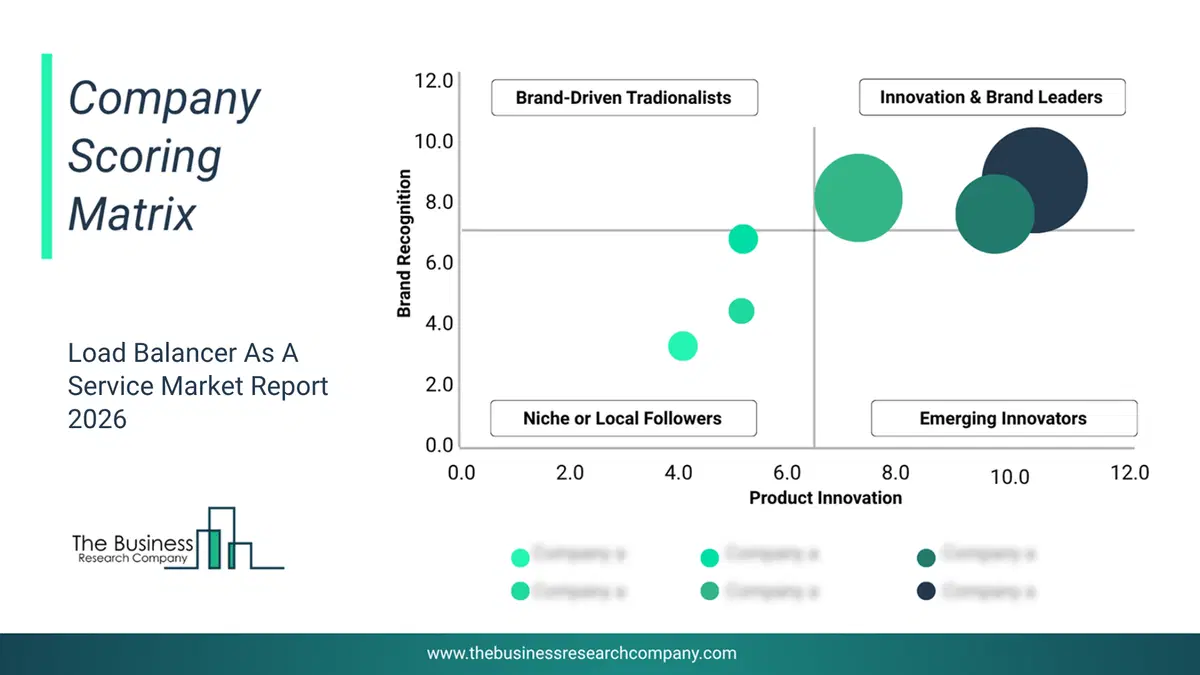
This chart maps companies by product innovation and brand strength, with bubble size indicating relative revenue, helping identify market leaders, challengers, and niche players. This is an illustrative chart; the full report provides a complete and accurate competitive analysis.
Global Load Balancer As A Service Market Trends and Insights
Major companies operating in the load balancer as a service market are focusing on developing advanced cloud-native solutions, such as automated traffic management systems, to boost application performance, enhance security, and reduce manual configuration and operational costs. Automated traffic management systems refer to intelligent platforms that dynamically distribute incoming network traffic across multiple servers, ensuring optimal resource use and preventing any single server from becoming a failure point. For instance, in February 2025, Alkira Inc., a US-based software company, launched the Load Balancer-as-a-Service (LBaaS) to simplify and modernize traffic management across cloud and on-premises environments. It is a fully integrated, cloud-native solution that provides centralized management and granular control of load balancing across multi-cloud and hybrid environments. It includes automated health checks and real-time traffic distribution, enabling seamless application scalability and high availability without operator intervention.What Are Latest Mergers And Acquisitions In The Load Balancer As A Service Market?
In November 2023, Broadcom Inc., a US-based software technology company, acquired VMware Inc. for $69 billion. With this acquisition, Broadcom aims to strengthen its position in the hybrid and private cloud infrastructure market by integrating VMware’s advanced software capabilities to deliver more efficient, secure, and scalable load balancing and application networking solutions. VMware Inc. is a US-based cloud computing and virtualization technology company that specializes in providing solutions to manage and optimize workload and balance across multi-cloud environments.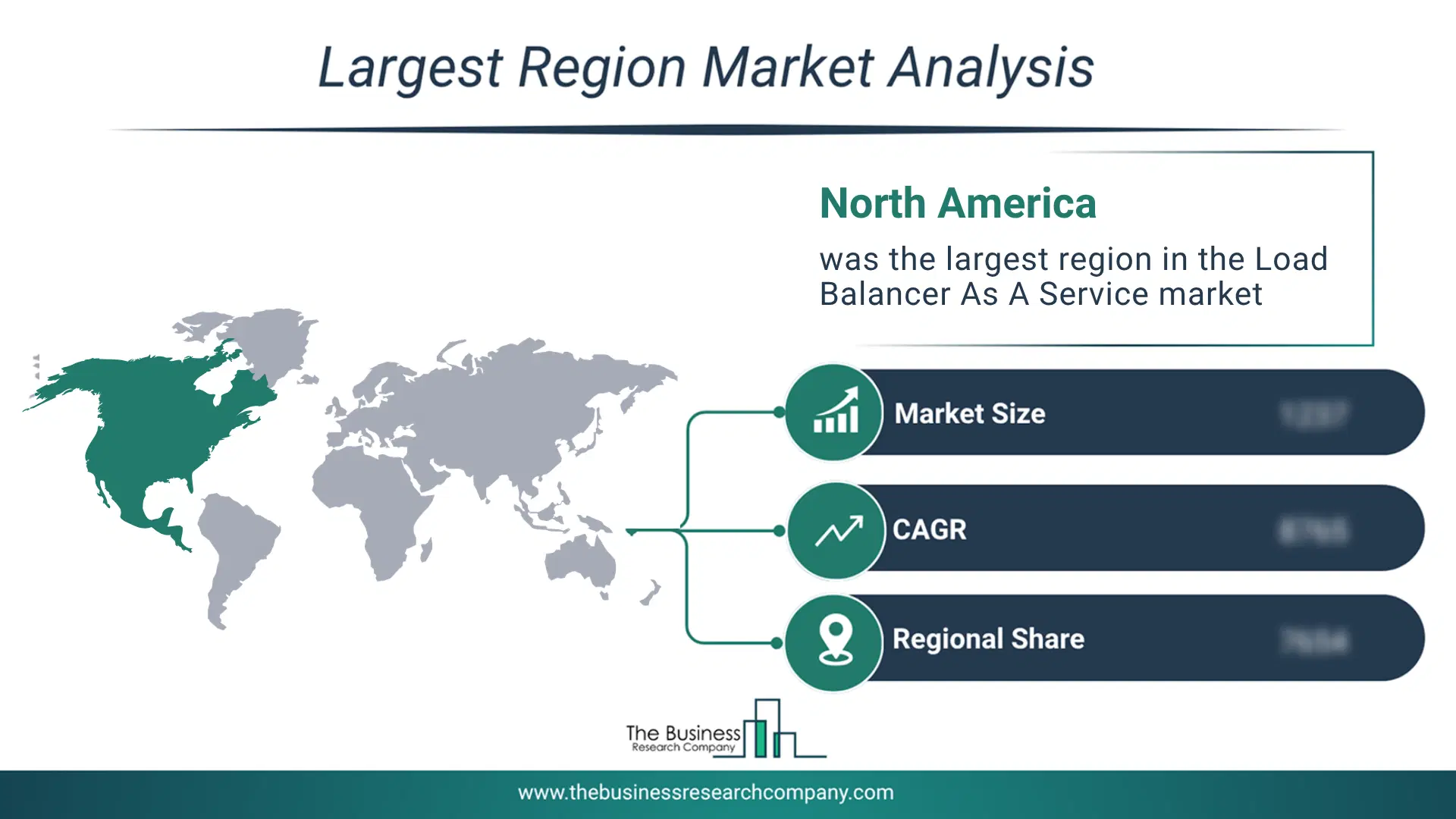
Regional Insights
North America was the largest region in the load balancer as a service market in 2025. Asia-Pacific is expected to be the fastest-growing region in the forecast period. The regions covered in this market report are Asia-Pacific, South East Asia, Western Europe, Eastern Europe, North America, South America, Middle East, Africa. The countries covered in this market report are Australia, Brazil, China, France, Germany, India, Indonesia, Japan, Taiwan, Russia, South Korea, UK, USA, Canada, Italy, Spain.What Defines the Load Balancer As A Service Market?
The load balancer as a service market consists of revenues earned by entities by providing services such as load balancing, automated traffic management, and dynamic resource distribution across multiple servers or instances. The market value includes the value of related goods sold by the service provider or included within the service offering. The load balancer as a service market also includes sales of application delivery controllers, network switches, routers, gateways, and dedicated load balancing appliances. Values in this market are ‘factory gate’ values, that is the value of goods sold by the manufacturers or creators of the goods, whether to other entities (including downstream manufacturers, wholesalers, distributors and retailers) or directly to end customers. The value of goods in this market includes related services sold by the creators of the goods.How is Market Value Defined and Measured?
The market value is defined as the revenues that enterprises gain from the sale of goods and/or services within the specified market and geography through sales, grants, or donations in terms of the currency (in USD unless otherwise specified). The revenues for a specified geography are consumption values that are revenues generated by organizations in the specified geography within the market, irrespective of where they are produced. It does not include revenues from resales along the supply chain, either further along the supply chain or as part of other products.
This chart presents market attractiveness based on a quantitative evaluation of growth, competition, strategic alignment, and risk, offering a clear view of opportunity areas for decision-making. This chart is for illustrative purposes; the full report contains the complete analysis.

This chart highlights the Total Addressable Market (TAM) by estimating the maximum revenue opportunity using an assumption-driven approach, supporting strategic planning and opportunity sizing across markets. The chart is illustrative; the full report provides a more comprehensive analysis.
What Key Data and Analysis Are Included in the Load Balancer As A Service Market Report 2026?
The load balancer as a service market research report is one of a series of new reports from The Business Research Company that provides market statistics, including industry global market size, regional shares, competitors with the market share, detailed market segments, market trends and opportunities, and any further data you may need to thrive in the load balancer as a service industry. The market research report delivers a complete perspective of everything you need, with an in-depth analysis of the current and future state of the industry.Load Balancer As A Service Market Report Forecast Analysis
| Report Attribute | Details |
|---|---|
| Market Size Value In 2026 | $2.79 billion |
| Revenue Forecast In 2030 | $6.84 billion |
| Growth Rate | CAGR of 25.1% from 2026 to 2030 |
| Base Year For Estimation | 2025 |
| Actual Estimates/Historical Data | 2020-2025 |
| Forecast Period | 2026 - 2030 |
| Market Representation | Revenue in USD Billion and CAGR from 2026 to 2030 |
| Segments Covered | Component, Deployment Mode, Enterprise Size, End-User |
| Regional Scope | Asia-Pacific, Western Europe, Eastern Europe, North America, South America, Middle East, Africa |
| Country Scope | The Countries Covered In This Market Report Are Australia, Brazil, China, France, Germany, India, Indonesia, Japan, Taiwan, Russia, South Korea, Uk, Usa, Canada, Italy, Spain. |
| Key Companies Profiled | Amazon.com Inc., Google LLC, Microsoft Corporation, Alibaba Cloud Computing Ltd., Huawei Technologies Co. Ltd., Tencent Cloud Computing (Beijing) Co. Ltd., International Business Machines Corporation (IBM), Oracle Corporation, Fortinet Inc., AkamAI Technologies Inc., Citrix Systems Inc., F5 Inc., Cloudflare Inc., DigitalOcean Holdings Inc., OVH Groupe SA, Radware Ltd., A10 Networks Inc., Array Networks Inc., Progress Software Corporation, HAProxy Technologies LLC, Loadbalancer.org Ltd. |
| Customization Scope | Request for Customization |
| Pricing And Purchase Options | Explore Purchase Options |