
Lunar Energy Harvesting Market Report 2026
Global Outlook – By Technology (Solar Power, Nuclear Power, Regolith-Based Power, Other Technologies), By Application (Space Missions, Lunar Bases, Satellite Operations, Other Applications), By End-User (Government, Commercial, Research Institutions, Other End-Users) – Market Size, Trends, Strategies, and Forecast to 2030
Lunar Energy Harvesting Market Overview
• Lunar Energy Harvesting market size has reached to $1.62 billion in 2025 • Expected to grow to $3.49 billion in 2030 at a compound annual growth rate (CAGR) of 16.6% • Growth Driver: Rising Investments In Space Exploration Fueling The Growth Of The Market Due To Increasing Development Of Sustainable Power Systems For Lunar Bases • Market Trend: Breakthrough In Excavator Prototype Advances Scalable Lunar Resource Extraction Technology • North America was the largest region in 2025 and Asia-Pacific is the fastest growing region.Market Gains By 2030 – Top Opportunities By Segment
Market Gain identifies the most promising market opportunities by highlighting the segments or products expected to generate the highest incremental revenue growth over the next five years.
What Is Covered Under Lunar Energy Harvesting Market?
Lunar energy harvesting refers to the process of capturing, converting, and utilizing the Moon's natural energy sources, such as solar radiation, thermal gradients, or kinetic motion, for the generation of usable power, typically through advanced technologies and infrastructure designed for deployment on the lunar surface or in its orbit. This approach supports long-duration space missions, facilitates extraterrestrial habitation, and contributes to space-based energy research and development. The main technologies in lunar energy harvesting are solar power, nuclear power, regolith-based power, and others. Solar power in lunar energy harvesting refers to the use of photovoltaic (PV) panels or solar concentrators to convert sunlight into electricity on the Moon’s surface for powering missions, equipment, and habitats. These are used in applications such as space missions, lunar bases, satellite operations, and others by end-users including government, commercial, research institutions, and others.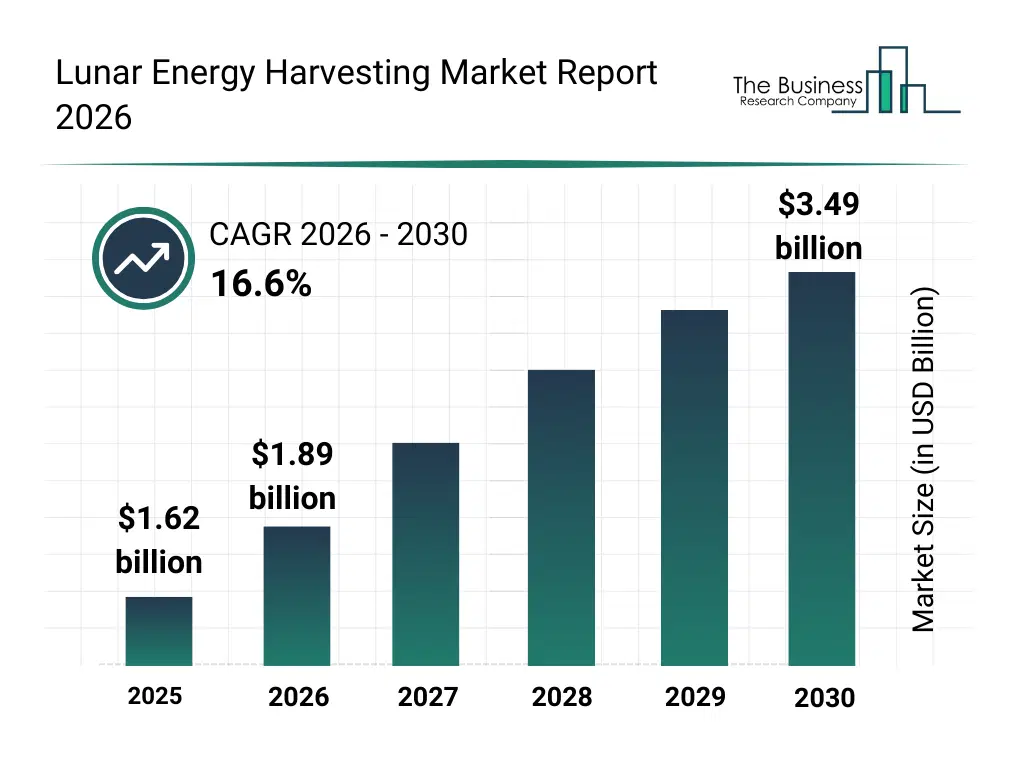
What Is The Lunar Energy Harvesting Market Size and Share 2026?
The lunar energy harvesting market size has grown rapidly in recent years. It will grow from $1.62 billion in 2025 to $1.89 billion in 2026 at a compound annual growth rate (CAGR) of 16.7%. The growth in the historic period can be attributed to advancements in lunar exploration programs, early development of lunar surface power prototypes, initial investments in space-based renewable energy research, emergence of commercial space logistics providers, foundational progress in radiation-hardened power electronics.What Is The Lunar Energy Harvesting Market Growth Forecast?
The lunar energy harvesting market size is expected to see rapid growth in the next few years. It will grow to $3.49 billion in 2030 at a compound annual growth rate (CAGR) of 16.6%. The growth in the forecast period can be attributed to increasing deployment of lunar habitats and research bases, rising investments in large-scale lunar solar infrastructure, advancements in autonomous lunar power systems and rovers, expansion of international collaborations for lunar energy projects, growing demand for high-efficiency lunar energy storage solutions. Major trends in the forecast period include increasing adoption of modular lunar power units, development of regolith-based energy storage and conversion, standardization of lunar power interfaces and microgrid protocols, expansion of commercial lunar energy-as-a-service business models, integration of lunar surface power networks with cislunar infrastructure.
Global Lunar Energy Harvesting Market Segmentation
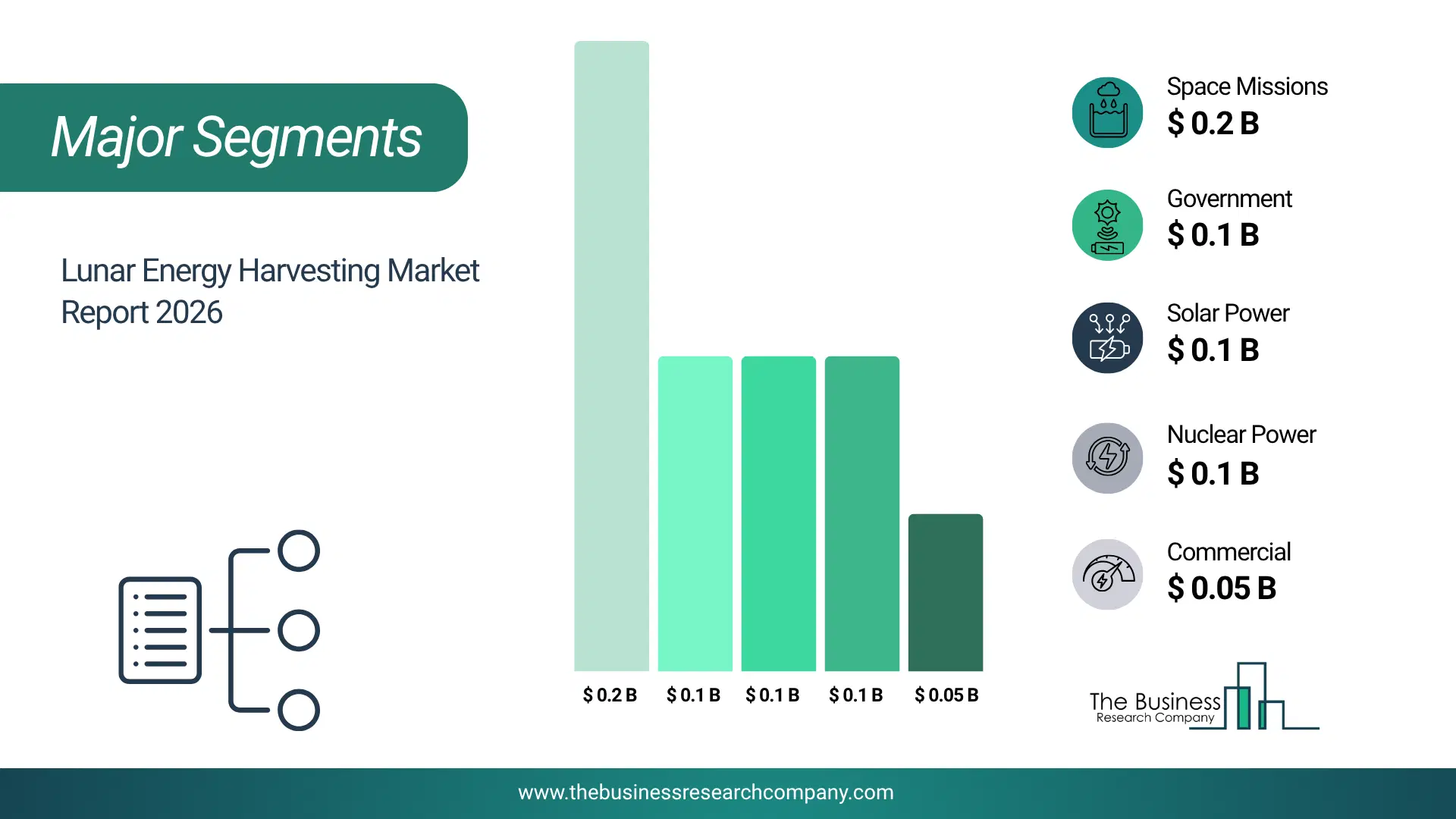
1) By Technology: Solar Power, Nuclear Power, Regolith-Based Power, Other Technologies 2) By Application: Space Missions, Lunar Bases, Satellite Operations, Other Applications 3) By End-User: Government, Commercial, Research Institutions, Other End-Users Subsegments: 1) By Solar Power: Photovoltaic Solar Panels, Concentrated Solar Power Systems, Dust-Resistant Solar Coatings, Solar Energy Storage Systems, Solar Tracking Systems 2) By Nuclear Power: Fission Reactors, Radioisotope Thermoelectric Generators (RTGs), Heat-To-Electricity Conversion Systems, Radiation Shielding Technologies, Compact Nuclear Reactor Modules 3) By Regolith-Based Power: Thermoelectric Generators Using Regolith, Regolith-Based Thermal Storage Systems, In-Situ Regolith Processing Technologies, Microwave Sintering Systems, Regolith-To-Fuel Conversion Units 4) By Other Technologies: Wireless Power Transmission Systems, Electromagnetic Beaming Technologies, Dynamic Power Systems, Hybrid Energy Systems, Energy Distribution And Control Units The top segments in the lunar energy harvesting market will be: • Space Missions will reach $262.92 Million by 2025. • Government will reach $175.1 Million by 2025. • Solar Power will reach $161.63 Million by 2025. • Nuclear Power will reach $101.29 Million by 2025. • Commercial will reach $59.26 Million by 2025.What Is Driver Of The Lunar Energy Harvesting Market?
The rising investments in space exploration are expected to propel the growth of the lunar energy harvesting market going forward. Space exploration refers to the scientific investigation and discovery of outer space using advanced technology to study celestial objects and cosmic phenomena beyond Earth. Investment in space exploration is rising due to growing commercial opportunities, as private companies increasingly see space-based technologies and services as profitable ventures with long-term returns. The rising investments in space exploration support the demand for lunar energy harvesting by accelerating the development of permanent lunar bases that require sustainable and localized power sources, such as solar farms or helium-3 extraction systems, to operate independently from Earth. For instance, in March 2025, according to the House of Commons Library, a UK-based library and information resource of the lower house of the British Parliament, between 2022 and 2024, the UK government announced that the country received contracts totaling $1.135 billion (£844 million) through the European Space Agency (ESA). Therefore, the rising investments in space exploration are propelling the growth of the lunar energy harvesting industry.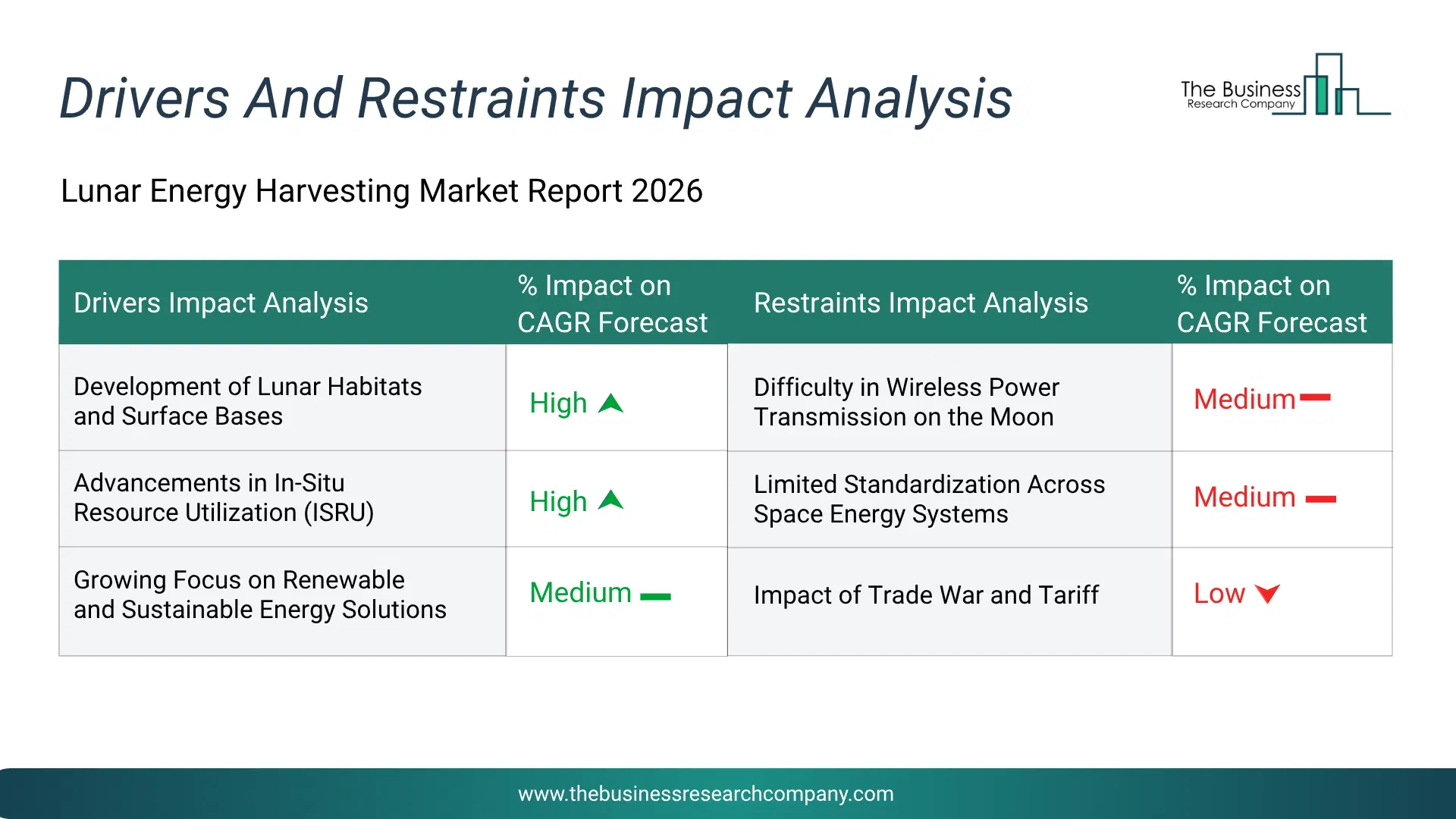
Infographic Chart Showing Key Market Drivers Analysis And Restraints For Lunar Energy Harvesting Market
The chart presents an impact analysis of key drivers and restraints, quantifying their relative influence on the market's growth rate and helping assess the balance between growth enablers and limiting factors. This chart offers a high-level perspective; the full report contains more detailed insights.
How Will The Drivers Impact Growth In The Global Lunar Energy Harvesting Market?
• Development of Lunar Habitats and Surface Bases (High) – The development of lunar habitats and surface bases will become a key driver of growth in the lunar energy harvesting market by 2030. Establishing permanent and semi-permanent infrastructure on the Moon requires consistent and sustainable energy systems to power essential functions such as life support, communication, research and industrial activities. Lunar habitats depend on reliable energy harvesting technologies to operate under extreme temperature variations and prolonged lunar nights. Moreover, these surface bases demand integrated energy storage and power distribution networks to support continuous operations and future human expansion. These developments highlight the growing emphasis on sustainable power systems and energy infrastructure to support lunar surface operations. As a result, the development of lunar habitats and surface bases is anticipated to contributing to a 2.5% annual growth in the market. • Advancements in In-Situ Resource Utilization (ISRU) (High) – The advancements in in-situ resource utilization (ISRU) will emerge as a major factor driving the expansion of the lunar energy harvesting market by 2030. ISRU technologies, which enable the extraction and utilization of lunar materials such as regolith, water ice and minerals, are crucial for supporting sustainable energy generation and reducing reliance on Earth-based resources. These systems allow lunar missions to produce essential materials like oxygen, hydrogen and construction feedstocks directly on the Moon, improving efficiency and reducing mission costs. Moreover, ISRU advancements are essential for powering life-support systems, habitats and energy-harvesting facilities in future lunar bases. These developments demonstrate NASA’s ongoing efforts to integrate ISRU technologies with power generation systems, enhancing the efficiency and scalability of lunar energy infrastructure. Consequently, the advancements in in-situ resource utilization (ISRU) capabilities is projected to contributing to a 2.0% annual growth in the market. • Growing Focus on Renewable and Sustainable Energy Solutions (Medium) – The growing focus on renewable and sustainable energy solutions will serve as a key growth catalyst for the lunar energy harvesting market by 2030. Increasing global commitment toward clean and renewable energy has encouraged the exploration of advanced power systems beyond Earth, including lunar-based energy harvesting. These technologies aim to generate, store and transmit energy sustainably to support long-term lunar operations and future space missions. The transition toward sustainable power generation aligns with international decarbonization goals and reduces dependence on fossil fuels for both terrestrial and off-planet applications. These initiatives demonstrate the growing integration of renewable energy strategies into space programs, paving the way for sustainable lunar energy generation. Therefore, this growing focus on renewable and sustainable energy solutions is projected to supporting to a 1.5% annual growth in the market. • Defense Interest in Space-Based Power Infrastructure (Medium) – The defense interest in space-based power infrastructure will become a significant driver contributing to the growth of the lunar energy harvesting market by 2030. The growing focus of defense organizations on leveraging space-based energy systems for secure and uninterrupted power generation is driving innovation and investment in lunar energy technologies. Space-based power infrastructure plays a vital role in supporting defense communication networks, surveillance systems and strategic operations in cislunar space. Moreover, such initiatives aim to strengthen energy resilience, reduce logistical dependence on Earth and ensure long-term operational readiness in off-planet environments. These developments demonstrate the increasing recognition of space-based power as a strategic asset that aligns with both defense and commercial objectives. Consequently, the defense interest in space-based power infrastructure strategies is projected to contributing to a 1.0% annual growth in the market.How Will The Restraints Impact Growth In The Global Lunar Energy Harvesting Market?
• Difficulty in Wireless Power Transmission on the Moon (High) – Difficulty in Wireless Power Transmission on the Moon will restrict the growth of the Lunar Energy Harvesting market during the forecast period. Wireless power transmission on the lunar surface faces technical challenges including distance, efficiency, and environmental factors. Power transmission challenges affect the feasibility and reliability of lunar energy systems. Technical difficulties can limit the development of lunar energy harvesting infrastructure. • Limited Standardization Across Space Energy Systems (Medium) – Limited Standardization Across Space Energy Systems will restrict the growth of the Lunar Energy Harvesting market during the forecast period. Lunar energy systems lack standardized interfaces and protocols for energy harvesting and distribution. Standardization gaps can affect system interoperability and integration. Limited standardization can increase costs and complexity of lunar energy projects. • Impact of Trade War and Tariff (Medium) – Impact of Trade War and Tariff will restrict the growth of the Lunar Energy Harvesting market during the forecast period. Trade tensions and economic uncertainty can affect space program funding and international collaboration. Reduced government budgets may limit lunar exploration and energy projects. Trade barriers can also impact technology transfer and international cooperation.Key Players In The Global Lunar Energy Harvesting Market
Major companies operating in the lunar energy harvesting market are Boeing, Lockheed Martin, Airbus, Northrop Grumman, Thales Alenia Space, Blue Origin, SpaceX, Sierra Nevada Corporation, Maxar Technologies, Intuitive Machines, Astrobotic Technology, iSpace, Masten Space Systems, Moon Express, OrbitBeyond, NASA Advanced Energy Division (contract ecosystem), Interlune, Shackleton Energy Company, Honeybee Robotics, Redwire Space, Ball Aerospace, Rocket Lab, ispace Europe, Lunar Outpost, Teledyne Brown Engineering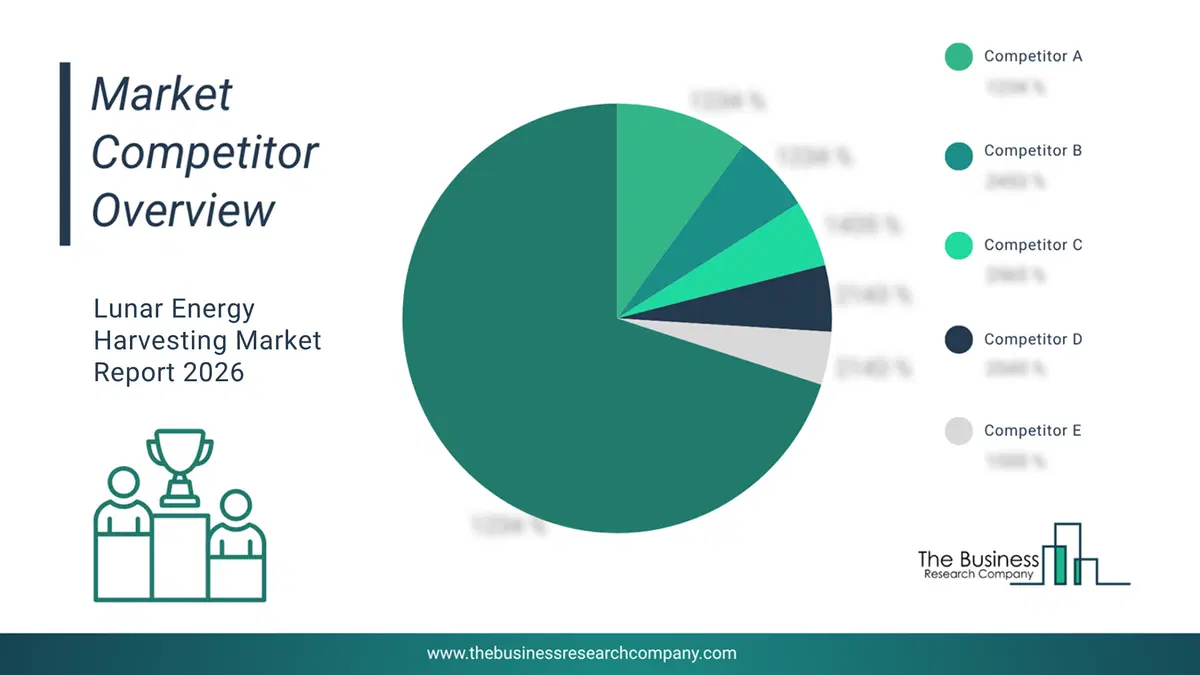
This chart is for illustrative purposes; the full report includes a detailed competitor analysis and comprehensive overview of the top 10 companies in the market.
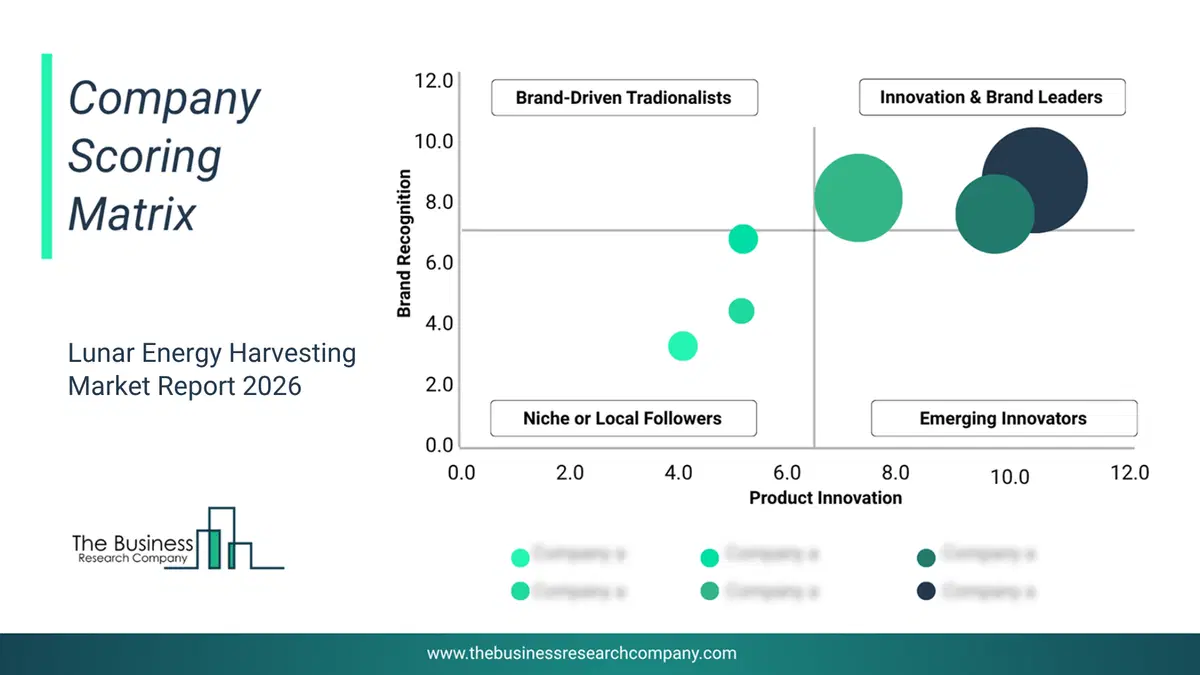
This chart maps companies by product innovation and brand strength, with bubble size indicating relative revenue, helping identify market leaders, challengers, and niche players. This is an illustrative chart; the full report provides a complete and accurate competitive analysis.
Global Lunar Energy Harvesting Market Trends and Insights
Major companies operating in the lunar energy harvesting market are focusing on developing advanced innovations such as lunar regolith excavators to establish reliable, high-throughput excavation capabilities necessary for scalable resource extraction on the Moon. A lunar regolith excavator is a specialized machine engineered to efficiently extract and handle large volumes of lunar soil under extreme extraterrestrial conditions, enabling the recovery of valuable in-situ resources such as helium-3. For instance, in May 2025, Interlune Corporation, a US-based space resources startup, launched the Interlune Excavator. The full-scale prototype is engineered to continuously process 100 metric tons of lunar regolith per hour, prioritizing operational efficiency and adaptability to lunar surface challenges. Its compact design minimizes energy use, mechanical strain, and dust dispersion, marking a significant advancement in extraterrestrial excavation technology.What Are Latest Mergers And Acquisitions In The Lunar Energy Harvesting Market? DOE And Interlune Partner To Commercialize Lunar Helium-3 Resources
In May 2025, The U.S. Department of Energy (DOE), a US-based federal government department, partnered with Interlune Corporation to establish a scalable model for utilizing extraterrestrial resources. This deal aims to advance the practical recovery, processing, and commercialization of lunar-derived materials, particularly helium-3, to support strategic Earth-based applications while laying the groundwork for a sustainable in-space resource economy. Interlune Corporation is a US-based space resources startup focused on harvesting natural resources from the moon to support a sustainable economy.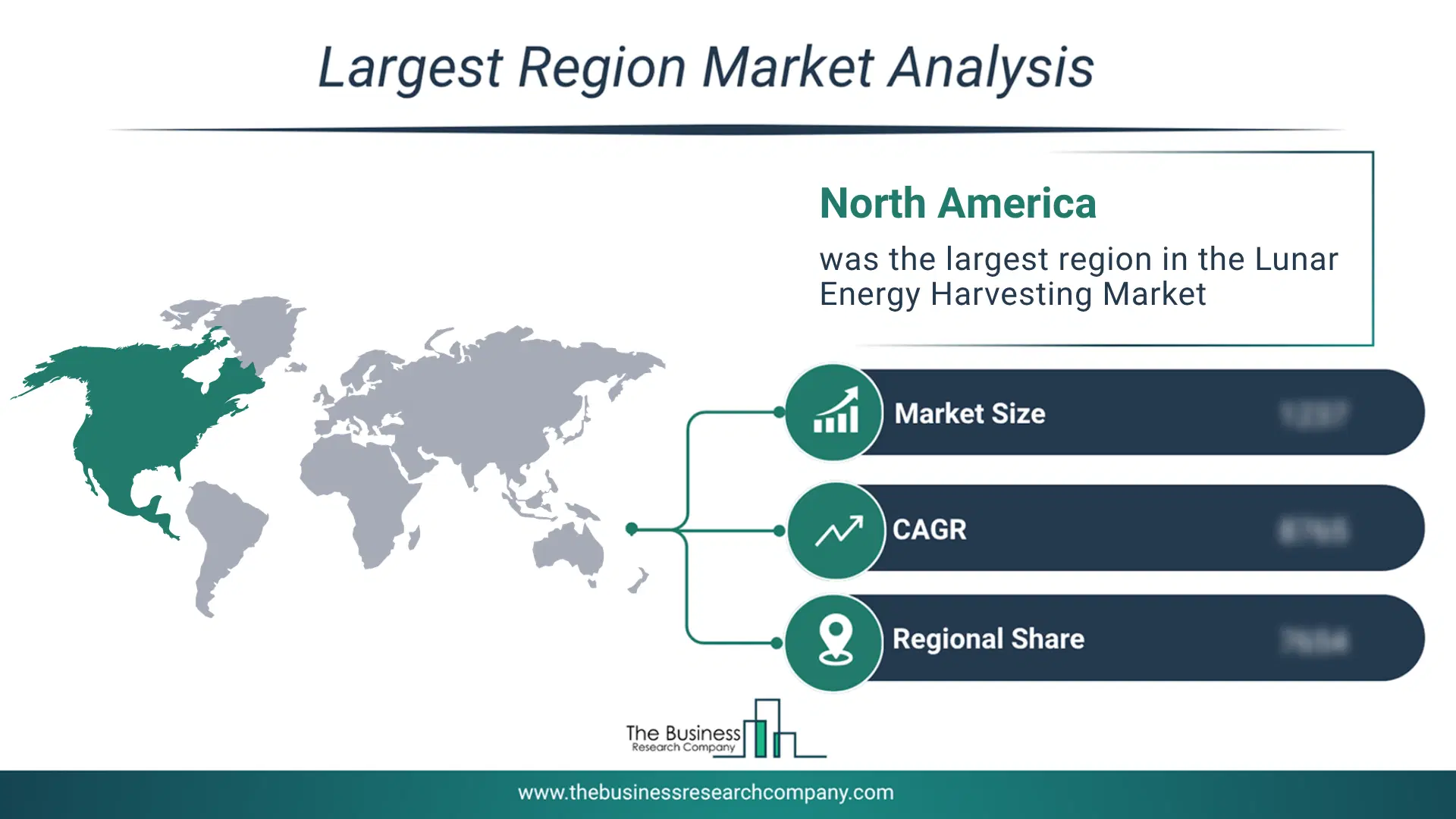
Regional Insights
North America was the largest region in the lunar energy harvesting market in 2025. Asia-Pacific is expected to be the fastest-growing region in the forecast period. The regions covered in this market report are Asia-Pacific, South East Asia, Western Europe, Eastern Europe, North America, South America, Middle East, Africa. The countries covered in this market report are Australia, Brazil, China, France, Germany, India, Indonesia, Japan, Taiwan, Russia, South Korea, UK, USA, Canada, Italy, SpainWhat Defines the Lunar Energy Harvesting Market?
The lunar energy harvesting market consists of revenues earned by entities by providing services such as lunar energy infrastructure deployment services, power system integration and testing, remote monitoring and diagnostics services, energy management for lunar missions, and maintenance and repair services for lunar power systems. The market value includes the value of related goods sold by the service provider or included within the service offering. The lunar energy harvesting market also includes sales of lunar solar panels, high-efficiency energy converters, cryogenic energy storage tanks, modular lunar power units, radiation-hardened electrical components, autonomous lunar power rovers, and thermal regulation systems for power units. Values in this market are ‘factory gate’ values, that is, the value of goods sold by the manufacturers or creators of the goods, whether to other entities (including downstream manufacturers, wholesalers, distributors, and retailers) or directly to end customers. The value of goods in this market includes related services sold by the creators of the goods.How is Market Value Defined and Measured?
The market value is defined as the revenues that enterprises gain from the sale of goods and/or services within the specified market and geography through sales, grants, or donations in terms of the currency (in USD unless otherwise specified). The revenues for a specified geography are consumption values that are revenues generated by organizations in the specified geography within the market, irrespective of where they are produced. It does not include revenues from resales along the supply chain, either further along the supply chain or as part of other products.
This chart presents market attractiveness based on a quantitative evaluation of growth, competition, strategic alignment, and risk, offering a clear view of opportunity areas for decision-making. This chart is for illustrative purposes; the full report contains the complete analysis.

This chart highlights the Total Addressable Market (TAM) by estimating the maximum revenue opportunity using an assumption-driven approach, supporting strategic planning and opportunity sizing across markets. The chart is illustrative; the full report provides a more comprehensive analysis.
What Key Data and Analysis Are Included in the Lunar Energy Harvesting Market Report 2026?
The lunar energy harvesting market research report is one of a series of new reports from The Business Research Company that provides market statistics, including industry global market size, regional shares, competitors with the market share, detailed market segments, market trends and opportunities, and any further data you may need to thrive in the lunar energy harvesting industry. The market research report delivers a complete perspective of everything you need, with an in-depth analysis of the current and future state of the industry.Lunar Energy Harvesting Market Report Forecast Analysis
| Report Attribute | Details |
|---|---|
| Market Size Value In 2026 | $1.89 billion |
| Revenue Forecast In 2030 | $3.49 billion |
| Growth Rate | CAGR of 16.7% from 2026 to 2030 |
| Base Year For Estimation | 2025 |
| Actual Estimates/Historical Data | 2020-2025 |
| Forecast Period | 2026 - 2030 |
| Market Representation | Revenue in USD Billion and CAGR from 2026 to 2030 |
| Segments Covered | Technology, Application, End-User |
| Regional Scope | Asia-Pacific, Western Europe, Eastern Europe, North America, South America, Middle East, Africa |
| Country Scope | The countries covered in the report are Australia, Brazil, China, France, Germany, India, Indonesia, Japan, Taiwan, Russia, South Korea, UK, USA, Canada, Italy, Spain. |
| Key Companies Profiled | Boeing, Lockheed Martin, Airbus, Northrop Grumman, Thales Alenia Space, Blue Origin, SpaceX, Sierra Nevada Corporation, Maxar Technologies, Intuitive Machines, Astrobotic Technology, iSpace, Masten Space Systems, Moon Express, OrbitBeyond, NASA Advanced Energy Division (contract ecosystem), Interlune, Shackleton Energy Company, Honeybee Robotics, Redwire Space, Ball Aerospace, Rocket Lab, ispace Europe, Lunar Outpost, Teledyne Brown Engineering |
| Customization Scope | Request for Customization |
| Pricing And Purchase Options | Explore Purchase Options |