
Lunar Exploration Technology Market Report 2026
Global Outlook – By Technology Type (Propulsion Systems, Landing Systems, Navigation And Guidance, Communication Systems, Power Systems, Robotics And Automation, Scientific Instruments, Other Technology Types), By Application (Manned Missions, Unmanned Missions, Lunar Rovers, Lunar Landers, Lunar Orbiters, Other Applications), By End-User (Government Space Agencies, Commercial Space Companies, Research Institutes, Other End-Users) – Market Size, Trends, Strategies, and Forecast to 2030
Lunar Exploration Technology Market Overview
• Lunar Exploration Technology market size has reached to $11.42 billion in 2025 • Expected to grow to $21.42 billion in 2030 at a compound annual growth rate (CAGR) of 13.3% • Growth Driver: Surge In Space Exploration Fueling The Growth Of The Market Due To Increasing Investment In Scientific Research • Market Trend: Advancements In Next-Generation Lunar Landers And Rovers • North America was the largest region in 2025 and Asia-Pacific is the fastest growing region.Market Gains By 2030 – Top Opportunities By Segment
Market Gain identifies the most promising market opportunities by highlighting the segments or products expected to generate the highest incremental revenue growth over the next five years.
What Is Covered Under Lunar Exploration Technology Market?
Lunar exploration technology refers to the tools, systems, and methods developed to study, navigate, and operate on the Moon, including spacecraft, landers, rovers, communication systems, and scientific instruments. Its purpose is to advance scientific understanding, support resource utilization, and enable future human and robotic missions for sustained lunar presence and space exploration. The main types of lunar exploration technology are propulsion systems, landing systems, navigation and guidance, communication systems, power systems, robotics and automation, scientific instruments, and others. Propulsion systems refer to the mechanisms and technologies used to generate thrust, enabling a spacecraft or vehicle to move and maneuver in space. These systems are used for various applications, including manned missions, unmanned missions, lunar rovers, lunar landers, lunar orbiters, and others, with the key end-users include government space agencies, commercial space companies, research institutes, and others.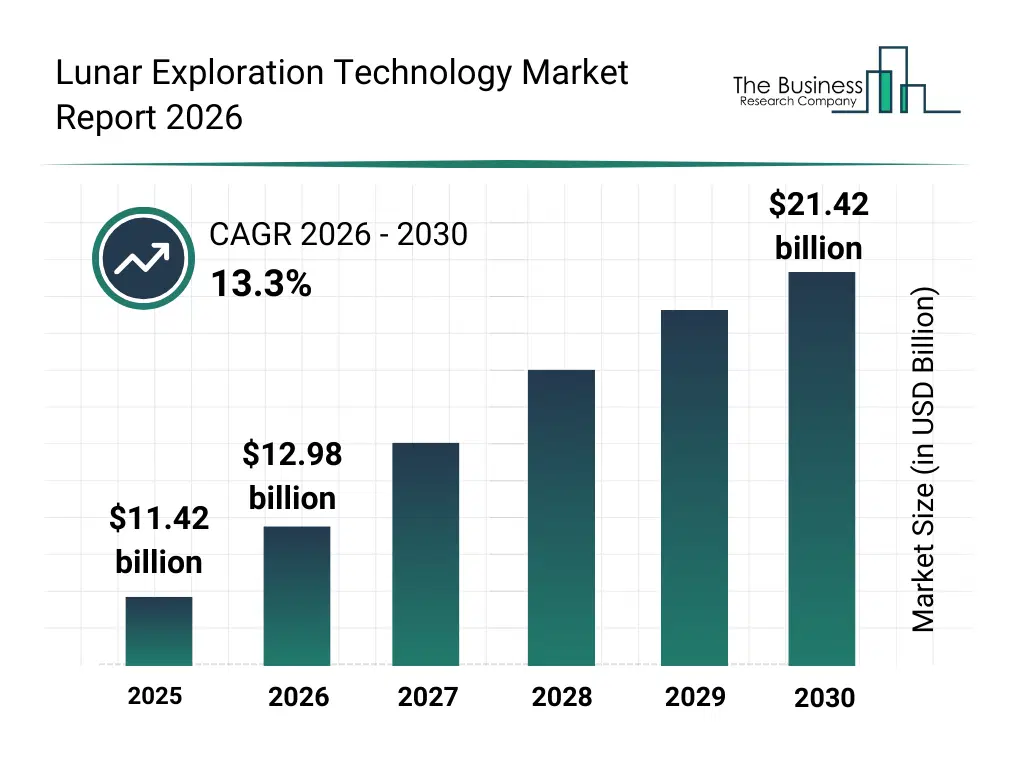
What Is The Lunar Exploration Technology Market Size and Share 2026?
The lunar exploration technology market size has grown rapidly in recent years. It will grow from $11.42 billion in 2025 to $12.98 billion in 2026 at a compound annual growth rate (CAGR) of 13.7%. The growth in the historic period can be attributed to successful robotic lunar missions, advances in lunar rover mobility, development of lunar communication relays, implementation of in-situ resource utilization experiments, government space agency investments.What Is The Lunar Exploration Technology Market Growth Forecast?
The lunar exploration technology market size is expected to see rapid growth in the next few years. It will grow to $21.42 billion in 2030 at a compound annual growth rate (CAGR) of 13.3%. The growth in the forecast period can be attributed to growth in commercial lunar exploration missions, demand for autonomous surface operations, development of advanced lunar drilling and excavation systems, adoption of radiation-resistant materials, integration of AI-driven lunar data analytics. Major trends in the forecast period include in-situ resource utilization (isru) adoption, modular lunar lander and rover designs, advanced lunar surface mobility solutions, lunar environment monitoring and hazard detection, high-precision lunar landing and navigation systems.
Global Lunar Exploration Technology Market Segmentation
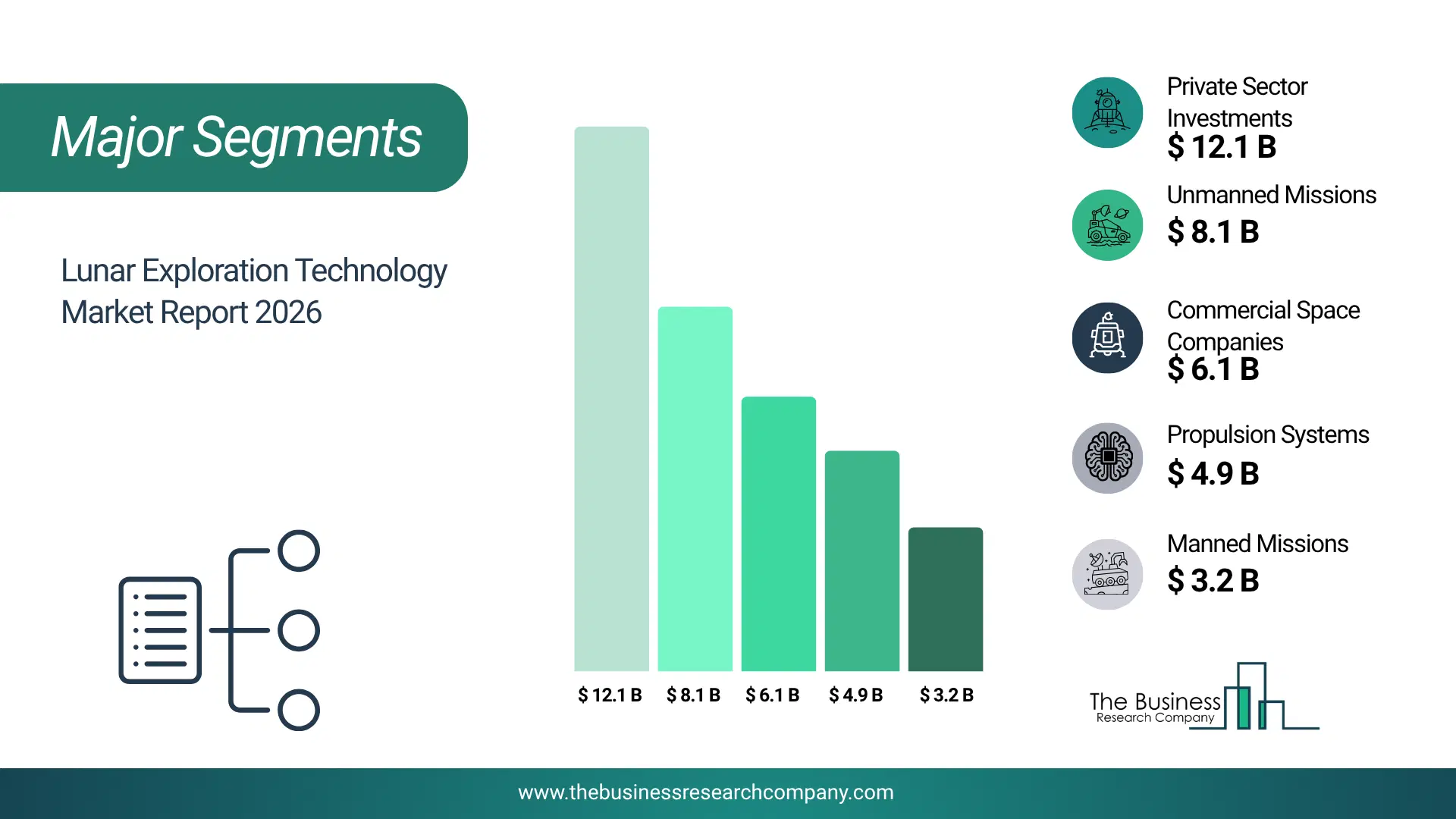
1) By Technology Type: Propulsion Systems, Landing Systems, Navigation And Guidance, Communication Systems, Power Systems, Robotics And Automation, Scientific Instruments, Other Technology Types 2) By Application: Manned Missions, Unmanned Missions, Lunar Rovers, Lunar Landers, Lunar Orbiters, Other Applications 3) By End-User: Government Space Agencies, Commercial Space Companies, Research Institutes, Other End-Users Subsegments: 1) By Propulsion Systems Type: Chemical Propulsion, Electric Propulsion, Hybrid Propulsion, Nuclear Propulsion 2) By Landing Systems Type: Powered Descent Systems, Precision Landing Systems, Hazard Detection And Avoidance Systems, Soft Landing Systems 3) By Navigation And Guidance Type: Inertial Navigation Systems, Celestial Navigation Systems, Terrain Relative Navigation, Autonomous Guidance Systems 4) By Communication Systems Type: Deep Space Communication Systems, Optical Communication Systems, Radio Frequency Communication Systems, Relay Satellite Systems 5) By Power Systems Type: Solar Power Systems, Nuclear Power Systems, Fuel Cell Systems, Battery Storage Systems 6) By Robotics And Automation Type: Lunar Rovers, Robotic Arms, Autonomous Navigation Robots, In Situ Resource Utilization Robots 7) By Scientific Instruments Type: Spectrometers, Seismometers, Imaging Systems, Drilling And Sampling Instruments 8) By Other Technology Types: Thermal Control Systems, Radiation Protection Systems, Habitat Support Systems, Additive Manufacturing Systems The top segments in the lunar exploration technology market will be: • Government Space Agencies will reach $12111.66 Million by 2030. • Unmanned Missions will reach $8159.12 Million by 2030. • Propulsion Systems will reach $4933.54 Million by 2030. • Commercial Space Companies will reach $6095.37 Million by 2030. • Manned Missions will reach $3236.31 Million by 2030.What Is Driver Of The Lunar Exploration Technology Market?
The increasing interest in space exploration is expected to propel the growth of the lunar exploration technology market going forward. Space exploration is the study and discovery of outer space using rockets, satellites, and spacecraft. The rise in space exploration is driven by increasing investment in scientific research, as it allows countries and companies to discover new knowledge and develop advanced technologies. Lunar exploration technology helps space exploration by enabling detailed study of the Moon’s surface, supporting future missions, and advancing our understanding of the solar system. For instance, in July 2023, according to Pixalytics Ltd., a UK-based earth observation company, there were 11330 individual satellites orbiting the Earth at the end of June 2023, a whopping 37.94% increase since January 2022. Therefore, the increasing interest in space exploration imagery is driving the growth of the lunar exploration technology industry.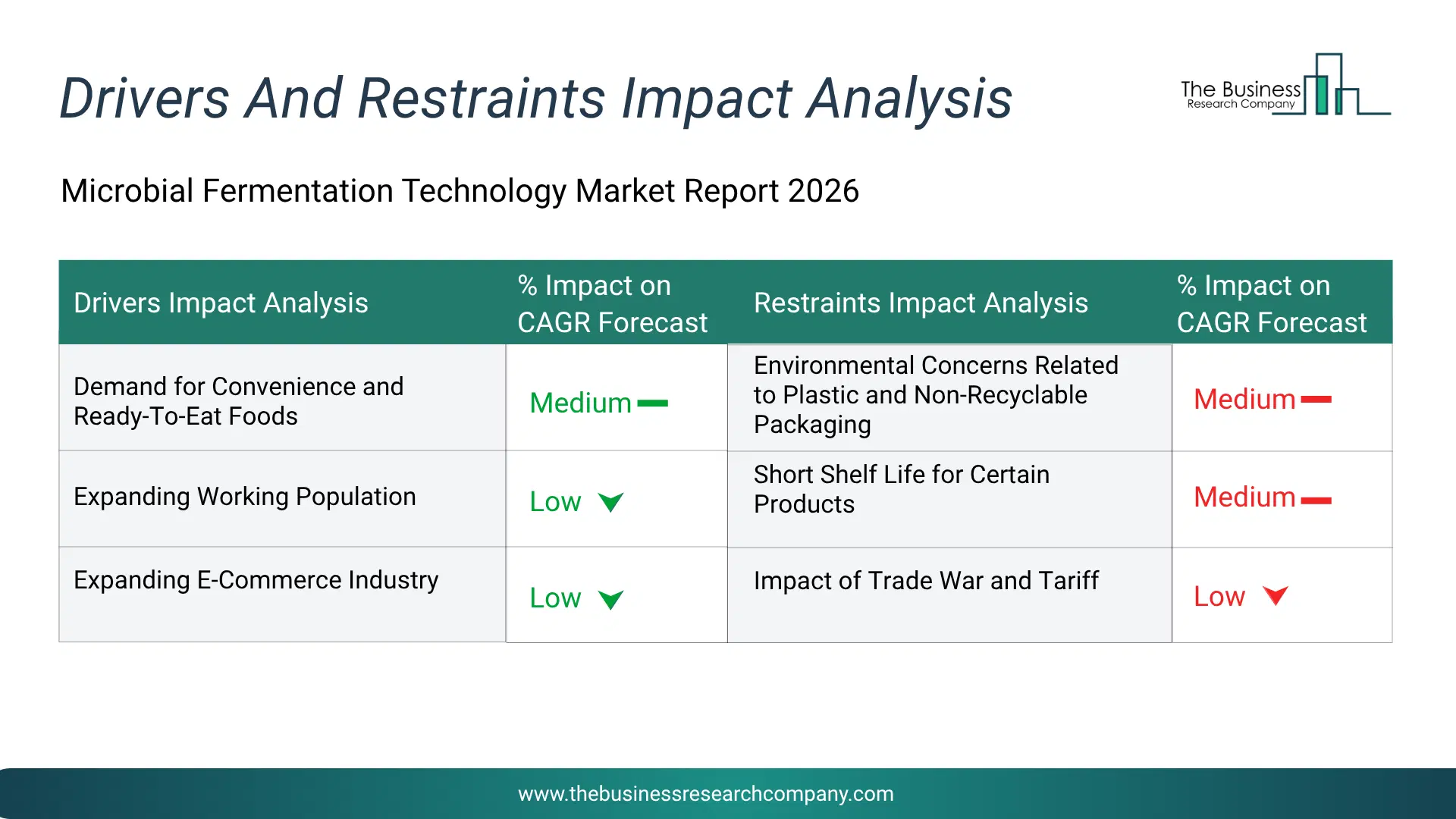
Infographic Chart Showing Key Market Drivers Analysis And Restraints For Lunar Exploration Technology Market
The chart presents an impact analysis of key drivers and restraints, quantifying their relative influence on the market's growth rate and helping assess the balance between growth enablers and limiting factors. This chart offers a high-level perspective; the full report contains more detailed insights.
How Will The Drivers Impact Growth In The Global Lunar Exploration Technology Market?
• Long-Term Budget Commitments for Moon-to-Mars Programs (Medium) – During the forecast period, the long-term budget commitments for moon-to-mars programs is expected to propel the growth of the lunar exploration technology market. lunar exploration technology acts as a proving ground for systems, infrastructure and mission operations that are directly reusable for moon-to-mars programs, reducing uncertainty and spreading development costs over multiple missions. continuous lunar missions enable phased investment, hardware reuse and incremental testing, which supports structured long-term budget commitments instead of one-time high-risk spending. nasa’s fy2026 budget request outlines sustained multi-year funding commitments for moon-to-mars programs, with continued support for transportation systems, exploration infrastructure and mission development through the end of the decade. it reinforces long-term investment in lunar missions and mars preparation capabilities, ensuring continuity of artemis and related deep space exploration efforts and long-term budget commitments for moon-to-mars programs may drive the growth of the lunar exploration technology. as a result, the long-term budget commitments for moon-to-mars programs is anticipated to contributing to a is 2.0% annual growth in the market. • Establishment Of Sustained Lunar Surface Infrastructure (Medium) – During the forecast period, the establishment of sustained lunar surface infrastructure is expected to propel the growth lunar exploration technology market. sustained lunar surface infrastructure refers to long-duration, continuously operating systems and facilities on the moon, such as habitats, power units, communication networks, mobility platforms and resource processing setups that support repeated or permanent missions rather than short visits and lunar exploration technology enables this through advanced landers, autonomous construction, in situ resource utilization, precision navigation and reliable surface power and life support systems, collectively reducing resupply dependence and enabling stable, scalable and long-term human and robotic operations on the lunar surface. nasa and the department of energy are collaborating to develop a lunar surface nuclear fission reactor targeted for deployment by 2030 to support long-duration moon missions. the planned reactor is designed to deliver continuous and reliable power on the lunar surface, helping overcome limits from long lunar nights and harsh environmental conditions. this power capability is intended to enable sustained lunar surface infrastructure, including habitats, science systems and operational technologies for ongoing exploration and the establishment of sustained lunar surface infrastructure may drive the growth of the lunar exploration technology market. consequently, the establishment of sustained lunar surface infrastructure is projected to contributing to a 1.8% annual growth in the market. • Advancements In Reusable Launch Vehicles (Medium) – During the forecast period, the advancements in reusable launch vehicles is expected to propel the growth of the lunar exploration technology market in the forecast period. lunar exploration technology accelerates advancements in reusable launch vehicles by driving demand for frequent, cost-efficient and high-payload missions to and from the moon. to support repeated lunar missions, agencies and private firms invest in reusable boosters, landers and deep-space-capable stages that can be refurbished and reflown. this continuous mission cycle improves reusability design, turnaround time and reliability, directly strengthening reusable launch vehicle capabilities. reusable rockets are transforming space exploration by providing a more sustainable and cost-effective alternative to traditional expendable rockets, highlighting technological advances like spacex’s falcon 9. it explains the scientific principles, historical development and engineering innovations that make reusability possible and discusses how these technologies lower launch costs and environmental impact. therefore, the advancements in reusable launch vehicles is projected to contributing to a 1.3% annual growth in the market. • Improvements In Lunar Landing Systems (Low) – During the forecast period, improvements in lunar landing systems are expected to propel the growth in the lunar exploration technology market. Lunar exploration technology supports improvement in lunar landing systems through advances in precision navigation, autonomous guidance and hazard detection that enable safer and more controlled surface descent, while modern propulsion and sensor systems improve landing accuracy and stability. Continuous mission testing, simulation and surface mapping enhance system reliability and decision-making during descent and touchdown, strengthening overall landing performance across missions. Multiple missions showed clear progress in lunar landing systems through improved propulsion testing, escape systems and precision landing technologies aimed at safer crewed and robotic Moon missions. Commercial landers under NASA partnership programs achieved successful soft landings, proving better navigation, guidance and surface operation capability. At the same time, partial mission failures highlighted remaining reliability gaps, driving further refinement and testing of lunar landing hardware and control systems and improvement in lunar landing systems may drive the growth of the lunar exploration technology market. The improvements in lunar landing systems growth contribution during the forecast period in 2025 is 0.8%.How Will The Restraints Impact Growth In The Global Lunar Exploration Technology Market?
• Payload Mass Constraints (Medium) – During the forecast period, payload mass constraints are restricting the growth of the lunar exploration technology market. Payload mass constraints limit the size and weight of instruments, habitats and support systems that can be delivered to the lunar surface, forcing reduced capability or multiple launches, which raises mission complexity and cost while slowing deployment timelines. Current space structures and missions are heavily constrained by traditional launch limits related to mass, volume and cost, which restrict how large and complex payloads can be sent into orbit. These limitations also reduce flexibility in mission design and delay the testing of advanced lunar systems and infrastructure. As a result, technology developers must prioritize miniaturization and modularity, which can extend development cycles and increase overall program risk. Growth affected by the payload mass constraints during the forecast period in 2025 is -1.0%. • Extreme Lunar Environmental Conditions (Medium) – During the forecast period, extreme lunar environmental conditions are restricting the growth of the lunar exploration technology market. Extreme lunar environmental conditions such as severe temperature swings, near vacuum, strong radiation and abrasive lunar dust reduce the reliability and lifespan of lunar exploration technology by stressing electronics, batteries and structural materials. Radiation and thermal cycling can cause component failures and performance degradation, while fine dust interferes with joints, optics, seals and power systems. These challenges increase system complexity, protection needs and mission risk, slowing deployment of sustained lunar surface technologies. Extreme lunar environmental conditions may hamper the growth of lunar exploration technology. Growth affected by the extreme lunar environmental conditions during the forecast period in 2025 is -0.5%. • Impact Of Trade Wars And Tariffs (Medium) – During the forecast period, the impact of trade wars and tariffs is restricting the growth of the lunar exploration technology market. Trade wars and tariffs increase the cost of critical components such as advanced electronics, propulsion materials, sensors and space-grade manufacturing equipment used in lunar exploration systems. Higher import duties and supply chain restrictions slow international collaboration and delay technology transfer across space agencies and private contractors. This raises project budgets and procurement timelines, thereby hampering innovation speed and deployment of lunar exploration technology. The global space industry is preparing for higher costs and supply chain disruption as the United States imposes tariffs on imported goods and materials that are integral to building satellites and other space technology, leading to uncertainty about project budgets and delivery timelines. Analysts say the full impact is still unclear, with potential exemptions and negotiations underway, but many companies expect increased expenses and planning challenges due to these trade policies. Growth affected by the impact of trade wars and tariffs during the forecast period in 2025 is -0.3%.Key Players In The Global Lunar Exploration Technology Market
Major companies operating in the lunar exploration technology market are Boeing Company, Lockheed Martin Corporation, Northrop Grumman Corporation, National Aeronautics and Space Administration (NASA), Space Exploration Technologies Corp. (SpaceX), Blue Origin LLC, Sierra Nevada Corporation, MDA Space Ltd., Teledyne Brown Engineering Inc., ispace Inc., Astrolab SAS, Intuitive Machines Inc., Firefly Aerospace Inc., The Exploration Company GmbH, GITAI Japan Inc., Special Aerospace Services Ltd., Astrobotic Technology Inc., Indian Space Research Organisation (ISRO), Lunar Outpost Inc., CisLunar Industries Inc.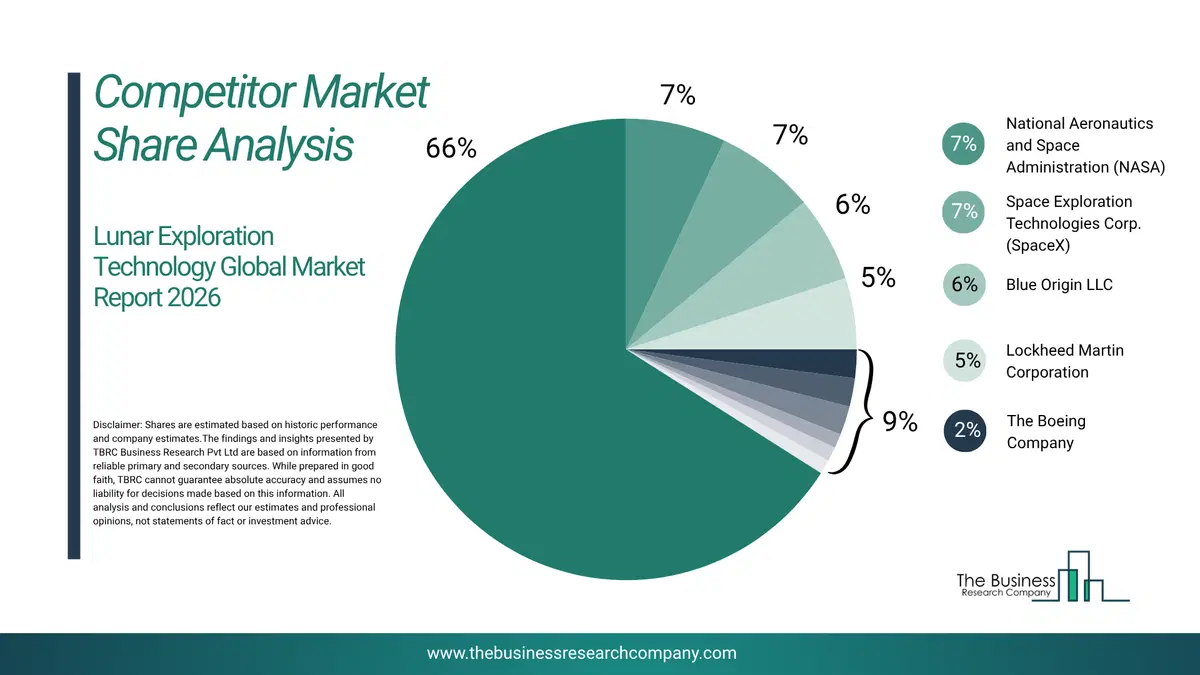
This chart is for illustrative purposes; the full report includes a detailed competitor analysis and comprehensive overview of the top 10 companies in the market.
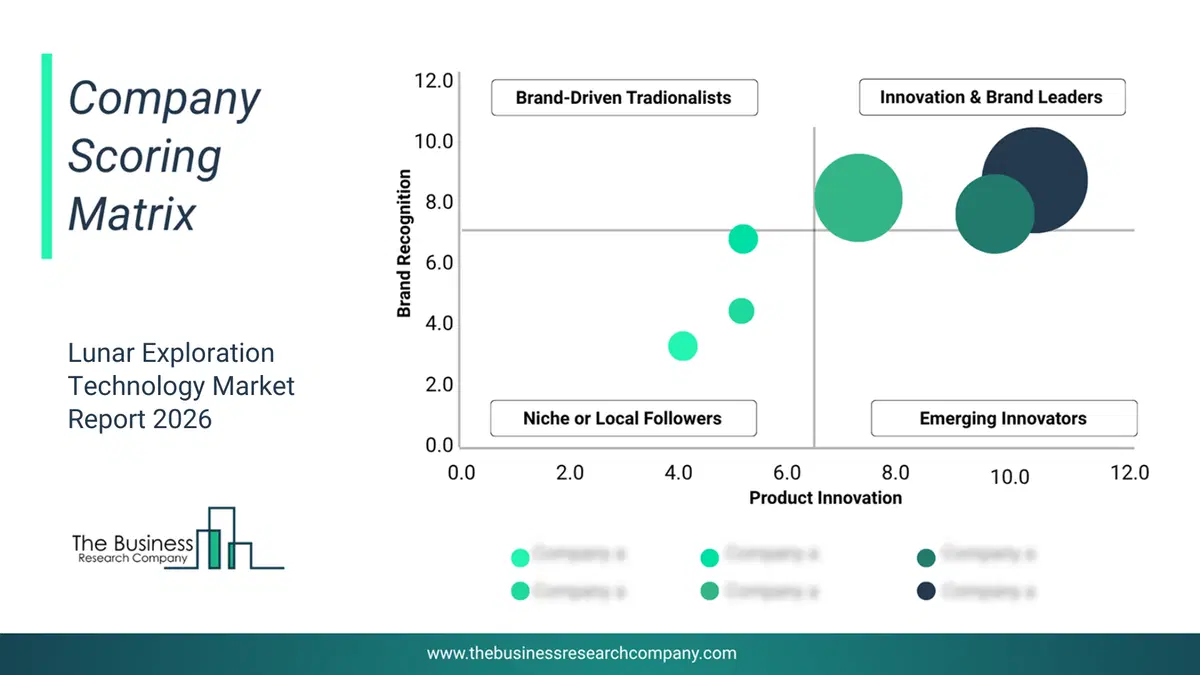
This chart maps companies by product innovation and brand strength, with bubble size indicating relative revenue, helping identify market leaders, challengers, and niche players. This is an illustrative chart; the full report provides a complete and accurate competitive analysis.
Global Lunar Exploration Technology Market Trends and Insights
Major companies operating in the lunar exploration technology market are focusing on developing technological advancements such as next-generation lunar lander and rover systems to achieve safe landing, mobility, and in-situ experiments on the Moon. Next-generation lunar lander and rover systems are advanced exploration technologies designed to perform precise landings, navigate rough lunar terrain, and carry scientific payloads for long-duration missions. For instance, in July 2023, the Indian Space Research Organisation (ISRO), an India-based government space agency, launched Chandrayaan-3. This demonstrated a successful soft landing near the lunar south pole, deployed a rover for surface exploration, enhanced India’s capability in planetary missions, and contributed vital scientific data for future lunar research. Additionally, the mission's data helps deepen understanding of the moon's geology and resources, opening avenues for further scientific discovery and potential utilization.What Are Latest Mergers And Acquisitions In The Lunar Exploration Technology Market? Voyager Space Acquires ZIN Technologies, Inc.
In March 2023, Voyager Space, a US-based provider of space station infrastructure, services, and technology solutions, acquired ZIN Technologies, Inc. for an undisclosed amount. With this acquisition, Voyager Space aimed to expand its space infrastructure and technology capabilities to further its development of Starlab, a continuously crewed commercial space station. ZIN Technologies, Inc. is a US-based advanced aerospace engineering company providing engineering, design, and integration services, including human-rated spaceflight systems, propulsion, and microgravity research equipment, with decades-long experience serving NASA, national security agencies, and leading aerospace and defense companies.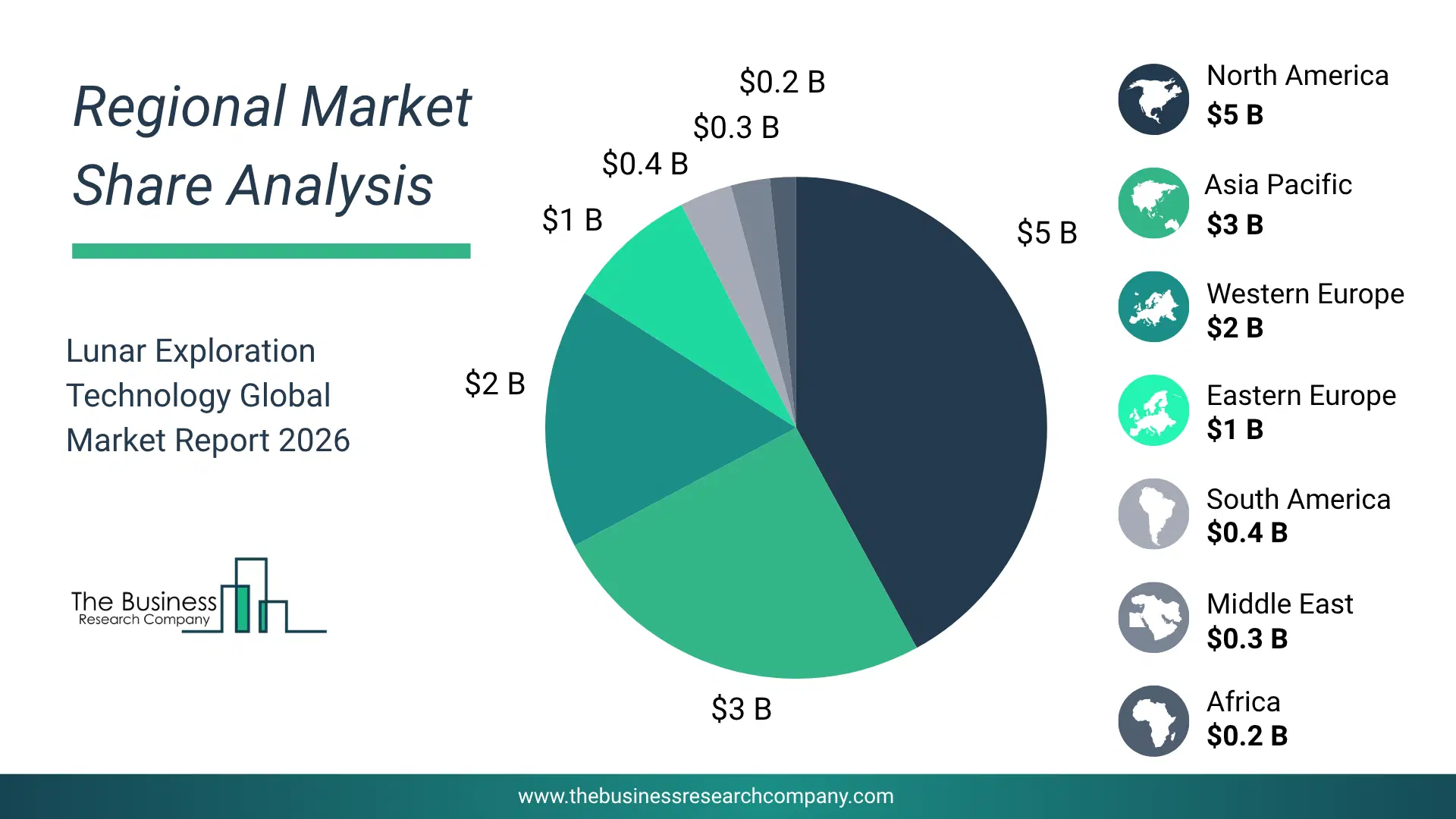
Regional Insights
North America was the largest region in the lunar exploration technology market in 2025. Asia-Pacific is expected to be the fastest-growing region in the forecast period. The regions covered in this market report are Asia-Pacific, South East Asia, Western Europe, Eastern Europe, North America, South America, Middle East, Africa. The countries covered in this market report are Australia, Brazil, China, France, Germany, India, Indonesia, Japan, Taiwan, Russia, South Korea, UK, USA, Canada, Italy, SpainWhat Defines the Lunar Exploration Technology Market?
The lunar exploration technology market consists of revenues earned by entities by providing services such as lunar landing site selection, surface mobility solutions, lunar data analytics, in-situ resource utilization (ISRU) operations, and lunar environment monitoring. The market value includes the value of related goods sold by the service provider or included within the service offering. The lunar exploration technology market includes sales of robotic arms for lunar operations, thermal control systems, radiation shielding materials, and lunar drilling and excavation equipment. Values in this market are ‘factory gate’ values, that is, the value of goods sold by the manufacturers or creators of the goods, whether to other entities (including downstream manufacturers, wholesalers, distributors, and retailers) or directly to end customers. The value of goods in this market includes related services sold by the creators of the goods.How is Market Value Defined and Measured?
The market value is defined as the revenues that enterprises gain from the sale of goods and/or services within the specified market and geography through sales, grants, or donations in terms of the currency (in USD unless otherwise specified). The revenues for a specified geography are consumption values that are revenues generated by organizations in the specified geography within the market, irrespective of where they are produced. It does not include revenues from resales along the supply chain, either further along the supply chain or as part of other products.
This chart presents market attractiveness based on a quantitative evaluation of growth, competition, strategic alignment, and risk, offering a clear view of opportunity areas for decision-making. This chart is for illustrative purposes; the full report contains the complete analysis.

This chart highlights the Total Addressable Market (TAM) by estimating the maximum revenue opportunity using an assumption-driven approach, supporting strategic planning and opportunity sizing across markets. The chart is illustrative; the full report provides a more comprehensive analysis.
What Key Data and Analysis Are Included in the Lunar Exploration Technology Market Report 2026?
The lunar exploration technology market research report is one of a series of new reports from The Business Research Company that provides market statistics, including industry global market size, regional shares, competitors with the market share, detailed market segments, market trends and opportunities, and any further data you may need to thrive in the lunar exploration technology industry. The market research report delivers a complete perspective of everything you need, with an in-depth analysis of the current and future state of the industry.Lunar Exploration Technology Market Report Forecast Analysis
| Report Attribute | Details |
|---|---|
| Market Size Value In 2026 | $12.98 billion |
| Revenue Forecast In 2030 | $21.42 billion |
| Growth Rate | CAGR of 13.7% from 2026 to 2030 |
| Base Year For Estimation | 2025 |
| Actual Estimates/Historical Data | 2020-2025 |
| Forecast Period | 2026 - 2030 - 2035 |
| Market Representation | Revenue in USD Billion and CAGR from 2026 to 2030 |
| Segments Covered | Technology Type, Application, End-User |
| Regional Scope | Asia-Pacific, Western Europe, Eastern Europe, North America, South America, Middle East, Africa |
| Country Scope | The countries covered in the report are Australia, Brazil, China, France, Germany, India, Indonesia, Japan, Taiwan, Russia, South Korea, UK, USA, Canada, Italy, Spain. |
| Key Companies Profiled | Boeing Company, Lockheed Martin Corporation, Northrop Grumman Corporation, National Aeronautics and Space Administration (NASA), Space Exploration Technologies Corp. (SpaceX), Blue Origin LLC, Sierra Nevada Corporation, MDA Space Ltd., Teledyne Brown Engineering Inc., ispace Inc., Astrolab SAS, Intuitive Machines Inc., Firefly Aerospace Inc., The Exploration Company GmbH, GITAI Japan Inc., Special Aerospace Services Ltd., Astrobotic Technology Inc., Indian Space Research Organisation (ISRO), Lunar Outpost Inc., CisLunar Industries Inc. |
| Customization Scope | Request for Customization |
| Pricing And Purchase Options | Explore Purchase Options |