
Magneto-Deoxyribonucleic Acid (DNA) Biosensors Market Report 2026
Global Outlook – By Product (Electrochemical Magneto-Deoxyribonucleic Acid Biosensors, Optical Magneto-Deoxyribonucleic Acid Biosensors), By Component (Hardware or Devices, Assay Kits And Reagents, Consumables, Software And Data Analytics), By Technology (Magnetoresistive Sensors (GMR/TMR), Superparamagnetic Nanoparticle-Based Sensors, Hall Effect Sensors, Magneto-Elastic Biosensors), By Application (Infectious Disease Diagnostics, Oncology And Liquid Biopsy, Genetic Testing And Screening, Food Safety Testing, Environmental Monitoring, Research And Drug Development), By End User – Market Size, Trends, Strategies, and Forecast to 2035
Magneto-Deoxyribonucleic Acid (DNA) Biosensors Market Overview
• Magneto-Deoxyribonucleic Acid (DNA) Biosensors market size has reached to $1.46 billion in 2025 • Expected to grow to $2.66 billion in 2030 at a compound annual growth rate (CAGR) of 12.9% • Growth Driver: Surge In Infectious Diseases Fueling The Growth Of The Market Due To Rapid Spread Of Pathogens And Increased Diagnostic Demand • North America was the largest region in 2025 and Asia-Pacific is the fastest growing region.
What Is Covered Under Magneto-Deoxyribonucleic Acid (DNA) Biosensors Market?
Magneto-deoxyribonucleic acid (DNA) biosensors are analytical devices that combine magnetic materials with DNA molecules to detect specific genetic sequences with high sensitivity. These biosensors work by using magnetic nanoparticles or magnetic fields to enhance the binding interactions between target DNA and the sensor, enabling rapid and precise identification of genetic material. They are widely utilized in biomedical research and diagnostics for applications such as detecting mutations, pathogens, or gene expression patterns. The main products of magneto-deoxyribonucleic acid (DNA) biosensors include electrochemical magneto-deoxyribonucleic acid biosensors and optical magneto-deoxyribonucleic acid biosensors. Electrochemical magneto-deoxyribonucleic acid biosensors are devices that detect specific deoxyribonucleic acid sequences by converting biological interactions into measurable electrical signals, enabling rapid and sensitive genetic analysis. They are supported by components such as hardware or devices, assay kits and reagents, consumables, and software and data analytics, and utilize technologies such as magnetoresistive sensors (GMR/TMR), superparamagnetic nanoparticle-based sensors, Hall effect sensors, and magneto-elastic biosensors. The various applications involved are infectious disease diagnostics, oncology and liquid biopsy, genetic testing and screening, food safety testing, environmental monitoring, and research and drug development, and are used by several end users such as hospitals and diagnostic laboratories, academic and research institutions, pharmaceutical and biotechnology companies, food and beverage testing laboratories, environmental testing agencies, and contract research organizations.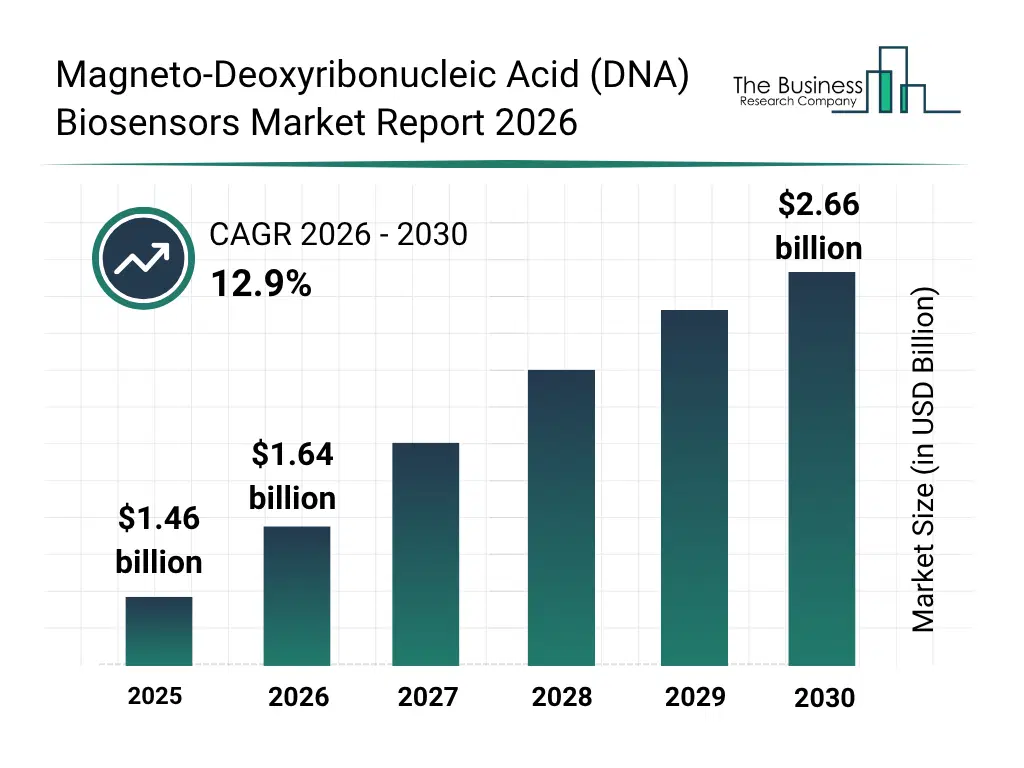
What Is The Magneto-Deoxyribonucleic Acid (DNA) Biosensors Market Size and Share 2026?
The magneto-deoxyribonucleic acid (DNA) biosensors market size has grown rapidly in recent years. It will grow from $1.46 billion in 2025 to $1.64 billion in 2026 at a compound annual growth rate (CAGR) of 12.7%. The growth in the historic period can be attributed to advancements in nanotechnology research, increasing prevalence of infectious diseases, growth in cancer diagnostics demand, rising investment in biomedical research, expanding use of magnetic nanoparticles in biosensing.What Is The Magneto-Deoxyribonucleic Acid (DNA) Biosensors Market Growth Forecast?
The magneto-deoxyribonucleic acid (DNA) biosensors market size is expected to see rapid growth in the next few years. It will grow to $2.66 billion in 2030 at a compound annual growth rate (CAGR) of 12.9%. The growth in the forecast period can be attributed to growing adoption of personalized medicine approaches, increasing demand for early disease detection tools, rising integration of AI-based data analytics, expansion of decentralized diagnostic testing, development of high-sensitivity portable biosensor devices. Major trends in the forecast period include increasing adoption of superparamagnetic nanoparticle-based sensors, rising demand for rapid point-of-care genetic diagnostics, growing integration of magnetoresistive (GMR/TMR) technologies, expansion of liquid biopsy applications, rising use in multiplexed pathogen detection.Global Magneto-Deoxyribonucleic Acid (DNA) Biosensors Market Segmentation
1) By Product: Electrochemical Magneto-Deoxyribonucleic Acid Biosensors, Optical Magneto-Deoxyribonucleic Acid Biosensors 2) By Component: Hardware or Devices, Assay Kits And Reagents, Consumables, Software And Data Analytics 3) By Technology: Magnetoresistive Sensors (GMR/TMR), Superparamagnetic Nanoparticle-Based Sensors, Hall Effect Sensors, Magneto-Elastic Biosensors 4) By Application: Infectious Disease Diagnostics, Oncology And Liquid Biopsy, Genetic Testing And Screening, Food Safety Testing, Environmental Monitoring, Research And Drug Development 5) By End User: Hospitals And Diagnostic Laboratories, Academic And Research Institutions, Pharmaceutical And Biotechnology Companies, Food And Beverage Testing Laboratories, Environmental Testing Agencies, Contract Research Organizations Subsegments: 1) By Electrochemical Magneto-DNA Biosensors: Voltammetric Detection, Amperometric Detection, Impedimetric Detection, Potentiometric Detection 2) By Optical Magneto-DNA Biosensors: Fluorescence Detection, Surface Plasmon Resonance Detection, Colorimetric Detection, Chemiluminescence DetectionWhat Are The Drivers Of The Magneto-Deoxyribonucleic Acid (DNA) Biosensors Market?
The growing global burden of infectious diseases is expected to drive the growth of the magneto-deoxyribonucleic acid (DNA) biosensors market in the coming years. Infectious diseases are caused by pathogenic microorganisms such as bacteria, viruses, fungi, or parasites and can spread directly or indirectly between individuals. Factors such as increasing international travel, urbanization, climate change, and evolving pathogen resistance patterns have heightened the risk of disease transmission and outbreaks worldwide. Magneto-DNA biosensors play a critical role in infectious disease management by enabling the rapid detection and identification of specific pathogen DNA sequences with high sensitivity, supporting early diagnosis, disease surveillance, and timely clinical intervention. For instance, according to World Health Organization, a Switzerland-based intergovernmental organization global demand for malaria vaccines is projected to reach 40–60 million doses annually by 2026 and increase further to 80–100 million doses per year by 2030, highlighting sustained efforts to combat infectious diseases worldwide. Therefore, the rising prevalence of infectious diseases is driving the growth of the magneto-deoxyribonucleic acid (DNA) biosensors industry. The increasing burden of genetic disorders is expected to drive the growth of the magneto-deoxyribonucleic acid (DNA) biosensors market in the coming years. Genetic disorders are conditions caused by abnormalities in an individual’s genes or chromosomes. The growing identification of genetic disorders is largely attributed to advances in genetic testing technologies and expanded screening programs, which enable earlier and more accurate detection of inherited conditions across populations. Magneto-DNA biosensors support the diagnosis and management of genetic disorders by enabling highly sensitive and rapid detection of specific gene mutations and chromosomal abnormalities, facilitating early diagnosis, risk assessment, and personalized treatment strategies. For instance, in November 2024, according to NHS Wales, a UK-based healthcare system, more than 380 rare childhood diseases were being screened, with cystic fibrosis identified as the most common genetic condition, occurring at a rate of 3.93 cases per 10,000 live births. Therefore, the rising prevalence of genetic disorders is driving the growth of the magneto-deoxyribonucleic acid (DNA) biosensors industry. The growing adoption of personalized medicine is expected to drive the growth of the magneto-deoxyribonucleic acid (DNA) biosensors market in the coming years. Personalized medicine is a medical approach that tailors treatment and prevention strategies based on an individual’s genetic, environmental, and lifestyle factors. Its increasing adoption is driven by improved treatment efficacy, as therapies aligned with a patient’s genetic profile enhance clinical outcomes while reducing adverse effects. Magneto-DNA biosensors support personalized medicine by enabling precise, rapid, and sensitive detection of specific genetic mutations and biomarkers, facilitating tailored therapies and optimized treatment plans. For instance, in February 2024, according to the Personalized Medicine Coalition, a US-based healthcare organization, the US Food and Drug Administration approved 16 new personalized treatments for rare disease patients in 2023, up from six approvals in 2022. Therefore, the growing adoption of personalized medicine is driving the growth of the magneto-deoxyribonucleic acid (DNA) biosensors industry.Key Players In The Global Magneto-Deoxyribonucleic Acid (DNA) Biosensors Market
Major companies operating in the magneto-deoxyribonucleic acid (DNA) biosensors market are Roche Diagnostics, Thermo Fisher Scientific, Siemens Healthineers, Merck KGaA, Danaher Corporation, GE Healthcare, Becton, Dickinson Company (BD), Agilent Technologies, Illumina Inc., Endress+Hauser Group, Sysmex Corporation, Revvity Inc., Bio-Rad Laboratories, Miltenyi Biotec, GenScript Biotech Corporation, Promega Corporation, Quanterix Corporation, MagArray, Inc., Creative Diagnostics, Pluslife.Regional Insights
North America was the largest region in the magneto-deoxyribonucleic acid (DNA) biosensors market in 2025. Asia-Pacific is expected to be the fastest-growing region in the forecast period. The regions covered in this market report are Asia-Pacific, South East Asia, Western Europe, Eastern Europe, North America, South America, Middle East, Africa. The countries covered in this market report are Australia, Brazil, China, France, Germany, India, Indonesia, Japan, Taiwan, Russia, South Korea, UK, USA, Canada, Italy, Spain.What Defines the Magneto-Deoxyribonucleic Acid (DNA) Biosensors Market?
The magneto-deoxyribonucleic acid (DNA) biosensors market consist of sales of magnetic beads, biosensor cartridges, signal transduction modules. Values in this market are ‘factory gate’ values, that is, the value of goods sold by the manufacturers or creators of the goods, whether to other entities (including downstream manufacturers, wholesalers, distributors, and retailers) or directly to end customers. The value of goods in this market includes related services sold by the creators of the goods.How is Market Value Defined and Measured?
The market value is defined as the revenues that enterprises gain from the sale of goods and/or services within the specified market and geography through sales, grants, or donations in terms of the currency (in USD unless otherwise specified). The revenues for a specified geography are consumption values that are revenues generated by organizations in the specified geography within the market, irrespective of where they are produced. It does not include revenues from resales along the supply chain, either further along the supply chain or as part of other products.What Key Data And Analysis Are Included In The Magneto-Deoxyribonucleic Acid (DNA) Biosensors Market Report 2026?
The magneto-deoxyribonucleic acid (dna) biosensors market research report is one of a series of new reports from The Business Research Company that provides market statistics, including industry global market size, regional shares, competitors with the market share, detailed market segments, market trends and opportunities, and any further data you may need to thrive in the magneto-deoxyribonucleic acid (dna) biosensors industry. The market research report delivers a complete perspective of everything you need, with an in-depth analysis of the current and future state of the industry.Magneto-Deoxyribonucleic Acid (DNA) Biosensors Market Report Forecast Analysis
| Report Attribute | Details |
|---|---|
| Market Size Value In 2026 | $1.64 billion |
| Revenue Forecast In 2035 | $2.66 billion |
| Growth Rate | CAGR of 12.7% from 2026 to 2035 |
| Base Year For Estimation | 2025 |
| Actual Estimates/Historical Data | 2020-2025 |
| Forecast Period | 2026 - 2030 - 2035 |
| Market Representation | Revenue in USD Billion and CAGR from 2026 to 2035 |
| Segments Covered | Product, Component, Technology, Application, End User |
| Regional Scope | Asia-Pacific, Western Europe, Eastern Europe, North America, South America, Middle East, Africa |
| Country Scope | The countries covered in the report are Australia, Brazil, China, France, Germany, India, Indonesia, Japan, Taiwan, Russia, South Korea, UK, USA, Canada, Italy, Spain. |
| Key Companies Profiled | Roche Diagnostics, Thermo Fisher Scientific, Siemens Healthineers, Merck KGaA, Danaher Corporation, GE Healthcare, Becton, Dickinson Company (BD), Agilent Technologies, Illumina Inc., Endress+Hauser Group, Sysmex Corporation, Revvity Inc., Bio-Rad Laboratories, Miltenyi Biotec, GenScript Biotech Corporation, Promega Corporation, Quanterix Corporation, MagArray, Inc., Creative Diagnostics, Pluslife. |
| Customization Scope | Request for Customization |
| Pricing And Purchase Options | Explore Purchase Options |