

Male Contraceptives Market Report 2026
Global Outlook – By Product Type (Hormonal Methods, Non Hormonal Methods, Barrier Devices, Reversible Inhibitors, Other Product Types), By Administration Route (Oral, Injectable, Topical Or Transdermal, Surgical, Implantable), By End User (Hospitals, Homecare, Clinics, Other End Users) – Market Size, Trends, Strategies, and Forecast to 2030
Male Contraceptives Market Overview
• Male Contraceptives market size has reached to $10.46 billion in 2025 • Expected to grow to $15.2 billion in 2030 at a compound annual growth rate (CAGR) of 7.8% • Growth Driver: Rising Awareness Of Male Reproductive Health Driving The Market Growth Due To Increasing Sexual Health Education And Preventive Care Awareness • Market Trend: Advancing Reversible, Non-Hormonal Innovation In Male Fertility Control Through Minimally Invasive Contraceptive Technologies • North America was the largest region in 2025 and Asia-Pacific is the fastest growing region.What Is Covered Under Male Contraceptives Market?
Male contraceptives refer to medical products and interventions designed to prevent pregnancy by regulating or controlling male fertility through temporary or long-term mechanisms. These solutions work by reducing sperm production, impairing sperm function, or blocking sperm delivery, and are developed to offer safe, effective, and user-controlled reproductive planning options. They are formulated and engineered to ensure efficacy, safety, and acceptability within reproductive health applications. The main product types of male contraceptives include hormonal methods, non hormonal methods, barrier devices, reversible inhibitors, and other product types. Hormonal methods refer to contraceptive approaches that use hormones to temporarily reduce or suppress sperm production. These products are administered through oral, injectable, topical or transdermal, surgical, and implantable routes and are used by end users including hospitals, homecare, clinics, and others.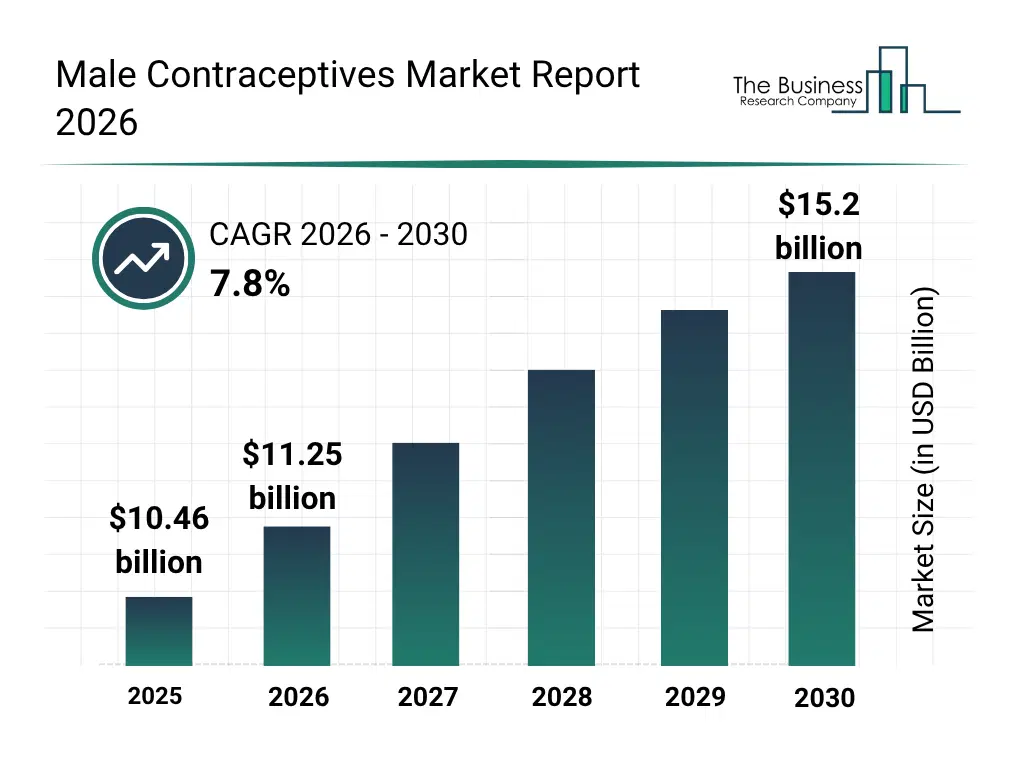
What Is The Male Contraceptives Market Size and Share 2026?
The male contraceptives market size has grown strongly in recent years. It will grow from $10.46 billion in 2025 to $11.25 billion in 2026 at a compound annual growth rate (CAGR) of 7.6%. The growth in the historic period can be attributed to increasing awareness of family planning and reproductive health, widespread adoption of condoms for pregnancy and sexually transmitted infection prevention, pharmaceutical research expansion in reproductive hormone regulation, government-led population control and reproductive health initiatives, rising focus on sexually transmitted disease prevention programs.What Is The Male Contraceptives Market Growth Forecast?
The male contraceptives market size is expected to see strong growth in the next few years. It will grow to $15.2 billion in 2030 at a compound annual growth rate (CAGR) of 7.8%. The growth in the forecast period can be attributed to advancements in reversible male contraceptive technologies and implants, development of non hormonal sperm inhibition therapies, increasing regulatory approvals for male contraceptive drug candidates, growth in AI driven drug discovery and reproductive biotech innovation, rising male participation in shared contraceptive decision making. Major trends in the forecast period include rising demand for non hormonal male contraceptive solutions with improved safety and reversibility, increasing clinical trials focused on male birth control innovation and long term efficacy, growing adoption of advanced condom materials enhancing durability comfort and sensitivity, expanding awareness and acceptance of shared contraceptive responsibility among men, rising integration of telehealth and digital reproductive health counseling services.
Global Male Contraceptives Market Segmentation
1) By Product Type: Hormonal Methods, Non Hormonal Methods, Barrier Devices, Reversible Inhibitors, Other Product Types 2) By Administration Route: Oral, Injectable, Topical Or Transdermal, Surgical, Implantable 3) By End User: Hospitals, Homecare, Clinics, Other End Users Subsegments: 1) By Hormonal Methods: Testosterone Based Pills, Hormonal Injections, Hormonal Gels, Hormonal Implants, Combination Hormone Therapies 2) By Non Hormonal Methods: Sperm Motility Inhibitors, Protein Targeting Agents, Retinoic Acid Inhibitors 3) By Barrier Devices: Latex Condoms, Non Latex Condoms, Polyurethane Condoms, Polyisoprene Condoms, Textured Condoms 4) By Reversible Inhibitors: Reversible Vas Deferens Blockers, Hydrogel Based Inhibitors, Sperm Transport Blocking Devices 5) By Other Product Types: Experimental Fertility Control Products, Combination Contraceptive Products, Reproductive Health SupplementsWhat Is The Driver Of The Male Contraceptives Market?
The rising awareness of male reproductive health is expected to propel the growth of the male contraceptives market going forward. Male reproductive health awareness refers to the increasing understanding among men about fertility control, contraception options, and preventive reproductive care. Awareness of male reproductive health is growing due to expanding sexual education programs that provide structured information about fertility, contraception, and preventive care, helping men understand and take responsibility for their reproductive health decisions. Awareness of male reproductive health supports the adoption of male contraceptives by encouraging men to understand fertility control options, take greater responsibility in shared family planning decisions, and actively choose preventive methods to avoid unintended pregnancies. For instance, in July 2025, according to the Local Government Association, a UK-based organization, more than 2.74 million individuals accessed sexual health clinics in England in 2023, with men representing over 60% of all new sexually transmitted infection (STI) diagnoses in the country. Therefore, the rising awareness of male reproductive health is driving the growth of the male contraceptives industry.Key Players In The Global Male Contraceptives Market
Major companies operating in the male contraceptives market are Bayer Aktiengesellschaft, Reckitt Benckiser Group plc, Church & Dwight Co. Inc., Mankind Pharma Limited, Okamoto Industries Inc., Karex Berhad, LifeStyles Healthcare Pte. Ltd., Fuji Latex Co. Ltd., HLL Lifecare Limited, Cupid Limited, Guilin Latex Factory Co. Ltd., Shanghai Mingbang Rubber Products Co. Ltd., Ritex GmbH, RFSU AB, Glyde Corporation Pty Ltd., Contraline Inc., NEXT Life Sciences Inc., YourChoice Therapeutics Inc., Eppin Pharma Inc.Global Male Contraceptives Market Trends and Insights
Major companies operating in the male contraceptives market are focusing on developing innovative solutions, such as non-hormonal reversible vas-occlusive technologies to provide safe, effective, and reversible birth control options for men with minimal side effects. Non-hormonal reversible vas-occlusive technology is a male contraceptive method that temporarily blocks or seals the vas deferens (the tubes that carry sperm) without using hormones, and it helps by preventing sperm from being included in semen while allowing the effect to be reversible so fertility can be restored later. For instance, in May 2023, Next Life Sciences, a US-based biotechnology company, launched Plan A, an innovative male birth control technology designed as a non-hormonal, reversible contraceptive solution that works through a minimally invasive procedure to place a biocompatible hydrogel-based material in the vas deferens. It creates a temporary barrier that blocks sperm transport while preserving normal hormone levels and sexual function, thereby offering an alternative to condoms and permanent vasectomy with the added benefit of potential reversibility as the material is designed to degrade or be removed over time to restore fertility.What Are Latest Mergers And Acquisitions In The Male Contraceptives Market?
In January 2023, the Male Contraceptive Initiative (MCI), a US-based nonprofit organization, partnered with Eppin Pharma to support the advancement of clinical research and development of a novel non-hormonal male contraceptive. With this investment, MCI and Eppin Pharma aim to accelerate the development of a first-in-class, non-hormonal contraceptive approach for men that works by targeting sperm function rather than altering hormone levels, with the goal of providing a safe, reversible, and effective alternative to existing contraceptive methods and addressing a significant unmet need in reproductive health. Eppin Pharma is a US-based biotechnology company that specializes in developing non-hormonal male contraceptive therapies targeting sperm motility through the EPPIN protein pathway.Regional Outlook
North America was the largest region in the male contraceptives market in 2025. Asia-Pacific is expected to be the fastest-growing region in the forecast period. The regions covered in this market report are Australia, Brazil, China, France, Germany, India, Indonesia, Japan, Taiwan, Russia, South Korea, UK, USA, Canada, Italy, Spain. The countries covered in this market report are Australia, Brazil, China, France, Germany, India, Indonesia, Japan, Taiwan, Russia, South Korea, UK, USA, Canada, Italy, Spain.What Defines the Male Contraceptives Market?
The male contraceptives market consists of sales of contraceptive pills, injectable formulations, transdermal gels, implants, intra-vas devices, spermicidal products, and other male-oriented fertility control products. Values in this market are ‘factory gate’ values, that is, the value of goods sold by the manufacturers or creators of the goods, whether to other entities (including downstream manufacturers, wholesalers, distributors, and retailers) or directly to end customers. The value of goods in this market includes related services sold by the creators of the goods.How is Market Value Defined and Measured?
The market value is defined as the revenues that enterprises gain from the sale of goods and/or services within the specified market and geography through sales, grants, or donations in terms of the currency (in USD unless otherwise specified). The revenues for a specified geography are consumption values that are revenues generated by organizations in the specified geography within the market, irrespective of where they are produced. It does not include revenues from resales along the supply chain, either further along the supply chain or as part of other products.What Key Data and Analysis Are Included in the Male Contraceptives Market Report 2026?
The male contraceptives market research report is one of a series of new reports from The Business Research Company that provides male contraceptives market statistics, including male contraceptives industry global market size, regional shares, competitors with a male contraceptives market share, detailed male contraceptives market segments, market trends and opportunities, and any further data you may need to thrive in the male contraceptives industry. This male contraceptives market research report delivers a complete perspective of everything you need, with an in-depth analysis of the current and future scenario of the industry.Male Contraceptives Market Report Forecast Analysis
| Report Attribute | Details |
|---|---|
| Market Size Value In 2026 | $11.25 billion |
| Revenue Forecast In 2030 | $15.2 billion |
| Growth Rate | CAGR of 7.8% from 2026 to 2030 |
| Base Year For Estimation | 2025 |
| Actual Estimates/Historical Data | 2020-2025 |
| Forecast Period | 2026 - 2030 |
| Market Representation | Revenue in USD Billion and CAGR from 2026 to 2030 |
| Segments Covered | Product Type, Administration Route, End User |
| Regional Scope | Asia-Pacific, Western Europe, Eastern Europe, North America, South America, Middle East, Africa |
| Country Scope | The countries covered in the male contraceptives market report are Australia, Brazil, China, France, Germany, India, Indonesia, Japan, Taiwan, Russia, South Korea, UK, USA, Canada, Italy, Spain. |
| Key Companies Profiled | Bayer Aktiengesellschaft, Reckitt Benckiser Group plc, Church & Dwight Co. Inc., Mankind Pharma Limited, Okamoto Industries Inc., Karex Berhad, LifeStyles Healthcare Pte. Ltd., Fuji Latex Co. Ltd., HLL Lifecare Limited, Cupid Limited, Guilin Latex Factory Co. Ltd., Shanghai Mingbang Rubber Products Co. Ltd., Ritex GmbH, RFSU AB, Glyde Corporation Pty Ltd., Contraline Inc., NEXT Life Sciences Inc., YourChoice Therapeutics Inc., Eppin Pharma Inc. |
| Customization Scope | Request for Customization |
| Pricing And Purchase Options | Explore Purchase Options |