
Man-Pack Biological Detector Market Report 2026
Global Outlook – By Product Type (Portable Biological Detectors, Wearable Biological Detectors, Handheld Biological Detectors), By Technology (Fluorescence Detection, Immunological Detection, PCR-Based Detection, Biosensors, Other Technologies), By Application (Military And Defense, Homeland Security, Environmental Monitoring, Public Safety, Other Applications), By End-User (Government Agencies, Law Enforcement, Emergency Responders, Commercial, Other End-Users) – Market Size, Trends, Strategies, and Forecast to 2035
Man-Pack Biological Detector Market Overview
• Man-Pack Biological Detector market size has reached to $1.71 billion in 2025 • Expected to grow to $2.76 billion in 2030 at a compound annual growth rate (CAGR) of 10% • Growth Driver: Increasing Geopolitical Tensions Fueling The Growth Of Market Due To Need For Rapid Detection Of Biological Threats • Market Trend: • North America was the largest region in 2025 and Asia-Pacific is the fastest growing region.What Is Covered Under Man-Pack Biological Detector Market?
A man-pack biological detector is a portable device designed to identify and detect airborne biological agents in real time. It uses advanced sensing technologies to monitor and analyze particles or aerosols for the presence of pathogens or toxins. It is lightweight and compact, allowing it to be carried and operated by a single individual in various field environments. The main product types of man-pack biological detector include portable biological detectors, wearable biological detectors, and handheld biological detectors. Portable biological detectors are designed for rapid, on-the-go detection of biological threats, allowing military personnel, first responders, and field operators to quickly identify hazardous agents in various environments. Different technologies are fluorescence detection, immunological detection, PCR-based detection, biosensors, and others. The applications include military and defense, homeland security, environmental monitoring, public safety, and others, and they are used by several end-users such as government agencies, law enforcement, emergency responders, commercial entities, and others.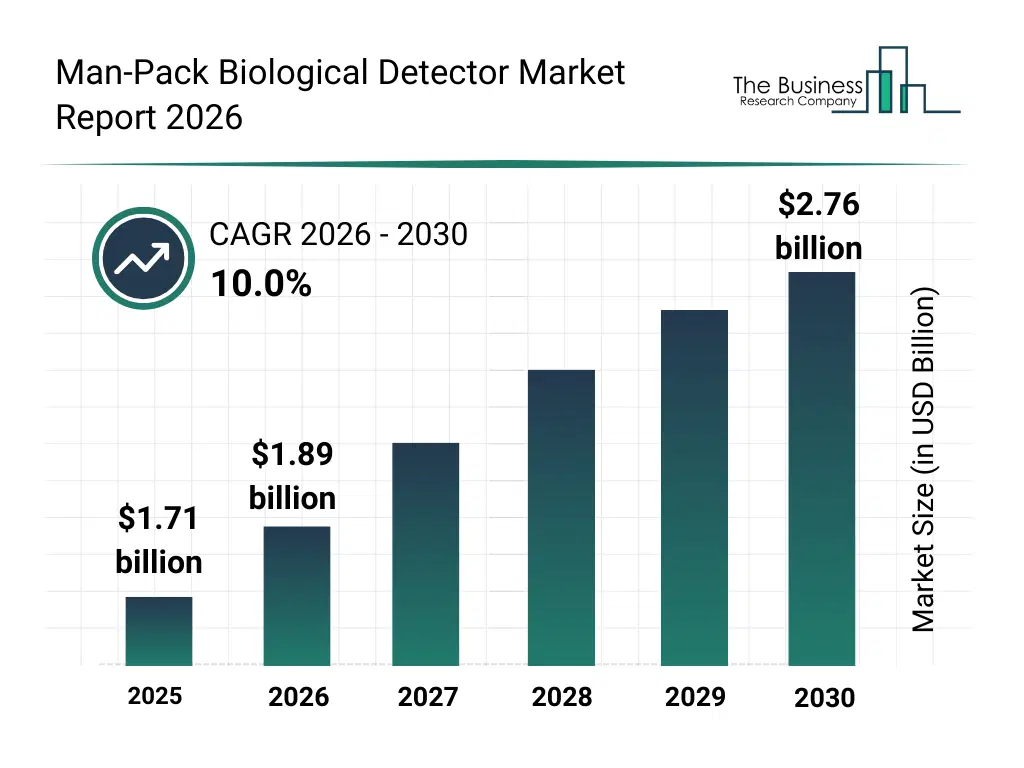
What Is The Man-Pack Biological Detector Market Size and Share 2026?
The man-pack biological detector market size has grown rapidly in recent years. It will grow from $1.71 billion in 2025 to $1.89 billion in 2026 at a compound annual growth rate (CAGR) of 10.2%. The growth in the historic period can be attributed to rising bioterrorism threats and security concerns, growing defence and homeland security investments, increasing public health preparedness initiatives, expansion of emergency response capabilities, and rising awareness of occupational safety.What Is The Man-Pack Biological Detector Market Growth Forecast?
The man-pack biological detector market size is expected to see rapid growth in the next few years. It will grow to $2.76 billion in 2030 at a compound annual growth rate (CAGR) of 10.0%. The growth in the forecast period can be attributed to increasing government incentives for defence research and development, growing demand for real-time pathogen detection, rising adoption in civilian and commercial sectors, expansion of integrated bio surveillance networks, and increasing focus on rapid response and emergency management. Major trends in the forecast period include integration of iot and connected bio surveillance, technology advancements in miniaturized portable detectors, innovations in ai and machine learning for improved detection, research and developments in multi-agent detection capabilities, and developments in sustainable and energy-efficient device designs.
Global Man-Pack Biological Detector Market Segmentation
1) By Product Type: Portable Biological Detectors, Wearable Biological Detectors, Handheld Biological Detectors 2) By Technology: Fluorescence Detection, Immunological Detection, PCR-Based Detection, Biosensors, Other Technologies 3) By Application: Military And Defense, Homeland Security, Environmental Monitoring, Public Safety, Other Applications 4) By End-User: Government Agencies, Law Enforcement, Emergency Responders, Commercial, Other End-Users Subsegments: 1) By Portable Biological Detectors: Air Sampling Units, Water Sampling Units, Surface Sampling Units, Mobile Field Detection Units, Portable Rapid Analysis Kits 2) By Wearable Biological Detectors: Wearable Environmental Monitoring Sensors, Wearable Pathogen Detection Badges, Wearable Exposure Monitoring Devices, Wearable Real-Time Biological Alert Systems 3) By Handheld Biological Detectors: Handheld Pathogen Detection Devices, Handheld Toxin Detection Devices, Handheld Environmental Screening Devices, Handheld Rapid Diagnostic Tools, Handheld Multiparameter Detection UnitsWhat Are The Drivers Of The Man-Pack Biological Detector Market?
The increasing geopolitical tensions are expected to propel the growth of the man-pack biological detector market going forward. Geopolitical tensions refer to conflicts, disputes, or rivalries between countries or regions that arise due to political, economic, territorial, or strategic interests. The increasing geopolitical tensions are due to territorial disputes, as they threaten national sovereignty and control over strategically important regions. Man-pack biological detectors help address geopolitical tensions by providing rapid, field-deployable detection of biological threats. They enhance national security preparedness, enabling timely response and minimizing the risk of bioterrorism or biological warfare. For instance, in October 2024, according to the U.S. Department of Homeland Security, a US-based federal agency, the migrant encounters at the US-Canada border reached over 181,000 in 2024, marking a 6.5% increase compared to 170,000 in 2023. Therefore, the increasing geopolitical tensions are driving the growth of the man-pack biological detector industry. The increasing defense budgets are expected to propel the growth of the man-pack biological detector market going forward. Defense budgets refer to the financial resources allocated by a government to fund its military operations, personnel, equipment, and defense infrastructure. The increasing defense budgets are driven by rising geopolitical tensions due to escalating conflicts and regional security challenges worldwide. Defense budgets support man-pack biological detectors by enabling procurement and deployment of advanced portable detection systems. They enhance military and homeland security capabilities, ensuring rapid response to biological threats and improving operational preparedness. For instance, in April 2024, according to the Stockholm International Peace Research Institute (SIPRI), a Sweden-based non-government organization, global military spending reached $2.443 trillion, marking a 6.8% increase compared to 2022. Therefore, the rising government defense budgets are driving the growth of the man-pack biological detector industry. The increasing international trade activity is expected to propel the growth of the man-pack biological detector market going forward. International trade activity refers to the exchange of goods and services across international borders, driven by global demand, supply chains, and economic cooperation between countries. The rising international trade activity is due to the expansion of e-commerce, as it enables businesses and consumers to easily buy and sell goods across borders, increasing demand for cross-border transactions. Man-pack biological detectors facilitate international trade activity by enabling rapid, on-site detection of biological hazards at ports, airports, and logistics hubs. They reduce the risk of contamination and ensure the safety and compliance of goods, supporting uninterrupted global trade. For instance, in April 2025, according to the World Trade Organization (WTO), a Switzerland-based trade organization, the value of global merchandise trade rose by 2% in 2024, rebounding from a 4% decline in 2023. Therefore, the increasing international trade activity is driving the growth of the man-pack biological detector industry.Key Players In The Global Man-Pack Biological Detector Market
Major companies operating in the man-pack biological detector market are Thermo Fisher Scientific Inc., Thales Group, Leidos Holdings Inc., Bruker Corporation, Bharat Electronics Limited, Battelle Memorial Institute, Teledyne FLIR LLC, Smiths Detection, Chemring Group plc, BioFire Defense LLC, Bertin Technologies S.A.S., Environics Oy, Tetracore Inc., Kromek Group plc, BBI Detection, Research International Inc., Response Biomedical Corporation, Morphix Technologies Inc., PositiveID Corporation, MicronView LimitedRegional Insights
North America was the largest region in the man-pack biological detector market in 2025. Asia-Pacific is expected to be the fastest-growing region in the forecast period. The regions covered in this market report are Asia-Pacific, South East Asia, Western Europe, Eastern Europe, North America, South America, Middle East, Africa. The countries covered in this market report are Australia, Brazil, China, France, Germany, India, Indonesia, Japan, Taiwan, Russia, South Korea, UK, USA, Canada, Italy, Spain.What Defines the Man-Pack Biological Detector Market?
The man-pack biological detector market consists of revenues earned by entities by providing services such as field-testing services, training services, installation services, technical support services, system integration services, and repair services. The market value includes the value of related goods sold by the service provider or included within the service offering. The man-pack biological detector market includes sales of wearable bio-threat monitors, portable decontamination units, biological assay strips, and ruggedized transport cases. Values in this market are ‘factory gate’ values, that is, the value of goods sold by the manufacturers or creators of the goods, whether to other entities (including downstream manufacturers, wholesalers, distributors, and retailers) or directly to end customers. The value of goods in this market includes related services sold by the creators of the goods.How is Market Value Defined and Measured?
The market value is defined as the revenues that enterprises gain from the sale of goods and/or services within the specified market and geography through sales, grants, or donations in terms of the currency (in USD unless otherwise specified). The revenues for a specified geography are consumption values that are revenues generated by organizations in the specified geography within the market, irrespective of where they are produced. It does not include revenues from resales along the supply chain, either further along the supply chain or as part of other products.What Key Data and Analysis Are Included in the Man-Pack Biological Detector Market Report 2026?
The man-pack biological detector market research report is one of a series of new reports from The Business Research Company that provides market statistics, including industry global market size, regional shares, competitors with the market share, detailed market segments, market trends and opportunities, and any further data you may need to thrive in the man-pack biological detector industry. The market research report delivers a complete perspective of everything you need, with an in-depth analysis of the current and future state of the industry.Man-Pack Biological Detector Market Report Forecast Analysis
| Report Attribute | Details |
|---|---|
| Market Size Value In 2026 | $1.89 billion |
| Revenue Forecast In 2035 | $2.76 billion |
| Growth Rate | CAGR of 10.2% from 2026 to 2035 |
| Base Year For Estimation | 2025 |
| Actual Estimates/Historical Data | 2020-2025 |
| Forecast Period | 2026 - 2030 - 2035 |
| Market Representation | Revenue in USD Billion and CAGR from 2026 to 2035 |
| Segments Covered | Product Type, Technology, Application, End-User |
| Regional Scope | Asia-Pacific, Western Europe, Eastern Europe, North America, South America, Middle East, Africa |
| Country Scope | The countries covered in the report are Australia, Brazil, China, France, Germany, India, ... |
| Key Companies Profiled | Thermo Fisher Scientific Inc., Thales Group, Leidos Holdings Inc., Bruker Corporation, Bharat Electronics Limited, Battelle Memorial Institute, Teledyne FLIR LLC, Smiths Detection, Chemring Group plc, BioFire Defense LLC, Bertin Technologies S.A.S., Environics Oy, Tetracore Inc., Kromek Group plc, BBI Detection, Research International Inc., Response Biomedical Corporation, Morphix Technologies Inc., PositiveID Corporation, MicronView Limited |
| Customization Scope | Request for Customization |
| Pricing And Purchase Options | Explore Purchase Options |