
Medical Batteries Market Report 2026
Global Outlook – By Battery Type (Lithium-Ion Batteries, Lithium Primary Batteries, Nickel-Metal Hydride (NiMH) Batteries, Nickel-Cadmium (NiCd) Batteries, Zinc-Based Batteries, Other Battery Types), By Application (Implantable Medical Devices, Non-Implantable Medical Devices, Portable And Wearable Medical Devices), By End-User (Hospitals And Clinics, Home Healthcare Settings, Ambulatory Surgical Centers, Diagnostic Centers, Medical Device Manufacturers) – Market Size, Trends, Strategies, and Forecast to 2030
Medical Batteries Market Overview
• Medical Batteries market size has reached to $1.87 billion in 2025 • Expected to grow to $2.56 billion in 2030 at a compound annual growth rate (CAGR) of 6.4% • Growth Driver: Rising Medical Device Demand Boosts Medical Battery Market Growth • Market Trend: Innovative P200 Mah Battery Launched To Improve Performance Of Implantable Devices • North America was the largest region in 2025 and Asia-Pacific is the fastest growing region.What Is Covered Under Medical Batteries Market?
Medical batteries are specialized power sources designed to meet the unique needs of medical devices. They provide reliable, long-lasting energy for devices such as pacemakers, hearing aids, and infusion pumps. These batteries must meet stringent safety and performance standards to ensure reliable operation in critical healthcare applications. They often feature high energy density, stability, and biocompatibility. The main battery types of medical batteries are lithium-ion batteries, nickel-metal hydride (NIMH) batteries, alkaline batteries, zinc-air batteries, and others. Lithium-ion batteries refer to rechargeable batteries known for their high energy density and long lifespan. The applications include implantable medical devices, non-implantable medical devices, and portable and wearable medical devices and the various end-users such as hospitals and clinics, home healthcare settings, ambulatory surgical centers, and research institutes.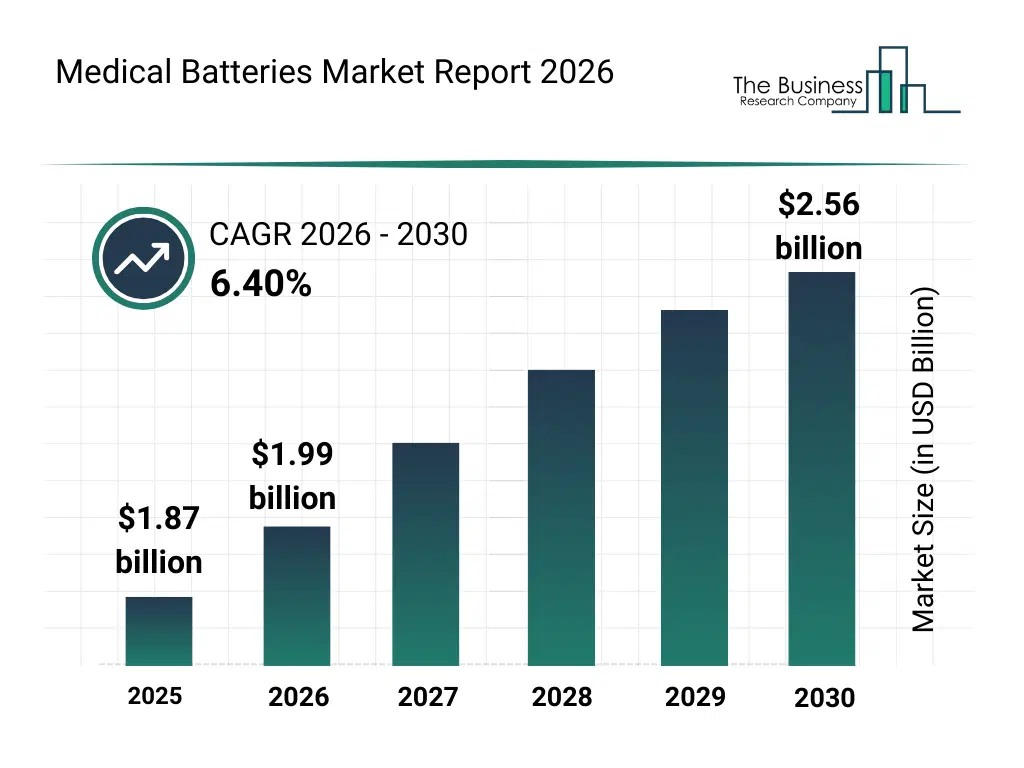
What Is The Medical Batteries Market Size and Share 2026?
The medical batteries market size has grown strongly in recent years. It will grow from $1.87 billion in 2025 to $1.99 billion in 2026 at a compound annual growth rate (CAGR) of 6.8%. The growth in the historic period can be attributed to reliance on standard alkaline and zinc-air batteries, limited battery life in implantable devices, growing home healthcare adoption, expansion of hospitals and clinics, increasing demand for portable medical monitoring.What Is The Medical Batteries Market Growth Forecast?
The medical batteries market size is expected to see strong growth in the next few years. It will grow to $2.56 billion in 2030 at a compound annual growth rate (CAGR) of 6.4%. The growth in the forecast period can be attributed to development of lithium-ion and lithium polymer advanced batteries, rising use of wearable medical devices, expansion of implantable cardiac and neurological devices, increasing focus on battery safety and biocompatibility, integration with IoT-enabled medical equipment. Major trends in the forecast period include rising demand for high-energy-density batteries in medical devices, growth of portable and wearable medical devices, increasing adoption of rechargeable and long-life batteries, expansion of implantable device applications, focus on safety, biocompatibility, and regulatory compliance.
Global Medical Batteries Market Segmentation
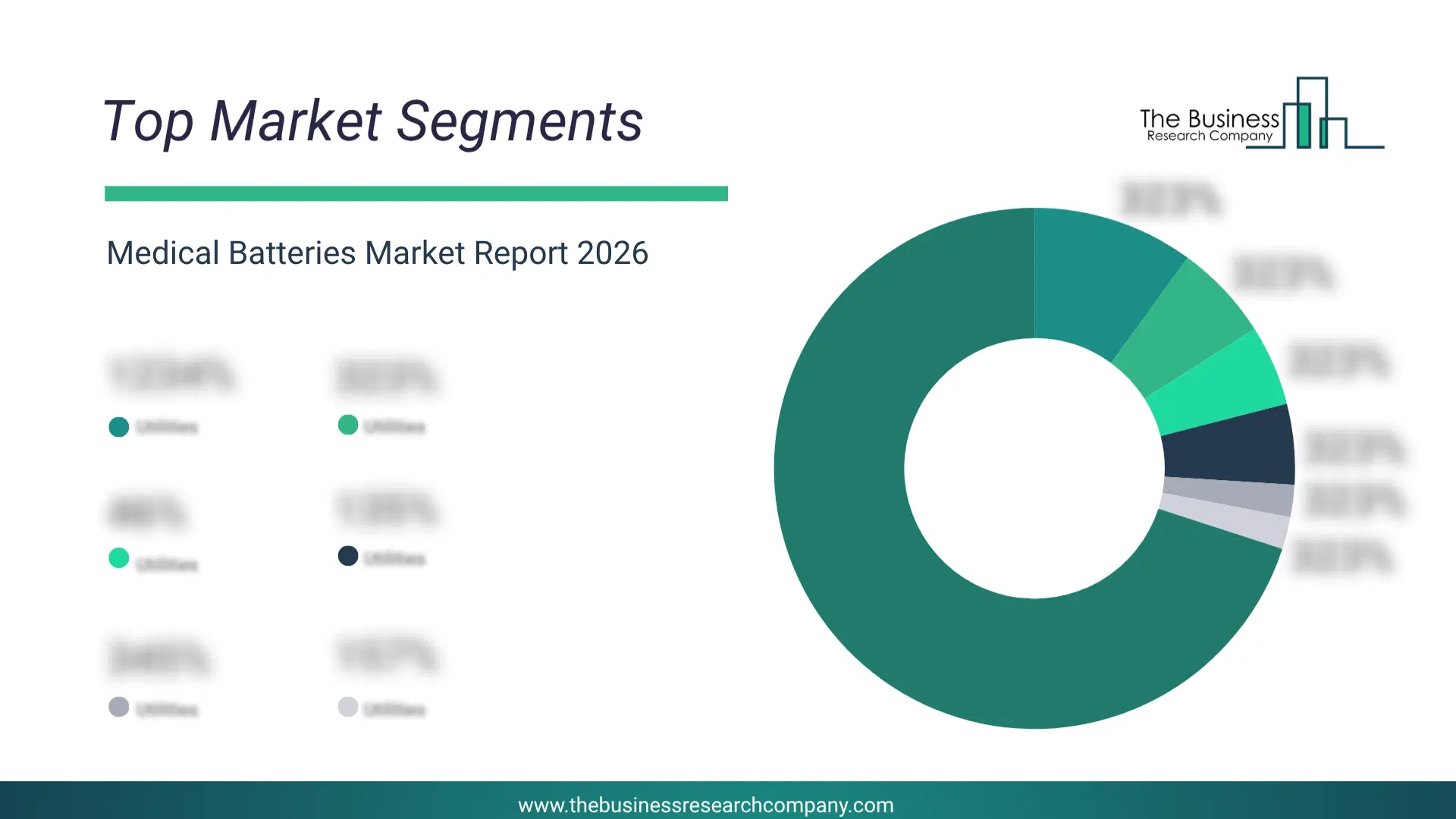
1) By Battery Type: Lithium-Ion Batteries, Lithium Primary Batteries, Nickel-Metal Hydride (NiMH) Batteries, Nickel-Cadmium (NiCd) Batteries, Zinc-Based Batteries, Other Battery Types 2) By Application: Implantable Medical Devices, Non-Implantable Medical Devices, Portable And Wearable Medical Devices 3) By End-User: Hospitals And Clinics, Home Healthcare Settings, Ambulatory Surgical Centers, Diagnostic Centers, Medical Device Manufacturers Subsegments: 1) By Lithium-Ion Batteries: Lithium Cobalt Oxide (LCO), Lithium Iron Phosphate (LFP), Lithium Manganese Oxide (LMO), Lithium Nickel Manganese Cobalt Oxide (NMC), Lithium Nickel Cobalt Aluminum Oxide (NCA), Lithium Polymer (LiPo) 2) By Lithium Primary Batteries: Lithium Iodine Batteries, Lithium Silver Vanadium Oxide (Li/SVO) Batteries, Lithium Carbon Monofluoride (Li/CFx) Batteries 3) By Nickel-Metal Hydride (NiMH) Batteries: Standard NiMH Batteries, Low Self-Discharge NiMH Batteries 4) By Nickel-Cadmium (NiCd) Batteries: Vented NiCd Batteries, Sealed NiCd Batteries 5) By Zinc-Based Batteries: Zinc-Air Batteries, Zinc-Carbon Batteries 6) By Other Battery Types: Silver-Oxide Batteries, Alkaline Batteries, Lead-Acid BatteriesWhat Is The Driver Of The Medical Batteries Market?
The increasing demand for medical devices is expected to propel the growth of the medical batteries market going forward. Medical devices are instruments, apparatus, or machines used in healthcare to diagnose, treat, or monitor medical conditions. The demand for medical devices is driven by aging populations, rising chronic diseases, and advancements in healthcare technology, leading to higher healthcare needs globally. Medical batteries are essential in powering various medical devices, ensuring reliable operation for patient monitoring, diagnostic tools, and life-saving equipment. For instance, in March 2025, according to the Large Battery, a China-based battery manufacturing company, over 90% of FDA-approved devices use medical-grade batteries to meet strict safety standards, with certifications like UL2054 and IEC 60086 reducing safety incidents and battery malfunctions by about 25%. Therefore, increasing demand for medical devices is driving the growth of the medical batteries industry.Key Players In The Global Medical Batteries Market
Major companies operating in the medical batteries market are TotalEnergies SE, Panasonic Corporation, 3M Company, Merck KGaA, Texas Instruments Incorporated, STMicroelectronics NV, Murata Manufacturing Co. Ltd, EnerSys Inc., Energizer Holdings Inc., Renata AG SA, VARTA Microbattery GmbH, Vitec Group PLC, EaglePicher Technologies LLC, Ultralife Corporation, Probo Medical LLC, Camelion Battery Co. Ltd., Maxim Integrated Products Inc., Tadiran Batteries Ltd., Blue Spark Technologies Inc., KAYO Battery Company Limited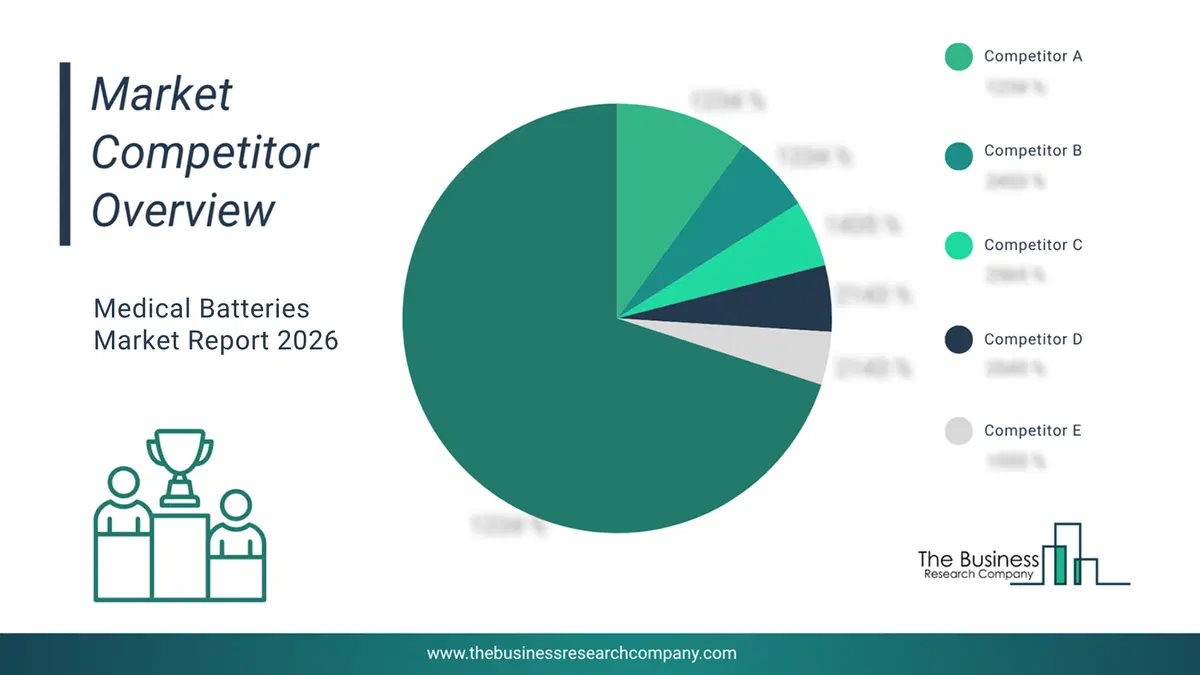
This chart is for illustrative purposes; the full report includes a detailed competitor analysis and comprehensive overview of the top 10 companies in the market.
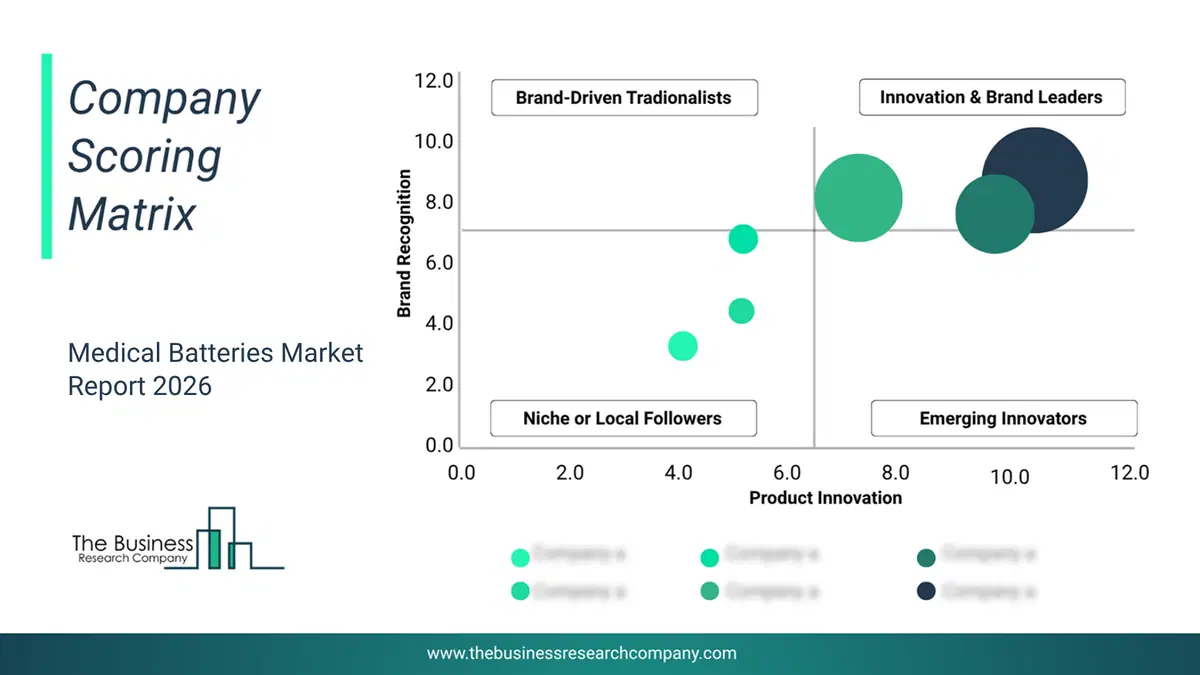
This chart maps companies by product innovation and brand strength, with bubble size indicating relative revenue, helping identify market leaders, challengers, and niche players. This is an illustrative chart; the full report provides a complete and accurate competitive analysis.
Global Medical Batteries Market Trends and Insights
Major companies in the medical batteries market are increasingly developing advanced lithium-ion medical batteries to improve the performance, safety, and reliability of medical devices. A lithium-ion medical battery is specifically engineered for use in medical equipment such as portable oxygen concentrators, insulin pumps, and other diagnostic or therapeutic devices that require dependable, consistent power. For instance, in September 2023, Resonetics, a US-based medtech manufacturing company, launched the Contego P200 mAh primary battery—a single-use, implantable lithium/carbon monofluoride (Li-CFx) battery designed for medical applications. This lightweight, miniature D-shaped cell offers high energy density, low self-discharge, and is well-suited for implantable devices with low to medium pulse power needs. It features a fully welded, hermetically sealed titanium casing and a thermal shutdown separator for enhanced safety, weighs just 1.75 grams, and measures 21.3 mm × 9.5 mm × 4.4 mm. Delivering a nominal voltage of 2.8V, the battery is available off-the-shelf or with custom pin configurations and is manufactured in an ISO 13485–certified facility. The Contego P200 bridges the capacity gap between Resonetics’ 140 mAh and 325 mAh cells, giving medical device manufacturers greater design flexibility for applications such as neuromodulation, monitoring, and sleep apnea. The company’s medical power division brings over 25 years of expertise in implantable medical-grade power systems.What Are Latest Mergers And Acquisitions In The Medical Batteries Market?
In May 2024, Battery Ventures, a US-based private equity company, acquired steute Technologies GmbH & Co. KG for an undisclosed amount. With this acquisition Battery Ventures’s aim is to accelerate the company's growth by leveraging Battery’s extensive expertise and global business network. Steute Technologies GmbH & Co. KG is a Germany-based company that provides products that use batteries for their medical devices.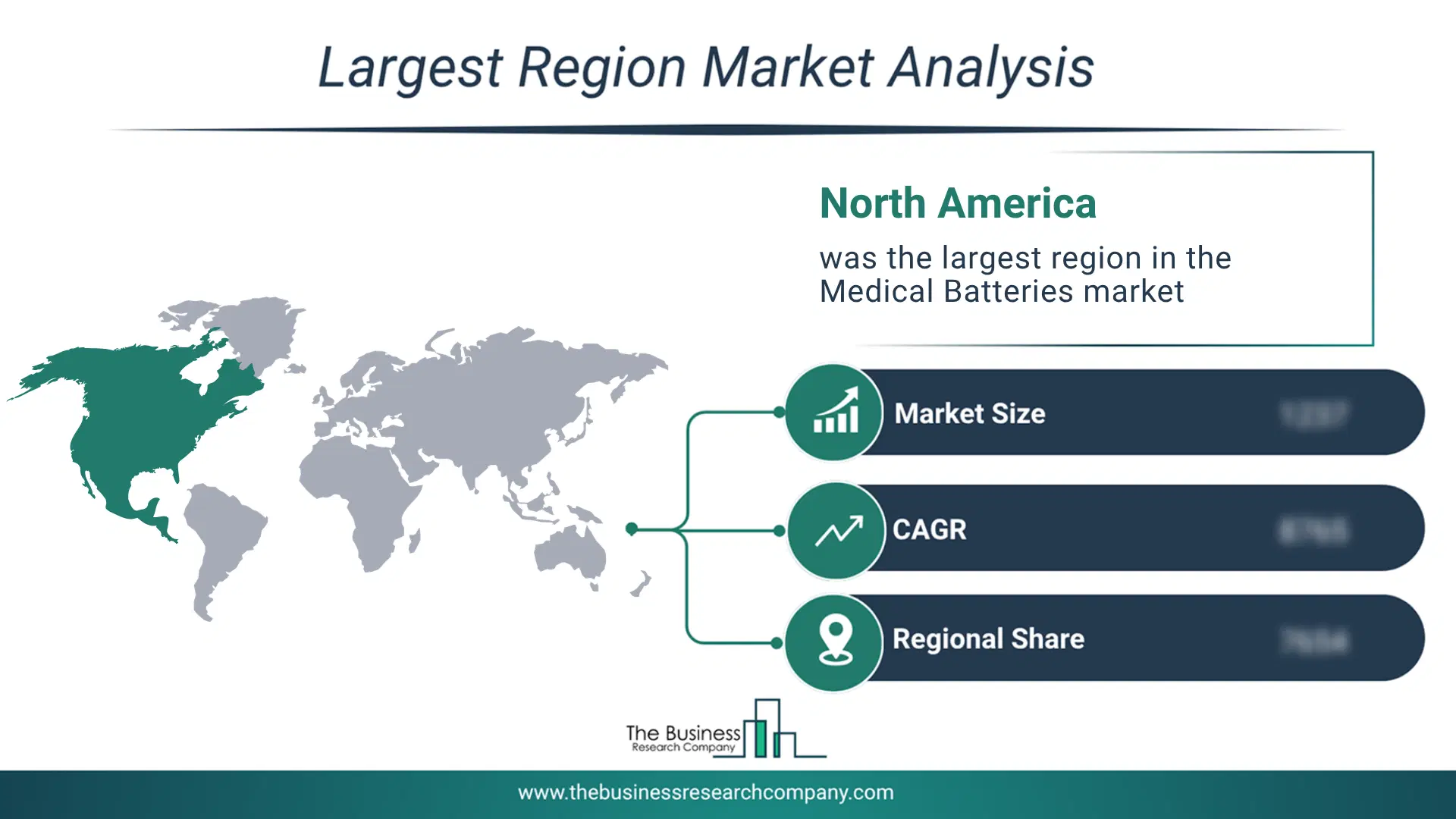
Regional Outlook
North America was the largest region in the medical batteries market in 2025. Asia-Pacific is expected to be the fastest-growing region in the forecast period. The regions covered in this market report are Asia-Pacific, South East Asia, Western Europe, Eastern Europe, North America, South America, Middle East, Africa. The countries covered in this market report are Australia, Brazil, China, France, Germany, India, Indonesia, Japan, Taiwan, Russia, South Korea, UK, USA, Canada, Italy, SpainWhat Defines the Medical Batteries Market?
The medical batteries market consists of sales of primary batteries, secondary batteries, battery packs, and custom batteries. Values in this market are ‘factory gate’ values, that is, the value of goods sold by the manufacturers or creators of the goods, whether to other entities (including downstream manufacturers, wholesalers, distributors, and retailers) or directly to end customers. The value of goods in this market includes related services sold by the creators of the goods.How is Market Value Defined and Measured?
The market value is defined as the revenues that enterprises gain from the sale of goods and/or services within the specified market and geography through sales, grants, or donations in terms of the currency (in USD unless otherwise specified). The revenues for a specified geography are consumption values that are revenues generated by organizations in the specified geography within the market, irrespective of where they are produced. It does not include revenues from resales along the supply chain, either further along the supply chain or as part of other products.
This chart presents market attractiveness based on a quantitative evaluation of growth, competition, strategic alignment, and risk, offering a clear view of opportunity areas for decision-making. This chart is for illustrative purposes; the full report contains the complete analysis.

This chart highlights the Total Addressable Market (TAM) by estimating the maximum revenue opportunity using an assumption-driven approach, supporting strategic planning and opportunity sizing across markets. The chart is illustrative; the full report provides a more comprehensive analysis.
What Key Data and Analysis Are Included in the Medical Batteries Market Report 2026?
The medical batteries market research report is one of a series of new reports from The Business Research Company that provides market statistics, including industry global market size, regional shares, competitors with the market share, detailed market segments, market trends and opportunities, and any further data you may need to thrive in the medical batteries industry. The market research report delivers a complete perspective of everything you need, with an in-depth analysis of the current and future state of the industry.Medical Batteries Market Report Forecast Analysis
| Report Attribute | Details |
|---|---|
| Market Size Value In 2026 | $1.99 billion |
| Revenue Forecast In 2030 | $2.56 billion |
| Growth Rate | CAGR of 6.4% from 2026 to 2030 |
| Base Year For Estimation | 2025 |
| Actual Estimates/Historical Data | 2020-2025 |
| Forecast Period | 2026 - 2030 |
| Market Representation | Revenue in USD Billion and CAGR from 2026 to 2030 |
| Segments Covered | Battery Type, Application, End-User |
| Regional Scope | Asia-Pacific, Western Europe, Eastern Europe, North America, South America, Middle East, Africa |
| Country Scope | The countries covered in the report are Australia, Brazil, China, France, Germany, India, Indonesia, Japan, Taiwan, Russia, South Korea, UK, USA, Canada, Italy, Spain. |
| Key Companies Profiled | TotalEnergies SE, Panasonic Corporation, 3M Company, Merck KGaA, Texas Instruments Incorporated, STMicroelectronics NV, Murata Manufacturing Co. Ltd, EnerSys Inc., Energizer Holdings Inc., Renata AG SA, VARTA Microbattery GmbH, Vitec Group PLC, EaglePicher Technologies LLC, Ultralife Corporation, Probo Medical LLC, Camelion Battery Co. Ltd., Maxim Integrated Products Inc., Tadiran Batteries Ltd., Blue Spark Technologies Inc., KAYO Battery Company Limited |
| Customization Scope | Request for Customization |
| Pricing And Purchase Options | Explore Purchase Options |