
Medium Heavy Lift Launch Vehicle Market Report 2026
Global Outlook – By Launch Vehicle Class (Medium Lift Launch Vehicle, Heavy Lift Launch Vehicle, Super Heavy Lift Launch Vehicle), By Subsystem (Structure, Avionics, Propulsion, Control System, Electrical System, Stage Separation, Thermal System), By Payload (Satellite, Cargo, Human), By End-User (Defense And Security, Media And Entertainment, Research Institutions, Space Exploration Agencies, Telecommunications) – Market Size, Trends, Strategies, and Forecast to 2030
Medium Heavy Lift Launch Vehicle Market Overview
• Medium Heavy Lift Launch Vehicle market size has reached to $10.39 billion in 2025 • Expected to grow to $15.66 billion in 2030 at a compound annual growth rate (CAGR) of 8.5% • Growth Driver: Increasing Government Spending On Space Capabilities Driving Growth Of The Market Due To National Security Investments • Market Trend: Advancements In Heavy-Lift Launch Vehicles To Support Satellite Deployment And Deep Space Missions • North America was the largest region in 2025.What Is Covered Under Medium Heavy Lift Launch Vehicle Market?
A medium-heavy lift launch vehicle (MHLLV) is a type of spacecraft designed to transport payloads of 2,000 to 10,000 kilograms to low Earth orbit (LEO). It offers higher payload capacity than medium-lift rockets and supports commercial, scientific, and military missions. Its primary purpose is to provide a cost-effective and versatile solution for space exploration and communication. The main types of medium-heavy lift launch vehicle classes are medium lift launch vehicle, heavy lift launch vehicle, and super heavy lift launch vehicle. A medium lift launch vehicle is a rocket capable of carrying payloads between 2,000 and 20,000 kilograms into low Earth orbit (LEO). The subsystems are structure, avionics, propulsion, control system, electrical system, stage separation, thermal system, with various payloads such as satellite, cargo, human, and are used by several end-users including defense and security, media and entertainment, research institutions, space exploration agencies, and telecommunications.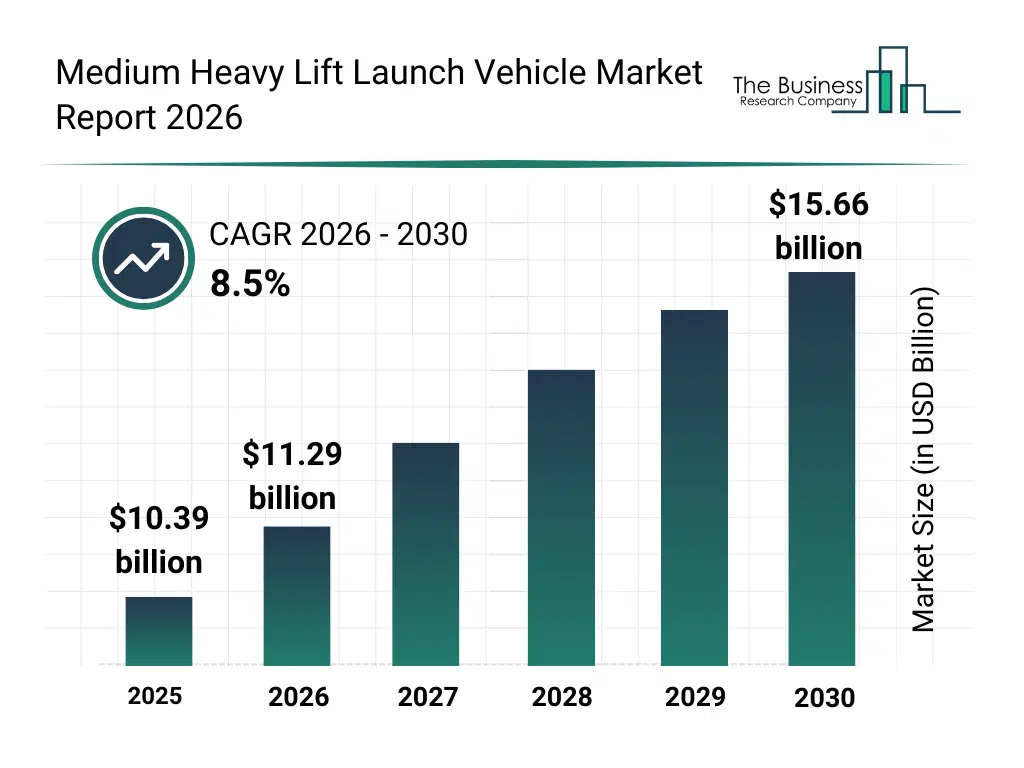
What Is The Medium Heavy Lift Launch Vehicle Market Size and Share 2026?
The medium heavy lift launch vehicle market size has grown strongly in recent years. It will grow from $10.39 billion in 2025 to $11.29 billion in 2026 at a compound annual growth rate (CAGR) of 8.6%. The growth in the historic period can be attributed to development and deployment of early medium-heavy lift launch vehicles, growth in government and commercial space programs requiring payload delivery to LEO, advancements in rocket fuel tank and ground support equipment technologies, adoption of safety systems to enhance launch reliability, increasing investment in versatile launch solutions for scientific and military missions.What Is The Medium Heavy Lift Launch Vehicle Market Growth Forecast?
The medium heavy lift launch vehicle market size is expected to see strong growth in the next few years. It will grow to $15.66 billion in 2030 at a compound annual growth rate (CAGR) of 8.5%. The growth in the forecast period can be attributed to rising demand for medium-heavy lift vehicles for satellite constellation deployment, growth in commercial and defense space missions, advancements in reusable and cost-efficient launch vehicle technologies, increasing investment in AI and predictive analytics for launch operations, expansion of international collaborations for medium-heavy lift launch services. Major trends in the forecast period include rising demand for medium-heavy launch capacity for commercial satellite deployment, increased funding for national space security and defense projects, advancements in cost-effective propulsion and fuel efficiency, growing commercial missions for communication and broadcasting payloads, expansion of ground support and safety infrastructure for rapid launch turnaround.
Global Medium Heavy Lift Launch Vehicle Market Segmentation
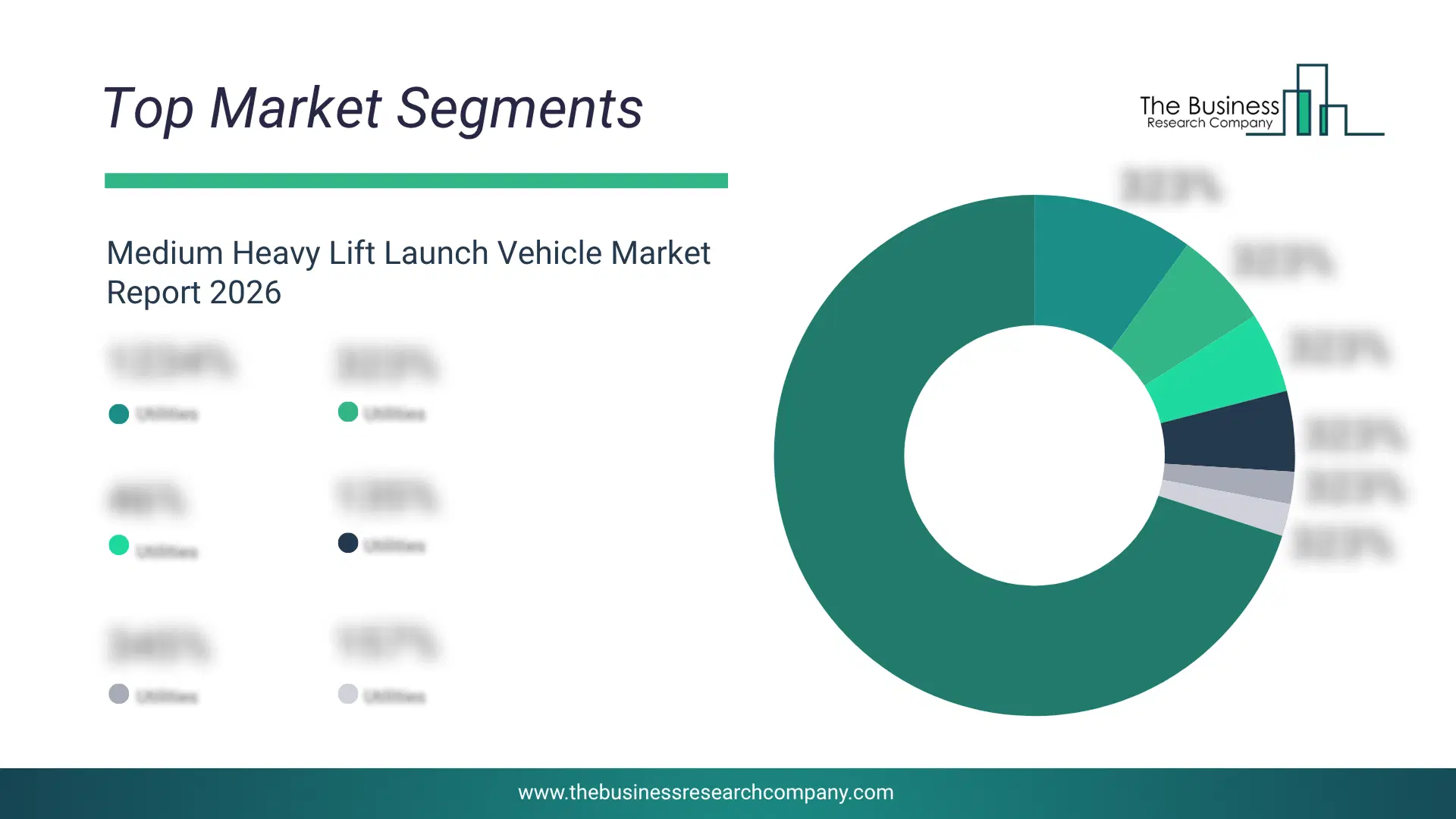
1) By Launch Vehicle Class: Medium Lift Launch Vehicle, Heavy Lift Launch Vehicle, Super Heavy Lift Launch Vehicle 2) By Subsystem: Structure, Avionics, Propulsion, Control System, Electrical System, Stage Separation, Thermal System 3) By Payload: Satellite, Cargo, Human 4) By End-User: Defense And Security, Media And Entertainment, Research Institutions, Space Exploration Agencies, Telecommunications Subsegments: 1) By Medium Lift Launch Vehicle: Payload To Low Earth Orbit (LEO) (2,000–20,000 Kilograms), Reusable Medium-Lift Vehicles, Expendable Medium-Lift Vehicles, Government Missions, Commercial Satellite Launches, Polar And Sun-Synchronous Orbit Missions 2) By Heavy Lift Launch Vehicle: Payload To Low Earth Orbit (LEO) (20,000–50,000 Kilograms), Human Spaceflight Missions, Deep Space Missions, Geostationary Transfer Orbit (GTO) Payloads, Modular Heavy-Lift Vehicles, Military Or Defense Applications 3) By Super Heavy Lift Launch Vehicle: Payload To Low Earth Orbit (LEO) (Greater Than 50,000 Kilograms), Lunar And Mars Missions, Interplanetary Cargo Launches, Space Station Module Launches, Fully Reusable Super Heavy Vehicles, National Flagship Launch ProgramsWhat Is Driver Of The Medium Heavy Lift Launch Vehicle Market?
The increasing government spending on space capabilities is expected to propel the growth of the medium-heavy lift launch vehicle market going forward. Government spending on space capabilities refers to the money that governments allocate to develop and support space-related activities, such as building rockets, satellites, and other space technologies. Rising government investment in space capabilities is driven by national security needs, aiming to boost defense capabilities and secure communications. Government spending drives the medium-heavy lift launch vehicle by investing in R&D, infrastructure, and mission launches, which lowers financial burdens for private firms. It also sustains demand through ongoing defense, scientific, and space exploration initiatives. For instance, in 2024, global government spending on space programs reached an estimated $135 billion, up nearly 10% from 2023. The U.S. led with a budget of approximately $79.7 billion, accounting for nearly 60% of global space expenditures, followed by China at around $20 billion and Japan at $6.8 billion. Therefore, the increasing government spending on space capabilities is driving the growth of the medium-heavy-lift launch vehicle market.Key Players In The Global Medium Heavy Lift Launch Vehicle Market
Major companies operating in the medium heavy lift launch vehicle market are The Boeing Company, Lockheed Martin Corporation, China Aerospace Science and Technology Corporation (CASC), Northrop Grumman Corporation, Mitsubishi Heavy Industries Ltd., SpaceX, Blue Origin LLC, ArianeGroup, Arianespace, United Launch Alliance LLC, Relativity Space, Rocket Lab USA Inc., Firefly Aerospace Inc., Gilmour Space Technologies, ROSCOSMOS, Virgin Orbit LLC, Galactic Energy, Isar Aerospace, Astra Space Inc., Interorbital System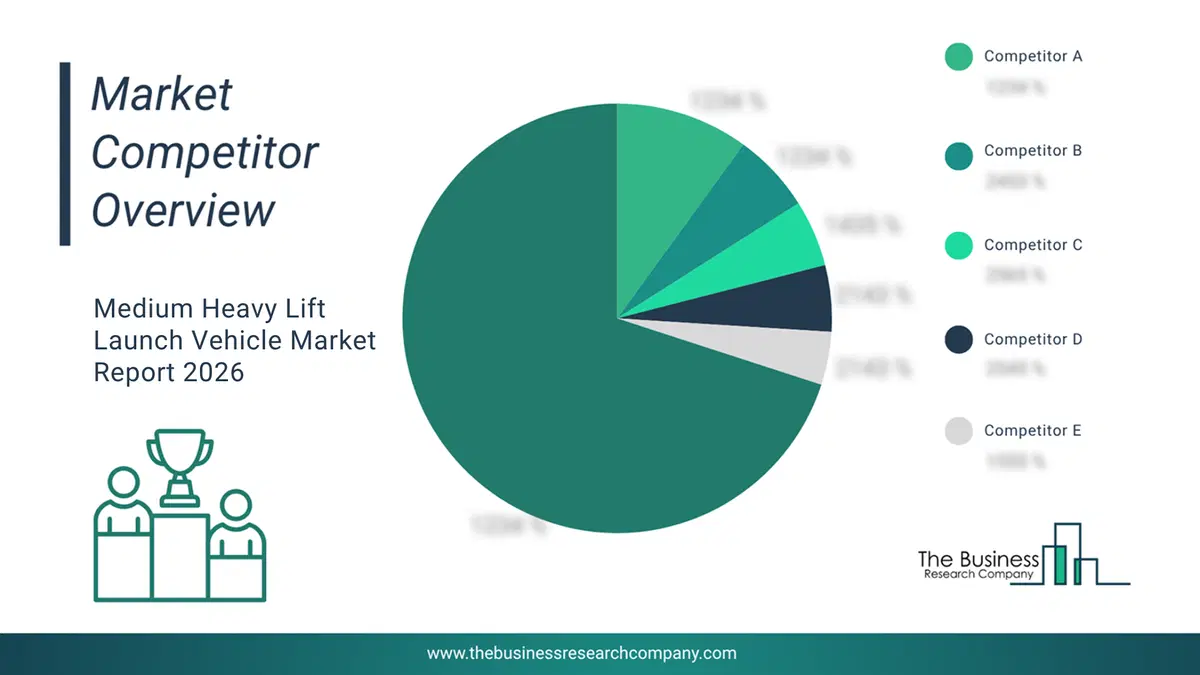
This chart is for illustrative purposes; the full report includes a detailed competitor analysis and comprehensive overview of the top 10 companies in the market.
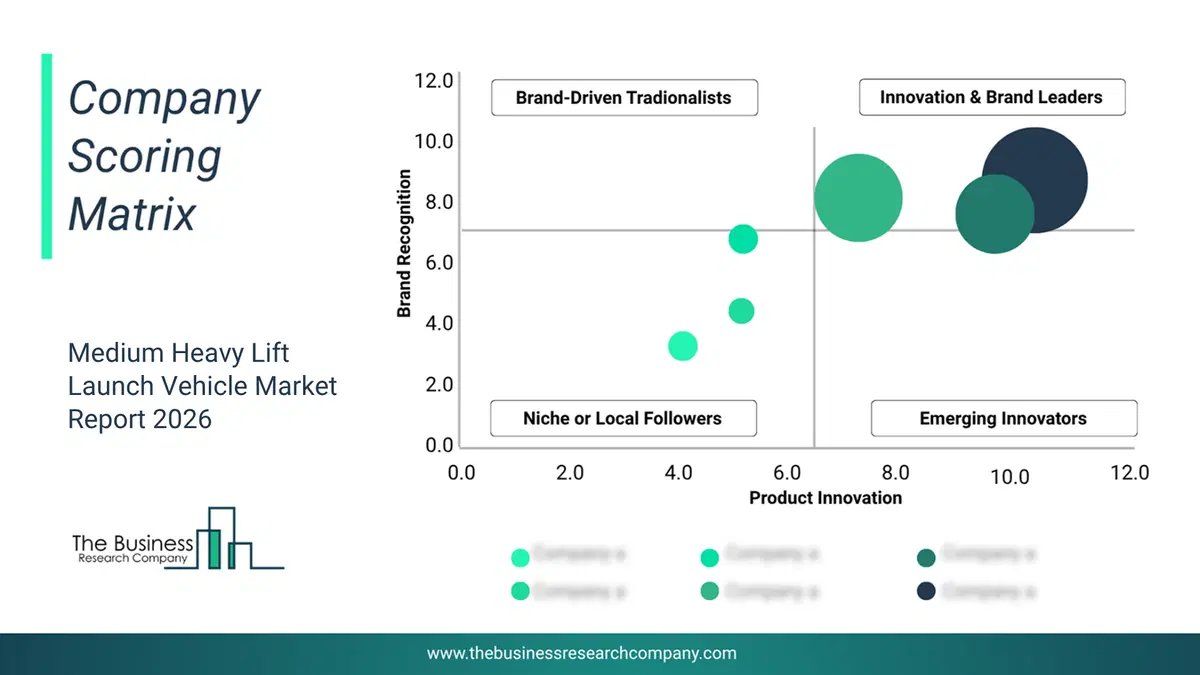
This chart maps companies by product innovation and brand strength, with bubble size indicating relative revenue, helping identify market leaders, challengers, and niche players. This is an illustrative chart; the full report provides a complete and accurate competitive analysis.
Global Medium Heavy Lift Launch Vehicle Market Trends and Insights
Major companies operating in the medium-heavy-lift launch vehicle market are focusing on developing advanced products such as heavy-lift rockets to meet the growing demand for satellite deployment and space exploration. A heavy-lift rocket is a launch vehicle designed to carry large payloads typically between 20,000 to 50,000 kilograms into low Earth orbit (LEO). These rockets are essential for transporting satellites, crewed spacecraft, and cargo for deep space missions. For instance, in July 2024, ArianeGroup, a France-based aerospace engineering company, launched Ariane 6. It is a next-generation heavy-lift launch vehicle developed for the European space agency. Its payload capacity ranges from 10,300 to 21,600 kg, depending on the variant. The Ariane 6 features a reignitable upper stage powered by the Vinci engine, enabling it to launch multiple payloads to different orbits in a single flight and to deorbit itself after mission completion, reducing space debris.What Are Latest Mergers And Acquisitions In The Medium Heavy Lift Launch Vehicle Market? Firefly Aerospace Acquires Spaceflight Inc To Expand On-Orbit And Launch Capabilities
In June 2023, Firefly Aerospace, a US-based space and defense technology company Spaceflight Inc for an undisclosed amount. The acquisition strengthens Firefly’s portfolio, including responsive launch, in-space mobility, on-orbit hosting, and lunar delivery operations. Spaceflight Inc is a US-based company involved in development of medium-heavy lift launch vehicle.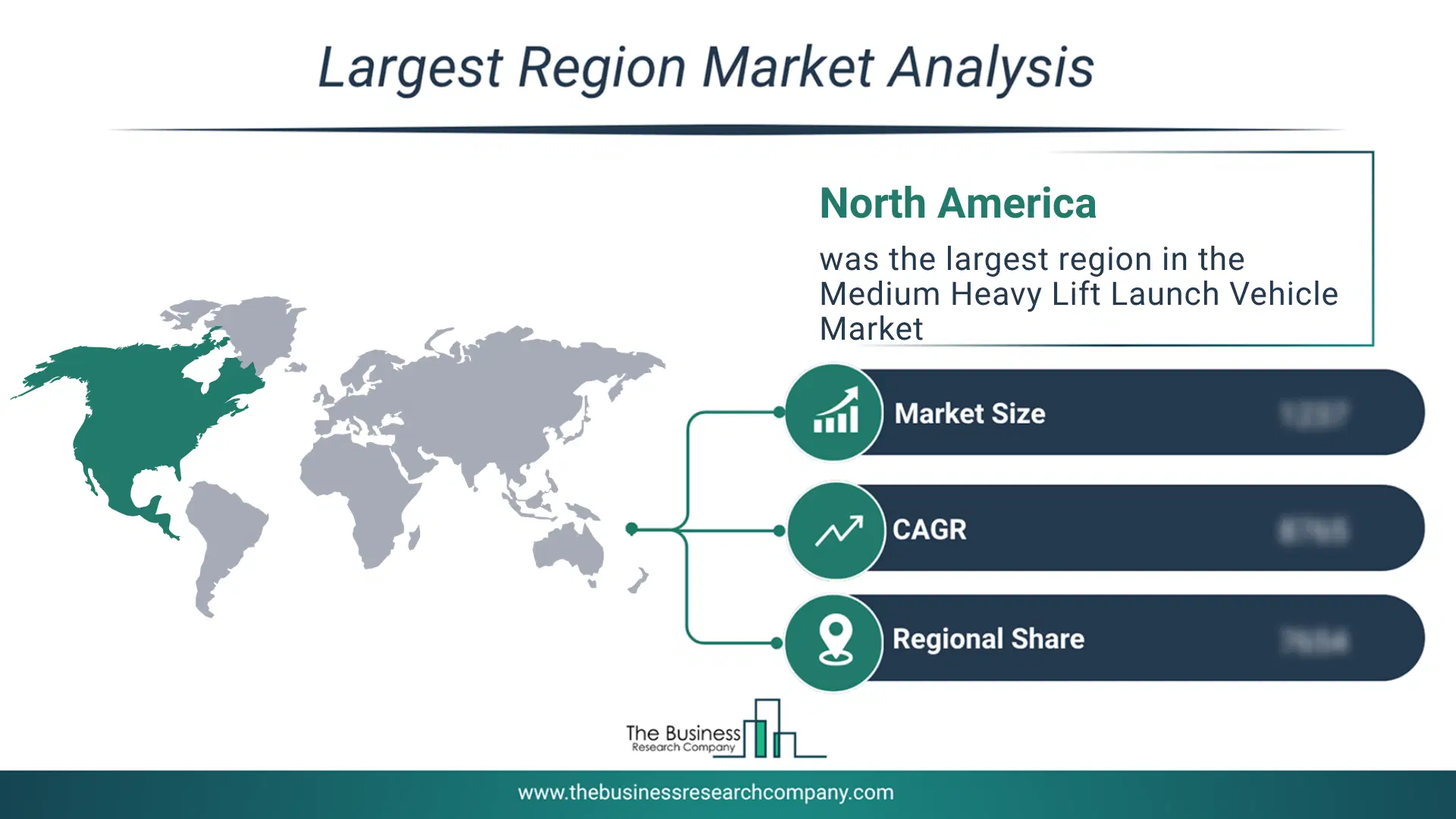
Regional Insights
North America was the largest region in the medium-heavy lift launch vehicle market in 2025. The regions covered in this market report are Asia-Pacific, South East Asia, Western Europe, Eastern Europe, North America, South America, Middle East, Africa. The countries covered in this market report are Australia, Brazil, China, France, Germany, India, Indonesia, Japan, Taiwan, Russia, South Korea, UK, USA, Canada, Italy, SpainWhat Defines the Medium Heavy Lift Launch Vehicle Market?
The medium-heavy lift launch vehicle market consists of sales of ground support equipment, safety systems, and fuel tanks. Values in this market are ‘factory gate’ values, that is, the value of goods sold by the manufacturers or creators of the goods, whether to other entities (including downstream manufacturers, wholesalers, distributors, and retailers) or directly to end customers. The value of goods in this market includes related services sold by the creators of the goods.How is Market Value Defined and Measured?
The market value is defined as the revenues that enterprises gain from the sale of goods and/or services within the specified market and geography through sales, grants, or donations in terms of the currency (in USD unless otherwise specified). The revenues for a specified geography are consumption values that are revenues generated by organizations in the specified geography within the market, irrespective of where they are produced. It does not include revenues from resales along the supply chain, either further along the supply chain or as part of other products.
This chart presents market attractiveness based on a quantitative evaluation of growth, competition, strategic alignment, and risk, offering a clear view of opportunity areas for decision-making. This chart is for illustrative purposes; the full report contains the complete analysis.

This chart highlights the Total Addressable Market (TAM) by estimating the maximum revenue opportunity using an assumption-driven approach, supporting strategic planning and opportunity sizing across markets. The chart is illustrative; the full report provides a more comprehensive analysis.
What Key Data and Analysis Are Included in the Medium Heavy Lift Launch Vehicle Market Report 2026?
The medium heavy lift launch vehicle market research report is one of a series of new reports from The Business Research Company that provides market statistics, including industry global market size, regional shares, competitors with the market share, detailed market segments, market trends and opportunities, and any further data you may need to thrive in the medium heavy lift launch vehicle industry. The market research report delivers a complete perspective of everything you need, with an in-depth analysis of the current and future state of the industry.Medium Heavy Lift Launch Vehicle Market Report Forecast Analysis
| Report Attribute | Details |
|---|---|
| Market Size Value In 2026 | $11.29 billion |
| Revenue Forecast In 2030 | $15.66 billion |
| Growth Rate | CAGR of 8.5% from 2026 to 2030 |
| Base Year For Estimation | 2025 |
| Actual Estimates/Historical Data | 2020-2025 |
| Forecast Period | 2026 - 2030 |
| Market Representation | Revenue in USD Billion and CAGR from 2026 to 2030 |
| Segments Covered | Launch Vehicle Class, Subsystem, Payload, End-User |
| Regional Scope | Asia-Pacific, Western Europe, Eastern Europe, North America, South America, Middle East, Africa |
| Country Scope | The countries covered in the medium heavy lift launch vehicle market report are Australia, Brazil, China, France, Germany, India, Indonesia, Japan, Taiwan, Russia, South Korea, UK, USA, Canada, Italy, Spain |
| Key Companies Profiled | The Boeing Company, Lockheed Martin Corporation, China Aerospace Science and Technology Corporation (CASC), Northrop Grumman Corporation, Mitsubishi Heavy Industries Ltd., SpaceX, Blue Origin LLC, ArianeGroup, Arianespace, United Launch Alliance LLC, Relativity Space, Rocket Lab USA Inc., Firefly Aerospace Inc., Gilmour Space Technologies, ROSCOSMOS, Virgin Orbit LLC, Galactic Energy, Isar Aerospace, Astra Space Inc., Interorbital System |
| Customization Scope | Request for Customization |
| Pricing And Purchase Options | Explore Purchase Options |