
Membrane Electrode Assemblies Market Report 2026
Global Outlook – By Component (Membrane, Electrode, Catalyst, Gasket), By MEA Type (3-layer Catalyst Coated Membrane (CCM), 5-layer (Full Membrane Electrode Assembly With Gas Diffusion Layers)), By Application (Fuel Cells, Electrolyzers, Hydrogen Generators), By End-User (Automotive, Power Generation, Industrial, Aerospace) – Market Size, Trends, Strategies, and Forecast to 2035
Membrane Electrode Assemblies Market Overview
• Membrane Electrode Assemblies market size has reached to $1.81 billion in 2025 • Expected to grow to $2.86 billion in 2030 at a compound annual growth rate (CAGR) of 9.7% • Growth Driver: Surge In Demand For Low-Emission Technologies Fueling The Growth Of The Market Due To Increasing Emphasis On Reducing Carbon Emissions • Market Trend: Advanced Thermal Control Technologies Improve High-Temperature Fuel Cell Performance • Asia-Pacific was the largest region and fastest growing region.What Is Covered Under Membrane Electrode Assemblies Market?
A membrane electrode assembly (MEA) is the core component of a fuel cell that enables the conversion of chemical energy into electrical energy through electrochemical reactions. It consists of a proton-conducting membrane sandwiched between electrodes coated with catalysts, facilitating efficient ion and electron transport. MEAs are essential for achieving high performance, durability, and energy efficiency in hydrogen-based energy systems. The main components of membrane electrode assemblies are membrane, electrode, catalyst, and gasket. Membrane refers to the proton-conducting layer that facilitates ion transport while separating reactant gases in the assembly. These assemblies are categorized by MEA type into 3-layer catalyst-coated membrane (CCM) and 5-layer (full membrane electrode assembly with gas diffusion layers). They are used across multiple applications, including fuel cells, electrolyzes, and hydrogen generators, and serve various end-users, such as automotive, power generation, industrial, and aerospace.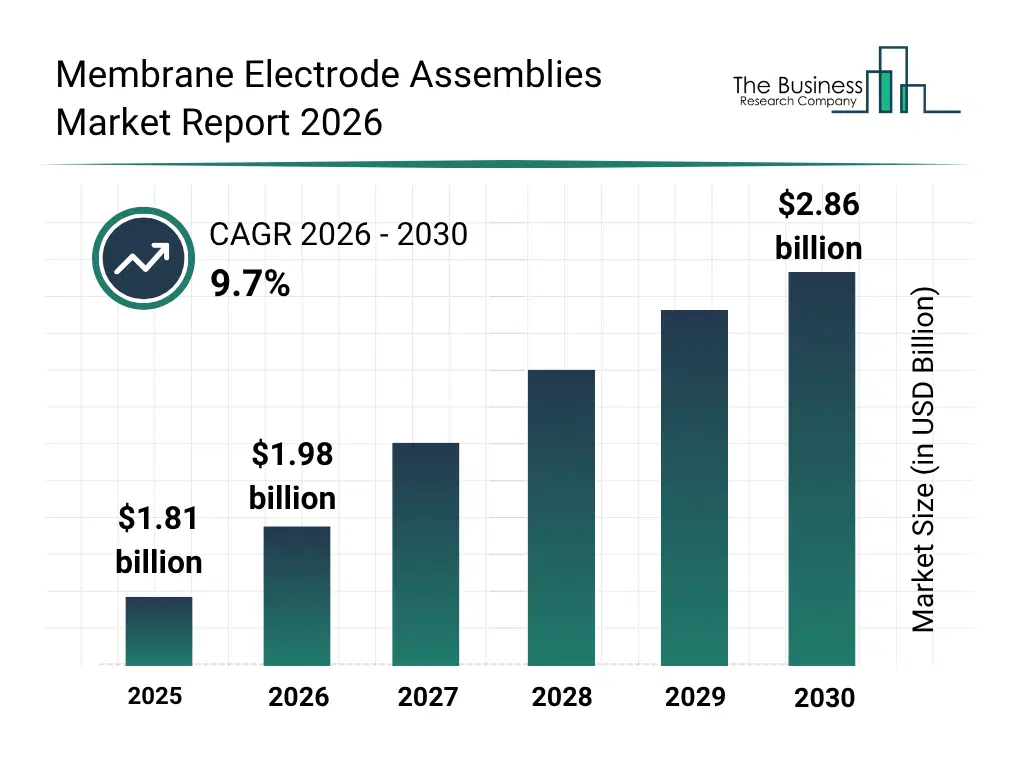
What Is The Membrane Electrode Assemblies Market Size and Share 2026?
The membrane electrode assemblies market size has grown strongly in recent years. It will grow from $1.81 billion in 2025 to $1.98 billion in 2026 at a compound annual growth rate (CAGR) of 9.4%. The growth in the historic period can be attributed to rising adoption of fuel cell vehicles, increasing hydrogen production initiatives, advancements in catalyst technologies, growth in power generation using fuel cells, supportive government policies for clean energy.What Is The Membrane Electrode Assemblies Market Growth Forecast?
The membrane electrode assemblies market size is expected to see strong growth in the next few years. It will grow to $2.86 billion by 2030 at a compound annual growth rate (CAGR) of 9.7%. The growth in the forecast period can be attributed to expansion of green hydrogen infrastructure, increasing demand for automotive fuel cells, development of cost-effective membrane materials, integration of advanced monitoring and diagnostic systems, rising industrial and aerospace applications of fuel cells. Major trends in the forecast period include advancements in proton exchange membrane technologies, development of high-performance catalyst materials, integration of meas in electrolyzers and hydrogen generators, focus on durability and longevity of meas, optimization of gas diffusion layers for enhanced efficiency.
Global Membrane Electrode Assemblies Market Segmentation
1) By Component: Membrane, Electrode, Catalyst, Gasket 2) By MEA Type: 3-layer Catalyst Coated Membrane (CCM), 5-layer (Full Membrane Electrode Assembly With Gas Diffusion Layers) 3) By Application: Fuel Cells, Electrolyzers, Hydrogen Generators 4) By End-User: Automotive, Power Generation, Industrial, Aerospace Subsegments: 1) By Membrane: Proton Exchange Membrane, Anion Exchange Membrane, Perfluorosulfonic Acid Membrane, Hydrocarbon Based Membrane, Composite Reinforced Membrane 2) By Electrode: Carbon Paper Electrode, Carbon Cloth Electrode, Metal Mesh Electrode, Porous Metal Electrode, Nanostructured Carbon Electrode 3) By Catalyst: Platinum Based Catalyst, Platinum Alloy Catalyst, Palladium Based Catalyst, Non Precious Metal Catalyst, Transition Metal Nitrogen Carbon Catalyst 4) By Gasket: Silicone Rubber Gasket, Polytetrafluoroethylene Gasket, Ethylene Propylene Diene Monomer Rubber Gasket, Fluoroelastomer Rubber Gasket, Graphite Composite GasketWhat Is The Driver Of The Membrane Electrode Assemblies Market?
The increasing emphasis on reducing carbon emissions is expected to propel the growth of the membrane electrode assemblies market going forward. Carbon emissions are the release of carbon dioxide (CO₂) into the atmosphere from activities such as fossil fuel combustion. The growing focus on reducing carbon emissions is driven by heightened environmental concerns, as lowering emissions is critical to mitigating climate change and preserving ecosystems. Membrane electrode assemblies (MEAs) contribute to reducing carbon emissions by enabling fuel cells to generate clean electricity with minimal greenhouse gas emissions. For instance, in November 2024, according to the Environmental Protection Agency, a US-based government agency, average real-world CO₂ emissions from new vehicles declined to a record 319 grams per mile, while fuel economy improved to 27.1 miles per gallon (mpg). Therefore, the increasing emphasis on reducing carbon emissions is driving the growth of the membrane electrode assemblies industry.Key Players In The Global Membrane Electrode Assemblies Market
Major companies operating in the membrane electrode assemblies market are Toyota Motor Corporation, BASF SE, Hyundai Mobis Co. Ltd., Cummins Inc., 3M Company, Johnson Matthey Plc, Toray Industries Inc., The Chemours Company, Plug Power Inc., Wuhan WUT New Energy Co. Ltd., Freudenberg Fuel Cell e-Power Systems, Ballard Power Systems Inc., FuelCellsEtc, W. L. Gore & Associates Inc., Horizon Fuel Cell Technologies, HyPlat (Pty) Ltd., Ion Power Inc., SinoHyKey Technology Company Limited, Sainergy Fuel Cell India Private Limited, Advent Technologies Holdings Inc.Global Membrane Electrode Assemblies Market Trends and Insights
Major companies operating in the membrane electrode assemblies (MEA) market are focusing on developing innovative solutions, such as superior heat management, to enhance fuel cell efficiency, improve durability, and enable reliable operation in high-temperature and extreme environmental conditions. Superior heat management refers to the ability of a system or technology to efficiently dissipate and control heat during operation to maintain optimal performance, reliability, and longevity. For instance, in October 2024, Advent Technologies Holdings, Inc., a U.S.-based clean energy technology company, launched the Advent MEA G2, an advanced membrane electrode assembly designed for high-temperature proton exchange membrane (HT-PEM) fuel cells. The technology delivers significantly higher power density and extended operational life through a low phosphoric acid formulation and optimized electrode architecture, enabling up to approximately 2.5 times higher power output and reduced degradation compared to conventional MEAs. It also simplifies system water and thermal management, supporting reliable performance across stationary, portable, automotive, and marine applications.What Are Latest Mergers And Acquisitions In The Membrane Electrode Assemblies Market?
In April 2023, SFC Energy AG, a Germany-based hydrogen and methanol fuel cell manufacturer, partnered with Johnson Matthey plc to advance hydrogen fuel cell technology and strengthen fuel cell component manufacturing. Through this collaboration, SFC Energy acquired Johnson Matthey’s technology and assets for producing membrane electrode assemblies (MEAs) for direct methanol fuel cells, while Johnson Matthey supplies catalysts and develops proton exchange membrane components for hydrogen fuel cells. Johnson Matthey plc is a UK-based sustainable technologies company specializing in catalysts and advanced materials for clean energy solutions.Regional Insights
Asia-Pacific was the largest region in the membrane electrode assemblies market in 2025. Asia-Pacific is expected to be the fastest-growing region in the forecast period. The regions covered in this market report are Asia-Pacific, South East Asia, Western Europe, Eastern Europe, North America, South America, Middle East, Africa. The countries covered in this market report are Australia, Brazil, China, France, Germany, India, Indonesia, Japan, Taiwan, Russia, South Korea, UK, USA, Canada, Italy, Spain.What Defines the Membrane Electrode Assemblies Market?
The membrane electrode assemblies market consists of sales of membrane, electrode, catalyst, gasket, gas diffusion layer, bipolar plate, sealing frame, ionomer, carbon paper, and flow field plate. Values in this market are ‘factory gate’ values, that is, the value of goods sold by the manufacturers or creators of the goods, whether to other entities (including downstream manufacturers, wholesalers, distributors, and retailers) or directly to end customers. The value of goods in this market includes related services sold by the creators of the goods.How is Market Value Defined and Measured?
The market value is defined as the revenues that enterprises gain from the sale of goods and/or services within the specified market and geography through sales, grants, or donations in terms of the currency (in USD unless otherwise specified). The revenues for a specified geography are consumption values that are revenues generated by organizations in the specified geography within the market, irrespective of where they are produced. It does not include revenues from resales along the supply chain, either further along the supply chain or as part of other products.What Key Data and Analysis Are Included in the Membrane Electrode Assemblies Market Report 2026?
The membrane electrode assemblies market research report is one of a series of new reports from The Business Research Company that provides market statistics, including industry global market size, regional shares, competitors with the market share, detailed market segments, market trends and opportunities, and any further data you may need to thrive in the membrane electrode assemblies industry. The market research report delivers a complete perspective of everything you need, with an in-depth analysis of the current and future state of the industry.Membrane Electrode Assemblies Market Report Forecast Analysis
| Report Attribute | Details |
|---|---|
| Market Size Value In 2026 | $1.98 billion |
| Revenue Forecast In 2035 | $2.86 billion |
| Growth Rate | CAGR of 9.4% from 2026 to 2035 |
| Base Year For Estimation | 2025 |
| Actual Estimates/Historical Data | 2020-2025 |
| Forecast Period | 2026 - 2030 - 2035 |
| Market Representation | Revenue in USD Billion and CAGR from 2026 to 2035 |
| Segments Covered | Component, MEA Type, Application, End-User |
| Regional Scope | Asia-Pacific, Western Europe, Eastern Europe, North America, South America, Middle East, Africa |
| Country Scope | The countries covered in the report are Australia, Brazil, China, France, Germany, India, ... |
| Key Companies Profiled | Toyota Motor Corporation, BASF SE, Hyundai Mobis Co. Ltd., Cummins Inc., 3M Company, Johnson Matthey Plc, Toray Industries Inc., The Chemours Company, Plug Power Inc., Wuhan WUT New Energy Co. Ltd., Freudenberg Fuel Cell e-Power Systems, Ballard Power Systems Inc., FuelCellsEtc, W. L. Gore & Associates Inc., Horizon Fuel Cell Technologies, HyPlat (Pty) Ltd., Ion Power Inc., SinoHyKey Technology Company Limited, Sainergy Fuel Cell India Private Limited, Advent Technologies Holdings Inc. |
| Customization Scope | Request for Customization |
| Pricing And Purchase Options | Explore Purchase Options |