
Microelectronic Residual Chlorine Sensor Market Report 2026
Global Outlook – By Type ( Amperometric Residual Chlorine Sensor, Potentiometric Residual Chlorine Sensor), By Technology ( Electrochemical Sensors, Optical Sensors, Other Technologies), By Application ( Smart Home, Food Industry, Medical Industry, Agriculture, Other Applications), By End-Use Industry ( Municipal Water Treatment, Industrial Sector, Commercial Sector, Residential Sector) – Market Size, Trends, Strategies, and Forecast to 2030
Microelectronic Residual Chlorine Sensor Market Overview
• Microelectronic Residual Chlorine Sensor market size has reached to $1.42 billion in 2025 • Expected to grow to $2.25 billion in 2030 at a compound annual growth rate (CAGR) of 9.6% • Growth Driver: The Increase In Demand For Safer Drinking Water Fueling The Growth Of The Market Due To Heightened Consumer Health Awareness • Market Trend: Use Of Amperometric Sensing Technology In Chlorine Analyzers To Improve Accuracy And Efficiency • Asia-Pacific was the largest region and fastest growing region.What Is Covered Under Microelectronic Residual Chlorine Sensor Market?
A microelectronic residual chlorine sensor is a small-scale electronic device designed to detect and measure the concentration of residual chlorine in water or other fluids. It uses microelectronic components and sensing technology to provide accurate, real-time monitoring of chlorine levels, ensuring water quality and safety in applications like water treatment, environmental monitoring, and industrial processes. The sensor converts chemical information into electrical signals for analysis and control. The main types of microelectronic residual chlorine sensor are the amperometric residual chlorine sensor and the potentiometric residual chlorine sensor. Amperometric residual chlorine sensors operate by measuring the current produced during the electrochemical reduction or oxidation of chlorine in a solution. The different technologies include electrochemical sensors, optical sensors, and others. The various applications include smart home, food industry, medical industry, agriculture, and others and are used by several end-users, including municipal water treatment, the industrial sector, the commercial sector, and the residential sector.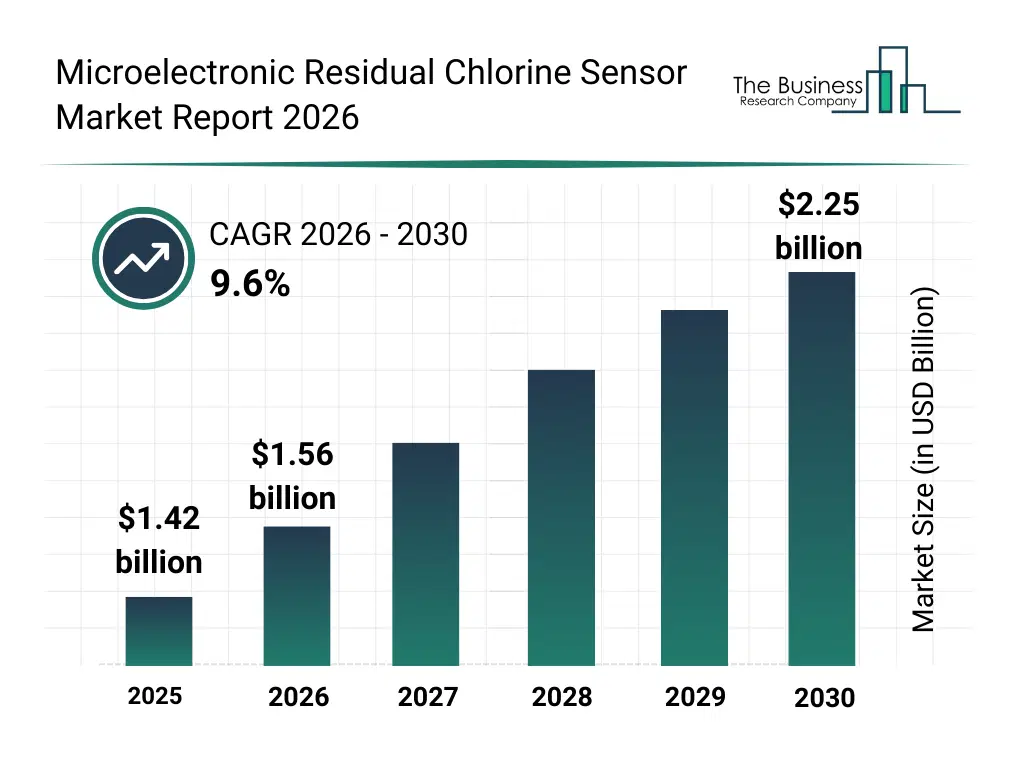
What Is The Microelectronic Residual Chlorine Sensor Market Size 2026 And Growth Rate?
The microelectronic residual chlorine sensor market size has grown strongly in recent years. It will grow from $1.42 billion in 2025 to $1.56 billion in 2026 at a compound annual growth rate (CAGR) of 9.9%. The growth in the historic period can be attributed to rising urbanization, increasing waterborne diseases, adoption of electrochemical sensors, regulatory mandates for water quality, growth in municipal water treatment.What Is The Microelectronic Residual Chlorine Sensor Market Growth Forecast?
The microelectronic residual chlorine sensor market size is expected to see strong growth in the next few years. It will grow to $2.25 billion in 2030 at a compound annual growth rate (CAGR) of 9.6%. The growth in the forecast period can be attributed to demand for smart water monitoring, integration with iot and cloud platforms, innovations in optical sensing technology, expansion of industrial water treatment, growth in agriculture and food industry water safety. Major trends in the forecast period include miniaturization and high-precision sensing, real-time water quality monitoring, integration with industrial automation systems, advanced electrochemical and optical sensing, remote monitoring and data analytics.
Global Microelectronic Residual Chlorine Sensor Market Segmentation
1) By Type: Amperometric Residual Chlorine Sensor, Potentiometric Residual Chlorine Sensor 2) By Technology: Electrochemical Sensors, Optical Sensors, Other Technologies 3) By Application: Smart Home, Food Industry, Medical Industry, Agriculture, Other Applications 4) By End-Use Industry: Municipal Water Treatment, Industrial Sector, Commercial Sector, Residential Sector Subsegments: 1) By Amperometric Residual Chlorine Sensor, Polarographic Sensors, Membrane-covered Sensors, Differential Sensors 2) By Potentiometric Residual Chlorine Sensor, Ion-selective Electrode (ISE) Sensors, Solid-state Sensors, Glass Electrode SensorsWhat Is The Driver Of The Microelectronic Residual Chlorine Sensor Market?
The increasing demand for safer drinking water is expected to propel the growth of the microelectronic residual chlorine sensor market going forward. Safer drinking water refers to water that is free from harmful contaminants and meets established health and safety standards for human consumption. The demand for safer drinking water is increasing as more people prioritize health and hygiene due to rising awareness of waterborne diseases and the need for clean, reliable water sources. Microelectronic residual chlorine sensors enhance water safety systems by providing accurate, real-time monitoring of chlorine levels from treatment plants to distribution points. For instance, in April 2023, according to the U.S. Environmental Protection Agency (EPA), a US-based government agency, the FY 2023 Drinking Water State Revolving Fund (DWSRF) has already awarded over US $5.1 billion to states, territories and tribes by the end of March 2023 under the Bipartisan Infrastructure Law water-infrastructure program, up from previous year levels. Therefore, substantial government investment in water safety is a key driver for the microelectronic residual chlorine sensor industry.Key Players In The Global Microelectronic Residual Chlorine Sensor Market
Major companies operating in the microelectronic residual chlorine sensor market are Thermo Fisher Scientific Inc., ABB Ltd., Emerson Electric Co., Endress+Hauser AG, Xylem Inc., ATI Inc., Polestar Technologies Inc., HORIBA Ltd., Hach Company, Swan Analytical Instruments, ProMinent GmbH, Nanjing Wotian Technology Co. Ltd., Myron L Company, Thermochem Corporation Pvt. Ltd., Axis Solutions Private Limited, Hangzhou Supmea International Trading Co. Ltd., ShanghAI Boqu Instrument Co. Ltd., Aquadax South Asia Private Limited (OPC), ShanghAI GL Environmental Technology Co. Ltd., Suzhou Delfino Environmental Technology Co. Ltd.
This chart is for illustrative purposes; the full report includes a detailed competitor analysis and comprehensive overview of the top 10 companies in the market.
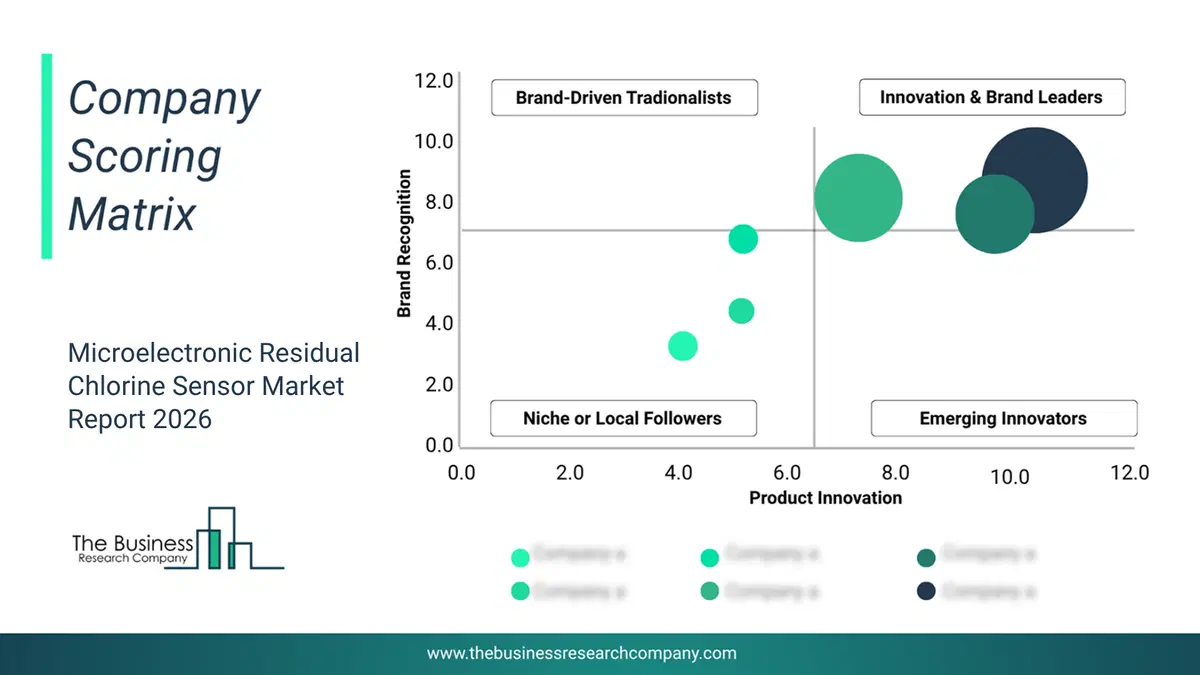
This chart maps companies by product innovation and brand strength, with bubble size indicating relative revenue, helping identify market leaders, challengers, and niche players. This is an illustrative chart; the full report provides a complete and accurate competitive analysis.
Global Microelectronic Residual Chlorine Sensor Market Trends and Insights
Major companies operating in the microelectronic residual chlorine sensor market are focusing on technology advancements, such as amperometric sensing, to enhance chlorine measurement accuracy and efficiency. Amperometric sensing refers to a measurement technique that detects the concentration of a chemical substance by monitoring the electric current generated from its oxidation or reduction at an electrode surface when a fixed voltage is applied. For instance, in April 2025, ABB Ltd., a Switzerland-based industrial technology company, launched the ChloroStar family of analysers, designed for precise and continuous monitoring of residual chlorine in water treatment and industrial processes. The analysers feature a direct-contact electrode cell with continuous sample flow cleaning, making them suitable for high-fouling environments such as wastewater and industrial effluents. The Key advantages include improved measurement accuracy, reduced maintenance requirements, and up to 20% lower consumables costs, enabling more efficient, reliable, and cost-effective chlorine monitoring for municipal and industrial applications.What Are Latest Mergers And Acquisitions In The Microelectronic Residual Chlorine Sensor Market?
In February 2024, ABB Ltd., a Switzerland-based provider of industrial automation, robotics, electrification, and water management solutions, acquired Real Tech Inc. for an undisclosed amount. With this acquisition, ABB strengthened its smart water management portfolio by integrating Real Tech’s advanced optical sensors for real-time monitoring of residual chlorine and other water quality parameters, enhancing its capabilities in municipal and industrial water treatment applications. Real Tech Inc. is a US-based company that specializes in manufacturing water quality monitoring and testing solutions.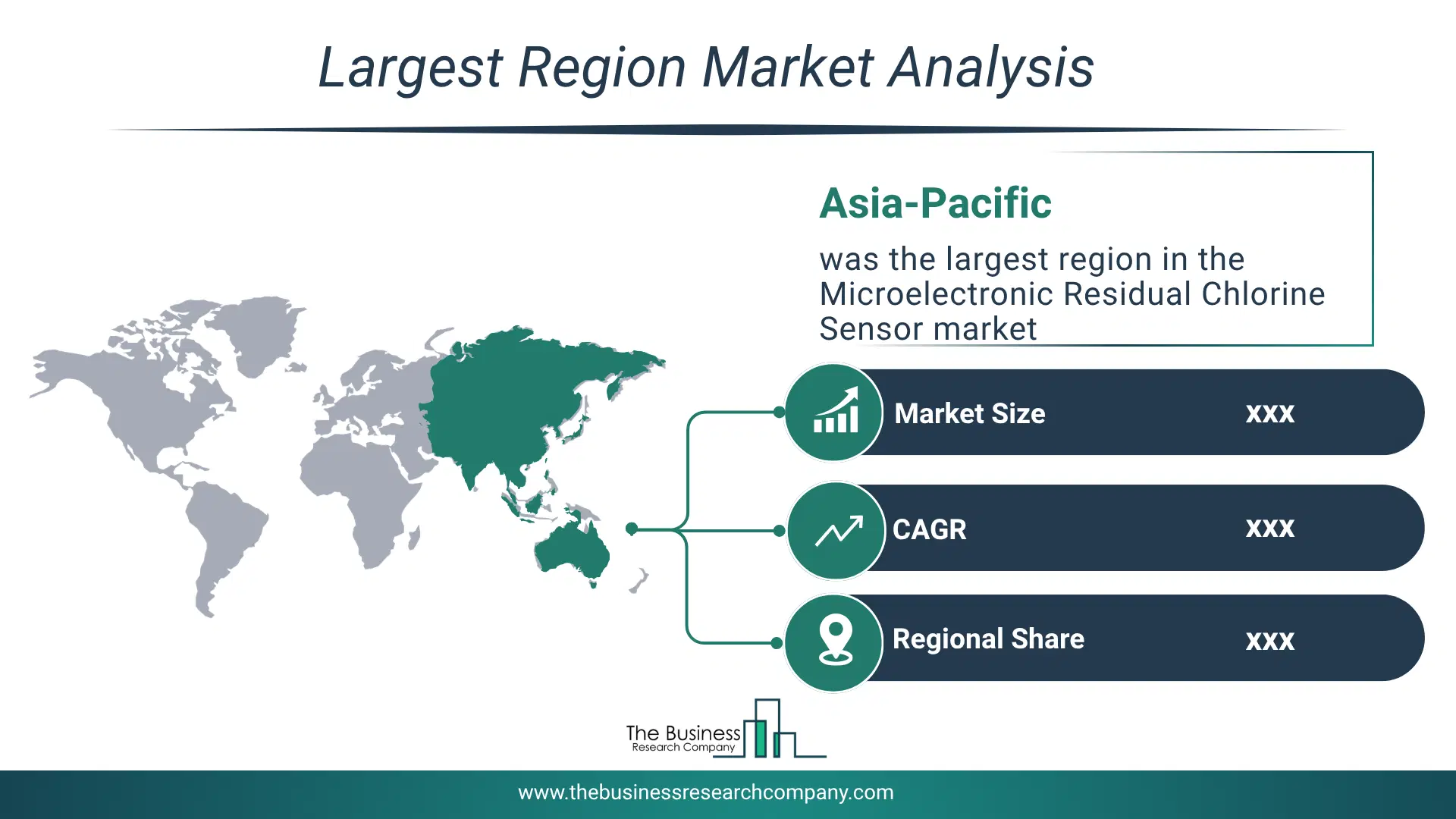
Regional Outlook
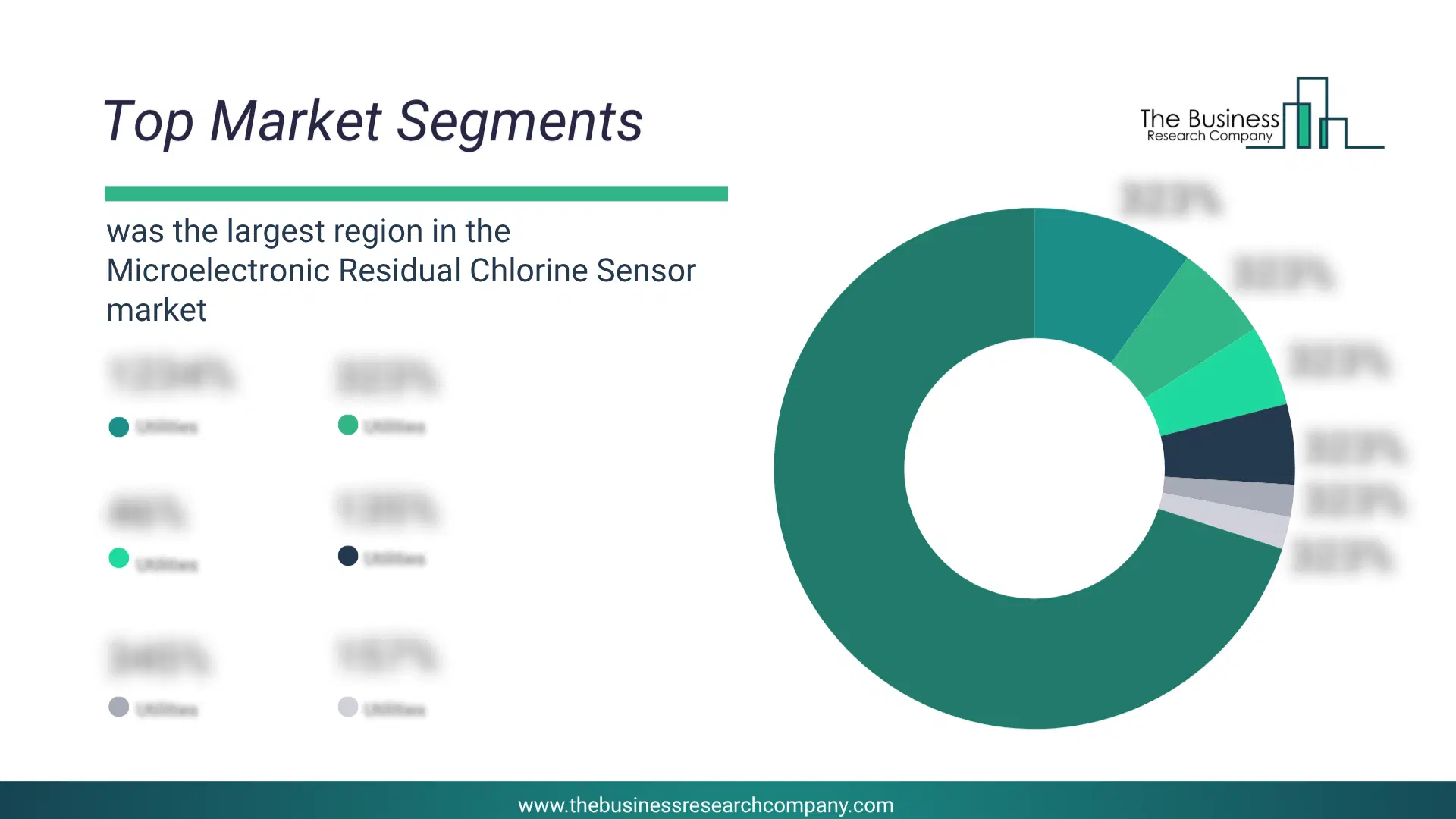
Asia-Pacific was the largest region in the microelectronic residual chlorine sensor market in 2025. Asia-Pacific is expected to be the fastest-growing region in the forecast period. The regions covered in this market report are Asia-Pacific, South East Asia, Western Europe, Eastern Europe, North America, South America, Middle East, Africa. The countries covered in this market report are Australia, Brazil, China, France, Germany, India, Indonesia, Japan, Taiwan, Russia, South Korea, UK, USA, Canada, Italy, Spain.What Defines the Microelectronic Residual Chlorine Sensor Market?
The microelectronic residual chlorine sensor market consists of revenues earned by entities by providing services such as water quality monitoring and analysis, sensor calibration and maintenance services, installation and integration services, remote monitoring and data reporting services, and custom sensor design and development services. The market value includes the value of related goods sold by the service provider or included within the service offering. The microelectronic residual chlorine sensor market also includes sales of optical residual chlorine sensors, membrane-based residual chlorine sensors, electrochemical residual chlorine sensors, ultraviolet absorption residual chlorine sensors, and digital residual chlorine sensors. Values in this market are ‘factory gate’ values; that is, the value of goods sold by the manufacturers or creators of the goods, whether to other entities (including downstream manufacturers, wholesalers, distributors, and retailers) or directly to end customers. The value of goods in this market includes related services sold by the creators of the goods.How is Market Value Defined and Measured?
The market value is defined as the revenues that enterprises gain from the sale of goods and/or services within the specified market and geography through sales, grants, or donations in terms of the currency (in USD unless otherwise specified). The revenues for a specified geography are consumption values that are revenues generated by organizations in the specified geography within the market, irrespective of where they are produced. It does not include revenues from resales along the supply chain, either further along the supply chain or as part of other products.
This chart presents market attractiveness based on a quantitative evaluation of growth, competition, strategic alignment, and risk, offering a clear view of opportunity areas for decision-making. This chart is for illustrative purposes; the full report contains the complete analysis.

This chart highlights the Total Addressable Market (TAM) by estimating the maximum revenue opportunity using an assumption-driven approach, supporting strategic planning and opportunity sizing across markets. The chart is illustrative; the full report provides a more comprehensive analysis.
What Key Data and Analysis Are Included in the Microelectronic Residual Chlorine Sensor Market Report 2026?
The microelectronic residual chlorine sensor market research report is one of a series of new reports from The Business Research Company that provides market statistics, including industry global market size, regional shares, competitors with the market share, detailed market segments, market trends and opportunities, and any further data you may need to thrive in the microelectronic residual chlorine sensor industry. The market research report delivers a complete perspective of everything you need, with an in-depth analysis of the current and future state of the industry.Microelectronic Residual Chlorine Sensor Market Report Forecast Analysis
| Report Attribute | Details |
|---|---|
| Market Size Value In 2026 | $1.56 billion |
| Revenue Forecast In 2030 | $2.25 billion |
| Growth Rate | CAGR of 9.6% from 2026 to 2030 |
| Base Year For Estimation | 2025 |
| Actual Estimates/Historical Data | 2020-2025 |
| Forecast Period | 2026 - 2030 |
| Market Representation | Revenue in USD Billion and CAGR from 2026 to 2030 |
| Segments Covered | Type, Technology, Application, End-Use Industry |
| Regional Scope | Asia-Pacific, Western Europe, Eastern Europe, North America, South America, Middle East, Africa |
| Country Scope | The countries covered in the report are Australia, Brazil, China, France, Germany, India, Indonesia, Japan, Taiwan, Russia, South Korea, UK, USA, Canada, Italy, Spain. |
| Key Companies Profiled | Thermo Fisher Scientific Inc., ABB Ltd., Emerson Electric Co., Endress+Hauser AG, Xylem Inc., ATI Inc., Polestar Technologies Inc., HORIBA Ltd., Hach Company, Swan Analytical Instruments, ProMinent GmbH, Nanjing Wotian Technology Co. Ltd., Myron L Company, Thermochem Corporation Pvt. Ltd., Axis Solutions Private Limited, Hangzhou Supmea International Trading Co. Ltd., ShanghAI Boqu Instrument Co. Ltd., Aquadax South Asia Private Limited (OPC), ShanghAI GL Environmental Technology Co. Ltd., Suzhou Delfino Environmental Technology Co. Ltd. |
| Customization Scope | Request for Customization |
| Pricing And Purchase Options | Explore Purchase Options |