

Microfluidics Market Report 2026
Global Outlook – By Material (Silicon-Based Microfluidics, Glass-Based Microfluidics, Polymer-Based Microfluidics), By Technology (Droplet-Based Microfluidics, Continuous-Flow Microfluidics, Digital Microfluidics, Paper-Based Microfluidics, Centrifugal Microfluidics, Organ-on-a-Chip Platforms), By Application (Industrial And Environmental, Drug Delivery, Pharmaceutical And Life Science Research, Analysis, Clinical And Veterinary Diagnostics) – Market Size, Trends, Strategies, and Forecast to 2030
Microfluidics Market Overview
• Microfluidics market size has reached to $10.33 billion in 2025 • Expected to grow to $20.73 billion in 2030 at a compound annual growth rate (CAGR) of 14.9% • Growth Driver: Expanding Role Of Microfluidics In Advancing Cell-Based Therapies Spurs Market Growth • Market Trend: Technological Advancements Driving Market Positioning In The Microfluidics Industry • North America was the largest region and fastest growing region.What Is Covered Under Microfluidics Market?
Microfluidics refers to the science and technology of devices that process or manipulate small volumes of fluid (10-9 to 10-18L) through channels with a width of a few tens to several hundred micrometers. Microfluidic devices perform chemical analysis on small amounts of liquid, such as a droplet (blood). Microfluidics-based devices evolved as an alternative to conventional laboratory techniques, as they have the potential to carry out complete laboratory protocols on a single small chip. The main types of microfluidics include silicone-based microfluidics, glass-based microfluidics, and polymer-based microfluidics. Silicon-based microfluidics refers to micro-manufactured devices used for the chip-scale management of tiny volumes of fluids made by mixing silicon with other materials such as glass, polymers, or other materials. They are used for various applications ranging from industrial or environmental, drug delivery, pharmaceutical and life science research, analysis, and clinical and veterinary diagnostics.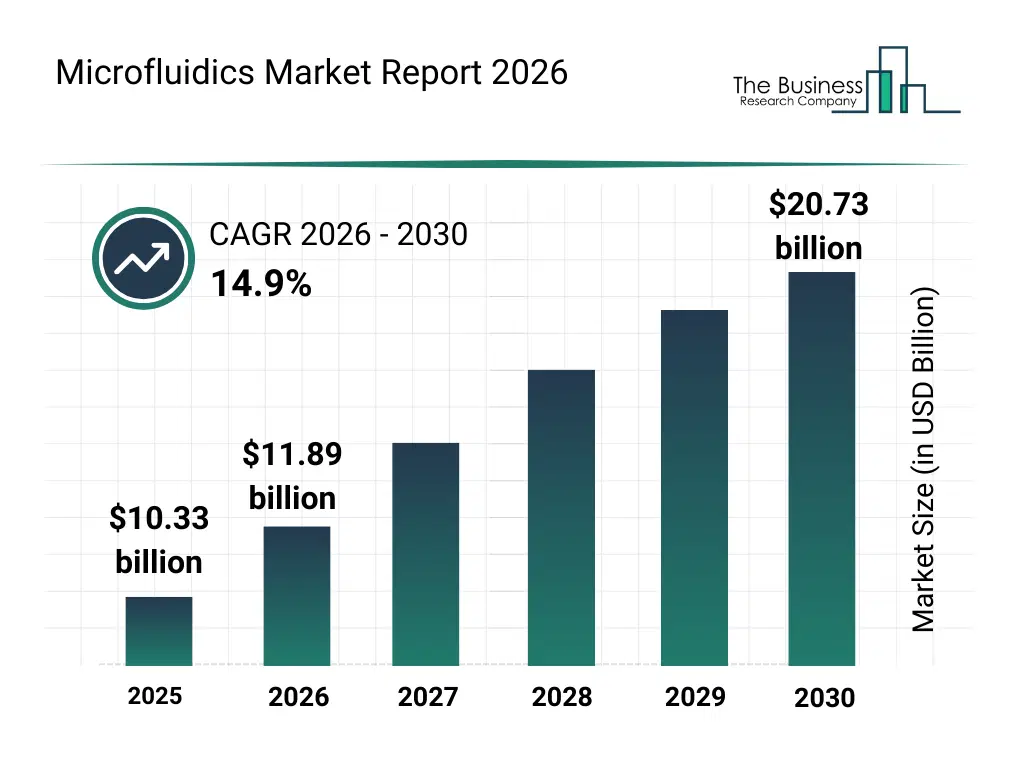
What Is The Microfluidics Market Size and Share 2026?
The microfluidics market size has grown rapidly in recent years. It will grow from $10.33 billion in 2025 to $11.89 billion in 2026 at a compound annual growth rate (CAGR) of 15.0%. The growth in the historic period can be attributed to growth in laboratory-on-a-chip research, increasing demand for miniaturized diagnostic devices, adoption in pharmaceutical R&D, expansion of analytical and clinical testing, development of silicon and glass-based microfluidic devices.What Is The Microfluidics Market Growth Forecast?
The microfluidics market size is expected to see rapid growth in the next few years. It will grow to $20.73 billion in 2030 at a compound annual growth rate (CAGR) of 14.9%. The growth in the forecast period can be attributed to rising adoption in point-of-care diagnostics, growth in personalized medicine applications, expansion of polymer-based microfluidics, increasing integration with IoT and smart lab systems, advancements in high-throughput screening technologies. Major trends in the forecast period include integration of microfluidics in drug delivery systems, adoption of microfluidics in clinical diagnostics, expansion of pharmaceutical and life science research applications, development of industrial and environmental microfluidics solutions, advancement in high-precision fluid manipulation technologies.

Global Microfluidics Market Segmentation
1) By Material: Silicon-Based Microfluidics, Glass-Based Microfluidics, Polymer-Based Microfluidics 2) By Technology: Droplet-Based Microfluidics, Continuous-Flow Microfluidics, Digital Microfluidics, Paper-Based Microfluidics, Centrifugal Microfluidics, Organ-on-a-Chip Platforms 3) By Application: Industrial And Environmental, Drug Delivery, Pharmaceutical And Life Science Research, Analysis, Clinical And Veterinary Diagnostics Subsegments: 1) By Silicon-Based Microfluidics: Bulk Micromachined Silicon, Silicon-on-Insulator (SOI), Nano-Structured Silicon 2) By Glass-Based Microfluidics: Borosilicate Glass, Fused Silica Glass, Soda-Lime Glass 3) By Polymer-Based Microfluidics: Polydimethylsiloxane (PDMS), Poly(methyl methacrylate) (PMMA), Polycarbonate (PC)What Is The Driver Of The Microfluidics Market?
The increased number of clinical studies for cell-based therapies contributed to the growth of the microfluidics market during the historic period. Microfluidics has emerged as a potential platform to advance biomanufacturing in the field of drug or gene or cell therapies via improved synthesis of nanoscale drug/gene delivery systems, microencapsulation of drug or cells, intracellular delivery of macromolecules and fabrication of macroscale construct of micro-nano-fibers. For instance, In July 2023, according to the American Society of Gene and Cell Therapy, a US-based medical and scientific development organization, the number of non-oncology gene and cell therapy clinical trials increased by 58% in the second quarter of 2023 as compared to first quarter of 2023. Therefore, the increased number of clinical studies for cell-based therapies is likely to drive the growth of the microfluidics industry during the forecast period.Key Players In The Global Microfluidics Market
Major companies operating in the microfluidics market report are Thermo Fisher Scientific, Agilent Technologies, Bio-Rad Laboratories, Fluidigm Corporation, Dolomite Microfluidics, PerkinElmer, Inc., Sphere Fluidics Limited, Micronit Micro Technologies B.V., Fluigent, Elveflow, Cellix Ltd., Microliquid S.L., Biosurfit S.A., FlowJEM, uFluidix, QuantWave Technologies Inc., Harvard Bioscience, Inc., Abaxis, Inc., OPKO Health, Inc., Abbott, Stämm
This chart is for illustrative purposes; the full report includes a detailed competitor analysis and comprehensive overview of the top 10 companies in the market.
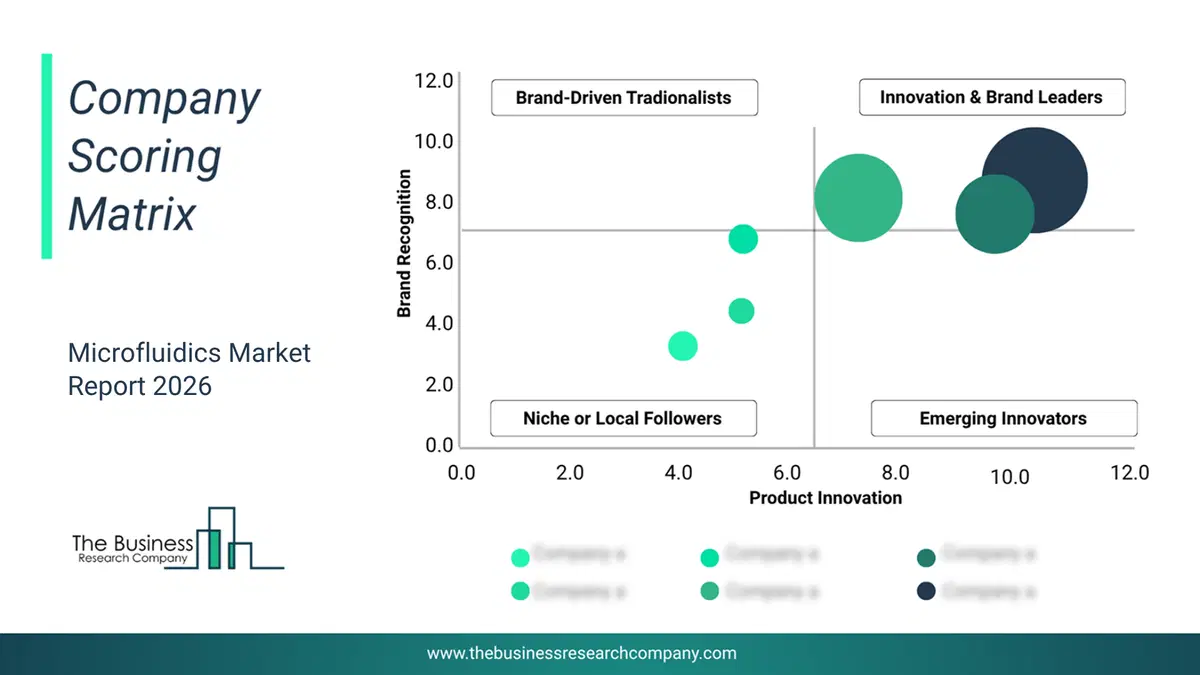
This chart maps companies by product innovation and brand strength, with bubble size indicating relative revenue, helping identify market leaders, challengers, and niche players. This is an illustrative chart; the full report provides a complete and accurate competitive analysis.
Global Microfluidics Market Trends and Insights
Major companies operating in the microfluidics market are focusing on developing advanced solutions, such as lab-on-a-chip devices and integrated microfluidic platforms, to enhance diagnostic precision, reduce sample processing time, and improve point-of-care testing capabilities. Lab-on-a-chip devices refer to miniaturized systems that integrate multiple laboratory functions on a single chip, enabling faster and more accurate analyses with minimal sample volumes.For instance, in March 2024, Takara Bio, a Japan-based scientific reagents manufacturing company launched the first commercial dissolvable microfluidic lentiviral transduction enhancer. The product utilizes a unique dissolvable microfluidic platform that allows for precise control over the transduction process, enhancing the delivery of lentiviral vectors into target cells. This enhancer is designed to significantly increase the efficiency of lentiviral transduction, which is crucial for gene therapy applications, ensuring more effective gene delivery into cells. The microfluidic system simplifies the experimental setup, making it easier for researchers to use without requiring extensive technical expertise.What Are Latest Mergers And Acquisitions In The Microfluidics Market?
In January 2025, bioMérieux SA, a France-based global leader in in vitro diagnostics, completed the acquisition of SpinChip Diagnostics ASA for an enterprise value of approximately 0.15 USD billion (EUR 138 million). Through this acquisition, bioMérieux aims to enhance its microfluidics-enabled point-of-care diagnostic capabilities by integrating SpinChip’s innovative microfluidic immunoassay technology, which delivers rapid, high-sensitivity results from small blood samples and expands the company’s diagnostic offerings. SpinChip Diagnostics ASA is a Norway-based diagnostics company that develops next-generation microfluidic-based testing solutions for acute and chronic disease diagnosis.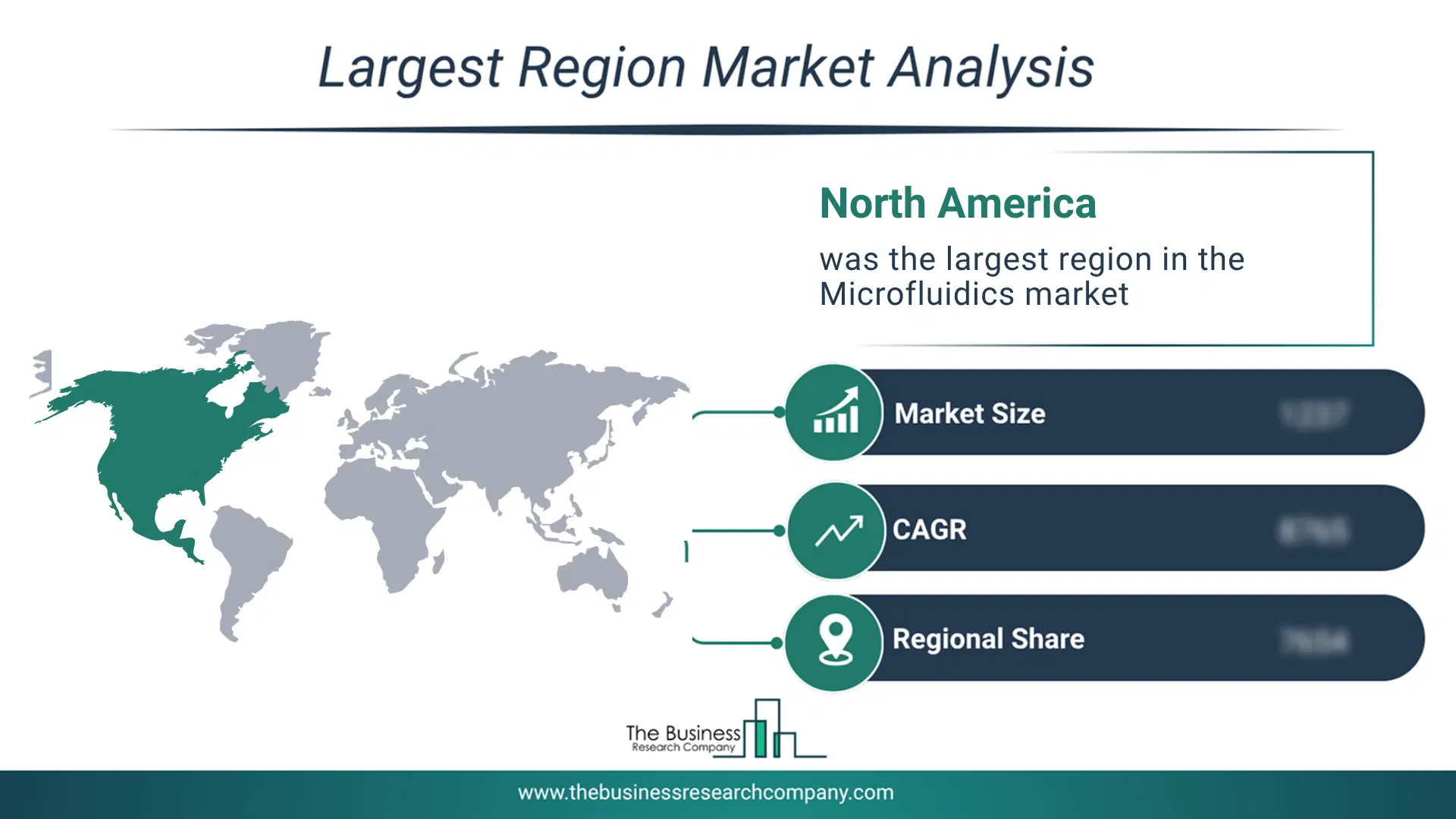
Regional Outlook
North America was the largest region in the microfluidics market in 2025. North America is expected to be the fastest-growing region in the forecast period. The regions covered in the microfluidics market are Asia-Pacific, South East Asia, Western Europe, Eastern Europe, North America, South America, Middle East, Africa. The countries covered in the microfluidics market are Australia, Brazil, China, France, Germany, India, Indonesia, Japan, Taiwan, Russia, South Korea, UK, USA, Canada, Italy, Spain.What Defines the Microfluidics Market?
The microfluidics market includes revenues earned by entities by developing molecular sensors based on bioassays, such as DNA amplification and analysis, cell separation, and immunoassay, among many more examples. The market value includes the value of related goods sold by the service provider or included within the service offering. Only goods and services traded between entities or sold to end consumers are included.How is Market Value Defined and Measured?
The market value is defined as the revenues that enterprises gain from the sale of goods and/or services within the specified market and geography through sales, grants, or donations in terms of the currency (in USD unless otherwise specified). The revenues for a specified geography are consumption values that are revenues generated by organizations in the specified geography within the market, irrespective of where they are produced. It does not include revenues from resales along the supply chain, either further along the supply chain or as part of other products.
This chart presents market attractiveness based on a quantitative evaluation of growth, competition, strategic alignment, and risk, offering a clear view of opportunity areas for decision-making. This chart is for illustrative purposes; the full report contains the complete analysis.

This chart highlights the Total Addressable Market (TAM) by estimating the maximum revenue opportunity using an assumption-driven approach, supporting strategic planning and opportunity sizing across markets. The chart is illustrative; the full report provides a more comprehensive analysis.
What Key Data and Analysis Are Included in the Microfluidics Market Report 2026?
The microfluidics market research report is one of a series of new reports from The Business Research Company that provides market statistics, including Market Report 2026?global market size, regional shares, competitors with the market share, detailed market segments, market trends and opportunities, and any further data you may need to thrive in the microfluidics Market Report 2026? The market research report delivers a complete perspective of everything you need, with an in-depth analysis of the current and future state of the Market Report 2026?Microfluidics Market Report Forecast Analysis
| Report Attribute | Details |
|---|---|
| Market Size Value In 2026 | $11.89 billion |
| Revenue Forecast In 2030 | $20.73 billion |
| Growth Rate | CAGR of 15.0% from 2026 to 2030 |
| Base Year For Estimation | 2025 |
| Actual Estimates/Historical Data | 2020-2025 |
| Forecast Period | 2026 - 2030 |
| Market Representation | Revenue in USD Billion and CAGR from 2026 to 2030 |
| Segments Covered | Material, Technology, Application |
| Regional Scope | Asia-Pacific, Western Europe, Eastern Europe, North America, South America, Middle East, Africa |
| Country Scope | The countries covered in the report are Australia, Brazil, China, France, Germany, India, Indonesia, Japan, Taiwan, Russia, South Korea, UK, USA, Canada, Italy, Spain. |
| Key Companies Profiled | Thermo Fisher Scientific, Agilent Technologies, Bio-Rad Laboratories, Fluidigm Corporation, Dolomite Microfluidics, PerkinElmer, Inc., Sphere Fluidics Limited, Micronit Micro Technologies B.V., Fluigent, Elveflow, Cellix Ltd., Microliquid S.L., Biosurfit S.A., FlowJEM, uFluidix, QuantWave Technologies Inc., Harvard Bioscience, Inc., Abaxis, Inc., OPKO Health, Inc., Abbott, Stämm |
| Customization Scope | Request for Customization |
| Pricing And Purchase Options | Explore Purchase Options |