
Microgranular Fertilizers Market Report 2026
Global Outlook – By Product Type (Nitrogen Based Fertilizers, Phosphorus Based Fertilizers, Potassium Based Fertilizers, Compound Fertilizers, Other Product Types), By Crop Type (Cereals And Grains, Fruits And Vegetables, Oilseeds And Pulses, Other Crop Types), By Distribution Channel (Direct Sales, Retail Sales, Online Sales, Other Distribution Channels), By Application Method (Soil Application, Foliar Application, Fertigation, Other Application Methods), By End User (Agricultural, Horticultural, Turf And Ornamental, Other End Users) – Market Size, Trends, Strategies, and Forecast to 2035
Microgranular Fertilizers Market Overview
• Microgranular Fertilizers market size has reached to $2.21 billion in 2025 • Expected to grow to $3.27 billion in 2030 at a compound annual growth rate (CAGR) of 8.2% • Growth Driver: Surge In Crop Productivity Fueling The Growth Of The Market Due To Improving Agricultural Practices And Enhanced Nutrient Efficiency • Market Trend: Advancements In High-Performance Micro-Granule Fertilizer Technology Drive Precision Nutrition Efficiency • Asia-Pacific was the largest region in 2025 and Asia-Pacific is the fastest growing region.What Is Covered Under Microgranular Fertilizers Market?
Microgranular fertilizers are specially formulated plant nutrients that are processed into very small, uniform granules to improve precision in nutrient delivery. These fertilizers are designed to enhance nutrient availability, absorption efficiency, and distribution in soil compared to conventional fertilizer forms. Microgranular fertilizers are widely used to support healthier crop growth by ensuring controlled and consistent nutrient release to plants. The main product types of microgranular fertilizers include nitrogen based fertilizers, phosphorus based fertilizers, potassium based fertilizers, compound fertilizers, and other product types. Nitrogen based fertilizers refer to nutrient-rich formulations designed in microgranular form to improve nutrient efficiency and uptake in crops. They are used across crop types including cereals and grains, fruits and vegetables, oilseeds and pulses, and other crop types and are distributed through direct sales, retail sales, online sales, and other distribution channels. The various application methods involved are soil application, foliar application, fertigation, and others, and they are used by several end users such as agricultural, horticultural, turf and ornamental, and others.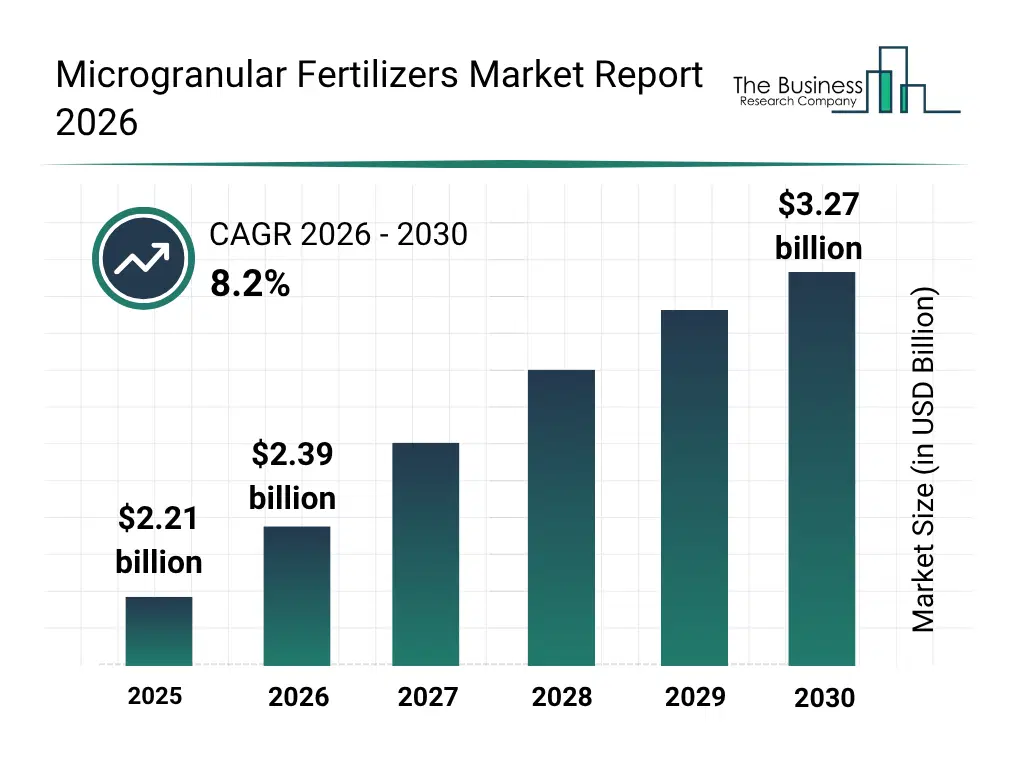
What Is The Microgranular Fertilizers Market Size and Share 2026?
The microgranular fertilizers market size has grown strongly in recent years. It will grow from $2.21 billion in 2025 to $2.39 billion in 2026 at a compound annual growth rate (CAGR) of 8.0%. The growth in the historic period can be attributed to traditional use of bulk granular fertilizers with low nutrient efficiency, limited precision agriculture adoption in early farming practices, high nutrient loss due to leaching and runoff in conventional systems, dependence on uniform crop fertilization methods, low awareness of soil micronutrient deficiencies in agriculture.What Is The Microgranular Fertilizers Market Growth Forecast?
The microgranular fertilizers market size is expected to see strong growth in the next few years. It will grow to $3.27 billion in 2030 at a compound annual growth rate (CAGR) of 8.2%. The growth in the forecast period can be attributed to rising adoption of precision farming and smart agriculture technologies, increasing global demand for food production efficiency, stricter environmental regulations on fertilizer runoff and soil pollution, growth in soil health monitoring and agritech analytics, expansion of sustainable and bio based fertilizer innovations. Major trends in the forecast period include increasing adoption of controlled release microgranular fertilizers for precision agriculture, rising demand for micronutrient enriched microgranular fertilizer formulations, growth in soil health focused sustainable fertilizer solutions, expansion of fertigation compatible microgranular nutrient systems, development of bio based and eco friendly microgranular fertilizers for regenerative farming.
Global Microgranular Fertilizers Market Segmentation
1) By Product Type: Nitrogen Based Fertilizers, Phosphorus Based Fertilizers, Potassium Based Fertilizers, Compound Fertilizers, Other Product Types 2) By Crop Type: Cereals And Grains, Fruits And Vegetables, Oilseeds And Pulses, Other Crop Types 3) By Distribution Channel: Direct Sales, Retail Sales, Online Sales, Other Distribution Channels 4) By Application Method: Soil Application, Foliar Application, Fertigation, Other Application Methods 5) By End User: Agricultural, Horticultural, Turf And Ornamental, Other End Users Subsegments: 1) By Nitrogen Based Fertilizers: Ammonium Nitrate Fertilizers, Urea Based Fertilizers, Calcium Nitrate Fertilizers, Ammonium Sulfate Fertilizers, Liquid Nitrogen Fertilizers 2) By Phosphorus Based Fertilizers: Monoammonium Phosphate Fertilizers, Diammonium Phosphate Fertilizers, Single Superphosphate Fertilizers, Triple Superphosphate Fertilizers, Rock Phosphate Fertilizers 3) By Potassium Based Fertilizers: Potassium Chloride Fertilizers, Potassium Sulfate Fertilizers, Potassium Nitrate Fertilizers, Potassium Magnesium Sulfate Fertilizers, Liquid Potash Fertilizers 4) By Compound Fertilizers: Nitrogen Phosphorus Fertilizers, Nitrogen Potassium Fertilizers, Phosphorus Potassium Fertilizers, Nitrogen Phosphorus Potassium Fertilizers, Multi Nutrient Blended Fertilizers 5) By Other Product Types: Micronutrient Enriched Fertilizers, Controlled Release Fertilizers, Organic Microgranular Fertilizers, Bio Based Fertilizers, Soil Conditioner FertilizersWhat Are The Drivers Of The Microgranular Fertilizers Market?
The rising crop productivity is expected to propel the growth of the microgranular fertilizers market going forward. Crop productivity refers to the amount of agricultural output produced per unit of land or input over a given period. The rise in crop productivity is driven by improved agricultural practices, as they enhance crop yields per unit area through better use of inputs such as fertilizers, irrigation, and high-yield seed varieties. Microgranular fertilizers help crop productivity by delivering nutrients in a highly precise and readily available form, which improves nutrient uptake efficiency, enhances plant growth, and increases overall crop yields per unit area. For instance, in December 2024, according to the Food and Agriculture Organization of the United Nations (FAO), an Italy-based intergovernmental organization that leads international efforts on food security and agriculture, the global production of primary crops reached 9.9 billion tonnes in 2023, increasing by 3 percent compared to 9.6 billion tonnes in 2022. Therefore, the rising crop productivity is driving the growth of the microgranular fertilizers industry. The increasing demand for precision agriculture practices is expected to propel the growth of the microgranular fertilizers market going forward. Precision agriculture practices refer to data-driven farming methods that use technologies such as GPS, sensors, and analytics to optimize field-level management of crops and improve the efficiency of inputs such as water, fertilizers, and pesticides. The increasing demand for precision agriculture practices is driven by improved resource efficiency, as they enable targeted application of water, fertilizers, and pesticides, reducing waste and enhancing crop productivity. Microgranular fertilizers help meet the demand for precision agriculture practices by enabling precise and uniform nutrient delivery directly to the root zone, which improves input efficiency, reduces wastage, and supports data-driven, site-specific crop management. For instance, in January 2024, according to the Government Accountability Office, a US-based non-partisan U.S. government agency, in 2023, around 27% of U.S. farms and ranches employed precision agriculture practices to manage their crops or livestock. Therefore, the increasing demand for precision agriculture practices is driving the growth of the microgranular fertilizers industry.Key Players In The Global Microgranular Fertilizers Market
Major companies operating in the microgranular fertilizers market are Syngenta Group Co. Ltd, Yara International ASA, The Mosaic Company, EuroChem Group AG, ICL Group Ltd., Sociedad Química y Minera de Chile S.A., UPL Limited, FMC Corporation, K+S Aktiengesellschaft, Groupe Roullier, Coromandel International Limited, OCI N.V., Deepak Fertilisers and Petrochemicals Corporation Limited, Zuari Agro Chemicals Limited, Rallis India Limited, Koch Fertilizer LLC, OCP Group (Office Chérifien des Phosphates S.A.), Omex Agriculture Limited, Richfield Fertilisers Private Limited, Swaroop Agri Sciences Private LimitedGlobal Microgranular Fertilizers Market Trends and Insights
Major companies operating in the microgranular fertilizers market are focusing on developing advanced nutrient delivery solutions, such as high-performance micro-granule formulations, to enhance nutrient uptake efficiency, improve crop productivity, and support precision agriculture practices. High-performance micro-granule formulations refer to finely engineered fertilizer particles designed for precise, efficient, and rapid nutrient delivery to enhance plant uptake and crop performance. For instance, in February 2025, Origin Amenity Solutions, a UK-based provider of turf, ground, and environmental management products, launched its Microlite micro-granule fertilizer range under its high-performance nutrient portfolio. It is designed to support improved soil nutrition and plant growth efficiency. The product enables precise nutrient application, enhanced absorption rates, and optimized crop performance, strengthening its role in modern precision agriculture systems.Regional Outlook/Insights
Asia-Pacific was the largest region in the microgranular fertilizers market in 2025. Asia-Pacific is expected to be the fastest-growing region in the forecast period. The regions covered in this market report are Asia-Pacific, South East Asia, Western Europe, Eastern Europe, North America, South America, Middle East, Africa. The countries covered in this market report are Australia, Brazil, China, France, Germany, India, Indonesia, Japan, Taiwan, Russia, South Korea, UK, USA, Canada, Italy, Spain.What Defines the Microgranular Fertilizers Market?
The microgranular fertilizers market consists of sales of urea ammonium nitrate microgranules, monoammonium phosphate (MAP) microgranules, diammonium phosphate (DAP) microgranules, and NPK starter microgranules. Values in this market are ‘factory gate’ values, that is, the value of goods sold by the manufacturers or creators of the goods, whether to other entities (including downstream manufacturers, wholesalers, distributors, and retailers) or directly to end customers. The value of goods in this market includes related services sold by the creators of the goods.How is Market Value Defined and Measured?
The market value is defined as the revenues that enterprises gain from the sale of goods and/or services within the specified market and geography through sales, grants, or donations in terms of the currency (in USD unless otherwise specified). The revenues for a specified geography are consumption values that are revenues generated by organizations in the specified geography within the market, irrespective of where they are produced. It does not include revenues from resales along the supply chain, either further along the supply chain or as part of other products.What Key Data and Analysis Are Included in the Microgranular Fertilizers Market Report 2026?
The microgranular fertilizers market research report is one of a series of new reports from The Business Research Company that provides market statistics, including industry global market size, regional shares, competitors with the market share, detailed market segments, market trends and opportunities, and any further data you may need to thrive in the microgranular fertilizers industry. The market research report delivers a complete perspective of everything you need, with an in-depth analysis of the current and future state of the industry.Microgranular Fertilizers Market Report Forecast Analysis
| Report Attribute | Details |
|---|---|
| Market Size Value In 2026 | $2.39 billion |
| Revenue Forecast In 2035 | $3.27 billion |
| Growth Rate | CAGR of 8.2% from 2026 to 2035 |
| Base Year For Estimation | 2025 |
| Actual Estimates/Historical Data | 2020-2025 |
| Forecast Period | 2026 - 2030 - 2035 |
| Market Representation | Revenue in USD Billion and CAGR from 2026 to 2035 |
| Segments Covered | Product Type, Crop Type, Distribution Channel, Application Method, End User |
| Regional Scope | Asia-Pacific, Western Europe, Eastern Europe, North America, South America, Middle East, Africa |
| Country Scope | The countries covered in the report are Australia, Brazil, China, France, Germany, India, Indonesia, Japan, Taiwan, Russia, South Korea, UK, USA, Canada, Italy, Spain. |
| Key Companies Profiled | Syngenta Group Co. Ltd, Yara International ASA, The Mosaic Company, EuroChem Group AG, ICL Group Ltd., Sociedad Química y Minera de Chile S.A., UPL Limited, FMC Corporation, K+S Aktiengesellschaft, Groupe Roullier, Coromandel International Limited, OCI N.V., Deepak Fertilisers and Petrochemicals Corporation Limited, Zuari Agro Chemicals Limited, Rallis India Limited, Koch Fertilizer LLC, OCP Group (Office Chérifien des Phosphates S.A.), Omex Agriculture Limited, Richfield Fertilisers Private Limited, Swaroop Agri Sciences Private Limited |
| Customization Scope | Request for Customization |
| Pricing And Purchase Options | Explore Purchase Options |