
Nitrogen Fertilizer Market Report 2026
Global Outlook – By Type (Urea, Calcium Ammonium Nitrate (CAN), Ammonium Nitrate, Ammonium Sulphate, Ammonia, Other Nitrogenous Fertilizers ), By Form (Liquid, Dry, Other Forms ), By Treatment (Soil, Foliar, Fertigation, Other Treatments), By Application (Cereals And Grains, Oilseeds And Pulses, Fruits And Vegetables, Other Applications ) – Market Size, Trends, Strategies, and Forecast to 2030
Nitrogen Fertilizer Market Overview
• Nitrogen Fertilizer market size has reached to $129.36 billion in 2025 • Expected to grow to $184.81 billion in 2030 at a compound annual growth rate (CAGR) of 7.6% • Growth Driver: Mitigating Crop Losses Is Growing Role Of Nitrogen Fertilizers Market • Market Trend: Low-Carbon Nitrogen Solutions Advancing Efficiency And Sustainability In Modern Agriculture • Asia-Pacific was the largest region in 2025 and North America is the fastest growing region.What Is Covered Under Nitrogen Fertilizer Market?
Nitrogen fertilizer are chemical fertilizers produced from sewage or animal waste and nitrogenous materials. Nitrogen fertilizers are used in agriculture to enhance productivity but must be managed carefully to prevent environmental issues like soil acidification and water contamination due to nitrogen runoff. The main types of nitrogen fertilizer are urea, calcium ammonium nitrate (CAN), ammonium nitrate, ammonium sulfate, ammonia, and other nitrogenous fertilizers. Ammonium nitrate is a white, crystalline, water-soluble powder, NH4NO3, produced by reacting nitric acid with vaporous ammonia and mainly used in explosives, fertilizers, freezing mixtures, and in the manufacture of nitrous oxide. The forms are liquid, dry, and other forms. The treatments used are soil, foliar, fertigation, and others. The applications involved are cereals and grains, oilseeds and pulses, fruits and vegetables, and other applications.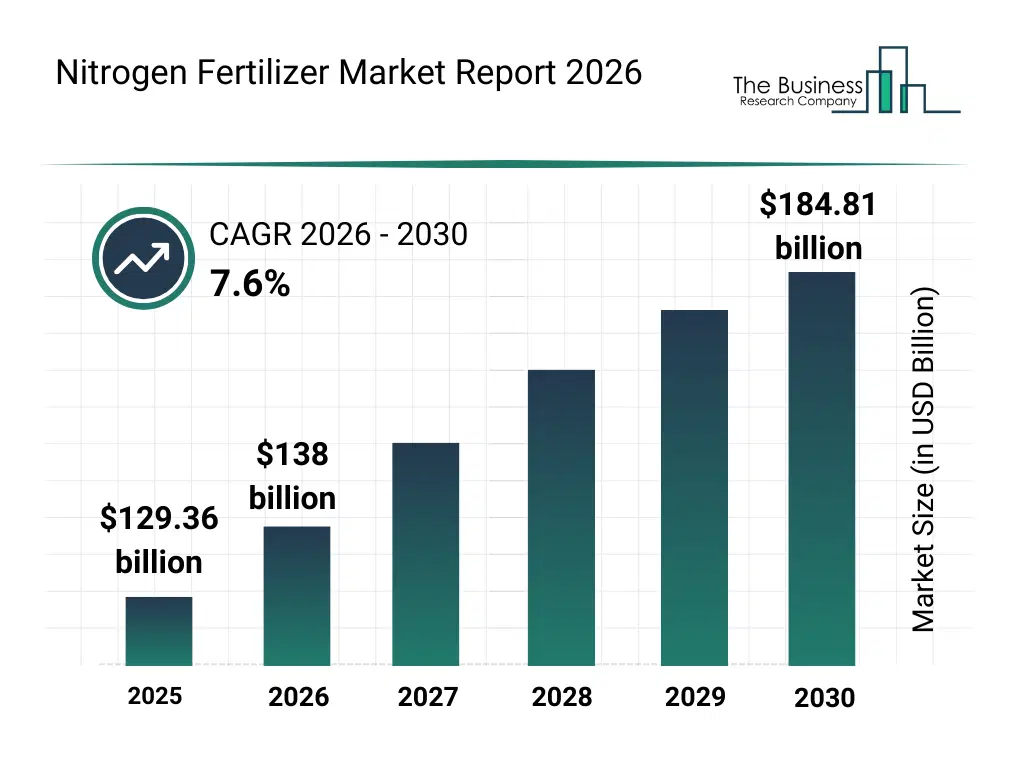
What Is The Nitrogen Fertilizer Market Size and Share 2026?
The nitrogen fertilizer market size has grown strongly in recent years. It will grow from $129.36 billion in 2025 to $138 billion in 2026 at a compound annual growth rate (CAGR) of 6.7%. The growth in the historic period can be attributed to increasing global food demand, expansion of commercial agriculture, rising cereal and grain cultivation, adoption of high yield crop varieties, government fertilizer subsidy programs.What Is The Nitrogen Fertilizer Market Growth Forecast?
The nitrogen fertilizer market size is expected to see strong growth in the next few years. It will grow to $184.81 billion in 2030 at a compound annual growth rate (CAGR) of 7.6%. The growth in the forecast period can be attributed to growth in precision agriculture adoption, rising demand for sustainable farming practices, increasing population driven food demand, expansion of irrigation infrastructure, advancements in nitrogen stabilizer technologies. Major trends in the forecast period include rising adoption of controlled release nitrogen fertilizers, growing use of precision farming based nitrogen application, increasing focus on reducing nitrogen runoff, expansion of fertigation based nitrogen delivery, higher demand for enhanced efficiency fertilizers.
Global Nitrogen Fertilizer Market Segmentation
1) By Type: Urea, Calcium Ammonium Nitrate (CAN), Ammonium Nitrate, Ammonium Sulphate, Ammonia, Other Nitrogenous Fertilizers 2) By Form: Liquid, Dry, Other Forms 3) By Treatment: Soil, Foliar, Fertigation, Other Treatments 4) By Application: Cereals And Grains, Oilseeds And Pulses, Fruits And Vegetables, Other Applications Subsegments: 1) By Urea: Granular Urea, Prilled Urea, Liquid Urea 2) By Calcium Ammonium Nitrate (CAN): Granular CAN, Liquid CAN 3) By Ammonium Nitrate: Granular Ammonium Nitrate, Solution Ammonium Nitrate 4) By Ammonium Sulphate: Granular Ammonium Sulphate, Liquid Ammonium Sulphate 5) By Ammonia: Anhydrous Ammonia, Ammonium Hydroxide 6) By Other Nitrogenous Fertilizers: Nitro-Phosphate Fertilizers, Other Blended Nitrogen FertilizersWhat Is The Driver Of The Nitrogen Fertilizer Market?
The increasing crop losses are expected to propel the growth of the nitrogen fertilizer market going forward. Crop losses refer to the reduction in the quantity or quality of agricultural crops that occurs due to various factors, including natural disasters, pests, diseases, adverse weather conditions, and other unfavorable events. Increasing crop losses is a factor for nitrogen fertilizers. Nitrogen is an essential nutrient for plant growth, and it helps to increase crop yields. For instance, in February 2024, according to the Climate Adaptation Platform, a New Zealand-based platform focused on providing resources and information related to climate adaptation, wheat harvests in 2023 reached 14 million tons. However, yields of other cereals saw declines compared to 2022, with barley down by 5.7%, oats by 18%, and oilseed rape by 11%, reflecting a notable drop in production across multiple crops. Therefore, the rising crop losses are driving the growth of the nitrogen fertilizer industry.Key Players In The Global Nitrogen Fertilizer Market
Major companies operating in the nitrogen fertilizer market are Yara International ASA, CF Industries Holdings Inc., Nutrien Ltd., EuroChem Group AG, OCI N.V., Saudi Basic Industries Corporation (SABIC), Indian Farmers Fertiliser Cooperative Limited (IFFCO), TogliattiAzot JSC, BASF SE, Grupa Azoty S.A., Rashtriya Chemicals and Fertilizers Ltd., Deepak Fertilisers and Petrochemicals Corporation Ltd., Gujarat Narmada Valley Fertilizers & Chemicals Ltd., Qatar Fertiliser Company (QAFCO), OCI Global, Koch Fertilizer LLC, CVR Partners LP, Terra Nitrogen Company LP, Haifa Group Ltd., Sinofert Holdings Limited, Sinochem Group Co. Ltd., Sociedad Química y Minera de Chile (SQM)
This chart is for illustrative purposes; the full report includes a detailed competitor analysis and comprehensive overview of the top 10 companies in the market.
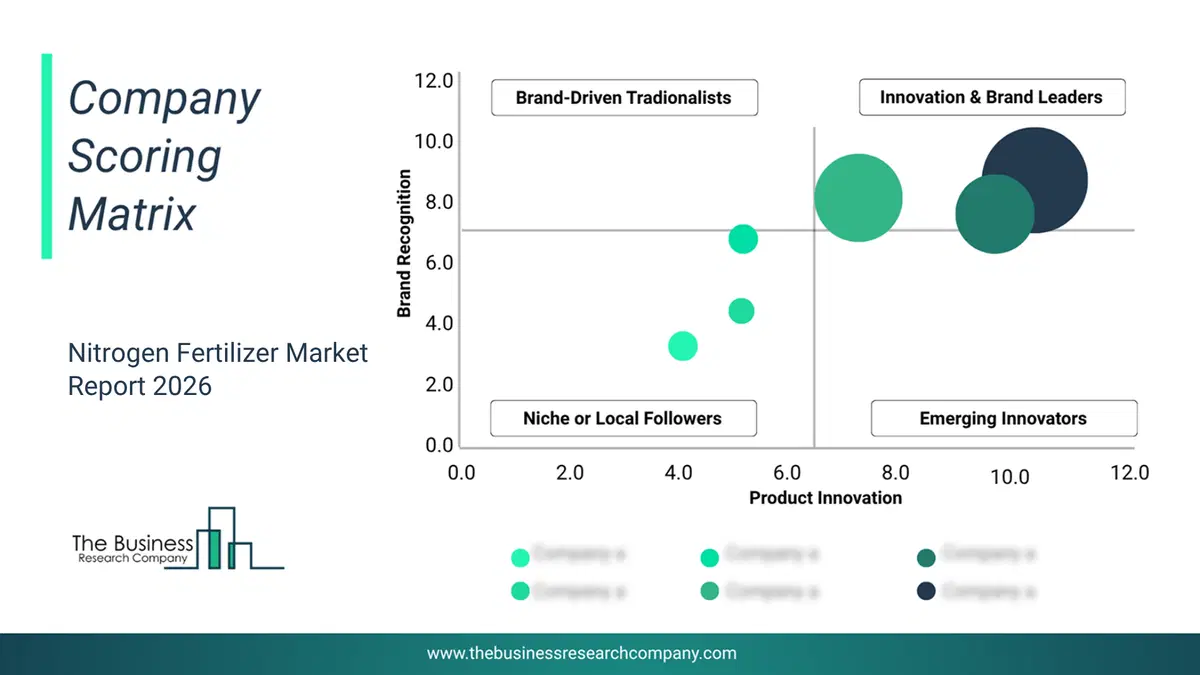
This chart maps companies by product innovation and brand strength, with bubble size indicating relative revenue, helping identify market leaders, challengers, and niche players. This is an illustrative chart; the full report provides a complete and accurate competitive analysis.
Global Nitrogen Fertilizer Market Trends and Insights
Major companies operating in the nitrogen fertilizer market are focusing on developing innovative products such as low carbon nitrogen fertilizers and nitrogen use efficiency enhancers, such as stabilized and green ammonia-based fertilizers, to reduce environmental impact and improve crop yields. Low carbon nitrogen fertilizers and nitrogen use efficiency enhancers are designed to minimize nitrogen loss from urea and ammonium fertilizers, improve nitrogen utilization by crops, and reduce greenhouse gas emissions from agricultural soils. For instance, in April 2025, BASF SE, a Germany based agrochemical company, launched Ampliqan, a nitrification inhibitor designed to reduce nitrogen loss from urea and ammonium fertilizers by inhibiting soil bacteria that convert ammonium into nitrate, thus improving nitrogen use efficiency and reducing greenhouse gas emissions. Similarly, in May 2023, CF Industries and CHS Inc. began producing and distributing low carbon nitrogen fertilizers, including green ammonia derived products, under their sustainable agriculture initiative. These developments respond to increasing regulatory and consumer pressure to lower the carbon footprint of agriculture and enable farmers to meet yield targets with reduced environmental impact. Wider adoption may face challenges due to higher costs compared with conventional fertilizers and the need for new production and supply chain infrastructure.What Are Latest Mergers And Acquisitions In The Nitrogen Fertilizer Market?
In September 2024, Koch Ag & Energy Solutions, a US-based fertilizer company, acquired OCI Global fertilizer plant for an $3.6 billion. With this acquisition, Koch aims to strengthen its position in the nitrogen fertilizer market and complement its existing operations, which include several production facilities in the U.S. and Canada. OCI Global is a Netherlands-based fertilizer company that operates on a global scale, specializing in nitrogen fertilizers.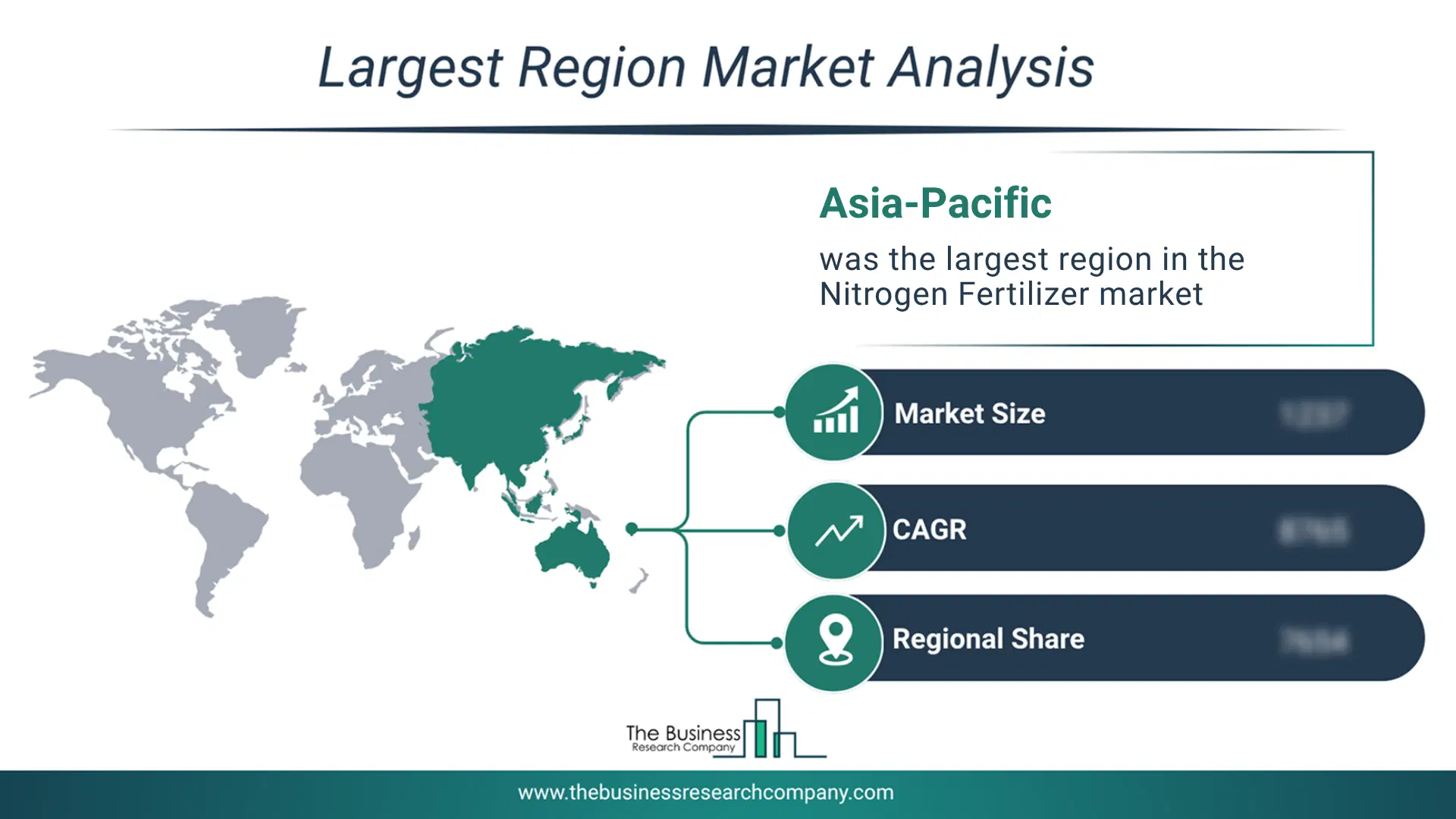
Regional Insights
Asia-Pacific was the largest region in the nitrogen fertilizer market in 2025. North America was the second-largest region in the global nitrogen fertilizer market. The regions covered in this market report are Asia-Pacific, South East Asia, Western Europe, Eastern Europe, North America, South America, Middle East, Africa The countries covered in this market report are Australia, Brazil, China, France, Germany, India, Indonesia, Japan, Taiwan, Russia, South Korea, UK, USA, Canada, Italy, SpainWhat Defines the Nitrogen Fertilizer Market?
The nitrogen fertilizer market consists of the sales of nitrogen fertilizers in forms such as anhydrous ammonia, urea, and urea-ammonium nitrate (UAN) solutions. Values in this market are factory gate values, that is the value of goods sold by the manufacturers or creators of the goods, whether to other entities (including downstream manufacturers, wholesalers, distributors, and retailers) or directly to end customers. The value of goods in this market includes related services sold by the creators of the goods.How is Market Value Defined and Measured?
The market value is defined as the revenues that enterprises gain from the sale of goods and/or services within the specified market and geography through sales, grants, or donations in terms of the currency (in USD unless otherwise specified). The revenues for a specified geography are consumption values that are revenues generated by organizations in the specified geography within the market, irrespective of where they are produced. It does not include revenues from resales along the supply chain, either further along the supply chain or as part of other products.
This chart presents market attractiveness based on a quantitative evaluation of growth, competition, strategic alignment, and risk, offering a clear view of opportunity areas for decision-making. This chart is for illustrative purposes; the full report contains the complete analysis.

This chart highlights the Total Addressable Market (TAM) by estimating the maximum revenue opportunity using an assumption-driven approach, supporting strategic planning and opportunity sizing across markets. The chart is illustrative; the full report provides a more comprehensive analysis.
What Key Data and Analysis Are Included in the Nitrogen Fertilizer Market Report 2026?
The nitrogen fertilizer market research report is one of a series of new reports from The Business Research Company that provides market statistics, including industry global market size, regional shares, competitors with the market share, detailed market segments, market trends and opportunities, and any further data you may need to thrive in the nitrogen fertilizer industry. The market research report delivers a complete perspective of everything you need, with an in-depth analysis of the current and future state of the industry.Nitrogen Fertilizer Market Report Forecast Analysis
| Report Attribute | Details |
|---|---|
| Market Size Value In 2026 | $138 billion |
| Revenue Forecast In 2030 | $184.81 billion |
| Growth Rate | CAGR of 6.7% from 2026 to 2030 |
| Base Year For Estimation | 2025 |
| Actual Estimates/Historical Data | 2020-2025 |
| Forecast Period | 2026 - 2030 |
| Market Representation | Revenue in USD Billion and CAGR from 2026 to 2030 |
| Segments Covered | Type, Form, Treatment, Application |
| Regional Scope | Asia-Pacific, Western Europe, Eastern Europe, North America, South America, Middle East, Africa |
| Country Scope | The countries covered in this market report are Australia, Brazil, China, France, Germany, India, Indonesia, Japan, Taiwan, Russia, South Korea, UK, USA, Canada, Italy, Spain |
| Key Companies Profiled | Yara International ASA, CF Industries Holdings Inc., Nutrien Ltd., EuroChem Group AG, OCI N.V., Saudi Basic Industries Corporation (SABIC), Indian Farmers Fertiliser Cooperative Limited (IFFCO), TogliattiAzot JSC, BASF SE, Grupa Azoty S.A., Rashtriya Chemicals and Fertilizers Ltd., Deepak Fertilisers and Petrochemicals Corporation Ltd., Gujarat Narmada Valley Fertilizers & Chemicals Ltd., Qatar Fertiliser Company (QAFCO), OCI Global, Koch Fertilizer LLC, CVR Partners LP, Terra Nitrogen Company LP, Haifa Group Ltd., Sinofert Holdings Limited, Sinochem Group Co. Ltd., Sociedad Química y Minera de Chile (SQM) |
| Customization Scope | Request for Customization |
| Pricing And Purchase Options | Explore Purchase Options |