
Military Aircraft Collision Avoidance Systems Market Report 2026
Global Outlook – By System Type (Radars, Traffic Alert And Collision Avoidance System, Terrain Awareness And Warning System, Collision Warning System, Obstacle Collision Avoidance System, Synthetic Vision Systems), By Platform (Manned Aircraft, Unmanned Aerial Vehicles (UAV)), By Technology (Laser Based Systems, Global Positioning System Based Systems, Computer Vision Systems), By End User (Original Equipment Manufacturer, Aftermarket) – Market Size, Trends, Strategies, and Forecast to 2030
Military Aircraft Collision Avoidance Systems Market Overview
• Military Aircraft Collision Avoidance Systems market size has reached to $0.94 billion in 2025 • Expected to grow to $1.38 billion in 2030 at a compound annual growth rate (CAGR) of 8.2% • Growth Driver: Surge In Defense Budgets Fueling The Growth Of The Market Due To Increasing Investments In Military Modernization And Aviation Safety • Market Trend: Strategic Collaboration For Enhanced Airspace Awareness And Integrated Detection Capabilities • North America was the largest region in 2025 and Asia-Pacific is the fastest growing region.What Is Covered Under Military Aircraft Collision Avoidance Systems Market?
Military aircraft collision avoidance systems are onboard safety systems designed to detect and prevent potential mid-air collisions between aircraft by continuously monitoring surrounding airspace. They use sensors, radar, and transponder data to identify nearby aircraft and provide timely alerts or automated guidance to pilots. These systems enhance flight safety by reducing the risk of accidents in both controlled and congested airspace, especially during complex military operations. The main system types of military aircraft collision avoidance systems include radars, traffic alert and collision avoidance system, terrain awareness and warning system, collision warning system, obstacle collision avoidance system, and synthetic vision systems. Radars refer to detection systems that use radio waves to identify nearby aircraft and obstacles to prevent mid-air collisions. These systems are deployed across platforms such as manned aircraft and Unmanned Aerial Vehicles (UAV). These are based on technologies including laser based systems, global positioning system based systems, and computer vision systems and they are utilized by end users including original equipment manufacturer and aftermarket.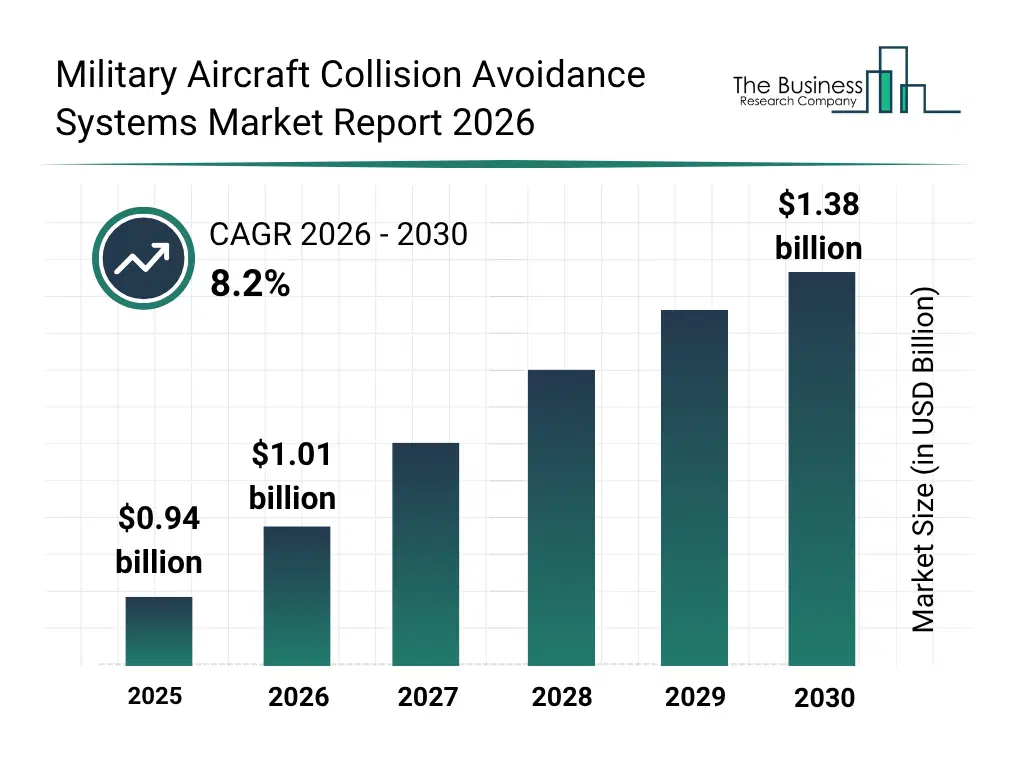
What Is The Military Aircraft Collision Avoidance Systems Market Size and Share 2026?
The military aircraft collision avoidance systems market size has grown strongly in recent years. It will grow from $0.94 billion in 2025 to $1.01 billion in 2026 at a compound annual growth rate (CAGR) of 7.9%. The growth in the historic period can be attributed to rising military aviation traffic density, increasing cross border airspace operations, modernization of legacy aircraft fleets, growth in unmanned aerial vehicle deployments, demand for improved flight safety and accident prevention systems.What Is The Military Aircraft Collision Avoidance Systems Market Growth Forecast?
The military aircraft collision avoidance systems market size is expected to see strong growth in the next few years. It will grow to $1.38 billion in 2030 at a compound annual growth rate (CAGR) of 8.2%. The growth in the forecast period can be attributed to integration of fully autonomous combat aircraft systems, expansion of network centric warfare capabilities, advancement in ai based real time decision systems, increasing investment in next generation avionics safety technologies, development of interoperable multi domain defense systems. Major trends in the forecast period include ai driven autonomous collision detection and predictive avoidance systems, multi sensor fusion of radar lidar and transponder based tracking systems, real time airspace situational awareness enhancement using advanced data links, cyber secure avionics communication and navigation systems, adaptive terrain mapping and synthetic vision integration for pilot assistance.
Global Military Aircraft Collision Avoidance Systems Market Segmentation
1) By System Type: Radars, Traffic Alert And Collision Avoidance System, Terrain Awareness And Warning System, Collision Warning System, Obstacle Collision Avoidance System, Synthetic Vision Systems 2) By Platform: Manned Aircraft, Unmanned Aerial Vehicles (UAV) 3) By Technology: Laser Based Systems, Global Positioning System Based Systems, Computer Vision Systems 4) By End User: Original Equipment Manufacturer, Aftermarket Subsegments: 1) By Radars: Airborne Surveillance Radars, Ground Proximity Radars, Weather Detection Radars, Multifunction Tracking Radars 2) By Traffic Alert And Collision Avoidance System: Active Collision Detection Systems, Passive Collision Detection Systems, Cooperative Traffic Alert Systems, Non Cooperative Traffic Alert Systems 3) By Terrain Awareness And Warning System: Forward Looking Terrain Avoidance Systems, Ground Proximity Warning Systems, Enhanced Terrain Awareness Systems, Digital Terrain Mapping Systems 4) By Collision Warning System: Visual Warning Systems, Audible Warning Systems, Predictive Collision Warning Systems, Real Time Monitoring Systems 5) By Obstacle Collision Avoidance System: Tower Detection Systems, Cable Detection Systems, Building Detection Systems, Low Altitude Obstacle Detection Systems 6) By Synthetic Vision Systems: Three Dimensional Terrain Visualization Systems, Enhanced Flight Vision Systems, Head Up Display Integrated Systems, Virtual Cockpit Navigation SystemsWhat Is The Driver Of The Military Aircraft Collision Avoidance Systems Market?
The increasing defense budgets is expected to propel the growth of the military aircraft collision avoidance systems market going forward. Defense budgets refer to the allocated government funds dedicated to maintaining and strengthening a country’s military capabilities, operations, and defence infrastructure. The increasing defence budgets are driven by rising geopolitical tensions, as countries allocate more funds to strengthen military capabilities, modernize equipment, and enhance national security preparedness. Higher defense budgets support military aircraft collision avoidance systems by providing sustained funding for advanced avionics procurement and modernization, which enables integration of detect and avoid technologies that enhance flight safety and reduce mid-air collision risks in complex operational environments. For instance, in February 2026, according to the International Institute for Strategic Studies, a UK-based defense research organization, that defense expenditure increased from $2.48 trillion in 2024 to $2.63 trillion in 2025, reflecting a 6.0% rise. Therefore, the increasing defense budgets is driving the growth of the military aircraft collision avoidance systems industry.Key Players In The Global Military Aircraft Collision Avoidance Systems Market
Major companies operating in the military aircraft collision avoidance systems market are RTX Corporation, Lockheed Martin Corporation, The Boeing Company, Airbus SE, Northrop Grumman Corporation, Honeywell International Inc., BAE Systems plc, Thales S.A., L3Harris Technologies Inc., Leonardo S.p.A., Elbit Systems Ltd., Saab AB, Indra Sistemas S.A., Garmin Ltd., Hanwha Systems Co. Ltd., ASELSAN Elektronik Sanayi ve Ticaret A.Ş., Curtiss-Wright Corporation, Moog Inc., Israel Aerospace Industries Ltd., HENSOLDT AG, Teledyne FLIR LLC, General Atomics Aeronautical Systems Inc., Telephonics Corporation, Terma A/S, Avidyne Corporation, Sagetech Avionics Inc., uAvionix Corporation, Vigilant Aerospace Systems Inc.Global Military Aircraft Collision Avoidance Systems Market Trends and Insights
Major companies operating in the military aircraft collision avoidance systems market are focusing on developing strategic collaborations, to enable access to new technologies or markets. Strategic collaborations are formal partnerships between organizations to jointly leverage resources, capabilities, and expertise to achieve shared long-term objectives. For instance, in September 2023, Iris Automation, a Us-based safety avionics technology company, partnered with uAvionix, a US-based provider of avionics systems, to to incorporate Iris Automation’s Casia G ground-based collision avoidance data into uAvionix’s SkyLine services to enable integrated Command and Control (C2) and Detect and Avoid (DAA) functionalities. The partnership is expected to enable uncrewed aircraft operators to achieve enhanced low-altitude airspace awareness along with best-in-class command and control connectivity, while maintaining cost levels that preserve the economic viability of small Uncrewed Aircraft Systems (sUAS). Iris Automation’s Casia G system provides critical complementary data to uAvionix’s ADS-B-based inputs, improving overall surveillance performance. By combining both systems, cooperative aircraft positions can be cross-verified using two independent sensing sources, improving reliability and accuracy. Additionally, the integrated solution enables rapid detection of non-cooperative aircraft, delivering a more comprehensive situational awareness capability than traditional single-sensor systems.What Are Latest Mergers And Acquisitions In The Military Aircraft Collision Avoidance Systems Market?
In March 2023, Sagetech Avionics, a US-based provider of advanced military aircraft collision avoidance systems, partnered with A-techSYN Ltd. to deliver the MX product family. Through this partnership, Sagetech Avionics and A-techSYN aim to enhance UAV flight safety by integrating advanced detect-and-avoid and collision avoidance technologies into the CGT50 VTOL platform to enable safer operations in shared airspace. A-techSYN Ltd. is an Ireland-based provider of unmanned aerial systems (UAS) solutions.Regional Outlook
North America was the largest region in the military aircraft collision avoidance systems market in 2025. Asia-Pacific is expected to be the fastest-growing region in the forecast period. The regions covered in this market report are Australia, Brazil, China, France, Germany, India, Indonesia, Japan, Taiwan, Russia, South Korea, UK, USA, Canada, Italy, Spain. The countries covered in this market report are Australia, Brazil, China, France, Germany, India, Indonesia, Japan, Taiwan, Russia, South Korea, UK, USA, Canada, Italy, Spain.What Defines the Military Aircraft Collision Avoidance Systems Market?
The military aircraft collision avoidance systems market consists of revenues earned by entities by providing services such as upgrade, integration, modernization support, technical support, and training. The market value includes the value of related goods sold by the service provider or included within the service offering. The military aircraft collision avoidance systems market also includes sales of alert annunciator panels, avionics processing units, and terrain sensing modules. Values in this market are ‘factory gate’ values, that is, the value of goods sold by the manufacturers or creators of the goods, whether to other entities (including downstream manufacturers, wholesalers, distributors, and retailers) or directly to end customers. The value of goods in this market includes related services sold by the creators of the goods.How is Market Value Defined and Measured?
The market value is defined as the revenues that enterprises gain from the sale of goods and/or services within the specified market and geography through sales, grants, or donations in terms of the currency (in USD unless otherwise specified). The revenues for a specified geography are consumption values that are revenues generated by organizations in the specified geography within the market, irrespective of where they are produced. It does not include revenues from resales along the supply chain, either further along the supply chain or as part of other products.What Key Data and Analysis Are Included in the Military Aircraft Collision Avoidance Systems Market Report 2026?
The military aircraft collision avoidance systems market research report is one of a series of new reports from The Business Research Company that provides military aircraft collision avoidance systems market statistics, including military aircraft collision avoidance systems industry global market size, regional shares, competitors with a military aircraft collision avoidance systems market share, detailed military aircraft collision avoidance systems market segments, market trends and opportunities, and any further data you may need to thrive in the military aircraft collision avoidance systems industry. This military aircraft collision avoidance systems market research report delivers a complete perspective of everything you need, with an in-depth analysis of the current and future scenario of the industry.Military Aircraft Collision Avoidance Systems Market Report Forecast Analysis
| Report Attribute | Details |
|---|---|
| Market Size Value In 2026 | $1.01 billion |
| Revenue Forecast In 2030 | $1.38 billion |
| Growth Rate | CAGR of 8.2% from 2026 to 2030 |
| Base Year For Estimation | 2025 |
| Actual Estimates/Historical Data | 2020-2025 |
| Forecast Period | 2026 - 2030 |
| Market Representation | Revenue in USD Billion and CAGR from 2026 to 2030 |
| Segments Covered | System Type, Platform, Technology, End User |
| Regional Scope | Asia-Pacific, Western Europe, Eastern Europe, North America, South America, Middle East, Africa |
| Country Scope | The countries covered in the military aircraft collision avoidance systems market report are Australia, Brazil, China, France, Germany, India, Indonesia, Japan, Taiwan, Russia, South Korea, UK, USA, Canada, Italy, Spain. |
| Key Companies Profiled | RTX Corporation, Lockheed Martin Corporation, The Boeing Company, Airbus SE, Northrop Grumman Corporation, Honeywell International Inc., BAE Systems plc, Thales S.A., L3Harris Technologies Inc., Leonardo S.p.A., Elbit Systems Ltd., Saab AB, Indra Sistemas S.A., Garmin Ltd., Hanwha Systems Co. Ltd., ASELSAN Elektronik Sanayi ve Ticaret A.Ş., Curtiss-Wright Corporation, Moog Inc., Israel Aerospace Industries Ltd., HENSOLDT AG, Teledyne FLIR LLC, General Atomics Aeronautical Systems Inc., Telephonics Corporation, Terma A/S, Avidyne Corporation, Sagetech Avionics Inc., uAvionix Corporation, Vigilant Aerospace Systems Inc. |
| Customization Scope | Request for Customization |
| Pricing And Purchase Options | Explore Purchase Options |