
Unmanned Defense Aerial Vehicle Market Report 2026
Global Outlook – By UAV Type (Multi Rotor, Single Rotor, Fixed Wing, Fixed Wing Hybrid VTOL ), By Range (Visual Line Of Sight (VLOS), Extended Visual Line Of Sight (EVLOS), Beyond Line Of Sight (BLOS) ), By Technology (Remotely Operated, Semi-Autonomous, Fully-Autonomous ) – Market Size, Trends, Strategies, and Forecast to 2030
Unmanned Defense Aerial Vehicle Market Overview
• Unmanned Defense Aerial Vehicle market size has reached to $17.91 billion in 2025 • Expected to grow to $27.73 billion in 2030 at a compound annual growth rate (CAGR) of 9.2% • Growth Driver: Unmanned Aerial Vehicle Market Expansion Fueled By Increasing Military Spending And Rising Need For Better Surveillance Systems • Market Trend: Increased Demand For Sustainable And Eco-Friendly UAV Defense Products • Asia-Pacific was the largest region in 2025 and Western Europe is the fastest growing region.What Is Covered Under Unmanned Defense Aerial Vehicle Market?
Unmanned defense aerial vehicle refers to drones and aircraft with no onboard humans that are guided autonomously, used in defense operations. UAVs carry sensors, target designators, aircraft ordnance such as ATGMs, missiles, bombs, or electronic transmitters that are designed to destroy enemy targets in defense applications. The main types of UAV in unmanned defense aerial vehicles are multi-rotor, single rotor, fixed-wing, and fixed-wing hybrid VTOL. A fixed-wing drone is a plane that doesn't have a human pilot on board. Fixed-wing UAVs can be commanded remotely by a human or autonomously by onboard systems. The different ranges include a visual line of sight (VLOS), extended visual line of sight (EVLOS), and beyond the line of sight (BLOS) and involve various technologies such as remotely operated, semi-autonomous, and fully autonomous.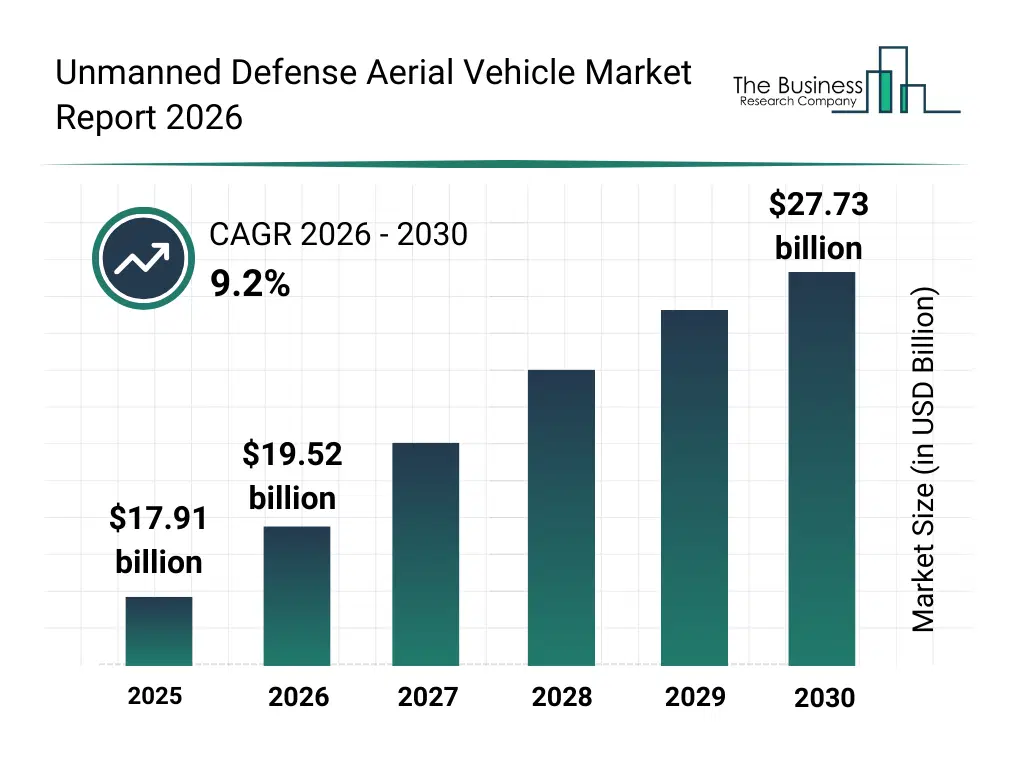
What Is The Unmanned Defense Aerial Vehicle Market Size and Share 2026?
The unmanned defense aerial vehicle market size has grown strongly in recent years. It will grow from $17.91 billion in 2025 to $19.52 billion in 2026 at a compound annual growth rate (CAGR) of 8.9%. The growth in the historic period can be attributed to early adoption of unmanned aerial vehicles (UAVs) for reconnaissance and surveillance, development of armed drones for targeted military strikes, technological advancements in flight control and navigation systems, growth in defense contracts for tactical drone deployment, integration of sensors and electronic warfare systems in defense UAVs.What Is The Unmanned Defense Aerial Vehicle Market Growth Forecast?
The unmanned defense aerial vehicle market size is expected to see strong growth in the next few years. It will grow to $27.73 billion in 2030 at a compound annual growth rate (CAGR) of 9.2%. The growth in the forecast period can be attributed to increasing deployment of autonomous uavs for combat and intelligence missions, advancements in AI-driven target recognition and mission planning, growth in long-endurance and stealth unmanned defense aircraft, rising investment in swarm and coordinated drone operations, integration of real-time data analytics and secure communication systems in defense UAVs. Major trends in the forecast period include integration of advanced weapon systems on uavs, development of long-endurance tactical and strategic uavs, miniaturization of uav payloads for reconnaissance and mapping, expansion of retrofit and upgrade services for legacy uavs, enhanced secure communication and real-time data transfer systems.
Global Unmanned Defense Aerial Vehicle Market Segmentation
1) By UAV Type: Multi Rotor, Single Rotor, Fixed Wing, Fixed Wing Hybrid VTOL 2) By Range: Visual Line Of Sight (VLOS), Extended Visual Line Of Sight (EVLOS), Beyond Line Of Sight (BLOS) 3) By Technology: Remotely Operated, Semi-Autonomous, Fully-Autonomous Subsegments: 1) By Multi Rotor: Quadcopters, Hexacopters, Octocopters 2) By Single Rotor: Small Single-Rotor UAVs, Large Single-Rotor UAVs 3) By Fixed Wing: Small Fixed-Wing UAVs, Tactical Fixed-Wing UAVs, Strategic Fixed-Wing UAVs 4) By Fixed Wing Hybrid VTOL: Tilt-Rotor UAVs, Tail-Sitter UAVs, Multi-Engine Hybrid VTOL UAVsWhat Is Driver Of The Unmanned Defense Aerial Vehicle Market?
The increasing military spending is expected to propel the growth of the unmanned defense aerial vehicle market going forward. Military spending refers to the total financial resources that governments allocate to maintain and enhance their armed forces, including procurement, operations, and research and development. Global military expenditures are rising as nations respond to heightened geopolitical tensions and invest in modern warfare technologies to strengthen national defense capabilities. The unmanned defense aerial vehicle market benefits from these spending increases because governments are prioritizing advanced drone systems for enhanced surveillance, reconnaissance, and precision strike capabilities. For instance, in April 2025, according to the Stockholm International Peace Research Institute (SIPRI), a Sweden-based independent institute that tracks global armaments, world military expenditure rose by 9.4% in real terms to reach USD 2.718 trillion in 2024, marking the highest global total ever recorded. Therefore, the increasing military spending is driving the growth of the unmanned defense aerial vehicle industry.Key Players In The Global Unmanned Defense Aerial Vehicle Market
Major companies operating in the unmanned defense aerial vehicle market are The Boeing Company, Northrop Grumman Corporation, General Atomics Aeronautical Systems Inc., Israel Aerospace Industries Ltd. (IAI), Elbit Systems Ltd., Textron Inc., AeroVironment Inc., Turkish Aerospace Industries Inc. (TAI), BAE Systems plc, Lockheed Martin Corporation, Thales Group, Airbus SE, Insitu, Shield AI Inc., Delair, Aurora Flight Sciences, Prox Dynamics AS / FLIR Systems, Vayu Inc., Raytheon Technologies Corporation, Science Applications International Corporation (SAIC).
This chart is for illustrative purposes; the full report includes a detailed competitor analysis and comprehensive overview of the top 10 companies in the market.
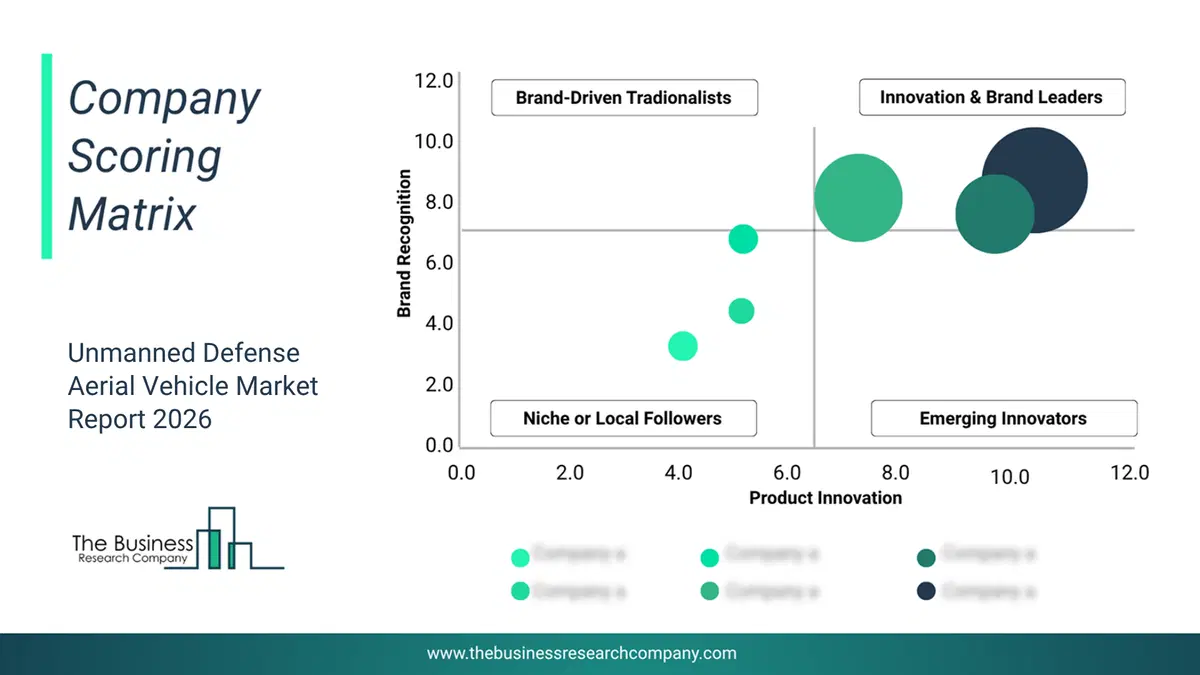
This chart maps companies by product innovation and brand strength, with bubble size indicating relative revenue, helping identify market leaders, challengers, and niche players. This is an illustrative chart; the full report provides a complete and accurate competitive analysis.
Global Unmanned Defense Aerial Vehicle Market Trends and Insights
Major companies operating in the unmanned defense aerial vehicle market are focusing on developing of sustainable and eco-friendly UAV defense products, such as carbon-neutral drones and hybrid-electric propulsion systems that reduce lifecycle greenhouse-gas emissions and lower dependence on liquid fuel. Carbon-neutral drones refer to airframes whose operating emissions and embodied carbon balance to net zero through a combination of low-emission propulsion, use of sustainable aviation fuels or biofuels, modular rechargeable energy packs, and verified carbon offset or sequestration programs carried out over the product lifecycle. For instance, in 2023, Garuda Aerospace, an India-based aerospace company, introduced a carbon-neutral drone for display at the World Economic Forum that the company described as using lifecycle carbon accounting, compatibility with low-carbon fuels, and modular battery systems to shorten field turnaround. The trend links to defense buyers’ focus on predictable operational costs and supply resilience because hybrid and electric systems shift expenditure from volatile liquid-fuel purchases to battery and power-system supply chains that firms can manage through long-term vendor contracts and local sourcing where possible.What Are Latest Mergers And Acquisitions In The Unmanned Defense Aerial Vehicle Market? Strategic Acquisitions Strengthen Capabilities In Medium-Sized Uas Development
In July 2025, Indra Group, a Spain-based technology holding focusing on defense, aerospace, air traffic, and digital transformation solutions acquired Aertec Defence & Aerial Systems (DAS) for an undisclosed amount. The move strengthens Indra’s leadership in the medium-sized UAS segment and enhances its new Weapons & Ammunition division, which focuses on anti-drone, precision-guided, directed-energy, and unmanned systems. Aertec Defence & Aerial Systems (DAS) is a Spain-based unmanned aerial systems (UAS) manufacturer.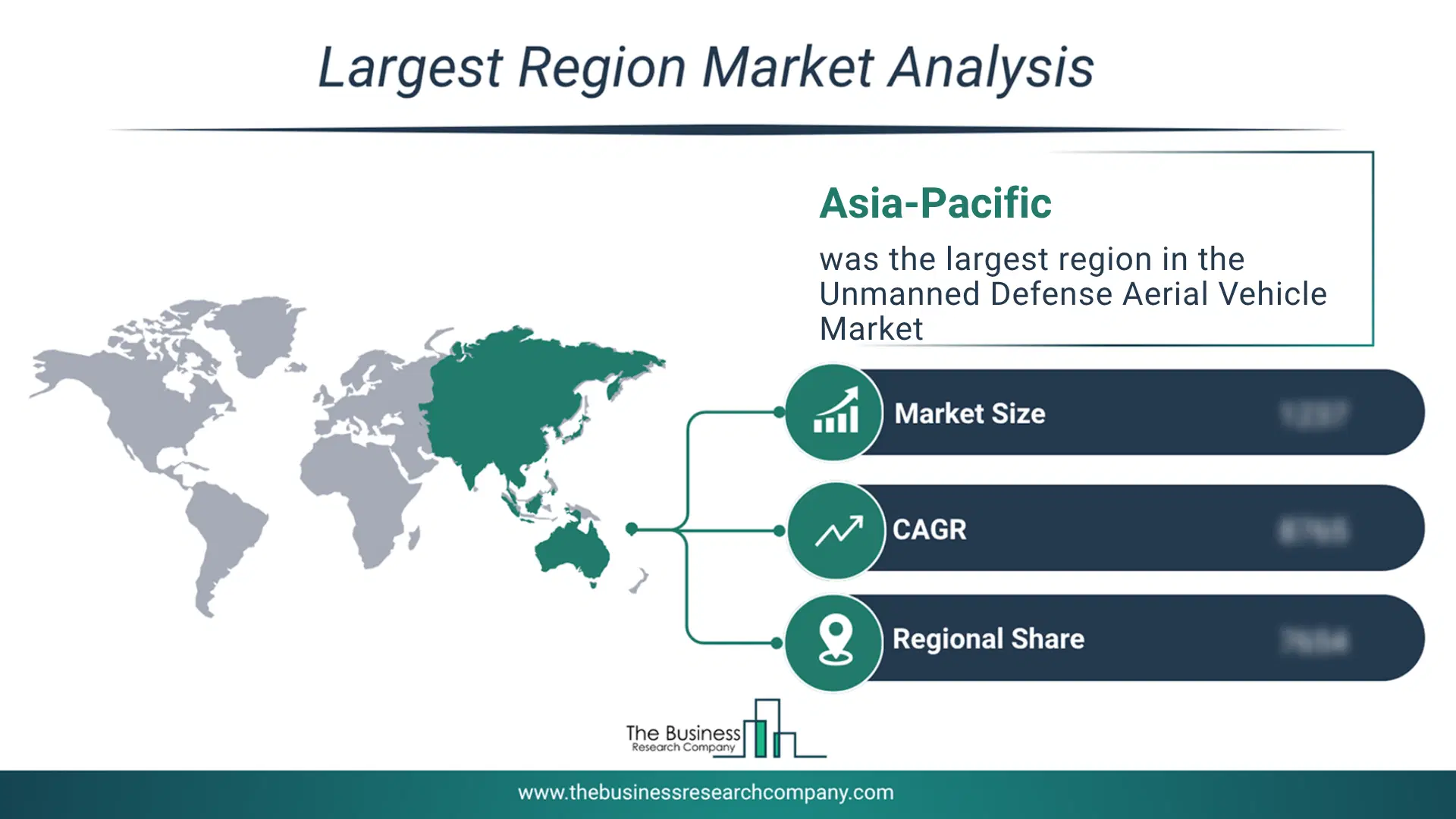
Regional Insights
Asia-Pacific was the largest region in unmanned defense aerial vehicle market in 2025. Western Europe is expected to be the fastest-growing region in the unmanned defense aerial vehicle market during the forecast period. The regions covered in this market report are Asia-Pacific, South East Asia, Western Europe, Eastern Europe, North America, South America, Middle East, Africa. The countries covered in this market report are Australia, Brazil, China, France, Germany, India, Indonesia, Japan, Taiwan, Russia, South Korea, UK, USA, Canada, Italy, SpainWhat Defines the Unmanned Defense Aerial Vehicle Market?
The unmanned defense aerial vehicle market consists of sales of remotely piloted and unpiloted aerial vehicles for defense purposes such as carry weapons, mapping, communication, and destroy targets. Values in this market are factory gate values, that is the value of goods sold by the manufacturers or creators of the goods, whether to other entities (including downstream manufacturers, wholesalers, distributors, and retailers) or directly to end customers. The value of goods in this market includes related services sold by the creators of the goods.How is Market Value Defined and Measured?
The market value is defined as the revenues that enterprises gain from the sale of goods and/or services within the specified market and geography through sales, grants, or donations in terms of the currency (in USD unless otherwise specified). The revenues for a specified geography are consumption values that are revenues generated by organizations in the specified geography within the market, irrespective of where they are produced. It does not include revenues from resales along the supply chain, either further along the supply chain or as part of other products.
This chart presents market attractiveness based on a quantitative evaluation of growth, competition, strategic alignment, and risk, offering a clear view of opportunity areas for decision-making. This chart is for illustrative purposes; the full report contains the complete analysis.

This chart highlights the Total Addressable Market (TAM) by estimating the maximum revenue opportunity using an assumption-driven approach, supporting strategic planning and opportunity sizing across markets. The chart is illustrative; the full report provides a more comprehensive analysis.
What Key Data and Analysis Are Included in the Unmanned Defense Aerial Vehicle Market Report 2026?
The unmanned defense aerial vehicle market research report is one of a series of new reports from The Business Research Company that provides market statistics, including industry global market size, regional shares, competitors with the market share, detailed market segments, market trends and opportunities, and any further data you may need to thrive in the unmanned defense aerial vehicle industry. The market research report delivers a complete perspective of everything you need, with an in-depth analysis of the current and future state of the industry.Unmanned Defense Aerial Vehicle Market Report Forecast Analysis
| Report Attribute | Details |
|---|---|
| Market Size Value In 2026 | $19.52 billion |
| Revenue Forecast In 2030 | $27.73 billion |
| Growth Rate | CAGR of 9.2% from 2026 to 2030 |
| Base Year For Estimation | 2025 |
| Actual Estimates/Historical Data | 2020-2025 |
| Forecast Period | 2026 - 2030 |
| Market Representation | Revenue in USD Billion and CAGR from 2026 to 2030 |
| Segments Covered | UAV Type, Range, Technology |
| Regional Scope | Asia-Pacific, Western Europe, Eastern Europe, North America, South America, Middle East, Africa |
| Country Scope | The countries covered in the unmanned defense aerial vehicle market report are Australia, Brazil, China, France, Germany, India, Indonesia, Japan, Taiwan, Russia, South Korea, UK, USA, Canada, Italy, Spain |
| Key Companies Profiled | The Boeing Company, Northrop Grumman Corporation, General Atomics Aeronautical Systems Inc., Israel Aerospace Industries Ltd. (IAI), Elbit Systems Ltd., Textron Inc., AeroVironment Inc., Turkish Aerospace Industries Inc. (TAI), BAE Systems plc, Lockheed Martin Corporation, Thales Group, Airbus SE, Insitu, Shield AI Inc., Delair, Aurora Flight Sciences, Prox Dynamics AS / FLIR Systems, Vayu Inc., Raytheon Technologies Corporation, Science Applications International Corporation (SAIC). |
| Customization Scope | Request for Customization |
| Pricing And Purchase Options | Explore Purchase Options |