

Military Surveillance System Market Report 2026
Global Outlook – By Component (Hardware, Software, Services), By Application (Intelligence Surveillance And Reconnaissance, Border Surveillance, Battlefield Surveillance, Coastal Surveillance), By End User (Army, Navy, Air Force, Homeland Security) – Market Size, Trends, Strategies, and Forecast to 2030
Military Surveillance System Market Overview
• Military Surveillance System market size has reached to $16.78 billion in 2025 • Expected to grow to $27.82 billion in 2030 at a compound annual growth rate (CAGR) of 10.7% • Growth Driver: Rising Geopolitical Tensions Fueling The Growth Of The Market Due To Increasing Global Fragmentation And Escalation Of State-Based Conflicts • Market Trend: Advancements In AI-Driven Electro-Optical Systems Enhancing Battlefield Awareness And Target Detection • North America was the largest region in 2025 and Asia-Pacific is the fastest growing region.What Is Covered Under Military Surveillance System Market?
Military surveillance systems are integrated defense technologies designed to monitor, detect, track, and analyze activities across land, air, sea, and cyber domains. These systems combine advanced sensing technologies, communication networks, data analytics, and command-and-control platforms to provide real-time situational awareness, threat detection, and intelligence support for defense and security operations. They are developed to enhance operational effectiveness, border security, and strategic decision-making in military environments. The main components of military surveillance system include hardware, software, and services. Hardware refers to physical surveillance equipment such as sensors, radar units, cameras, and communication devices used to detect, monitor, and track military activities in real time. These systems support applications including intelligence surveillance and reconnaissance, border surveillance, battlefield surveillance, and coastal surveillance and are utilized by end users including army, navy, air force, and homeland security.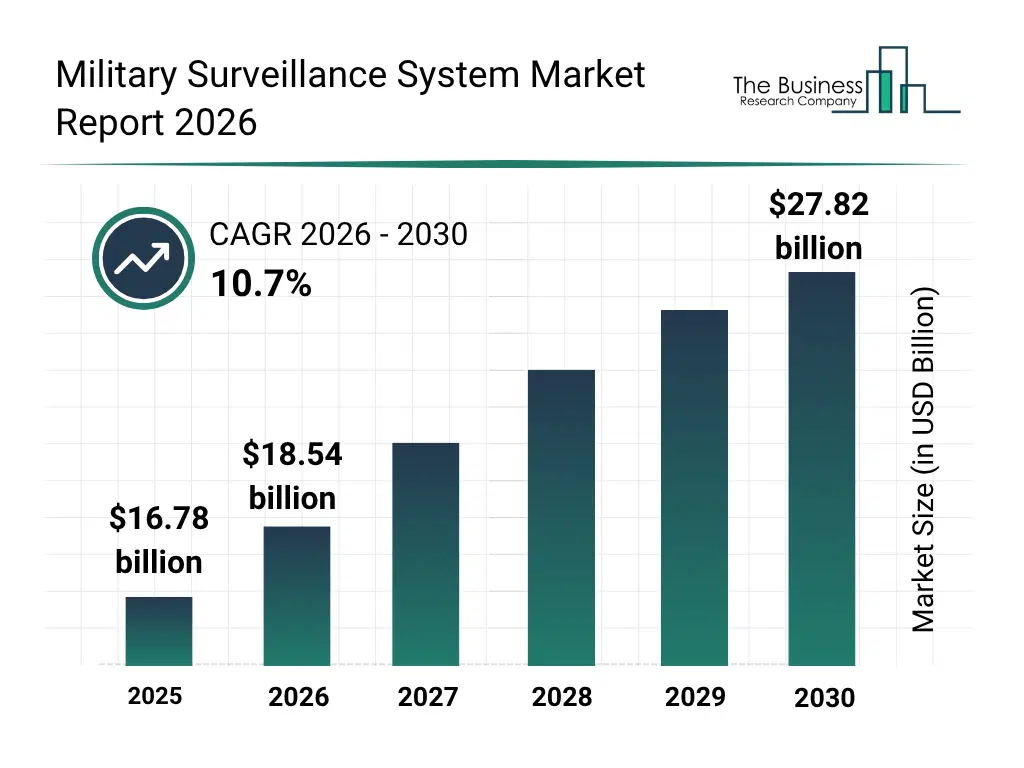
What Is The Military Surveillance System Market Size and Share 2026?
The military surveillance system market size has grown rapidly in recent years. It will grow from $16.78 billion in 2025 to $18.54 billion in 2026 at a compound annual growth rate (CAGR) of 10.5%. The growth in the historic period can be attributed to increasing cross border security threats and geopolitical tensions, rising demand for border and coastal monitoring systems, modernization of legacy military surveillance infrastructure, growing adoption of radar and imaging based surveillance technologies, expansion of intelligence surveillance and reconnaissance operations.What Is The Military Surveillance System Market Growth Forecast?
The military surveillance system market size is expected to see rapid growth in the next few years. It will grow to $27.82 billion in 2030 at a compound annual growth rate (CAGR) of 10.7%. The growth in the forecast period can be attributed to rising integration of AI driven surveillance analytics for threat prediction, increasing deployment of autonomous surveillance platforms and drones, growing demand for real time multi domain situational awareness, expansion of cloud based command and control surveillance systems, strengthening of cybersecurity integrated defense monitoring systems. Major trends in the forecast period include AI powered real time surveillance analytics for multi domain threat detection, integrated multi sensor surveillance platforms for unified battlefield awareness, cloud based defense surveillance systems for centralized monitoring and control, edge enabled surveillance processing for low latency threat identification, autonomous surveillance systems using unmanned aerial and ground platforms.
Global Military Surveillance System Market Segmentation
1) By Component: Hardware, Software, Services 2) By Application: Intelligence Surveillance And Reconnaissance, Border Surveillance, Battlefield Surveillance, Coastal Surveillance 3) By End User: Army, Navy, Air Force, Homeland Security Subsegments: 1) By Hardware: Sensor Systems, Imaging Systems, Radar Systems, Communication Equipment, Data Storage Devices, Display Systems 2) By Software: Surveillance Analytics Software, Command And Control Software, Video Management Software, Data Fusion Software, Cybersecurity Software, Artificial Intelligence Based Monitoring Software 3) By Services: Installation And Integration Services, Maintenance And Support Services, Training And Simulation Services, Consulting Services, Managed Surveillance ServicesWhat Is The Driver Of The Military Surveillance System Market?
The rising geopolitical tensions are expected to propel the growth of the military surveillance systems market going forward. Geopolitical tensions refer to political, economic, and military conflicts or rivalries between countries or regions that increase global instability and heighten the risk of armed conflicts and security threats. Geopolitical tensions are growing due to conflicting political interests among major countries, which leads to competition, mistrust, and disputes over global influence. Military surveillance systems support national security by enabling continuous monitoring of borders, early threat detection, real-time intelligence gathering, and improved situational awareness in high-risk environments. For instance, in July 2024, according to the Armed Conflict Location and Event Data, a US-based non-profit organization, between July 2023 and June 2024, over 165,273 incidents of political violence were reported worldwide, representing a 15% increase from the previous year. During this time, it is estimated that approximately one in seven people around the world were affected by conflict. Therefore, the rising geopolitical tensions are driving the growth of the military surveillance systems industry.Key Players In The Global Military Surveillance System Market
Major companies operating in the military surveillance system market are The Boeing Company, RTX Corporation, Lockheed Martin Corporation, General Dynamics Corporation, Northrop Grumman Corporation, BAE Systems plc, Airbus Defence and Space SAS, Thales S.A., L3Harris Technologies Inc., Safran S.A., Leonardo S.p.A., Leidos Holdings, Rheinmetall Aktiengesellschaft, Textron Systems, Israel Aerospace Industries Ltd., Elbit Systems Ltd., Teledyne Technologies Incorporated, Saab Aktiebolag, Palantir Technologies Inc., Kratos Defense & Security Solutions, HENSOLDT AG, Teledyne FLIR LLC, Anduril Industries Inc., General Atomics Aeronautical Systems Inc., Planet Labs PBC, BlackSky Technology Inc., HawkEye 360 Inc., TCOM L.P., L3HarrisGlobal Military Surveillance System Market Trends and Insights
Major companies operating in the military surveillance systems market are focusing on developing innovative solutions, such as electro-optical intelligent sensing systems to enhance real-time threat detection, improve situational awareness, and accelerate decision-making in complex battlefield environments. Electro-optical intelligent sensing systems are advanced surveillance technologies that combine electro-optical and infrared sensors with artificial intelligence to detect, identify, and track threats in real time, improving situational awareness, enabling faster and more accurate decision-making, and reducing operator workload in complex environments. For instance, in April 2023, RTX Corporation, a US-based aerospace and defense company, unveiled RAIVEN, a next-generation electro-optical intelligent sensing capability designed to enhance airborne surveillance and targeting performance. The system is engineered to provide high-speed threat identification and improved visual intelligence by combining advanced sensor fusion and AI-driven analytics, enabling military operators and pilots to detect and respond to threats more efficiently in dynamic combat scenarios. It integrates high-resolution electro-optical and infrared imaging technologies to deliver enhanced visibility across day, night, and adverse weather conditions, ensuring continuous situational awareness in complex operational environments. The solution also incorporates automated object recognition and tracking algorithms that help reduce cognitive workload on operators while improving decision accuracy and response time.What Are Latest Mergers And Acquisitions In The Military Surveillance System Market?
In November 2025, Firefly Aerospace Inc., a US-based space and defense technology company, acquired SciTec Inc. for an undisclosed amount. With this acquisition, Firefly Aerospace aims to strengthen its national security and defense capabilities by integrating advanced AI-enabled software, big data processing, and mission-critical analytics with its launch, lunar, and in-space systems, thereby creating a more vertically integrated space-defense platform for government and commercial missions. SciTec Inc. is a US-based defense technology company that specializes in providing advanced national security software solutions, including missile warning, tracking and defense systems, intelligence, surveillance and reconnaissance (ISR) analytics.Regional Outlook
North America was the largest region in the military surveillance systems market in 2025. Asia-Pacific is expected to be the fastest-growing region in the forecast period. The regions covered in this market report are Australia, Brazil, China, France, Germany, India, Indonesia, Japan, Taiwan, Russia, South Korea, UK, USA, Canada, Italy, Spain. The countries covered in this market report are Australia, Brazil, China, France, Germany, India, Indonesia, Japan, Taiwan, Russia, South Korea, UK, USA, Canada, Italy, Spain.What Defines the Military Surveillance System Market?
The military surveillance system market consists of revenues earned by entities by providing services such as intelligence surveillance and reconnaissance (ISR) operations, system integration, command and control solutions, data analytics, cybersecurity monitoring, installation and deployment, maintenance and support, and modernization of surveillance infrastructure. The market value includes the value of related goods sold by the service provider or included within the service offering. The military surveillance system market also includes sales of radar systems, electro-optical and infrared sensors, unmanned aerial vehicles (UAVs), surveillance cameras, satellite imaging systems, ground control stations, and communication equipment. Values in this market are ‘factory gate’ values, that is, the value of goods sold by the manufacturers or creators of the goods, whether to other entities (including downstream manufacturers, wholesalers, distributors, and retailers) or directly to end customers. The value of goods in this market includes related services sold by the creators of the goods.How is Market Value Defined and Measured?
The market value is defined as the revenues that enterprises gain from the sale of goods and/or services within the specified market and geography through sales, grants, or donations in terms of the currency (in USD unless otherwise specified). The revenues for a specified geography are consumption values that are revenues generated by organizations in the specified geography within the market, irrespective of where they are produced. It does not include revenues from resales along the supply chain, either further along the supply chain or as part of other products.What Key Data and Analysis Are Included in the Military Surveillance System Market Report 2026?
The military surveillance system market research report is one of a series of new reports from The Business Research Company that provides military surveillance system market statistics, including military surveillance system industry global market size, regional shares, competitors with a military surveillance system market share, detailed military surveillance system market segments, market trends and opportunities, and any further data you may need to thrive in the military surveillance system industry. This military surveillance system market research report delivers a complete perspective of everything you need, with an in-depth analysis of the current and future scenario of the industry.Military Surveillance System Market Report Forecast Analysis
| Report Attribute | Details |
|---|---|
| Market Size Value In 2026 | $18.54 billion |
| Revenue Forecast In 2030 | $27.82 billion |
| Growth Rate | CAGR of 10.7% from 2026 to 2030 |
| Base Year For Estimation | 2025 |
| Actual Estimates/Historical Data | 2020-2025 |
| Forecast Period | 2026 - 2030 |
| Market Representation | Revenue in USD Billion and CAGR from 2026 to 2030 |
| Segments Covered | Component, Application, End User |
| Regional Scope | Asia-Pacific, Western Europe, Eastern Europe, North America, South America, Middle East, Africa |
| Country Scope | The countries covered in the military surveillance system market report are Australia, Brazil, China, France, Germany, India, Indonesia, Japan, Taiwan, Russia, South Korea, UK, USA, Canada, Italy, Spain. |
| Key Companies Profiled | The Boeing Company, RTX Corporation, Lockheed Martin Corporation, General Dynamics Corporation, Northrop Grumman Corporation, BAE Systems plc, Airbus Defence and Space SAS, Thales S.A., L3Harris Technologies Inc., Safran S.A., Leonardo S.p.A., Leidos Holdings, Rheinmetall Aktiengesellschaft, Textron Systems, Israel Aerospace Industries Ltd., Elbit Systems Ltd., Teledyne Technologies Incorporated, Saab Aktiebolag, Palantir Technologies Inc., Kratos Defense & Security Solutions, HENSOLDT AG, Teledyne FLIR LLC, Anduril Industries Inc., General Atomics Aeronautical Systems Inc., Planet Labs PBC, BlackSky Technology Inc., HawkEye 360 Inc., TCOM L.P., L3Harris |
| Customization Scope | Request for Customization |
| Pricing And Purchase Options | Explore Purchase Options |