
Military Uniform Market Report 2026
Global Outlook – By Type (Combat Uniforms, Ceremonial Uniforms, Tactical Gear, Accessories), By Material Composition (Cotton, Polyester, Nylon, Ripstop Fabric, Blend Fabrics), By Distribution Channel (Online, Offline), By Application (Battle Or Combat Operations, Training And Exercises, Ceremonial Or Parade, Daily Duty), By End-User (Army, Navy, Air Force, Marine Corps, Special Forces, Paramilitary Forces) – Market Size, Trends, Strategies, and Forecast to 2030
Military Uniform Market Overview
• Military Uniform market size has reached to $2.91 billion in 2025 • Expected to grow to $4.09 billion in 2030 at a compound annual growth rate (CAGR) of 7% • Growth Driver: Increasing Defense Budgets Fueling The Market Growth Due To Military Modernization Initiatives • Market Trend: Next-Generation Military Uniforms Focus On Advanced Ripstop Fabrics For Enhancing Durability And Mobility • North America was the largest region in 2025 and Asia-Pacific is the fastest growing region.Market Gains By 2030 – Top Opportunities By Segment
Market Gain identifies the most promising market opportunities by highlighting the segments or products expected to generate the highest incremental revenue growth over the next five years.
What Is Covered Under Military Uniform Market?
A military uniform is a standardized set of clothing worn by members of the armed forces to represent their service, rank, and role within the organization. It symbolizes unity, discipline, and tradition, fostering a sense of belonging and pride among those who wear it. The uniform also serves practical purposes such as offering protection, ensuring camouflage in combat, and allowing for quick recognition of rank, branch, or function. The main types of military uniforms are combat uniforms, ceremonial uniforms, tactical gear, and accessories. Combat uniforms are durable, functional military clothing designed to protect personnel and enhance performance in diverse combat environments. They are made from materials such as cotton, polyester, nylon, ripstop fabric, and blended fabrics, and are distributed through channels including online and offline sales. They are used for applications such as battle or combat operations, training and exercises, ceremonial events or parades, and daily duty, and are utilized by end-users including the army, navy, air force, marine corps, special forces, and paramilitary forces.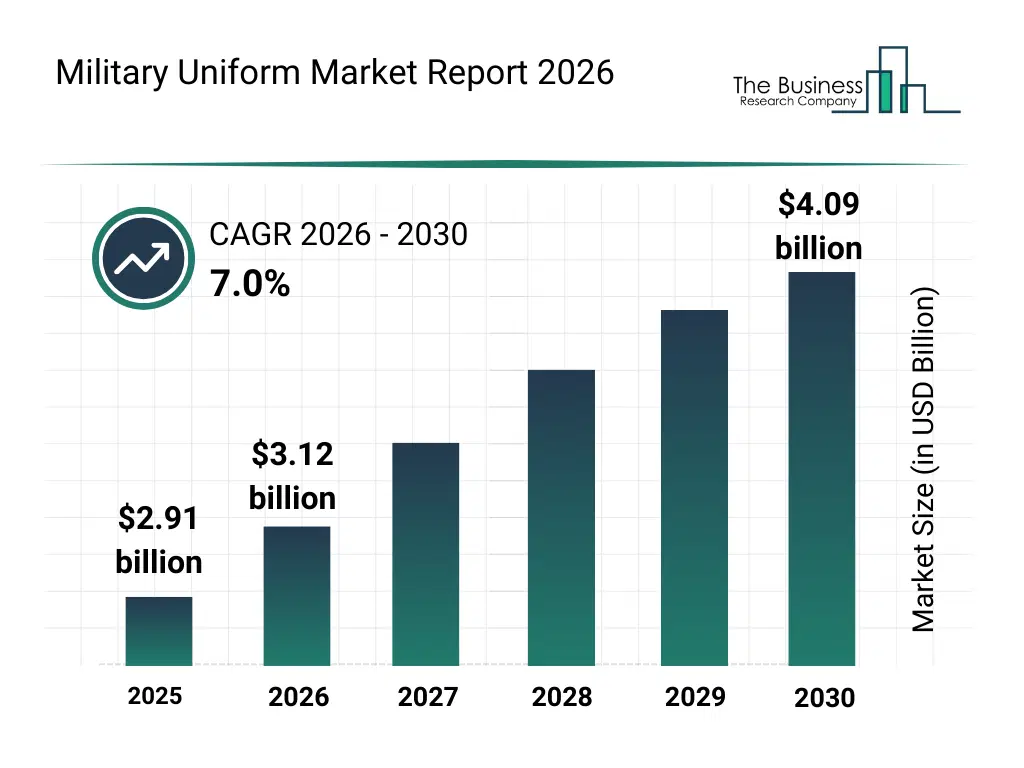
What Is The Military Uniform Market Size and Share 2026?
The military uniform market size has grown strongly in recent years. It will grow from $2.91 billion in 2025 to $3.12 billion in 2026 at a compound annual growth rate (CAGR) of 7.3%. The growth in the historic period can be attributed to increasing defense spending levels, expansion of active military personnel, modernization of armed forces apparel, rising operational deployment frequency, standardization of military clothing requirements.What Is The Military Uniform Market Growth Forecast?
The military uniform market size is expected to see strong growth in the next few years. It will grow to $4.09 billion in 2030 at a compound annual growth rate (CAGR) of 7.0%. The growth in the forecast period can be attributed to increasing investments in next-generation soldier systems, rising focus on enhanced survivability and mobility, growing adoption of smart textiles, expansion of special forces units, increasing emphasis on climate-adaptive uniforms. Major trends in the forecast period include increasing adoption of advanced camouflage fabrics, rising demand for lightweight and durable uniform materials, growing integration of protective and tactical gear, expansion of modular and multi-environment uniform designs, enhanced focus on comfort and ergonomics.
Global Military Uniform Market Segmentation
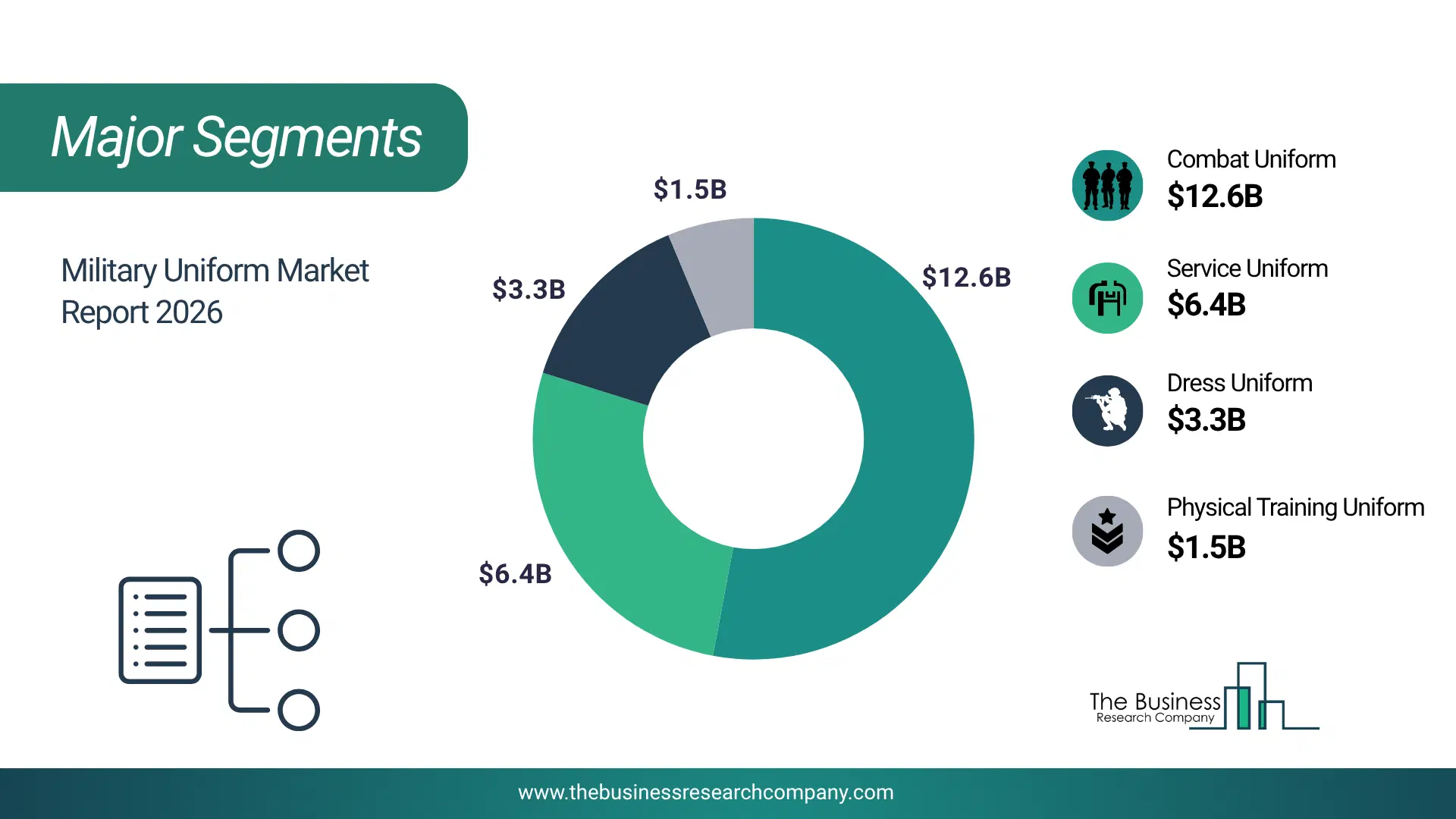
1) By Type: Combat Uniforms, Ceremonial Uniforms, Tactical Gear, Accessories 2) By Material Composition: Cotton, Polyester, Nylon, Ripstop Fabric, Blend Fabrics 3) By Distribution Channel: Online, Offline 4) By Application: Battle Or Combat Operations, Training And Exercises, Ceremonial Or Parade, Daily Duty 5) By End-User: Army, Navy, Air Force, Marine Corps, Special Forces, Paramilitary Forces Subsegments: 1) By Combat Uniforms: Battle Dress Uniforms, Camouflage Uniforms, Field Jackets And Pants, Protective Clothing 2) By Ceremonial Uniforms: Parade Uniforms, Dress Uniforms, Honor Guard Uniforms, Formal Military Attire 3) By Tactical Gear: Body Armor Suits, Load Bearing Vests, Tactical Pants And Jackets, Helmet And Headgear 4) By Accessories: Belts And Holsters, Boots And Footwear, Gloves And Protective Gear, Insignia And Badges The top segments in the military uniform market will be: • Combat Uniform will reach $12.55 billion by 2030. • Service Uniform will reach $6.36 billion by 2030. • Dress Uniform will reach $3.22 billion by 2030. • Physical Training Uniform will reach $1.45 billion by 2030.What Is The Driver Of The Military Uniform Market?
The increasing defense budgets are expected to propel the growth of the military uniform market going forward. Defense spending is rising due to escalating security threats and geopolitical tensions, which are driving nations to strengthen their military capabilities and maintain combat readiness through enhanced defense preparedness. Increased government spending on defense allows for greater investment in advanced uniforms, including research on protective materials and the integration of smart textile technologies that enhance soldier performance and safety. For instance, in May 2025, according to the UK Parliament's House of Commons Library, a UK-based government administration, the UK government’s defense budget is projected to rise from $70.5 billion in 2024/25 to $73.9 billion in 2025/26, enabling procurement of modernized military gear. Therefore, the increasing defense budgets are driving the growth of the military uniform industry.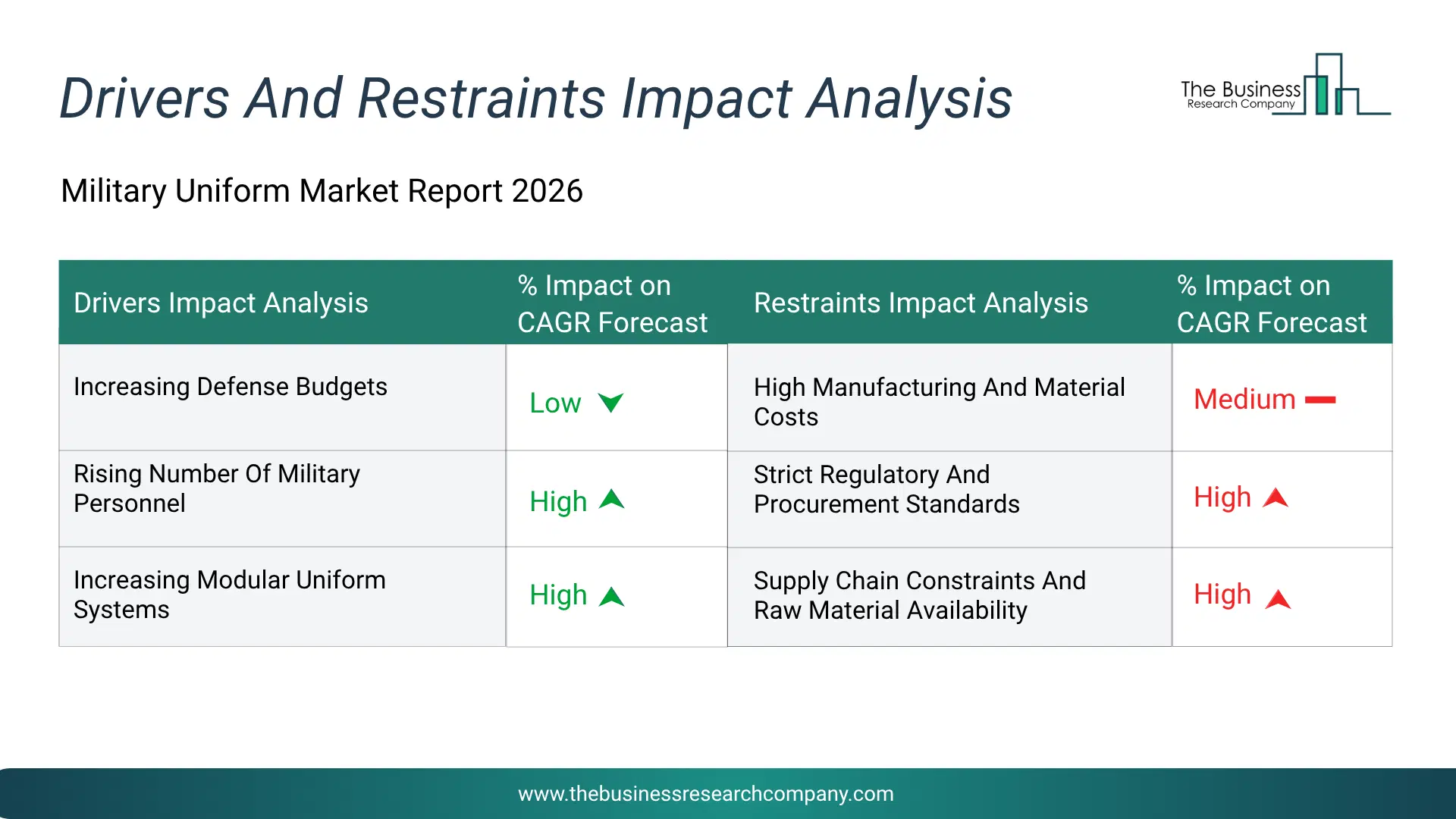
Infographic Chart Showing Key Market Drivers Analysis And Restraints For Military Uniform Market
The chart presents an impact analysis of key drivers and restraints, quantifying their relative influence on the market's growth rate and helping assess the balance between growth enablers and limiting factors. This chart offers a high-level perspective; the full report contains more detailed insights.
How Will The Drivers Impact Growth In The Global Military Uniform Market?
• Increasing Defense Budgets (Low) – During the forecast period, the increasing defense budgets is expected to become a key growth driver for the military uniform market by 2030. Rising defense budgets significantly support the military uniform market by enabling higher procurement of new and replacement uniforms across armed forces. Higher allocations allow governments to invest in advanced combat apparel, flame-resistant fabrics, and climate-adaptive gear that enhance soldier protection and performance. Additionally, expanded modernization programs and force expansion initiatives further drive sustained demand for high-quality military uniforms. • Rising Number Of Military Personnel (High) – During the forecast period, the rising number of military personnel is expected to emerge as a major factor driving the expansion of the military uniform market by 2030. The rising number of military personnel worldwide is driving the demand for military uniforms, as each new recruit requires standard -issue clothing for training and active duty. Growing defense budgets and military modernization programs in several countries are leading to force expansion and replenishment of existing uniforms. Additionally, frequent training exercises, deployments, and harsh operating environments increase wear and tear, creating recurring replacement needs. • Increasing Modular Uniform Systems (High) – During the forecast period, the increasing modular uniform systems is expected to act as a key growth catalyst for the military uniform market by 2030. The increasing adoption of modular uniform systems is driving growth in the military uniform market as armed forces seek greater adaptability, functionality, and comfort in combat gear. Modular systems allow soldiers to customize uniforms based on mission type, climate, and operational requirements by adding or removing components like armor panels, pouches, and thermal layers. This flexibility enhances mobility and protection, improving overall performance in the field. Additionally, the trend aligns with modernization programs emphasizing advanced materials and ergonomic design, fueling demand for innovative modular uniform solutions.How Will The Restraints Impact Growth In The Global Military Uniform Market?
• High Manufacturing And Material Costs (Medium) – During the forecast period, the high manufacturing and material costs act as a key restraint in the military uniform market because producing durable, functional, and technologically advanced uniforms requires high-quality fabrics, specialized coatings, and precision manufacturing processes. These costs increase the overall price of uniforms, making large-scale procurement expensive for defense organizations. Additionally, incorporating features like flame resistance, camouflage patterns, and modular designs further raises production costs. High costs can limit adoption, delay orders, and pressure manufacturers to find cost-effective alternatives without compromising quality. This creates a financial barrier that slows market growth despite rising demand for advanced military apparel. • Strict Regulatory And Procurement Standards (High) – During the forecast period, the strict regulatory and procurement standards act as a key restraint for the military uniform market because they impose rigorous requirements on materials, design, quality, and safety. Manufacturers must comply with government-mandated specifications, certifications, and testing protocols, which can increase production costs and extend lead times. These standards limit flexibility in design innovation and sourcing, as only approved suppliers and materials are allowed. Additionally, the lengthy procurement processes and bureaucratic approvals slow down market entry for new players. • Supply Chain Constraints And Raw Material Availability (High) – During the forecast period, the supply chain constraints and raw material availability act as a key restraint for the military uniform market by causing delays in production and limiting consistent access to high-quality fabrics and specialized inputs. Disruptions in global logistics and dependence on limited suppliers can lead to fluctuations in material supply, affecting manufacturing schedules. This unpredictability increases lead times and operational costs for manufacturers. Additionally, shortages of specialized fibers and treated textiles can hinder large-scale procurement for defense organizations. Overall, these constraints reduce production efficiency and slow down timely fulfillment of military uniform contracts.Key Players In The Global Military Uniform Market
Major companies operating in the military uniform market report are Crye Precision LLC, Propper International Inc, 5.11 Tactical, TRU‑SPEC, UF PRO, Helikon‑Tex, Arktis, Condor Outdoor Products, NFM Group, Wild Things Tactical, Massif, Claw Gear, FirstSpear, Direct Action, Pentagon Tactical, Platatac, Vertx, Rothco, LUPU Tactical Gear, Snigel Design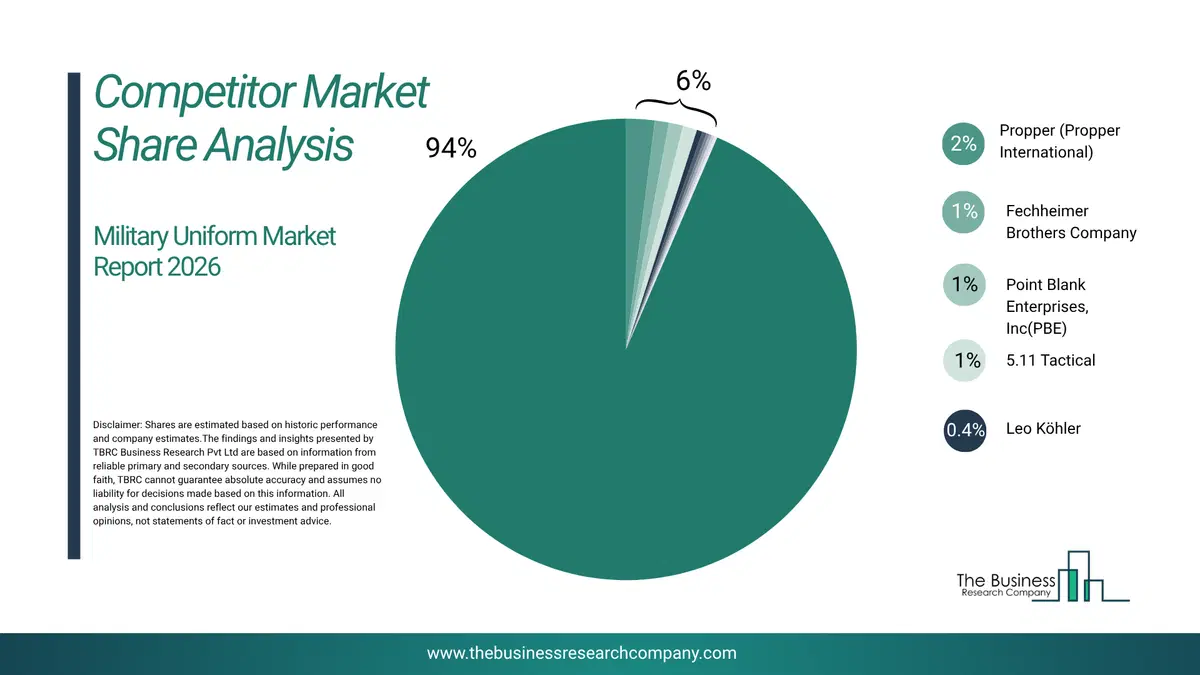
This chart is for illustrative purposes; the full report includes a detailed competitor analysis and comprehensive overview of the top 10 companies in the market.
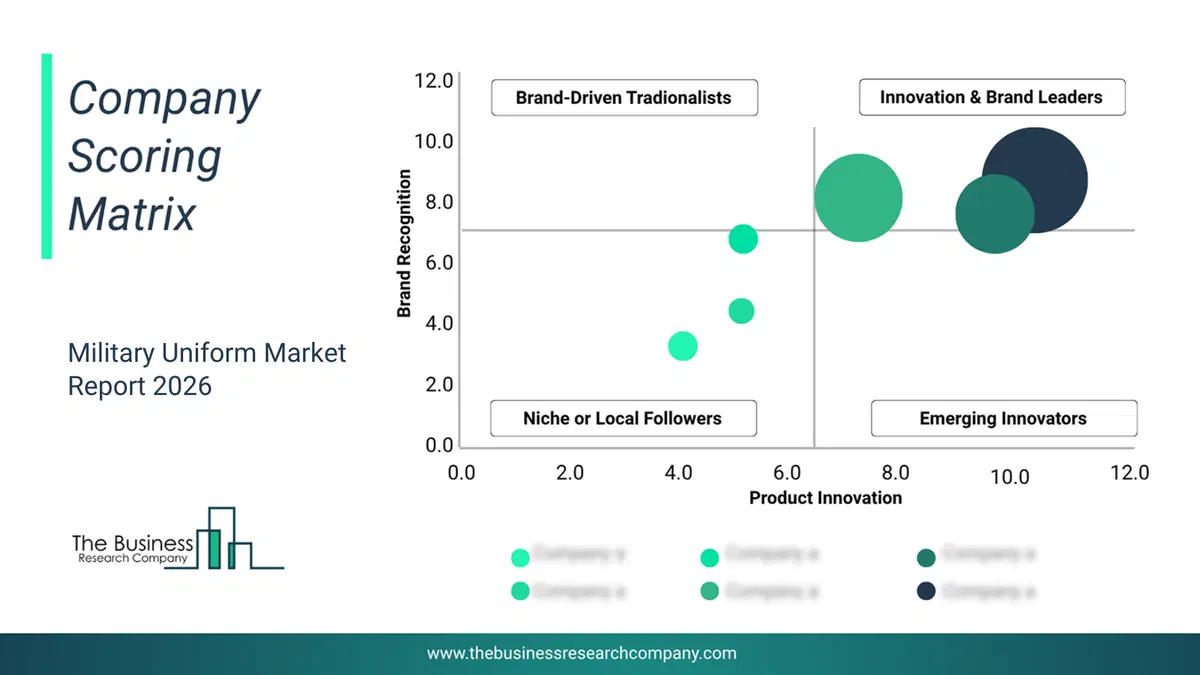
This chart maps companies by product innovation and brand strength, with bubble size indicating relative revenue, helping identify market leaders, challengers, and niche players. This is an illustrative chart; the full report provides a complete and accurate competitive analysis.
Global Military Uniform Market Trends and Insights
Major companies operating in the military uniform market are focusing on innovative fabrics, such as advanced ripstop textiles, to enhance durability, comfort, and mobility while providing better protection in demanding field conditions. These fabrics feature a reinforced crosshatch pattern that resists tearing, keeping uniforms lightweight, flexible, and long-lasting. For instance, in August 2025, Crye Precision LLC, a US-based manufacturing company, launched the G3.5 Series, combining proven design elements with VTX RIPSTOP fabric technology to improve mobility, comfort, and durability. The series includes flame-resistant, moisture-wicking combat shirts and pants with adaptable features like removable elbow and knee pads, illustrating how advanced textiles are driving product innovation and performance in the military uniform market.What Are Latest Mergers And Acquisitions In The Military Uniform Market?
In June 2025, Nate Woodard LLC, a US-based veteran-owned company specializing in military and service uniforms, acquired Abbotts Uniforms for an undisclosed amount. With this acquisition, Nate Woodard LLC aims to expand its market presence, continue Abbott’s legacy of high-quality uniforms, enhance accessibility for uniformed professionals, and reinforce its commitment to U.S.-made products and exceptional customer service. Abbotts Uniforms is a US-based manufacturing company that specializes in providing premium military and service uniforms.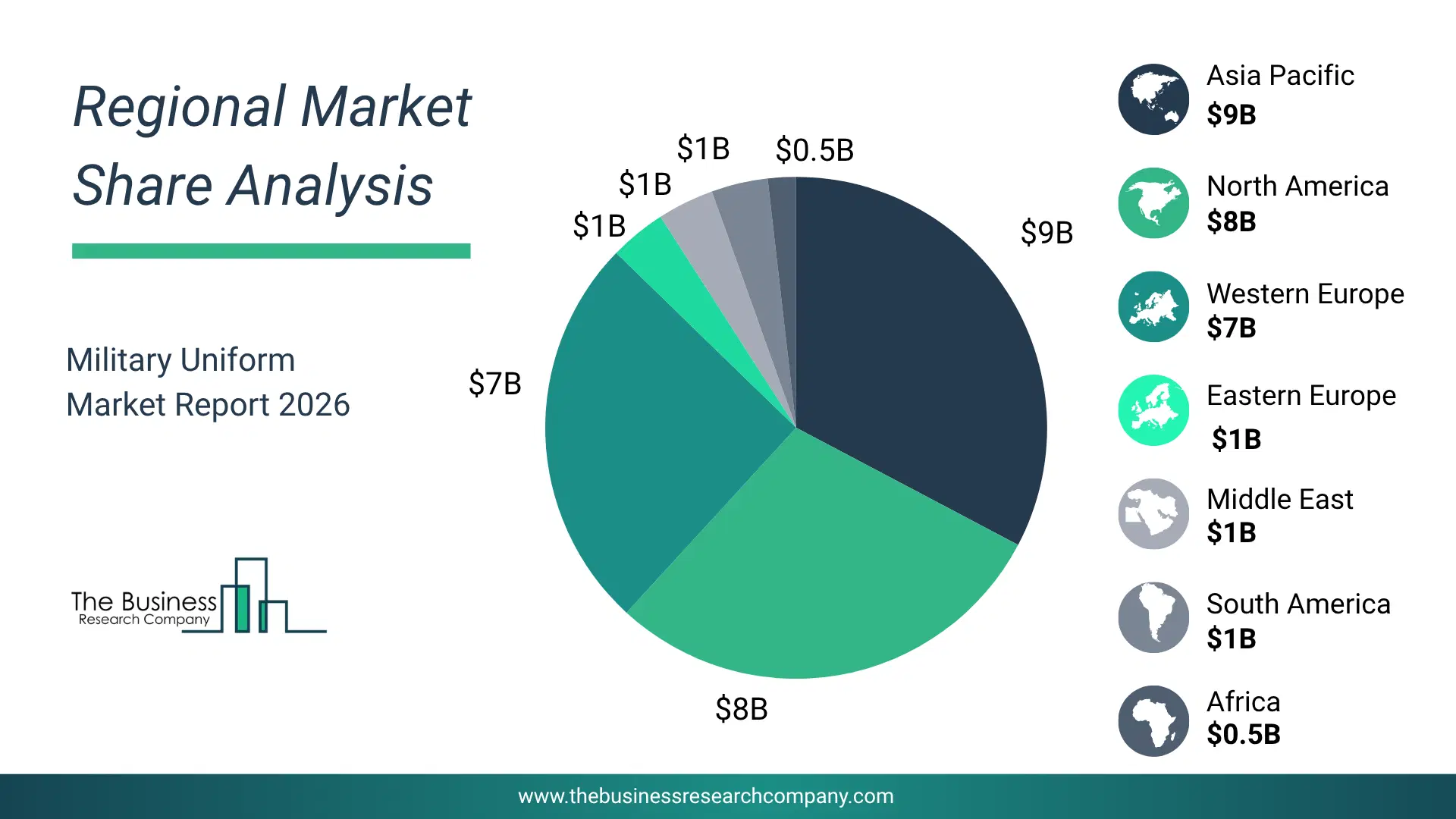
Regional Outlook
North America was the largest region in the military uniform market in 2025. Asia-Pacific is expected to be the fastest-growing region in the forecast period. The regions covered in this market report are Asia-Pacific, South East Asia, Western Europe, Eastern Europe, North America, South America, Middle East, Africa. The countries covered in this market report are Australia, Brazil, China, France, Germany, India, Indonesia, Japan, Taiwan, Russia, South Korea, UK, USA, Canada, Italy, SpainWhat Defines the Military Uniform Market?
The military uniform market also consists of sales of amouflage uniforms, flight suits, ghillie suits, jackets, rain gear, cold-weather gear, and flame-resistant clothing. Values in this market are ‘factory gate’ values, that is the value of goods sold by the manufacturers or creators of the goods, whether to other entities (including downstream manufacturers, wholesalers, distributors and retailers) or directly to end customers. The value of goods in this market includes related services sold by the creators of the goods.How is Market Value Defined and Measured?
The market value is defined as the revenues that enterprises gain from the sale of goods and/or services within the specified market and geography through sales, grants, or donations in terms of the currency (in USD unless otherwise specified). The revenues for a specified geography are consumption values that are revenues generated by organizations in the specified geography within the market, irrespective of where they are produced. It does not include revenues from resales along the supply chain, either further along the supply chain or as part of other products.
This chart presents market attractiveness based on a quantitative evaluation of growth, competition, strategic alignment, and risk, offering a clear view of opportunity areas for decision-making. This chart is for illustrative purposes; the full report contains the complete analysis.

This chart highlights the Total Addressable Market (TAM) by estimating the maximum revenue opportunity using an assumption-driven approach, supporting strategic planning and opportunity sizing across markets. The chart is illustrative; the full report provides a more comprehensive analysis.
What Key Data and Analysis Are Included in the Military Uniform Market Report 2026?
The military uniform market research report is one of a series of new reports from The Business Research Company that provides market statistics, including industry global market size, regional shares, competitors with the market share, detailed market segments, market trends and opportunities, and any further data you may need to thrive in the military uniform industry. The market research report delivers a complete perspective of everything you need, with an in-depth analysis of the current and future state of the industry.Military Uniform Market Report Forecast Analysis
| Report Attribute | Details |
|---|---|
| Market Size Value In 2026 | $3.12 billion |
| Revenue Forecast In 2030 | $4.09 billion |
| Growth Rate | CAGR of 7% from 2026 to 2030 |
| Base Year For Estimation | 2025 |
| Actual Estimates/Historical Data | 2020-2025 |
| Forecast Period | 2026 - 2030 |
| Market Representation | Revenue in USD Billion and CAGR from 2026 to 2030 |
| Segments Covered | Type, Material Composition, Distribution Channel, Application, End-User |
| Regional Scope | Asia-Pacific, Western Europe, Eastern Europe, North America, South America, Middle East, Africa |
| Country Scope | The countries covered in the report are Australia, Brazil, China, France, Germany, India, ... |
| Key Companies Profiled | Crye Precision LLC, Propper International Inc, 5.11 Tactical, TRU‑SPEC, UF PRO, Helikon‑Tex, Arktis, Condor Outdoor Products, NFM Group, Wild Things Tactical, Massif, Claw Gear, FirstSpear, Direct Action, Pentagon Tactical, Platatac, Vertx, Rothco, LUPU Tactical Gear, Snigel Design |
| Customization Scope | Request for Customization |
| Pricing And Purchase Options | Explore Purchase Options |