
Military Wireless Communication Market Report 2026
Global Outlook – By Component (Hardware, Software, Services), By Technology (Software Defined Radio, Satellite Communication, Secure Mobile Communication, Mesh Networking, Radio Frequency Communication), By Platform (Land Based, Airborne, Naval, Space Based), By Application (Voice Communication, Data Communication, Video Communication, Network Management, Situational Awareness), By End Use (Defense Forces, Government Agencies, Aerospace, Naval, Ground Forces) – Market Size, Trends, Strategies, and Forecast to 2030
Military Wireless Communication Market Overview
• Military Wireless Communication market size has reached to $19.94 billion in 2025 • Expected to grow to $28.84 billion in 2030 at a compound annual growth rate (CAGR) of 7.7% • Growth Driver: Surge In Adoption Of Advanced Wireless Communication Technologies Fueling The Growth Of The Market Due To Rising Demand For Real-Time Defense Connectivity • Market Trend: Next-Generation Communication Technologies Transform Modern Military Operations • North America was the largest region in 2025 and Asia-Pacific is the fastest growing region.What Is Covered Under Military Wireless Communication Market?
Military wireless communication refers to advanced communication systems that enable secure, real-time, and long-range transmission of voice, data, and video across military operations without the need for wired infrastructure. These systems utilize wireless technologies such as radio frequency (RF), satellite links, tactical communication networks, and encrypted wireless protocols to ensure reliable connectivity across land, air, sea, and space domains. Military wireless communication enhances battlefield coordination, situational awareness, and mission effectiveness while ensuring secure and uninterrupted information exchange in dynamic and hostile environments. The main components of military wireless communication include hardware, software, and services. Hardware refers to physical communication devices such as radios, antennas, and transceivers used to enable secure and reliable wireless connectivity in defense operations. These systems are built using technologies such as software defined radio, satellite communication, secure mobile communication, mesh networking, and radio frequency communication and are deployed across platforms including land based, airborne, naval, and space based. They find application in voice communication, data communication, video communication, network management, and situational awareness, serving end use including defense forces, government agencies, aerospace, naval, and ground forces.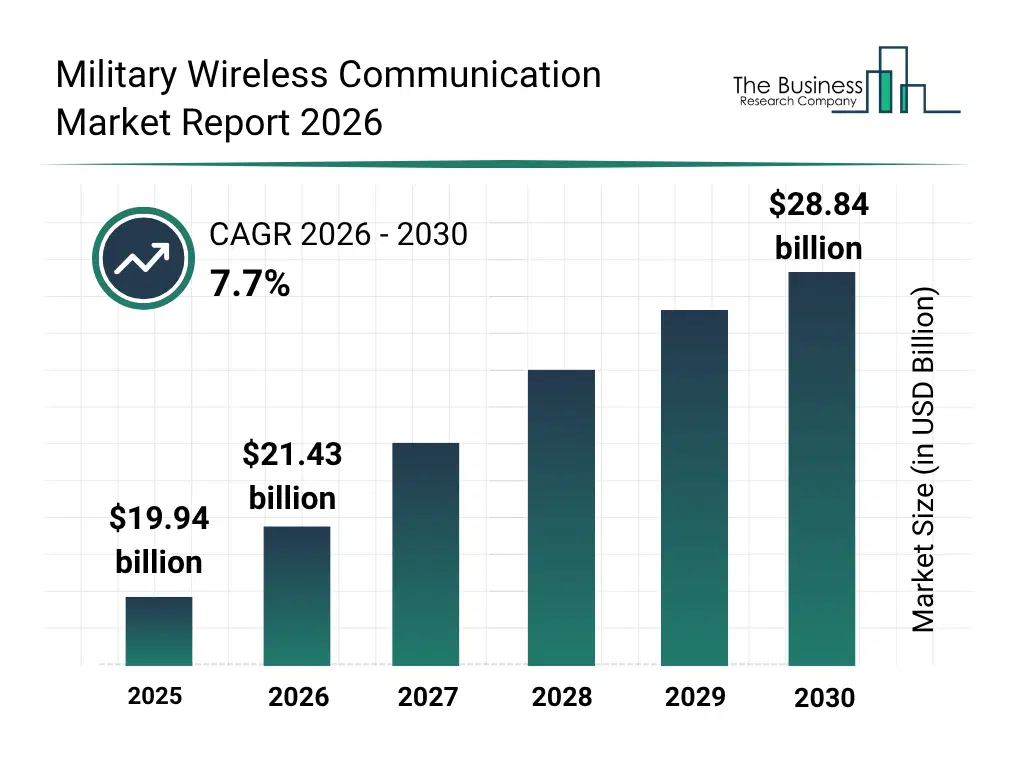
What Is The Military Wireless Communication Market Size and Share 2026?
The military wireless communication market size has grown strongly in recent years. It will grow from $19.94 billion in 2025 to $21.43 billion in 2026 at a compound annual growth rate (CAGR) of 7.5%. The growth in the historic period can be attributed to transition from analog to digital wireless communication systems, expansion of satellite based defense communication infrastructure, rise of network centric warfare strategies, increasing demand for real time battlefield connectivity, modernization of military radio frequency systems.What Is The Military Wireless Communication Market Growth Forecast?
The military wireless communication market size is expected to see strong growth in the next few years. It will grow to $28.84 billion in 2030 at a compound annual growth rate (CAGR) of 7.7%. The growth in the forecast period can be attributed to integration of ai driven adaptive wireless communication systems, expansion of leo satellite constellations for defense communication, growing adoption of quantum resistant encryption protocols, rising demand for autonomous battlefield communication networks, increased investment in resilient multi domain wireless infrastructure. Major trends in the forecast period include software defined secure wireless communication systems, satellite enabled military wireless networks, encrypted mesh networking for battlefield coordination, low latency rf based tactical communication systems, multi domain interoperable wireless communication platforms.
Global Military Wireless Communication Market Segmentation
1) By Component: Hardware, Software, Services 2) By Technology: Software Defined Radio, Satellite Communication, Secure Mobile Communication, Mesh Networking, Radio Frequency Communication 3) By Platform: Land Based, Airborne, Naval, Space Based 4) By Application: Voice Communication, Data Communication, Video Communication, Network Management, Situational Awareness 5) By End Use: Defense Forces, Government Agencies, Aerospace, Naval, Ground Forces Subsegments: 1) By Hardware: Communication Devices, Network Equipment, Antenna Systems, Signal Transmitters, Signal Receivers 2) By Software: Network Management Software, Communication Control Software, Encryption Software, Signal Processing Software, Monitoring Software 3) By Services: Integration Services, Maintenance Services, Consulting Services, Training Services, Support ServicesWhat Is The Driver Of The Military Wireless Communication Market?
The growing adoption of advanced wireless communication technologies is expected to propel the growth of the military wireless communication market going forward. Advanced wireless communication technologies refer to modern communication systems such as 5G, satellite communication, and secure tactical networks that enable high-speed, reliable, and real-time data transmission in military operations. The adoption of these technologies is increasing due to the rising need for secure, resilient, and high-bandwidth communication systems in defense and tactical environments. Military wireless communication systems support this demand by enabling seamless connectivity, enhanced situational awareness, and efficient command and control across various defense operations. For instance, in 2023, according to the International Telecommunication Union, a Switzerland-based specialized agency, there were 87 mobile-broadband subscriptions per 100 inhabitants globally in 2023, with mobile-broadband subscriptions growing by 27% over the past five years. Therefore, the growing adoption of advanced wireless communication technologies is driving the growth of the military wireless communication industry.Key Players In The Global Military Wireless Communication Market
Major companies operating in the military wireless communication market are Lockheed Martin Corporation, General Dynamics Corporation, Northrop Grumman Corporation, Honeywell International Inc., BAE Systems plc, Thales S.A., L3Harris Technologies Inc., Motorola Solutions Inc., Elbit Systems Ltd., Rohde & Schwarz GmbH & Co KG, Iridium Communications Inc., Comtech Telecommunications Corp., Tait Communications Ltd., Cambium Networks Corporation, Telos Corporation, Hytera Communications Corporation Limited, KVH Industries Inc., Rajant Corporation, Airgain Inc., Airbus Defence and Space GmbH, FreeWave Technologies Inc., Microhard Systems Inc., Simoco Wireless Solutions Limited, Leonardo S.p.A., RTX Corporation, Saab AB, Leonardo DRS Inc., Kratos Defense & Security Solutions Inc.Global Military Wireless Communication Market Trends and Insights
Major companies operating in the military wireless communication market are focusing on developing innovative solutions, such as software-defined radios (SDRs), to enable secure, flexible, and interoperable communication across multiple frequencies and evolving battlefield environments. Software-defined radios (SDRs) are communication systems in which radio functions like modulation, demodulation, and signal processing are implemented through software rather than fixed hardware, enabling flexibility and reconfigurability. For instance, in December 2024, Pacific Defense, a US-based defense technology company, launched the COM6300VP tactical radio card, an innovative wireless communication solution designed for modern military platforms. The COM6300VP integrates multiple radio functions and an embedded cryptographic module into a single compact card, reducing size, weight, and power requirements while enabling secure, multi-channel communication across diverse operational environments. It supports modular open systems architecture (MOSA), allowing rapid integration into various military vehicles and systems, and enhances interoperability with existing communication infrastructures. Additionally, the system facilitates secure data transmission aligned with advanced encryption standards and future certification requirements, making it suitable for command-and-control, situational awareness, and mission-critical operations.What Are Latest Mergers And Acquisitions In The Military Wireless Communication Market?
In December 2025, CoreEL Technologies India Private Limited, an India-based provider of advanced electronic system-level solutions for aerospace, defence, and commercial sectors, acquired the Aerospace & Defence Systems (ADS) division of Lekha Wireless for an undisclosed amount. With this acquisition, CoreEL aims to strengthen its position in the military communication domain by integrating Lekha ADS’s indigenous wireless communication technologies, specialized engineering capabilities, and proven intellectual property. Lekha Wireless is an India-based wireless communications company specializing in advanced communication technologies for aerospace and defence applications.Regional Outlook
North America was the largest region in the military wireless communication market in 2025. Asia-Pacific is expected to be the fastest-growing region in the forecast period. The regions covered in this market report are Australia, Brazil, China, France, Germany, India, Indonesia, Japan, Taiwan, Russia, South Korea, UK, USA, Canada, Italy, Spain. The countries covered in this market report are Australia, Brazil, China, France, Germany, India, Indonesia, Japan, Taiwan, Russia, South Korea, UK, USA, Canada, Italy, Spain.What Defines the Military Wireless Communication Market?
The military wireless communication market consists of revenues earned by entities by providing services such as secure battlefield data transmission, real-time situational awareness support, remote command and control coordination, and electronic warfare communication support. The market value includes the value of related goods sold by the service provider or included within the service offering. The military wireless communication also includes sales of software-defined radios, tactical communication systems, satellite communication terminals, and encrypted handheld radios. Values in this market are ‘factory gate’ values, that is the value of goods sold by the manufacturers or creators of the goods, whether to other entities (including downstream manufacturers, wholesalers, distributors and retailers) or directly to end customers. The value of goods in this market includes related services sold by the creators of the goods.How is Market Value Defined and Measured?
The market value is defined as the revenues that enterprises gain from the sale of goods and/or services within the specified market and geography through sales, grants, or donations in terms of the currency (in USD unless otherwise specified). The revenues for a specified geography are consumption values that are revenues generated by organizations in the specified geography within the market, irrespective of where they are produced. It does not include revenues from resales along the supply chain, either further along the supply chain or as part of other products.What Key Data and Analysis Are Included in the Military Wireless Communication Market Report 2026?
The military wireless communication market research report is one of a series of new reports from The Business Research Company that provides military wireless communication market statistics, including military wireless communication industry global market size, regional shares, competitors with a military wireless communication market share, detailed military wireless communication market segments, market trends and opportunities, and any further data you may need to thrive in the military wireless communication industry. This military wireless communication market research report delivers a complete perspective of everything you need, with an in-depth analysis of the current and future scenario of the industry.Military Wireless Communication Market Report Forecast Analysis
| Report Attribute | Details |
|---|---|
| Market Size Value In 2026 | $21.43 billion |
| Revenue Forecast In 2030 | $28.84 billion |
| Growth Rate | CAGR of 7.7% from 2026 to 2030 |
| Base Year For Estimation | 2025 |
| Actual Estimates/Historical Data | 2020-2025 |
| Forecast Period | 2026 - 2030 |
| Market Representation | Revenue in USD Billion and CAGR from 2026 to 2030 |
| Segments Covered | Component, Technology, Platform, Application, End Use |
| Regional Scope | Asia-Pacific, Western Europe, Eastern Europe, North America, South America, Middle East, Africa |
| Country Scope | The countries covered in the military wireless communication market report are Australia, Brazil, China, France, Germany, India, Indonesia, Japan, Taiwan, Russia, South Korea, UK, USA, Canada, Italy, Spain. |
| Key Companies Profiled | Lockheed Martin Corporation, General Dynamics Corporation, Northrop Grumman Corporation, Honeywell International Inc., BAE Systems plc, Thales S.A., L3Harris Technologies Inc., Motorola Solutions Inc., Elbit Systems Ltd., Rohde & Schwarz GmbH & Co KG, Iridium Communications Inc., Comtech Telecommunications Corp., Tait Communications Ltd., Cambium Networks Corporation, Telos Corporation, Hytera Communications Corporation Limited, KVH Industries Inc., Rajant Corporation, Airgain Inc., Airbus Defence and Space GmbH, FreeWave Technologies Inc., Microhard Systems Inc., Simoco Wireless Solutions Limited, Leonardo S.p.A., RTX Corporation, Saab AB, Leonardo DRS Inc., Kratos Defense & Security Solutions Inc. |
| Customization Scope | Request for Customization |
| Pricing And Purchase Options | Explore Purchase Options |