

Mobile Wi-Fi (MiFi) Market Report 2026
Global Outlook – By Type ( High Density Wireless Fidelity (Wi-Fi), Enterprise-Class Wireless Fidelity (Wi-Fi), Consumer-Grade MiFi, Other Types), By Cellular Technology ( Fourth Generation (4G) Or Long-Term Evolution (LTE) (Wireless Fidelity (Wi-Fi),, Fifth Generation (5G) (Wireless Fidelity (Wi-Fi) 6 Or Wireless Fidelity (Wi-Fi) 6E)), By Enterprise Type ( Small Office Or Home Office (SOHO), Large Enterprises, Small And Mid-Sized Enterprises (SMEs)), By Application ( Information Technology And Telecom, Hospitality, Healthcare, Military And Defense, Financial Services, Retail, Government And Public Sector, Transportation, Other Applications), By End User ( Frequent Travelers, Remote Workers, Families Or Teams, Backup Users, Other End Users) – Market Size, Trends, Strategies, and Forecast to 2035
Mobile Wi-Fi (MiFi) Market Overview
• Mobile Wi-Fi (MiFi) market size has reached to $5.63 billion in 2025 • Expected to grow to $14.41 billion in 2030 at a compound annual growth rate (CAGR) of 20.6% • Growth Driver: Growth In Remote And Hybrid Work Fueling The Growth Of The Market Due To Rising Demand For Reliable High-Speed Internet • Market Trend: Advanced Platforms Enhance Real-Time Data Sharing And Efficiency • North America was the largest region in 2025.Market Gains By 2030 – Top Opportunities By Segment
Market Gain identifies the most promising market opportunities by highlighting the segments or products expected to generate the highest incremental revenue growth over the next five years.
What Is Covered Under Mobile Wi-Fi (MiFi) Market?
A mobile Wi-Fi (MiFi) is a portable wireless device that acts as a mobile Wi-Fi hotspot, allowing multiple devices such as smartphones, laptops, and tablets to connect to the internet via cellular networks. It is used to provide on-the-go internet access without relying on fixed broadband connections, making it ideal for travel, remote work, or areas with limited wired internet infrastructure. It is compact, battery-powered, and supports secure connections for multiple users simultaneously. The main types of mobile Wi-Fi (MiFi) are high-density wireless fidelity (Wi-Fi), enterprise-class Wi-Fi, consumer-grade MiFi, and others. High-density Wi-Fi is designed to deliver fast, reliable connectivity to large numbers of users simultaneously in crowded or high-traffic areas. It uses various cellular technologies, including fourth-generation (4G) or long-term evolution (LTE) Wi-Fi 5, and fifth-generation (5G) Wi-Fi 6 or Wi-Fi 6E, and serves various enterprise types, including small office or home office (SOHO), large enterprises, and small and mid-sized enterprises (SMEs). It is applied across multiple industries, such as information technology and telecom, hospitality, healthcare, military and defense, financial services, retail, government and public sector, and transportation, serving end users such as frequent travelers, remote workers, families or teams, backup users, and other groups seeking portable and reliable wireless connectivity.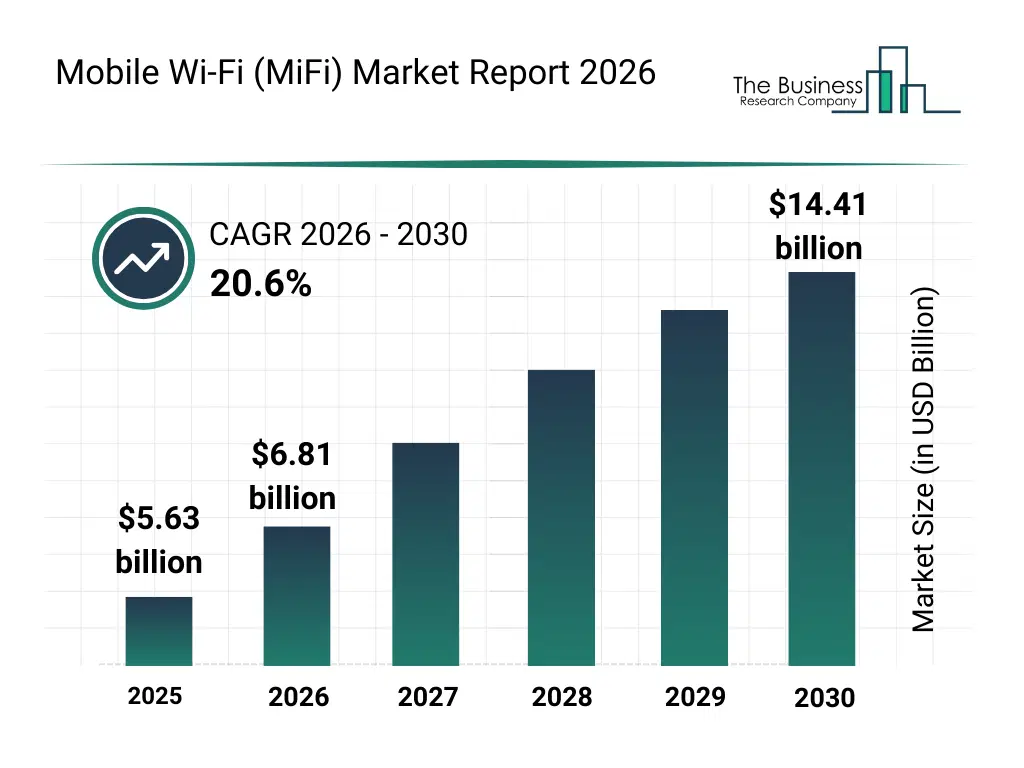
What Is The Mobile Wi-Fi (MiFi) Market Size 2026 And Growth Rate?
The mobile wi-fi (mifi) market size has grown exponentially in recent years. It will grow from $5.63 billion in 2025 to $6.81 billion in 2026 at a compound annual growth rate (CAGR) of 21.0%. The growth in the historic period can be attributed to increased smartphone penetration, growth in remote work, rising travel and tourism, expansion of 4g/lte networks, demand for mobile connectivity in underserved regions.What Is The Mobile Wi-Fi (MiFi) Market Growth Forecast?
The mobile wi-fi (mifi) market size is expected to see exponential growth in the next few years. It will grow to $14.41 billion in 2030 at a compound annual growth rate (CAGR) of 20.6%. The growth in the forecast period can be attributed to deployment of 5g networks, rising adoption of smart devices, increased need for high-speed mobile internet, growth in IoT applications, expansion in enterprise mobility solutions. Major trends in the forecast period include portable wi-fi expansion, battery-efficient devices, multi-device connectivity, secure mobile hotspot solutions, on-the-go internet access.
Global Mobile Wi-Fi (MiFi) Market Segmentation
1) By Type: High Density Wireless Fidelity (Wi-Fi), Enterprise-Class Wireless Fidelity (Wi-Fi), Consumer-Grade MiFi, Other Types 2) By Cellular Technology: Fourth Generation (4G) Or Long-Term Evolution (LTE) (Wireless Fidelity (Wi-Fi) 5), Fifth Generation (5G) (Wireless Fidelity (Wi-Fi) 6 Or Wireless Fidelity (Wi-Fi) 6E) 3) By Enterprise Type: Small Office Or Home Office (SOHO), Large Enterprises, Small And Mid-Sized Enterprises (SMEs) 4) By Application: Information Technology And Telecom, Hospitality, Healthcare, Military And Defense, Financial Services, Retail, Government And Public Sector, Transportation, Other Applications 5) By End User: Frequent Travelers, Remote Workers, Families Or Teams, Backup Users, Other End Users Subsegments: 1) By High Density Wireless Fidelity: Outdoor Coverage, Indoor Coverage, Campus Networks 2) By Enterprise Class Wireless Fidelity: Corporate Networks, Institutional Networks, Government Networks 3) By Consumer Grade MiFi: Portable Hotspot, Home Router, Travel Router 4) By Other Types: Industrial Wireless Fidelity, Vehicle Mounted Devices, Temporary Event Networks The top segments in the mobile wi-fi (mifi) market will be: • Fourth Generation (4G) Or Long-Term Evolution (LTE) (Wi-Fi 5) will reach $1906.7 Million by 2025. • Enterprise-Class Wireless Fidelity (Wi-Fi) will reach $1097.9 Million by 2025. • Small And Mid-Sized Enterprises (SMEs) will reach $1091.1 Million by 2025. • Large Enterprises will reach $1041.2 Million by 2025. • Fifth Generation (5G) (Wi-Fi 6 Or Wi-Fi 6E) will reach $956.7 Million by 2025.What Is The Driver Of The Mobile Wi-Fi (MiFi) Market?
The growth in remote and hybrid work is expected to propel the growth of the mobile Wi-Fi (MiFi) market going forward. Remote and hybrid work refers to flexible work arrangements where employees perform their job duties either entirely from locations outside the traditional office (remote) or through a combination of on-site and off-site work (hybrid). Remote and hybrid work is rising due to growing demand for reliable high-speed internet, as employees need uninterrupted access to cloud-based tools and real-time communication platforms. The growth in remote and hybrid work enhances mobile Wi-Fi (MiFi) device adoption by providing reliable, high-speed internet access on the go, enabling seamless connectivity for employees working from multiple locations. They improve productivity by supporting real-time collaboration and access to cloud-based applications, making remote and hybrid work more efficient and flexible. For instance, in February 2023, according to the Office for National Statistics, a UK-based government department, between September 2022 and January 2023, 16% of working adults reported exclusively working from home, while 28% reported a combination of working from home and commuting to work. Therefore, the growth in remote and hybrid work is driving the growth of the mobile Wi-Fi (MiFi) industry.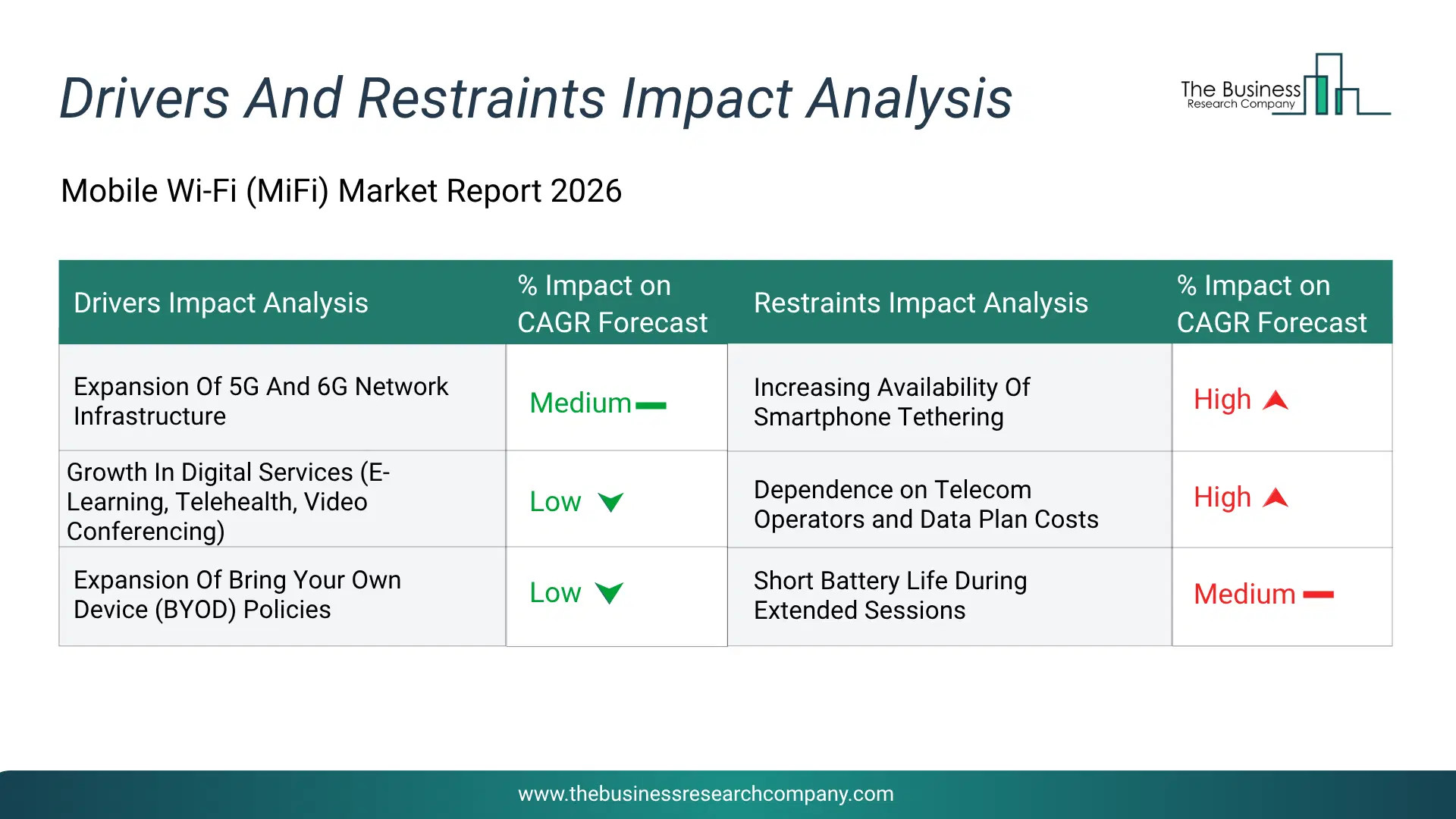
Infographic Chart Showing Key Market Drivers Analysis And Restraints For Mobile Wi-Fi (Mifi) Market
The chart presents an impact analysis of key drivers and restraints, quantifying their relative influence on the market's growth rate and helping assess the balance between growth enablers and limiting factors. This chart offers a high-level perspective; the full report contains more detailed insights.
How Will The Drivers Impact Growth In The Global Mobile Wi-Fi (MiFi) Market?
• Expansion Of 5G And 6G Network Infrastructure (Medium) – The expansion of 5g and 6g network infrastructure will become a key driver of growth in the mobile wi-fi (MiFi) market by 2030. The continuous rollout of high-speed mobile networks is enabling faster data transmission, lower latency and improved network reliability, which enhances the performance and usability of MiFi devices. As telecom operators invest in expanding 5G coverage and advancing next-generation network capabilities, mobile Wi-Fi solutions are becoming more efficient in supporting high-bandwidth applications such as streaming, cloud computing and real-time collaboration. The improved network ecosystem is expected to encourage greater adoption of MiFi devices across consumer, enterprise and industrial use cases. As a result, the expansion of 5g and 6g network infrastructure is anticipated to contributing to a 1.0% annual growth in the market. • Growth In Digital Services (E-Learning, Telehealth, Video Conferencing) (Low) – The growth in digital services (e-learning, telehealth, video conferencing) will emerge as a major factor driving the expansion of the mobile wi-fi (MiFi) market by 2030. The increasing reliance on digital platforms for education, healthcare delivery and remote communication is driving the need for stable, high-speed and portable internet connectivity. Users across urban and remote environments require uninterrupted access to virtual classrooms, telemedicine consultations and real-time collaboration tools. Mobile Wi-Fi (MiFi) devices enable seamless connectivity in areas where fixed broadband is unavailable or unreliable, supporting continuous access to digital services. Consequently, the growth in digital services (e-learning, telehealth, video conferencing) is projected to contributing to a 0.8% annual growth in the market. • Expansion Of Bring Your Own Device (BYOD) Policies (Low) – The expansion of bring your own device (byod) policies will serve as a key growth catalyst for the mobile wi-fi (MiFi) market by 2030. BYOD policies enable employees to use personal devices such as smartphones, tablets and laptops for work purposes, increasing the need for secure and flexible internet connectivity outside traditional office networks. Organizations are increasingly adopting BYOD strategies to enhance productivity, reduce hardware costs and support remote and hybrid work environments. Mobile Wi-Fi (MiFi) devices complement this trend by providing secure, dedicated connectivity that protects enterprise data while supporting multiple personal devices simultaneously. The growing adoption of BYOD across industries is expected to drive demand for portable and secure connectivity solutions. Therefore, this expansion of bring your own device (byod) policies is projected to supporting to a 0.5% annual growth in the market. • Expansion Of Global Tourism And Business Travel (Low) – The expansion of global tourism and business travel will become a significant driver contributing to the growth of the mobile wi-fi (MiFi) market by 2030. As international travel, cross-border business operations and global workforce mobility continue to recover and expand, there is a growing need for reliable, portable and secure internet connectivity across geographies. Travelers, corporate professionals and digital nomads increasingly require uninterrupted access to navigation tools, communication platforms, cloud applications and enterprise systems while on the move. Mobile Wi-Fi (MiFi) devices support these needs by offering secure, high-speed internet access without relying on public Wi-Fi networks or incurring high roaming costs. The increasing frequency of travel and temporary work setups across regions is expected to drive sustained demand for portable connectivity solutions. Consequently, the expansion of global tourism and business travel is projected to contributing to a 0.3% annual growth in the market.How Will The Restraints Impact Growth In The Global Mobile Wi-Fi (MiFi) Market?
• Increasing Availability Of Smartphone Tethering (Medium) – Increasing availability of smartphone tethering is expected to restrain market growth during the forecast period. It creates operational, financial, regulatory, or commercial challenges that can increase costs, delay projects, reduce investments, or discourage purchasing decisions depending on the market. These challenges can reduce product adoption, affect business confidence, and limit the ability of companies to expand efficiently across key regions. This can reduce operational efficiency, delay expansion plans, and affect the ability of companies to achieve sustainable business growth. • Dependence on Telecom Operators and Data Plan Costs (Low) – During the forecast period, dependence on telecom operators and data plan costs is likely to limit market expansion. It creates operational, financial, regulatory, or commercial challenges that can increase costs, delay projects, reduce investments, or discourage purchasing decisions depending on the market. These challenges can reduce product adoption, affect business confidence, and limit the ability of companies to expand efficiently across key regions. As a result, businesses may face increased cost pressures, slower commercial adoption, and reduced revenue opportunities. • Short Battery Life During Extended Sessions (Low) – The market is expected to face challenges due to short battery life during extended sessions over the forecast period. It creates operational, financial, regulatory, or commercial challenges that can increase costs, delay projects, reduce investments, or discourage purchasing decisions depending on the market. These challenges can reduce product adoption, affect business confidence, and limit the ability of companies to expand efficiently across key regions. This may discourage new investments, delay strategic expansion initiatives, and weaken the overall competitive position of market participants. • Impact Of Trade War And Tariffs (Low) – Impact of trade war and tariffs will remain a significant restraint for the market throughout the forecast period. It creates operational, financial, regulatory, or commercial challenges that can increase costs, delay projects, reduce investments, or discourage purchasing decisions depending on the market. These challenges can reduce product adoption, affect business confidence, and limit the ability of companies to expand efficiently across key regions. Consequently, manufacturers and service providers may experience lower profitability, slower market penetration, and delayed business expansion.Key Players In The Global Mobile Wi-Fi (MiFi) Market
Major companies operating in the mobile wi-fi (mifi) market are Huawei Technologies Co. Ltd., Quanta Computer Inc., ZTE Corporation, ASUSTeK Computer Inc., Kyocera Corporation, TP-Link Systems Inc., Ubiquiti Inc., NETGEAR Inc., Cradlepoint Inc., Yaojin Technology (Shenzhen) Co. Ltd., Inseego Corp., D-Link (India) Limited, Teltonika Networks UAB, uCloudlink Group Inc., Franklin Wireless Corp., Keepgo Inc., Shenzhen Skyworth Digital Technology Co. Ltd., WINSPIRE Technology Limited, Shenzhen Junhaoyue Technology Co. Ltd., TravelWifi Inc.
This chart is for illustrative purposes; the full report includes a detailed competitor analysis and comprehensive overview of the top 10 companies in the market.
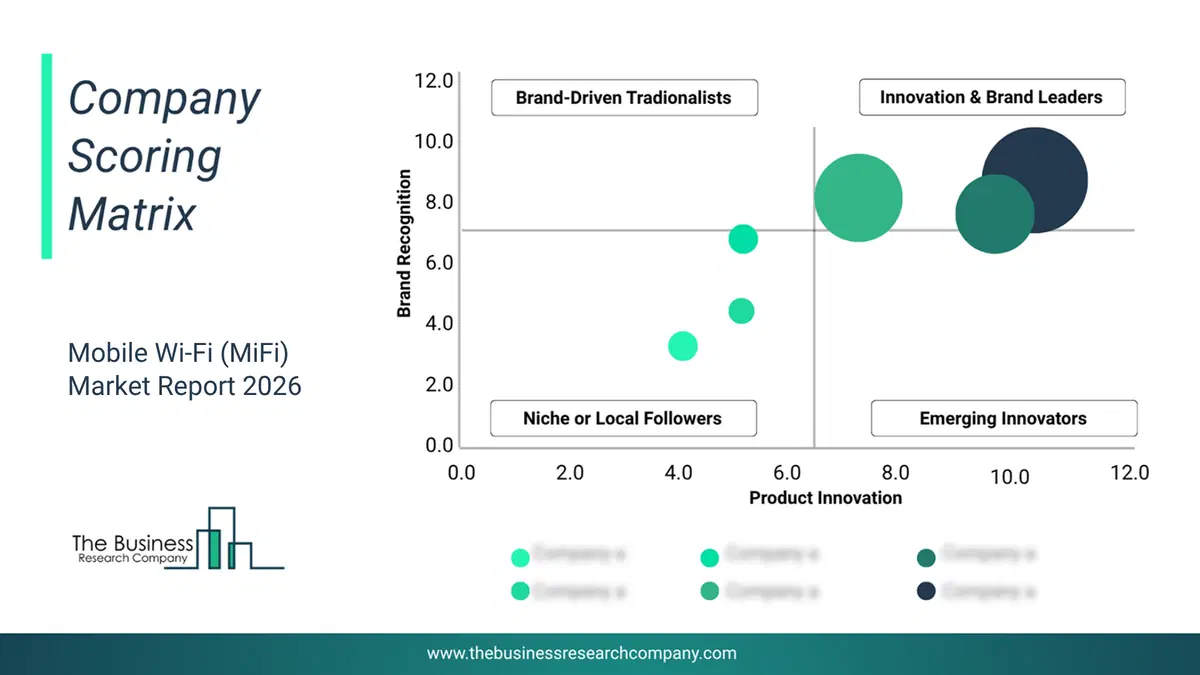
This chart maps companies by product innovation and brand strength, with bubble size indicating relative revenue, helping identify market leaders, challengers, and niche players. This is an illustrative chart; the full report provides a complete and accurate competitive analysis.
Global Mobile Wi-Fi (MiFi) Market Trends and Insights
Major companies operating in the mobile Wi-Fi (MiFi) market are focusing on developing innovative solutions, such as advanced mobile connectivity platforms, to boost operational efficiency, enhance real-time data sharing, and improve ground crew productivity. Advanced mobile connectivity platforms refer to integrated systems that provide reliable, high-speed internet access for personnel and equipment across the airport ramp, enabling seamless communication and data transfer. For instance, in June 2025, SITA SC SA, a Switzerland-based information technology company, launched the SITA Mobile WIFI (MIFI), an advanced mobile connectivity platform to enhance connectivity for airports, airlines, and ground handling operations. This solution provides robust, secure, and high-performance Wi-Fi connectivity directly on the tarmac, addressing the challenge of poor cellular and Wi-Fi coverage in these critical operational areas. It includes automatic network switching and secure, seamless roaming functionality, enabling ground handling teams to access cloud-based applications and communicate in real-time without interruption, significantly improving turnaround coordination.What Are Latest Mergers And Acquisitions In The Mobile Wi-Fi (MiFi) Market?
In October 2024, OptConnect Inc., a US-based technology company, acquired Capestone B.V. for an undisclosed amount. With this acquisition, OptConnect aims to expand its presence, strengthen its capabilities in Europe, enhance IoT and managed wireless solutions, and leverage Capestone’s hardware, software, and partner network for seamless services. Capestone B.V. is a Netherlands-based telecommunications company that specialises in providing MiFi solutions.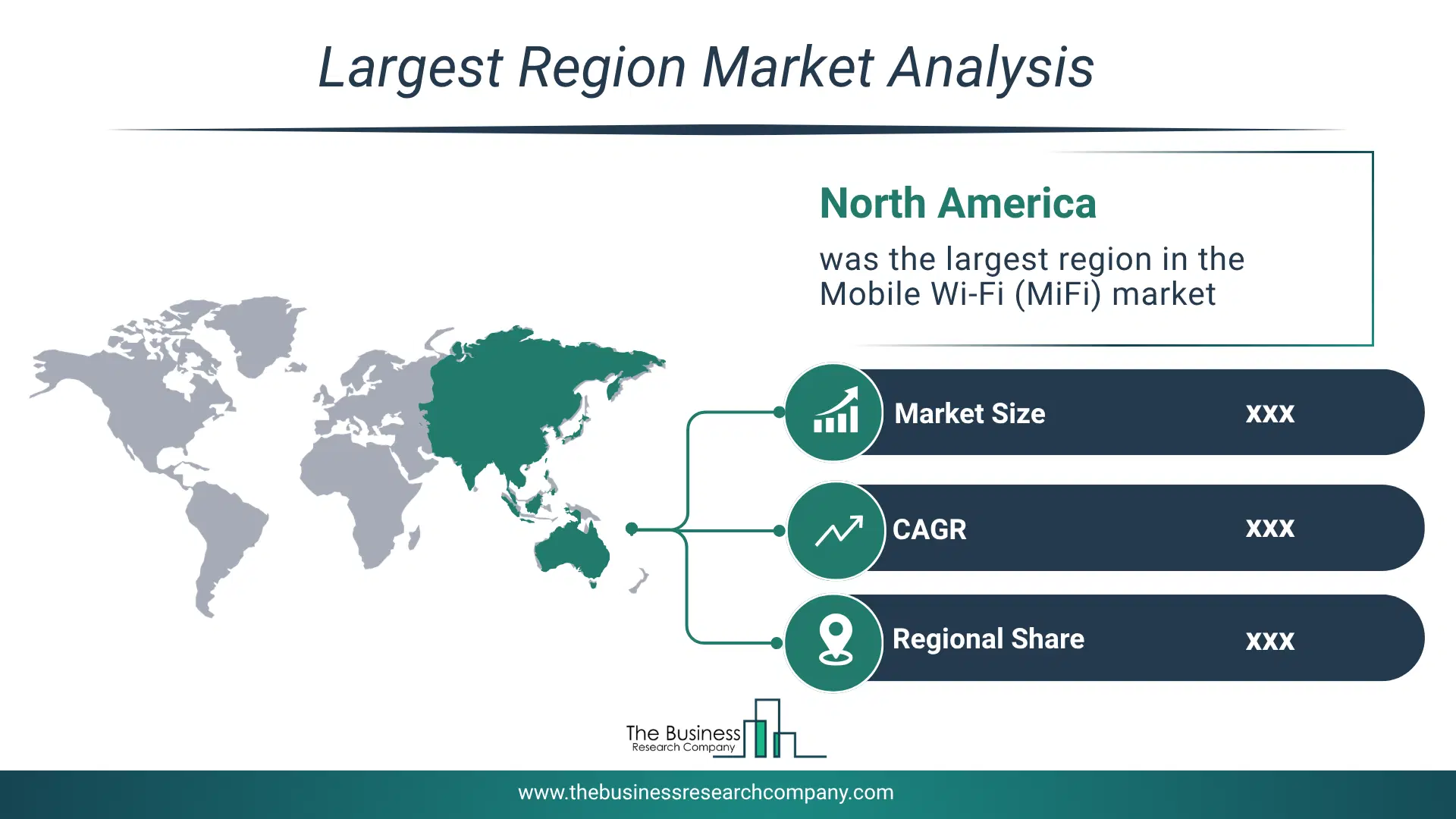
Regional Outlook
North America was the largest region in the mobile Wi-Fi (MiFi) market in 2025. The regions covered in this market report are Asia-Pacific, South East Asia, Western Europe, Eastern Europe, North America, South America, Middle East, Africa. The countries covered in this market report are Australia, Brazil, China, France, Germany, India, Indonesia, Japan, Taiwan, Russia, South Korea, UK, USA, Canada, Italy, Spain.What Defines the Mobile Wi-Fi (MiFi) Market?
The mobile Wi-Fi (MiFi) market consists of revenues earned by entities by providing services such as portable mobile data connectivity, international roaming services, prepaid and postpaid data plans, failover internet services, internet of things (IoT) and telematics connectivity, rental and leasing services, customer support, and maintenance services. The market value includes the value of related goods sold by the service provider or included within the service offering. The MiFi market also includes sales of portable MiFi devices, wireless routers, mobile broadband accessories, and related connectivity hardware. Values in this market are ‘factory gate’ values, that is the value of goods sold by the manufacturers or creators of the goods, whether to other entities (including downstream manufacturers, wholesalers, distributors and retailers) or directly to end customers. The value of goods in this market includes related services sold by the creators of the goods.How is Market Value Defined and Measured?
The market value is defined as the revenues that enterprises gain from the sale of goods and/or services within the specified market and geography through sales, grants, or donations in terms of the currency (in USD unless otherwise specified). The revenues for a specified geography are consumption values that are revenues generated by organizations in the specified geography within the market, irrespective of where they are produced. It does not include revenues from resales along the supply chain, either further along the supply chain or as part of other products.
This chart presents market attractiveness based on a quantitative evaluation of growth, competition, strategic alignment, and risk, offering a clear view of opportunity areas for decision-making. This chart is for illustrative purposes; the full report contains the complete analysis.

This chart highlights the Total Addressable Market (TAM) by estimating the maximum revenue opportunity using an assumption-driven approach, supporting strategic planning and opportunity sizing across markets. The chart is illustrative; the full report provides a more comprehensive analysis.
What Key Data and Analysis Are Included in the Mobile Wi-Fi (MiFi) Market Report 2026?
The mobile wi-fi (mifi) market research report is one of a series of new reports from The Business Research Company that provides market statistics, including industry global market size, regional shares, competitors with the market share, detailed market segments, market trends and opportunities, and any further data you may need to thrive in the mobile wi-fi (mifi) industry. The market research report delivers a complete perspective of everything you need, with an in-depth analysis of the current and future state of the industry.Mobile Wi-Fi (MiFi) Market Report 2026 Market Report Forecast Analysis
| Report Attribute | Details |
|---|---|
| Market Size Value In 2026 | $6.81 billion |
| Revenue Forecast In 2035 | $14.41 billion |
| Growth Rate | CAGR of 21.0% from 2026 to 2035 |
| Base Year For Estimation | 2025 |
| Actual Estimates/Historical Data | 2020-2025 |
| Forecast Period | 2026 - 2030 - 2035 |
| Market Representation | Revenue in USD Billion and CAGR from 2026 to 2035 |
| Segments Covered | Type, Cellular Technology, Enterprise Type, Application, End User |
| Regional Scope | Asia-Pacific, Western Europe, Eastern Europe, North America, South America, Middle East, Africa |
| Country Scope | The countries covered in the report are Australia, Brazil, China, France, Germany, India, ... |
| Key Companies Profiled | Huawei Technologies Co. Ltd., Quanta Computer Inc., ZTE Corporation, ASUSTeK Computer Inc., Kyocera Corporation, TP-Link Systems Inc., Ubiquiti Inc., NETGEAR Inc., Cradlepoint Inc., Yaojin Technology (Shenzhen) Co. Ltd., Inseego Corp., D-Link (India) Limited, Teltonika Networks UAB, uCloudlink Group Inc., Franklin Wireless Corp., Keepgo Inc., Shenzhen Skyworth Digital Technology Co. Ltd., WINSPIRE Technology Limited, Shenzhen Junhaoyue Technology Co. Ltd., TravelWifi Inc. |
| Customization Scope | Request for Customization |
| Pricing And Purchase Options | Explore Purchase Options |