

Mobile Worldwide Interoperability For Microwave Access (WiMAX) Market Report 2026
Global Outlook – By Device Type (Customer Premises Equipment (CPE) Devices, Smartphones, Tablets, Laptops, Internet Of Things (IoT) Devices), By Deployment Type (Outdoor, Indoor, Mobile Hotspot), By Technology (Fixed Worldwide Interoperability For Microwave Access (WiMAX), Nomadic Worldwide Interoperability For Microwave Access (WiMAX), Mobile Worldwide Interoperability For Microwave Access (WiMAX)), By Application (Mobile Broadband Connectivity, Online Gaming And Streaming, Voice Over Internet Protocol (VoIP) Services, Machine-To-Machine Communications (M2M)), By End User (Residential Users, Business Enterprises, Government Agencies, Educational Institutions) – Market Size, Trends, Strategies, and Forecast to 2030
Mobile Worldwide Interoperability For Microwave Access (WiMAX) Market Overview
• Mobile Worldwide Interoperability For Microwave Access (WiMAX) market size has reached to $4.06 billion in 2025 • Expected to grow to $6.62 billion in 2030 at a compound annual growth rate (CAGR) of 10.2% • Growth Driver: Rising Demand For High-Speed Internet Services Fueling The Growth Of The Market Due To Increasing Reliance On Digital Applications • Market Trend: Strategic Collaborations Driving Innovation And Next-Generation wireless connectivity • North America was the largest region in 2025 and Asia-Pacific is the fastest growing region.What Is Covered Under Mobile Worldwide Interoperability For Microwave Access (WiMAX) Market?
Mobile worldwide interoperability for microwave access (WiMAX) refers to a high-speed wireless communication standard that provides broadband internet access over long distances using microwave and radio frequency technologies. It supports both fixed and mobile connectivity, enabling users to access data, voice, and video services seamlessly while traveling, making it an early foundation for 4G wireless communication systems. The main types of devices in mobile worldwide interoperability for microwave access (WiMAX) are customer premises equipment (CPE) devices, smartphones, tablets, laptops, and internet of things (IoT) devices. Customer premises equipment (CPE) devices are hardware units installed at the user’s location to connect to a broadband network. It is deployed through outdoor, indoor, and mobile hotspots, and technologies include fixed worldwide interoperability for microwave access (WiMAX), nomadic worldwide interoperability for microwave access (WiMAX), mobile worldwide interoperability for microwave access (WiMAX), and hybrid worldwide interoperability for microwave access (WiMAX) solutions. It finds applications in mobile broadband connectivity, online gaming and streaming, voice over internet protocol (VoIP) services, machine-to-machine communications (M2M), and serving end users, such as residential users, business enterprises, government agencies, and educational institutions.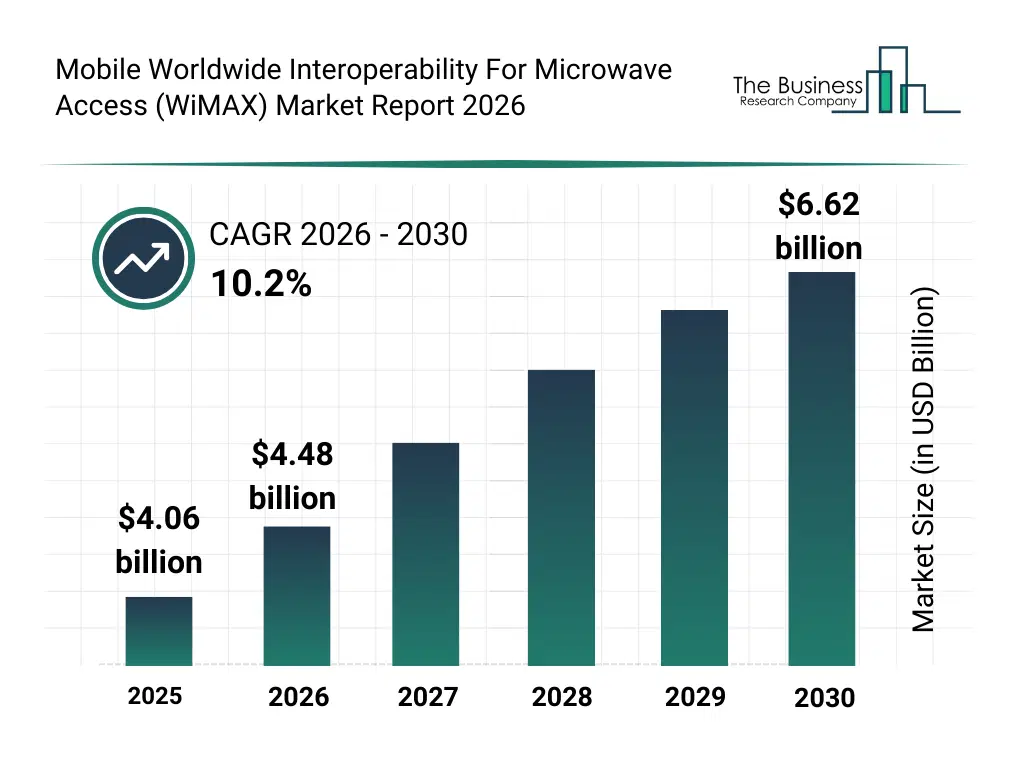
What Is The Mobile Worldwide Interoperability For Microwave Access (WiMAX) Market Size and Share 2026?
The mobile worldwide interoperability for microwave access (wimax) market size has grown rapidly in recent years. It will grow from $4.06 billion in 2025 to $4.48 billion in 2026 at a compound annual growth rate (CAGR) of 10.4%. The growth in the historic period can be attributed to early 4g deployment initiatives in emerging markets, demand for long-range broadband connectivity, limited fiber availability in rural areas, enterprise wireless connectivity for remote sites, government programs for digital inclusion.What Is The Mobile Worldwide Interoperability For Microwave Access (WiMAX) Market Growth Forecast?
The mobile worldwide interoperability for microwave access (wimax) market size is expected to see rapid growth in the next few years. It will grow to $6.62 billion in 2030 at a compound annual growth rate (CAGR) of 10.2%. The growth in the forecast period can be attributed to private wireless upgrades and spectrum refarming, integration with iot gateways and industrial devices, replacement cycles toward 4g and 5G equipment, managed fixed wireless services for rural broadband, cost-driven use cases for temporary connectivity. Major trends in the forecast period include fixed wireless broadband for underserved regions, migration of legacy wimax networks to lte and 5g, use of wimax for private and industrial connectivity, interoperable cpe device ecosystems for last-mile access, backhaul alternatives using microwave broadband links.
Global Mobile Worldwide Interoperability For Microwave Access (WiMAX) Market Segmentation
1) By Device Type: Customer Premises Equipment (CPE) Devices, Smartphones, Tablets, Laptops, Internet Of Things (IoT) Devices 2) By Deployment Type: Outdoor, Indoor, Mobile Hotspot 3) By Technology: Fixed Worldwide Interoperability For Microwave Access (WiMAX), Nomadic Worldwide Interoperability For Microwave Access (WiMAX), Mobile Worldwide Interoperability For Microwave Access (WiMAX), Hybrid Worldwide Interoperability For Microwave Access (WiMAX) Solutions 4) By Application: Mobile Broadband Connectivity, Online Gaming And Streaming, Voice Over Internet Protocol (VoIP) Services, Machine-To-Machine Communications (M2M) 5) By End User: Residential Users, Business Enterprises, Government Agencies, Educational Institutions Subsegments: 1) By Customer Premises Equipment (CPE) Devices: Indoor Units, Outdoor Units, Fixed Wireless Terminals, Residential Gateways, Enterprise Routers 2) By Smartphones: 4G Smartphones, 5G Smartphones, Dual SIM Smartphones, Rugged Smartphones, Feature Smartphones 3) By Tablets: Wi-Fi Tablets, Cellular Tablets, Convertible Tablets, Rugged Tablets, Mini Tablets 4) By Laptops: Ultrabooks, Gaming Laptops, Business Laptops, Convertible Laptops, Chromebooks 5) By Internet Of Things (IoT) Devices: Smart Home Devices, Wearable Devices, Industrial Internet Of Things (IoT) Devices, Connected Vehicles, Healthcare Monitoring DevicesWhat Is The Driver Of The Mobile Worldwide Interoperability For Microwave Access (WiMAX) Market?
The increasing demand for high-speed internet services is expected to propel the growth of the mobile worldwide interoperability for microwave access (WiMAX) market. High-speed internet services refer to internet connections that deliver fast and reliable data transmission, enabling smooth access to online applications, streaming, and communication. Demand for high-speed internet is rising due to the growing reliance on digital applications, as more users adopt streaming, online education, remote work, and cloud-based services, driving the need for faster and more reliable connectivity. Mobile worldwide interoperability for microwave access (WiMAX) plays a crucial role in meeting this demand by providing reliable wireless broadband connectivity across wide areas. For instance, in September 2023, according to Ofcom, a UK-based regulatory body, 88% of broadband lines in UK recorded a 24-hour average download speed of at least 30 Mbit/s in March 2023, up from 83% in March 2022. Therefore, the increasing demand for high-speed internet services is driving the growth of the WiMAX market.Key Players In The Global Mobile Worldwide Interoperability For Microwave Access (WiMAX) Market
Major companies operating in the mobile worldwide interoperability for microwave access (wimax) market are Samsung Electronics Co. Ltd., Huawei Technologies Co. Ltd., LG Electronics Inc., Cisco Systems Inc., Intel Corporation, KDDI Corporation, Qualcomm Incorporated, NEC Corporation, ZTE Corporation, Texas Instruments Inc., Analog Devices Inc., Motorola Solutions Inc., YTL Communications Sdn. Bhd., Anritsu Corporation, Zyxel Communications Corporation, Green Packet Berhad, Aviat Networks Inc., EION Inc., UTStarcom Holdings Corp., Mobile Mark Inc.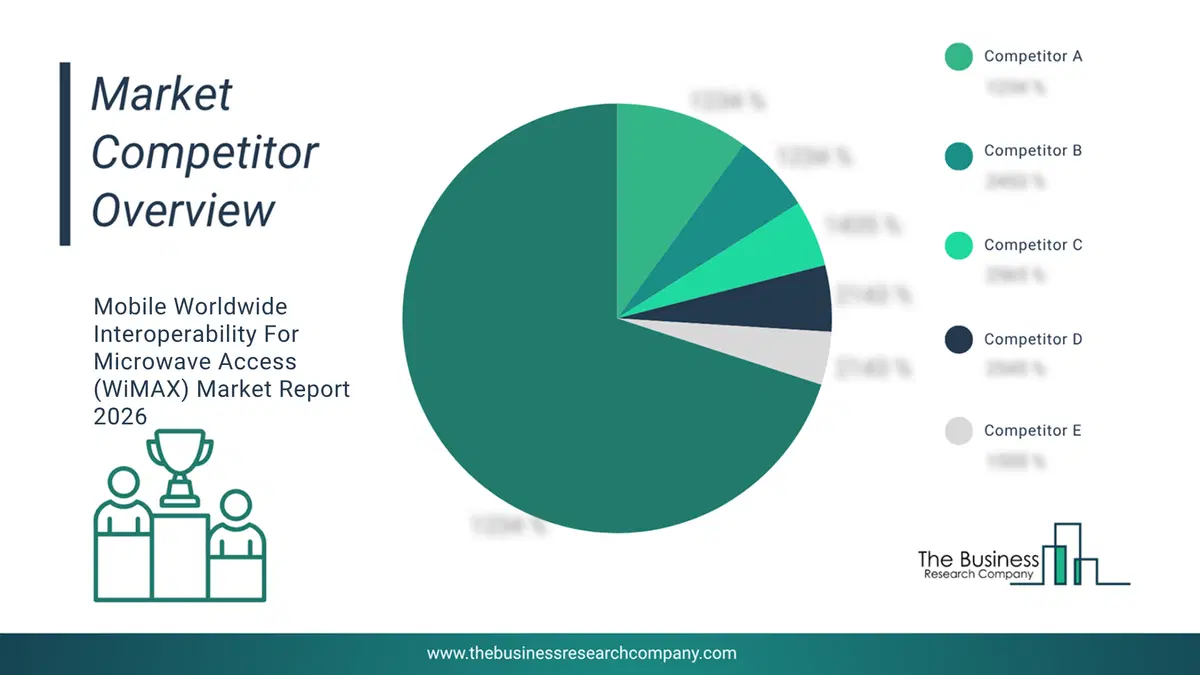
This chart is for illustrative purposes; the full report includes a detailed competitor analysis and comprehensive overview of the top 10 companies in the market.
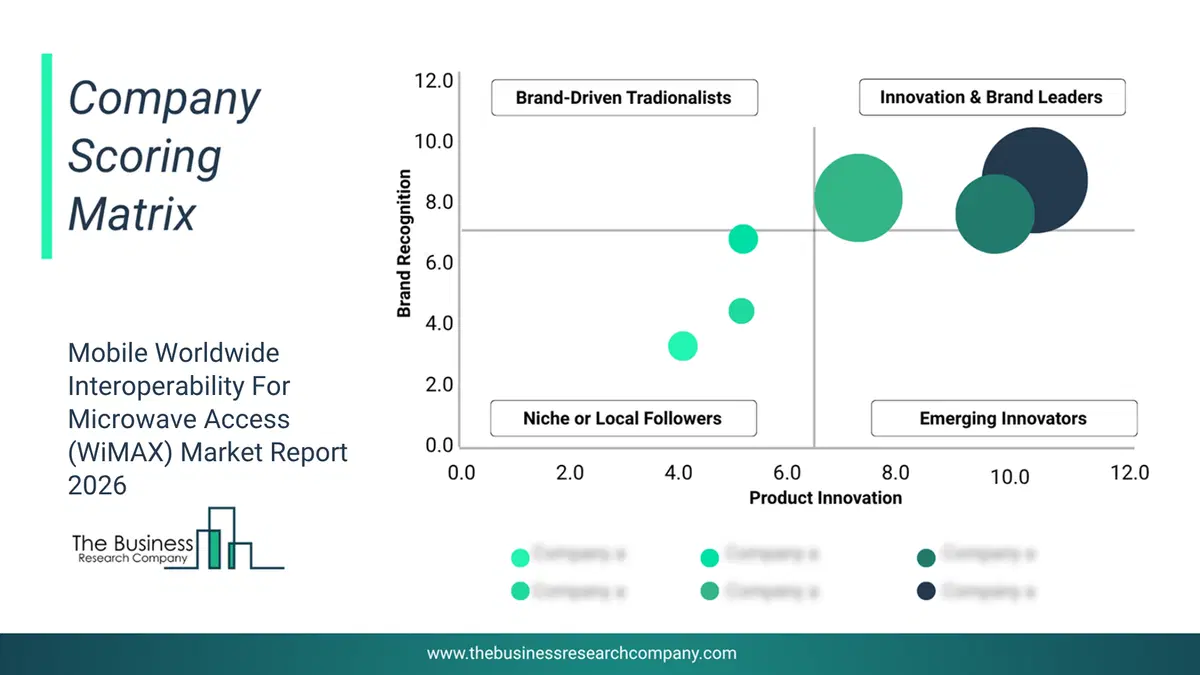
This chart maps companies by product innovation and brand strength, with bubble size indicating relative revenue, helping identify market leaders, challengers, and niche players. This is an illustrative chart; the full report provides a complete and accurate competitive analysis.
Global Mobile Worldwide Interoperability For Microwave Access (WiMAX) Market Trends and Insights
Major companies operating in the mobile worldwide interoperability for microwave access (WiMAX) market are emphasizing the development of advanced solutions through strategic collaborations to enhance network performance, expand coverage, and accelerate the deployment of next-generation wireless connectivity. Strategic collaborations refer to partnerships between technology providers, network operators, and equipment manufacturers aimed at combining their strengths to develop advanced WiMAX solutions and accelerate the deployment of high-speed wireless networks. For instance, in September 2023, ACL Digital, a US-based software company, and Lekha Wireless Solutions Private Limited, an India-based deep-tech company specializing in mobile wireless technology, partnered to deliver advanced 5G wireless system integration solutions targeting telecom operators and enterprises. Lekha Wireless brings expertise in 5G NR, LTE, WiMAX, and software-defined radio, along with strong R&D capabilities for customizing wireless access technologies. ACL Digital contributes its experience in system integration and digital transformation services. Together, they offer end-to-end 5G and 4G RAN network design, deployment, optimization, IoT integration, security, and enterprise platforms.What Are Latest Mergers And Acquisitions In The Mobile Worldwide Interoperability For Microwave Access (WiMAX) Market?
In October 2024, Olin Group, a Spain-based telecommunication company, acquired Fibranet Telecomunicaciones for an estimated $35 million. Through this acquisition, Olin Group aims to expand its capabilities in fiber optic and wireless broadband services and leverage Fibranet’s expertise to strengthen its presence in the Spanish telecommunications market. Fibranet Telecomunicaciones is a Spain-based telecommunications company that offers FTTH fiber optics and WiMAX wireless broadband services.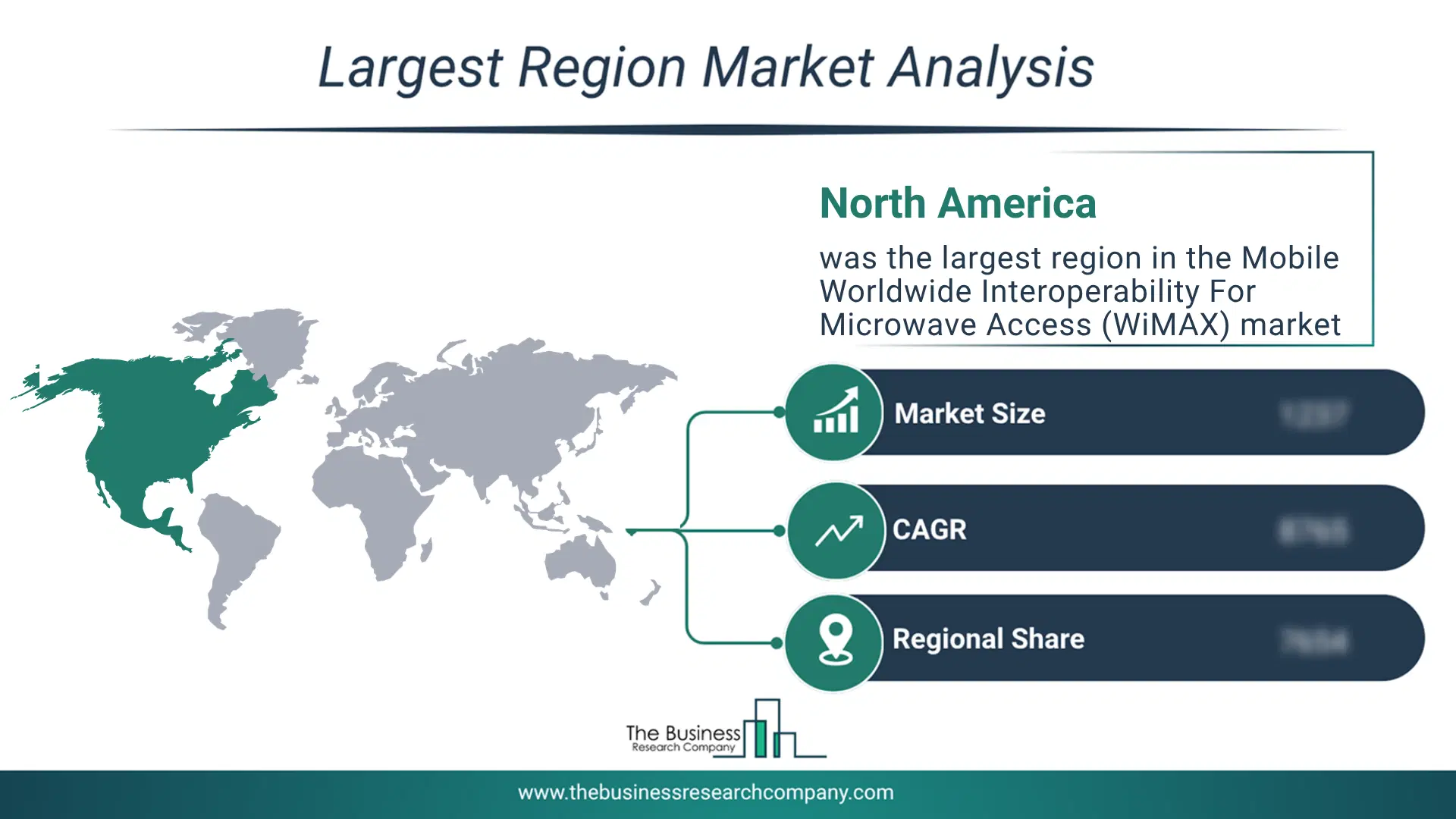
Regional Insights
North America was the largest region in the mobile worldwide interoperability for microwave access (WiMAX) market in 2025. Asia-Pacific is expected to be the fastest-growing region in the forecast period. The regions covered in this market report are Asia-Pacific, South East Asia, Western Europe, Eastern Europe, North America, South America, Middle East, Africa. The countries covered in this market report are Australia, Brazil, China, France, Germany, India, Indonesia, Japan, Taiwan, Russia, South Korea, UK, USA, Canada, Italy, Spain.What Defines the Mobile Worldwide Interoperability For Microwave Access (WiMAX) Market?
The mobile worldwide interoperability for microwave access (WiMAX) market consists of revenues earned by entities by providing services such as high-speed internet access, mobile data services, backhaul connectivity, public safety and emergency services, and video conferencing and streaming. The market value includes the value of related goods sold by the service provider or included within the service offering. The mobile worldwide interoperability for microwave access (WiMAX) market also includes sales of access points and gateways, network antennas, signal repeaters, USB modems, customer premises equipment, and IoT connectivity modules. Values in this market are ‘factory gate’ values, that is the value of goods sold by the manufacturers or creators of the goods, whether to other entities (including downstream manufacturers, wholesalers, distributors and retailers) or directly to end customers. The value of goods in this market includes related services sold by the creators of the goods.How is Market Value Defined and Measured?
The market value is defined as the revenues that enterprises gain from the sale of goods and/or services within the specified market and geography through sales, grants, or donations in terms of the currency (in USD unless otherwise specified). The revenues for a specified geography are consumption values that are revenues generated by organizations in the specified geography within the market, irrespective of where they are produced. It does not include revenues from resales along the supply chain, either further along the supply chain or as part of other products.
This chart presents market attractiveness based on a quantitative evaluation of growth, competition, strategic alignment, and risk, offering a clear view of opportunity areas for decision-making. This chart is for illustrative purposes; the full report contains the complete analysis.

This chart highlights the Total Addressable Market (TAM) by estimating the maximum revenue opportunity using an assumption-driven approach, supporting strategic planning and opportunity sizing across markets. The chart is illustrative; the full report provides a more comprehensive analysis.
What Key Data and Analysis Are Included in the Mobile Worldwide Interoperability For Microwave Access (WiMAX) Market Report 2026?
The mobile worldwide interoperability for microwave access (wimax) market research report is one of a series of new reports from The Business Research Company that provides market statistics, including industry global market size, regional shares, competitors with the market share, detailed market segments, market trends and opportunities, and any further data you may need to thrive in the mobile worldwide interoperability for microwave access (wimax) industry. The market research report delivers a complete perspective of everything you need, with an in-depth analysis of the current and future state of the industry.Mobile Worldwide Interoperability For Microwave Access (WiMAX) Market Report Forecast Analysis
| Report Attribute | Details |
|---|---|
| Market Size Value In 2026 | $4.48 billion |
| Revenue Forecast In 2030 | $6.62 billion |
| Growth Rate | CAGR of 10.2% from 2026 to 2030 |
| Base Year For Estimation | 2025 |
| Actual Estimates/Historical Data | 2020-2025 |
| Forecast Period | 2026 - 2030 |
| Market Representation | Revenue in USD Billion and CAGR from 2026 to 2030 |
| Segments Covered | Device Type, Deployment Type, Technology, Application, End User |
| Regional Scope | Asia-Pacific, Western Europe, Eastern Europe, North America, South America, Middle East, Africa |
| Country Scope | The Countries Covered In This Market Report Are Australia, Brazil, China, France, Germany, India, Indonesia, Japan, Taiwan, Russia, South Korea, Uk, Usa, Canada, Italy, Spain. |
| Key Companies Profiled | Samsung Electronics Co. Ltd., Huawei Technologies Co. Ltd., LG Electronics Inc., Cisco Systems Inc., Intel Corporation, KDDI Corporation, Qualcomm Incorporated, NEC Corporation, ZTE Corporation, Texas Instruments Inc., Analog Devices Inc., Motorola Solutions Inc., YTL Communications Sdn. Bhd., Anritsu Corporation, Zyxel Communications Corporation, Green Packet Berhad, Aviat Networks Inc., EION Inc., UTStarcom Holdings Corp., Mobile Mark Inc. |
| Customization Scope | Request for Customization |
| Pricing And Purchase Options | Explore Purchase Options |