
Multi-Trade Prefabrication Market Report 2026
Global Outlook – By Product Type (Mechanical, Electrical, Plumbing, Structural, Other Product Types), By Construction Method (Volumetric, Panelized, Component, Hybrid), By Application (Residential, Commercial, Industrial, Infrastructure), By End-User (Contractors, Developers, Architects, Other End-Users) – Market Size, Trends, Strategies, and Forecast to 2030
Multi-Trade Prefabrication Market Overview
• Multi-Trade Prefabrication market size has reached to $16.46 billion in 2025 • Expected to grow to $27.54 billion in 2030 at a compound annual growth rate (CAGR) of 10.8% • Growth Driver: Increasing Construction Activities Fueling The Growth Of The Market Due To Rising Urban Development • Market Trend: Centralized Offsite Hubs Accelerate Modular Construction And Boost Productivity • North America was the largest region in 2025 and Asia-Pacific is the fastest growing region.What Is Covered Under Multi-Trade Prefabrication Market?
Multi-trade prefabrication refers to the off-site assembly of building components that integrate multiple construction trades into a single modular unit. These prefabricated systems are designed to be assembled quickly on construction sites, reducing time, labor, and material waste while ensuring consistent quality. The main product types in multi-trade prefabrication include mechanical, electrical, plumbing, structural, and others. Mechanical prefabricated systems are widely adopted due to their ability to streamline complex building services, reduce on-site labor requirements, and improve installation accuracy through off-site manufacturing. Multi-trade prefabrication is executed through construction methods such as volumetric, panelized, component, and hybrid approaches and is applied across residential, commercial, industrial, and infrastructure projects, serving end-users, including contractors, developers, architects, and others.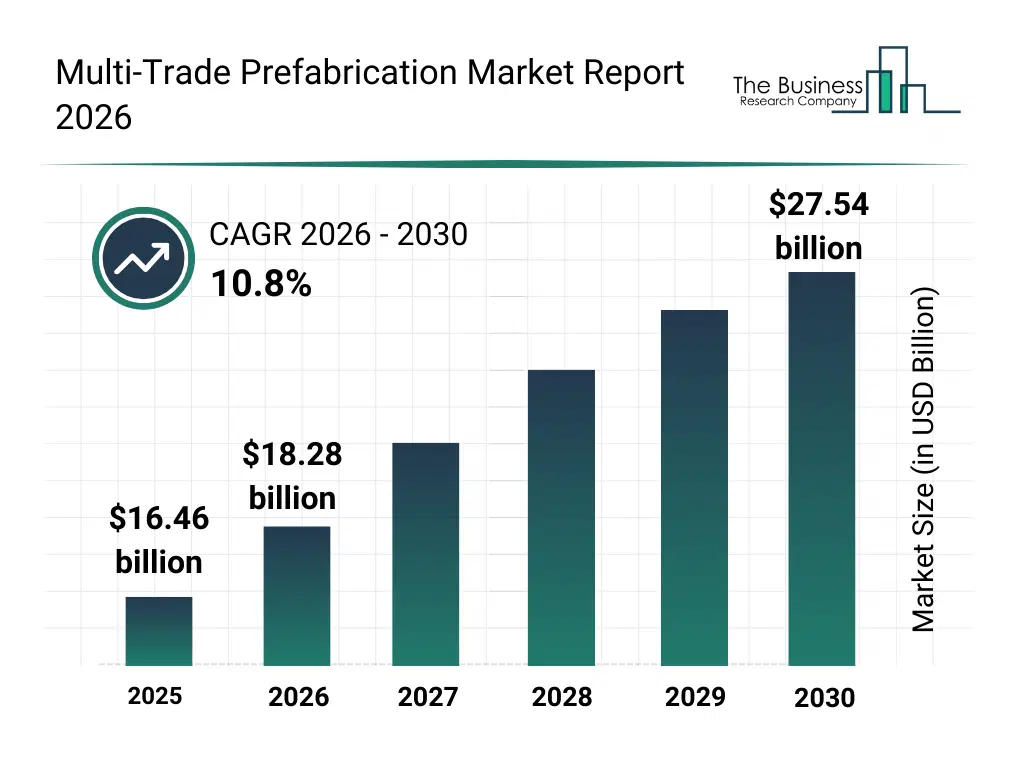
What Is The Multi-Trade Prefabrication Market Size and Share 2026?
The multi-trade prefabrication market size has grown rapidly in recent years. It will grow from $16.46 billion in 2025 to $18.28 billion in 2026 at a compound annual growth rate (CAGR) of 11.1%. The growth in the historic period can be attributed to increasing adoption of modular construction techniques, rising demand for faster building completion, growing preference for cost-efficient construction methods, increasing use of off-site prefabrication for MEP systems, rising urbanization and infrastructure development.What Is The Multi-Trade Prefabrication Market Growth Forecast?
The multi-trade prefabrication market size is expected to see rapid growth in the next few years. It will grow to $27.54 billion in 2030 at a compound annual growth rate (CAGR) of 10.8%. The growth in the forecast period can be attributed to growing investment in large-scale infrastructure projects, increasing demand for integrated multi-trade prefabricated systems, rising adoption of modular construction in emerging economies, growing focus on reducing construction timelines and costs, increasing emphasis on labor-efficient and safe building methods. Major trends in the forecast period include advancement in automated prefabrication and assembly technologies, Innovation in integrated mechanical, electrical, and plumbing (MEP) modules, Integration of digital design and BIM (building information modeling) solutions.
Global Multi-Trade Prefabrication Market Segmentation
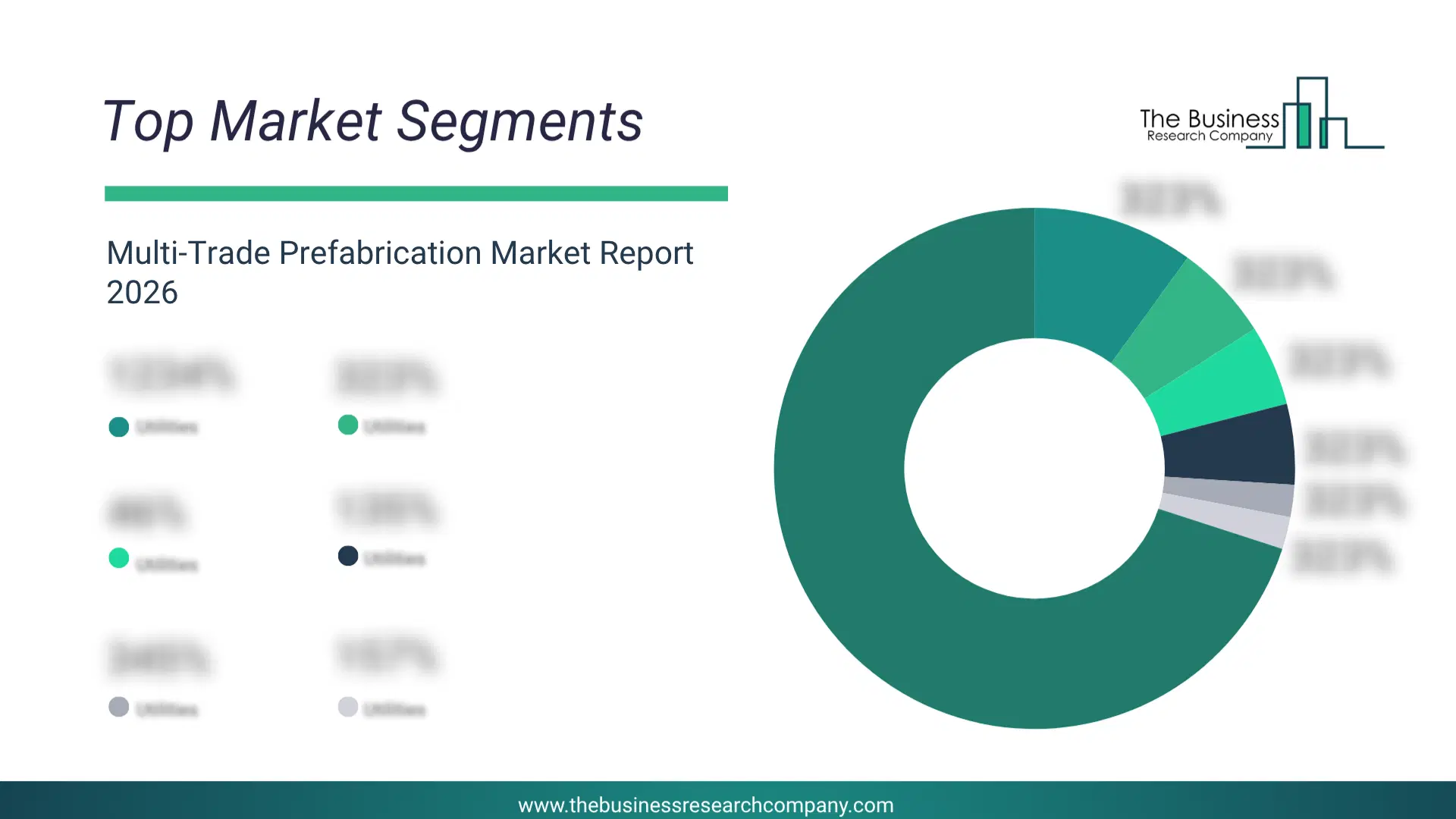
1) By Product Type: Mechanical, Electrical, Plumbing, Structural, Other Product Types 2) By Construction Method: Volumetric, Panelized, Component, Hybrid 3) By Application: Residential, Commercial, Industrial, Infrastructure 4) By End-User: Contractors, Developers, Architects, Other End-Users Subsegments: 1) By Mechanical: Heating, Ventilation, And Air Conditioning (HVAC) Duct Modules, Prefabricated Chiller Or Boiler Skids, Pump And Valve Assemblies, Pre-insulated Piping Systems, Mechanical Equipment Racks, Air-Handling Unit (AHU) Skids, Mechanical Room Modular Packages 2) By Electrical: Prefabricated Electrical Risers, Modular Switchgear Assemblies, Prewired Conduit And Cable Trays, Lighting And Power Distribution Modules, Prefabricated Electrical Panels, Data And Communication Cabling Kits, Modular Control Panels 3) By Plumbing: Bathroom Or Kitchen Plumbing Pods, Preassembled Pipe Racks, Drainage And Vent Modules, Water Supply Manifolds, Sanitary Piping Assemblies, Hot Or Cold Water Piping Skids, Prefabricated Pump Station Units 4) By Structural: Prefabricated Steel Frames, Modular Wall And Floor Panels, Structural Truss Systems, Load-bearing Modular Units, Precast Concrete Structural Components, Modular Structural Shells, Structural Support Beams Or Columns 5) By Other Product Types: Fire Protection Modules, Modular Insulation Panels, Prefabricated Façade Systems, Acoustic Wall Or Ceiling Modules, Modular Elevator Shafts, Prefab Stair Systems, Specialty Modular AssembliesWhat Is The Driver Of The Multi-Trade Prefabrication Market?
The increasing construction activities are expected to propel the growth of the multi-trade prefabrication market going forward. Construction activities refer to the processes involved in building, repairing, or altering structures such as buildings, roads, bridges, and other infrastructure. The rising construction activities are due to urbanization, as increasing population concentration in cities creates a higher demand for residential, commercial, and infrastructure development. Multi-trade prefabrication supports construction activities by streamlining the assembly of building components off-site, making on-site work faster and more efficient. It reduces labor requirements, minimizes errors, and accelerates project timelines, improving overall construction productivity. For instance, in April 2025, according to the United States Census Bureau, a US-based government agency, construction spending reached $2,156,495 million in 2024, an increase from $2,023,662 million in 2023. Therefore, the increasing construction activities are driving the growth of the multi-trade prefabrication industry.Key Players In The Global Multi-Trade Prefabrication Market
Major companies operating in the multi-trade prefabrication market are Sekisui House Ltd., Kiewit Corporation, Bouygues Bâtiment International, Lendlease Group, Clayton Homes Inc., ATCO Structures And Logistics, Champion Home Builders Inc., NRB Inc., Red Sea International Company, Fleetwood Australia Pty Ltd., McAvoy Group Ltd., Skender Manufacturing, CIMC Modular Building Systems Co.Ltd., Algeco Scotsman Inc., Legal & General Modular Homes Ltd., Blokable Inc., Katerra Inc., Larsen & Toubro Limited, Prefab Logic Inc., Modular Space Corporation
This chart is for illustrative purposes; the full report includes a detailed competitor analysis and comprehensive overview of the top 10 companies in the market.
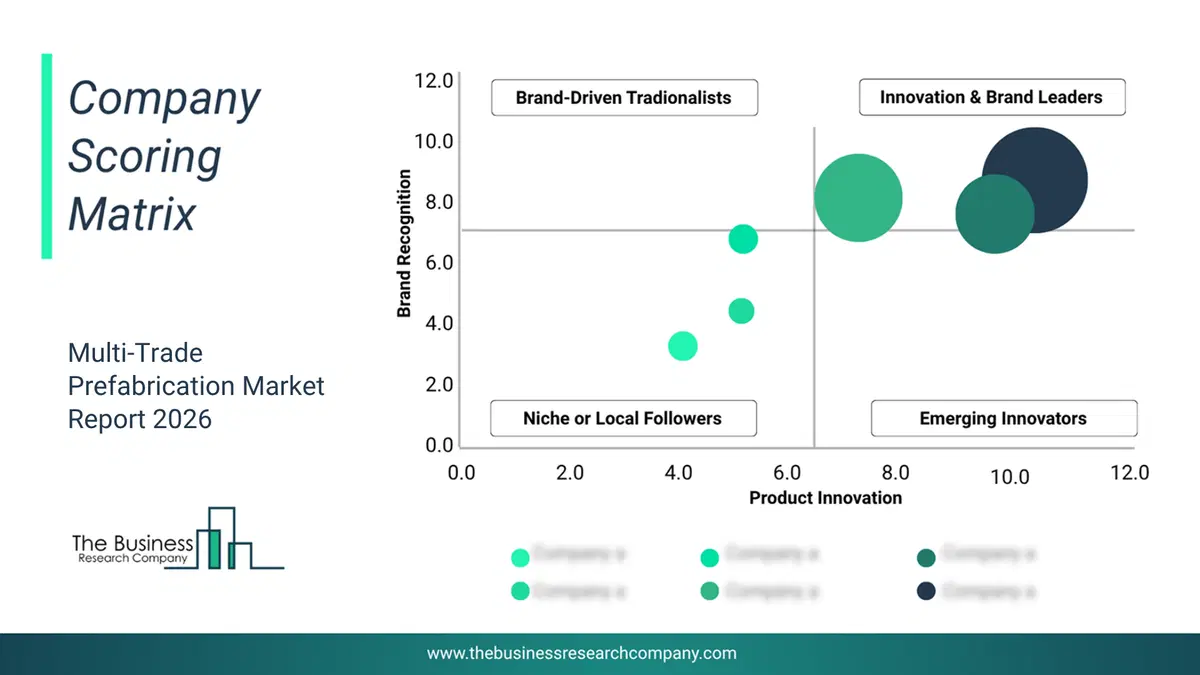
This chart maps companies by product innovation and brand strength, with bubble size indicating relative revenue, helping identify market leaders, challengers, and niche players. This is an illustrative chart; the full report provides a complete and accurate competitive analysis.
Global Multi-Trade Prefabrication Market Trends and Insights
Major companies operating in the multi-trade prefabrication market are focusing on infrastructural advancement, such as centralized offsite manufacturing hubs, to improve project productivity, reduce onsite congestion, and support large-scale modular construction delivery. Centralized offsite manufacturing hubs refer to dedicated facilities where building components are prefabricated or assembled away from the construction site in a controlled environment. For instance, in May 2025, the Hong Kong Development Bureau (DEVB), a Hong Kong-based government infrastructure authority, opened an Expression of Interest (EOI) process for a new Advanced Construction Industry Building (ACIB). The ACIB will provide 30,000–60,000 square metres of fabrication space, dedicated areas for rebar prefabrication and MiMEP processing, 10,000 square metres of outdoor material-handling yard, and a 30-year Build-Operate-Transfer model for development and operation. This initiative strengthens Hong Kong’s capacity for modular integrated construction, addresses labour and cost pressures, and supports faster, safer, and more scalable delivery of future housing and infrastructure projects.What Are Latest Mergers And Acquisitions In The Multi-Trade Prefabrication Market?
In December 2024, Nordic Environment Finance Corporation (NEFCO), a U.S.-based value-added supply partner serving specialty construction trades, acquired Unistrut Midwest LLC for an undisclosed amount. With this acquisition, NEFCO aims to significantly expand its modular steel support, prefabrication, and engineering capabilities, strengthening its SHARP portfolio for mechanical, electrical, and plumbing (MEP) contractors across high-growth sectors such as data centers, semiconductor plants, EV/battery manufacturing, and healthcare infrastructure. Unistrut Midwest LLC is a US-based company providing multi-trade prefabrication solutions, offering engineered support systems and modular assemblies.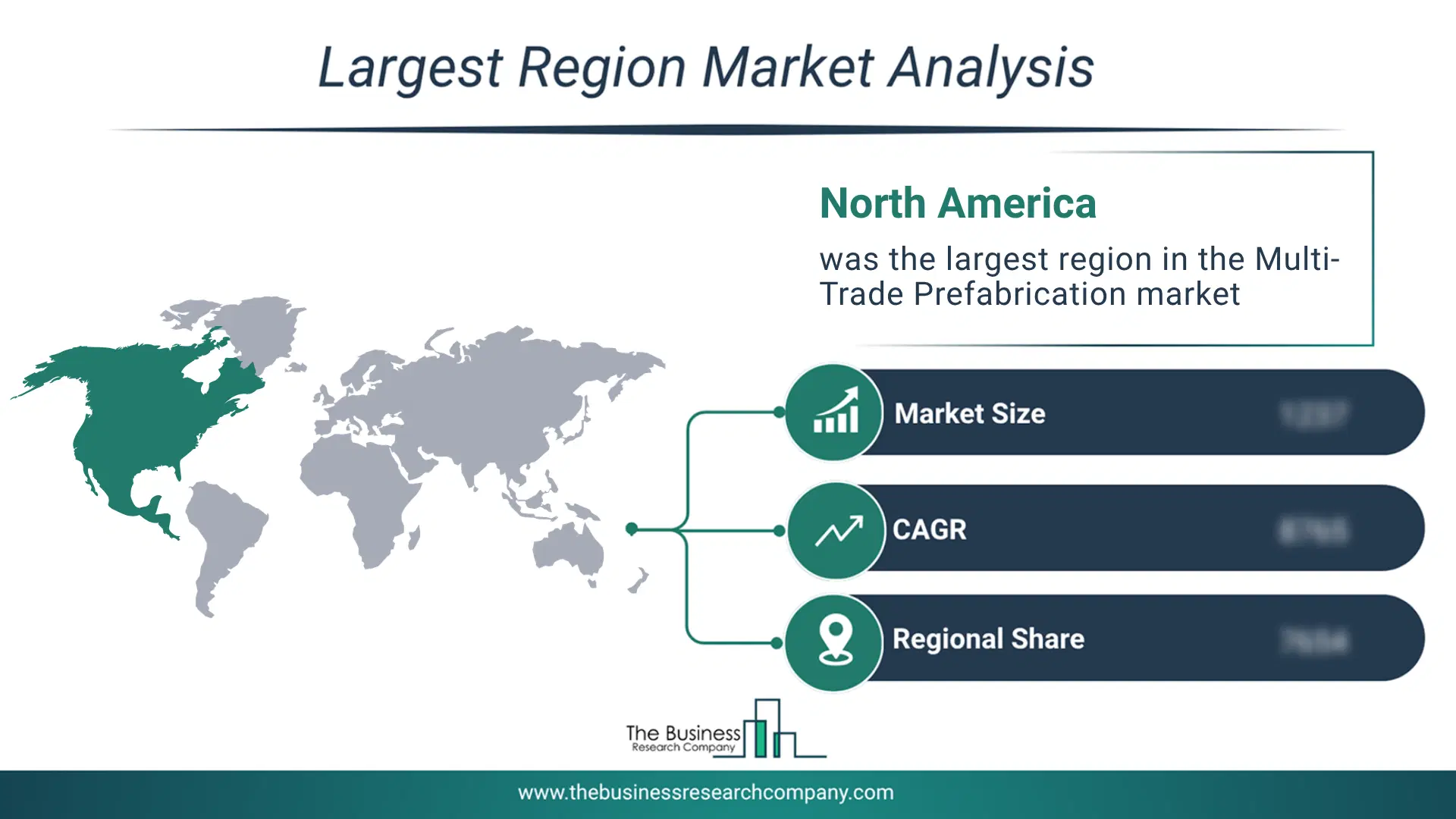
Regional Insights
North America was the largest region in the multi-trade prefabrication market in 2025. Asia-Pacific is expected to be the fastest-growing region in the forecast period. The regions covered in this market report are Asia-Pacific, South East Asia, Western Europe, Eastern Europe, North America, South America, Middle East, Africa. The countries covered in this market report are Australia, Brazil, China, France, Germany, India, Indonesia, Japan, Taiwan, Russia, South Korea, UK, USA, Canada, Italy, Spain.What Defines the Multi-Trade Prefabrication Market?
The multi-trade prefabrication market includes sales of prefabricated building modules, integrated mechanical, electrical, and plumbing (MEP) systems, structural components, modular walls and panels, utility pods, piping assemblies, heating, ventilation, and air conditioning (HVAC) modules, and electrical assemblies. Values in this market are ‘factory gate’ values, that is, the value of goods sold by the manufacturers or creators of the goods, whether to other entities (including downstream manufacturers, wholesalers, distributors, and retailers) or directly to end customers. The value of goods in this market includes related services sold by the creators of the goods.How is Market Value Defined and Measured?
The market value is defined as the revenues that enterprises gain from the sale of goods and/or services within the specified market and geography through sales, grants, or donations in terms of the currency (in USD unless otherwise specified). The revenues for a specified geography are consumption values that are revenues generated by organizations in the specified geography within the market, irrespective of where they are produced. It does not include revenues from resales along the supply chain, either further along the supply chain or as part of other products.
This chart presents market attractiveness based on a quantitative evaluation of growth, competition, strategic alignment, and risk, offering a clear view of opportunity areas for decision-making. This chart is for illustrative purposes; the full report contains the complete analysis.

This chart highlights the Total Addressable Market (TAM) by estimating the maximum revenue opportunity using an assumption-driven approach, supporting strategic planning and opportunity sizing across markets. The chart is illustrative; the full report provides a more comprehensive analysis.
What Key Data and Analysis Are Included in the Multi-Trade Prefabrication Market Report 2026?
The multi-trade prefabrication market research report is one of a series of new reports from The Business Research Company that provides market statistics, including industry global market size, regional shares, competitors with the market share, detailed market segments, market trends and opportunities, and any further data you may need to thrive in the multi-trade prefabrication industry. The market research report delivers a complete perspective of everything you need, with an in-depth analysis of the current and future state of the industry.Multi-Trade Prefabrication Market Report Forecast Analysis
| Report Attribute | Details |
|---|---|
| Market Size Value In 2026 | $18.28 billion |
| Revenue Forecast In 2030 | $27.54 billion |
| Growth Rate | CAGR of 11.1% from 2026 to 2030 |
| Base Year For Estimation | 2025 |
| Actual Estimates/Historical Data | 2020-2025 |
| Forecast Period | 2026 - 2030 |
| Market Representation | Revenue in USD Billion and CAGR from 2026 to 2030 |
| Segments Covered | Product Type, Construction Method, Application, End-User |
| Regional Scope | Asia-Pacific, Western Europe, Eastern Europe, North America, South America, Middle East, Africa |
| Country Scope | The countries covered in this market report are Australia, Brazil, China, France, Germany, India, Indonesia, Japan, Taiwan, Russia, South Korea, UK, USA, Canada, Italy, Spain |
| Key Companies Profiled | Sekisui House Ltd., Kiewit Corporation, Bouygues Bâtiment International, Lendlease Group, Clayton Homes Inc., ATCO Structures And Logistics, Champion Home Builders Inc., NRB Inc., Red Sea International Company, Fleetwood Australia Pty Ltd., McAvoy Group Ltd., Skender Manufacturing, CIMC Modular Building Systems Co.Ltd., Algeco Scotsman Inc., Legal & General Modular Homes Ltd., Blokable Inc., Katerra Inc., Larsen & Toubro Limited, Prefab Logic Inc., Modular Space Corporation |
| Customization Scope | Request for Customization |
| Pricing And Purchase Options | Explore Purchase Options |