

Nerve Repair Biomaterials Market Report 2026
Global Outlook – By Product Type (Nerve Conduits, Nerve Wraps, Nerve Guides, Nerve Plates, Nerve Grafts), By Material Type (Natural Biomaterials, Synthetic Biomaterials, Composite Biomaterials), By Application (Peripheral Nerve Repair, Central Nerve Repair, Spinal Cord Injury Repair, Facial Nerve Repair), By End User (Hospitals, Specialty Clinics, Ambulatory Surgical Centers, Research Laboratories) – Market Size, Trends, Strategies, and Forecast to 2035
Nerve Repair Biomaterials Market Overview
• Nerve Repair Biomaterials market size has reached to $2.27 billion in 2025 • Expected to grow to $4.71 billion in 2030 at a compound annual growth rate (CAGR) of 15.8% • Growth Driver: Rising Incidence of Traumatic Brain Injuries Driving The Market Growth Due To Increasing Demand for Advanced Neural Repair Solutions • Market Trend: Advancements In Nerve Protection Platforms Enhancing Peripheral Nerve Regeneration • North America was the largest region in 2025 and Asia-Pacific is the fastest growing region.What Is Covered Under Nerve Repair Biomaterials Market?
Nerve repair biomaterials are natural or synthetic materials designed to support the regeneration and recovery of damaged nerves. They act as scaffolds to guide nerve growth, protect tissues, and promote cell interaction, helping restore nerve function and improve healing outcomes. The main product types of nerve repair biomaterials include nerve conduits, nerve wraps, nerve guides, nerve plates, and nerve grafts. Nerve conduits are tubular structures used to bridge nerve gaps and support axonal regeneration. The various material types include natural biomaterials, synthetic biomaterials, and composite biomaterials. They find application in peripheral nerve repair, central nerve repair, spinal cord injury repair, and facial nerve repair, serving end users including hospitals, specialty clinics, ambulatory surgical centers, and research laboratories.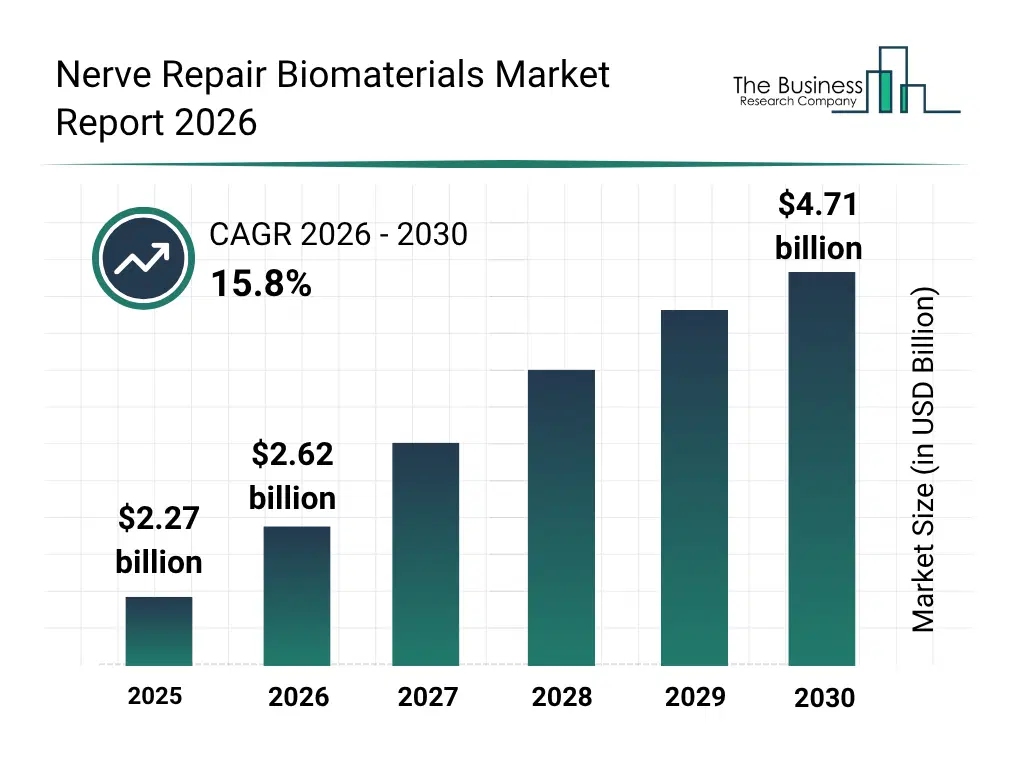
What Is The Nerve Repair Biomaterials Market Size and Share 2026?
The nerve repair biomaterials market size has grown rapidly in recent years.It will grow from $2.27 billion in 2025 to $2.62 billion in 2026 at a compound annual growth rate (CAGR) of 15.6%. The growth in the historic period can be attributed to limited effectiveness of autograft nerve repair techniques, high incidence of traumatic nerve injuries, lack of advanced biomaterial scaffolds for nerve regeneration, slow clinical translation of experimental nerve repair solutions, high complication rates in traditional nerve graft procedures.What Is The Nerve Repair Biomaterials Market Growth Forecast?
The nerve repair biomaterials market size is expected to see rapid growth in the next few years.It will grow to $4.71 billion by 2030 at a compound annual growth rate (CAGR) of 15.8%. The growth in the forecast period can be attributed to advancements in regenerative medicine and tissue engineering, rising demand for minimally invasive nerve repair procedures, increasing adoption of bioengineered and personalized implants, expansion of clinical trials for next-generation nerve conduits, growing integration of smart biomaterials with bioactive molecules.Major trends in the forecast period include electrospun nanofiber scaffold structures enabling guided axonal regeneration, bioresorbable polymer-based nerve conduits with controlled degradation profiles, hydrogel-based nerve guidance matrices enhancing cellular migration and repair, growth factor-embedded biomaterial systems for accelerated nerve healing, stem cell-seeded bioengineered nerve graft scaffolds for functional recovery.
Global Nerve Repair Biomaterials Market Segmentation
1) By Product Type: Nerve Conduits, Nerve Wraps, Nerve Guides, Nerve Plates, Nerve Grafts 2) By Material Type: Natural Biomaterials, Synthetic Biomaterials, Composite Biomaterials 3) By Application: Peripheral Nerve Repair, Central Nerve Repair, Spinal Cord Injury Repair, Facial Nerve Repair 4) By End User: Hospitals, Specialty Clinics, Ambulatory Surgical Centers, Research Laboratories Subsegments: 1) By Nerve Conduits: Natural Biomaterial Based Nerve Conduits, Synthetic Biomaterial Based Nerve Conduits, Hybrid Biomaterial Based Nerve Conduits 2) By Nerve Wraps: Collagen Based Nerve Wraps, Synthetic Polymer Based Nerve Wraps, Amniotic Membrane Based Nerve Wraps 3) By Nerve Guides: Biodegradable Nerve Guides, Non Biodegradable Nerve Guides, Electrospun Fiber Based Nerve Guides 4) By Nerve Plates: Resorbable Nerve Plates, Non Resorbable Nerve Plates, Polymer Based Nerve Plates 5) By Nerve Grafts: Autograft Nerve Grafts, Allograft Nerve Grafts, Xenograft Nerve Grafts, Synthetic Nerve GraftsWhat Are The Drivers Of The Nerve Repair Biomaterials Market?
The rising incidence of traumatic brain injuries is expected to propel the growth of the nerve repair biomaterials industry going forward.Traumatic brain injuries (TBIs) are a form of acquired brain damage caused by an external mechanical force that disrupts normal brain function.The growing prevalence of TBIs is largely driven by the aging global population, as older adults are significantly more susceptible to falls, which are the leading cause of TBI, leading to a steady increase in injury-related hospitalizations and deaths across developed nations.The rising incidence of TBIs increases the need for advanced nerve repair biomaterial capable of facilitating nerve regeneration, bridging damaged neural tissue, and restoring functional connectivity in injured patients.For instance, in September 2025, according to the South Dakota Department of Health, a US-based government health agency, TBI-related deaths in the state rose from 241 in 2023 to 267 in 2024, reflecting an 11% increase.Therefore, the rising incidence of traumatic brain injuries is driving the growth of the nerve repair biomaterials industry. The growing preference for minimally invasive surgical procedures is expected to propel the growth of the nerve repair biomaterials industry going forward.Minimally invasive surgical procedures are techniques that allow surgeons to operate through small incisions or natural body openings, causing less trauma to surrounding tissues compared to traditional open surgery.The rising adoption of minimally invasive surgical procedures is primarily driven by advancements in surgical robotics and imaging technologies, which have expanded the range of complex operations that can be performed with greater precision and minimal tissue disruption.This growing preference for minimally invasive surgery directly increases the demand for nerve repair biomaterials capable of supporting delicate nerve repair in confined surgical spaces, as surgeons require materials that are compatible with less invasive approaches.For instance, in April 2025, according to the British Association of Aesthetic Plastic Surgeons, a UK-based surgical organization, between 2023 and 2024, cosmetic surgical procedures increased by 5%, reaching a total of 27,462 procedures performed in 2024.Therefore, the growing preference for minimally invasive surgical procedures is driving the growth of the nerve repair biomaterials industry.Key Players In The Global Nerve Repair Biomaterials Market
Major companies operating in the nerve repair biomaterials market are Medtronic plc, Stryker Corporation, Boston Scientific Corporation, Baxter International Inc., B. Braun SE, Toyobo Co. Ltd., Integra LifeSciences Holdings Corporation, Taibang Biologic Group Co. Ltd., Axogen Inc., PolyNovo Limited, Tissium SA, Checkpoint Surgical Inc., Synapse Biomedical Inc., Collagen Matrix Inc., BioCircuit Technologies Inc., Orthocell Limited, Alafair Biosciences Inc., Regenity AG, Neurotex Ltd, NeuroSigma Inc., TissueGen Inc.Global Nerve Repair Biomaterials Market Trends and Insights
Major companies operating in the nerve repair biomaterials market are focusing on developing advanced products such as nerve protection platforms to improve axonal regeneration, minimize tissue adhesion, and enhance functional recovery after peripheral nerve injuries. A nerve protection platform encompasses technologies or therapies designed to preserve nerve function, prevent damage, and support recovery through protective, regenerative, or advanced delivery approaches. For instance, in September 2023, Axogen, Inc., a US-based peripheral nerve repair company, launched Axoguard HA+ Nerve Protector, a porcine submucosa extracellular matrix-based nerve wrap coated with a proprietary hyaluronate-alginate gel. The nerve protection platform facilitates enhanced nerve gliding to reduce soft tissue attachments, provides long-term structural protection by remodeling into a stable tissue layer, and offers optimized handling for surgeons treating complex nerve injuries near high-mobility joints, expanding clinical options for peripheral nerve protection and regeneration.Regional Insights
North America was the largest region in the nerve repair biomaterials market in 2025. Asia-Pacific is expected to be the fastest-growing region in the forecast period. The regions covered in this market report are Asia-Pacific, South East Asia, Western Europe, Eastern Europe, North America, South America, Middle East and Africa. The countries covered in this market report are Australia, Brazil, China, France, Germany, India, Indonesia, Japan, Taiwan, Russia, South Korea, UK, USA, Canada, Italy, Spain.What Defines the Nerve Repair Biomaterials Market?
The nerve repair biomaterials market consists of sales of nerve connectors, nerve protectors, nerve cuffs, and nerve patches. Values in this market are ‘factory gate’ values, that is, the value of goods sold by the manufacturers or creators of the goods, whether to other entities (including downstream manufacturers, wholesalers, distributors, and retailers) or directly to end customers. The value of goods in this market includes related services sold by the creators of the goods.What is the Market Assessment and Strategic Outlook for the Nerve Repair Biomaterials Industry?
The nerve repair biomaterials market research report is one of a series of new reports from The Business Research Company that provides market statistics, including industry global market size, regional shares, competitors with the market share, detailed market segments, market trends and opportunities, and any further data you may need to thrive in the nerve repair biomaterials industry. The market research report delivers a complete perspective of everything you need, with an in-depth analysis of the current and future state of the industry.What is the Market Assessment and Strategic Outlook for the Nerve Repair Biomaterials Market Report 2026?
The nerve repair biomaterials market research report is one of a series of new reports from The Business Research Company that provides nerve repair biomaterials market statistics, including nerve repair biomaterials industry global market size, regional shares, competitors with a nerve repair biomaterials market share, detailed nerve repair biomaterials market segments, market trends and opportunities, and any further data you may need to thrive in the nerve repair biomaterials industry. This nerve repair biomaterials market research report delivers a complete perspective of everything you need, with an in-depth analysis of the current and future scenario of the industry.Nerve Repair Biomaterials Market Report Forecast Analysis
| Report Attribute | Details |
|---|---|
| Market Size Value In 2026 | $2.62 billion |
| Revenue Forecast In 2035 | $4.71 billion |
| Growth Rate | CAGR of 15.8% from 2026 to 2035 |
| Base Year For Estimation | 2025 |
| Actual Estimates/Historical Data | 2020-2025 |
| Forecast Period | 2026 - 2030 - 2035 |
| Market Representation | Revenue in USD Billion and CAGR from 2026 to 2035 |
| Segments Covered | Product Type, Material Type, Application, End User |
| Regional Scope | Asia-Pacific, Western Europe, Eastern Europe, North America, South America, Middle East, Africa |
| Country Scope | The countries covered in the report are Australia, Brazil, China, France, Germany, India, Indonesia, Japan, Taiwan, Russia, South Korea, UK, USA, Canada, Italy, Spain. |
| Key Companies Profiled | Medtronic plc, Stryker Corporation, Boston Scientific Corporation, Baxter International Inc., B. Braun SE, Toyobo Co. Ltd., Integra LifeSciences Holdings Corporation, Taibang Biologic Group Co. Ltd., Axogen Inc., PolyNovo Limited, Tissium SA, Checkpoint Surgical Inc., Synapse Biomedical Inc., Collagen Matrix Inc., BioCircuit Technologies Inc., Orthocell Limited, Alafair Biosciences Inc., Regenity AG, Neurotex Ltd, NeuroSigma Inc., TissueGen Inc. |
| Customization Scope | Request for Customization |
| Pricing And Purchase Options | Explore Purchase Options |