
Net-Zero Energy Buildings Market Report 2026
Global Outlook – By Equipment (Lighting, Walls And Roofs, Heating, Ventilation, And Air Conditioning (HVAC) Systems, Other Equipment), By Service (Software, Consulting And Designing), By Construction Phase (New Construction, Renovation Or Retrofit, Hybrid Approach), By Technology Integration (Passive Design Strategies, Energy-Efficient Systems, Renewable Energy Sources), By End-User (Residential, Non-Residential) – Market Size, Trends, Strategies, and Forecast to 2030
Net-Zero Energy Buildings Market Overview
• Net-Zero Energy Buildings market size has reached to $44.47 billion in 2025 • Expected to grow to $103.16 billion in 2030 at a compound annual growth rate (CAGR) of 18.3% • Growth Driver: Boost In Renewable Energy Adoption To Accelerate Growth In Net-Zero Energy Buildings Market • Market Trend: Adoption Of Portfolio-Wide Digital Building Performance Platforms To Enhance Energy Efficiency And Transparency • North America was the largest region and fastest growing region.What Is Covered Under Net-Zero Energy Buildings Market?
A net-zero energy building (NZEB) is a building that produces as much energy as it consumes on an annual basis. This balance is achieved through energy efficiency and renewable energy sources, such as solar panels or wind turbines. A net-zero energy building aims to reduce greenhouse gas emissions and reliance on non-renewable energy, contributing to sustainable building practices. The main equipment types of net-zero energy buildings are lighting, walls and roofs, heating, ventilation, and air conditioning (HVAC) systems, and others. Lighting refers to the use of artificial light sources to illuminate spaces, enhancing visibility and creating ambiance. The various services include software, consulting, and designing with various construction phases such as new construction, renovation or retrofit, and hybrid approach. The various technology integrations include passive design strategies, energy-efficient systems, and renewable energy sources. These are used by various end-users such as residential, and non-residential.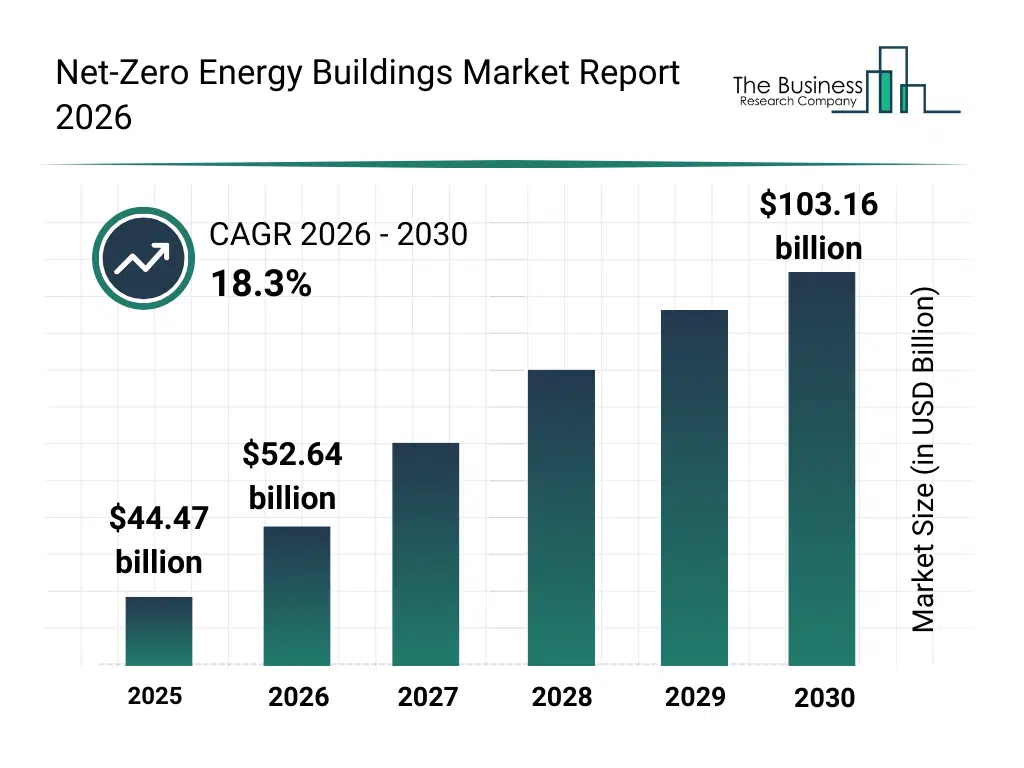
What Is The Net-Zero Energy Buildings Market Size and Share 2026?
The net-zero energy buildings market size has grown rapidly in recent years. It will grow from $44.47 billion in 2025 to $52.64 billion in 2026 at a compound annual growth rate (CAGR) of 18.4%. The growth in the historic period can be attributed to growth in sustainable construction adoption, early integration of renewable systems, rising building efficiency requirements, expansion of green certification programs, increasing demand for energy-resilient buildings.What Is The Net-Zero Energy Buildings Market Growth Forecast?
The net-zero energy buildings market size is expected to see rapid growth in the next few years. It will grow to $103.16 billion in 2030 at a compound annual growth rate (CAGR) of 18.3%. The growth in the forecast period can be attributed to increased deployment of renewable-powered buildings, expansion of smart building ecosystems, rising adoption of net-zero design mandates, growth in energy storage integration, increased investment in high-efficiency building materials. Major trends in the forecast period include increased adoption of Energy-Efficient Building systems, integration of smart energy monitoring tools, rise in AI-driven building optimization, expansion of IOT-connected renewable systems, growth in digital design and modeling.
Global Net-Zero Energy Buildings Market Segmentation
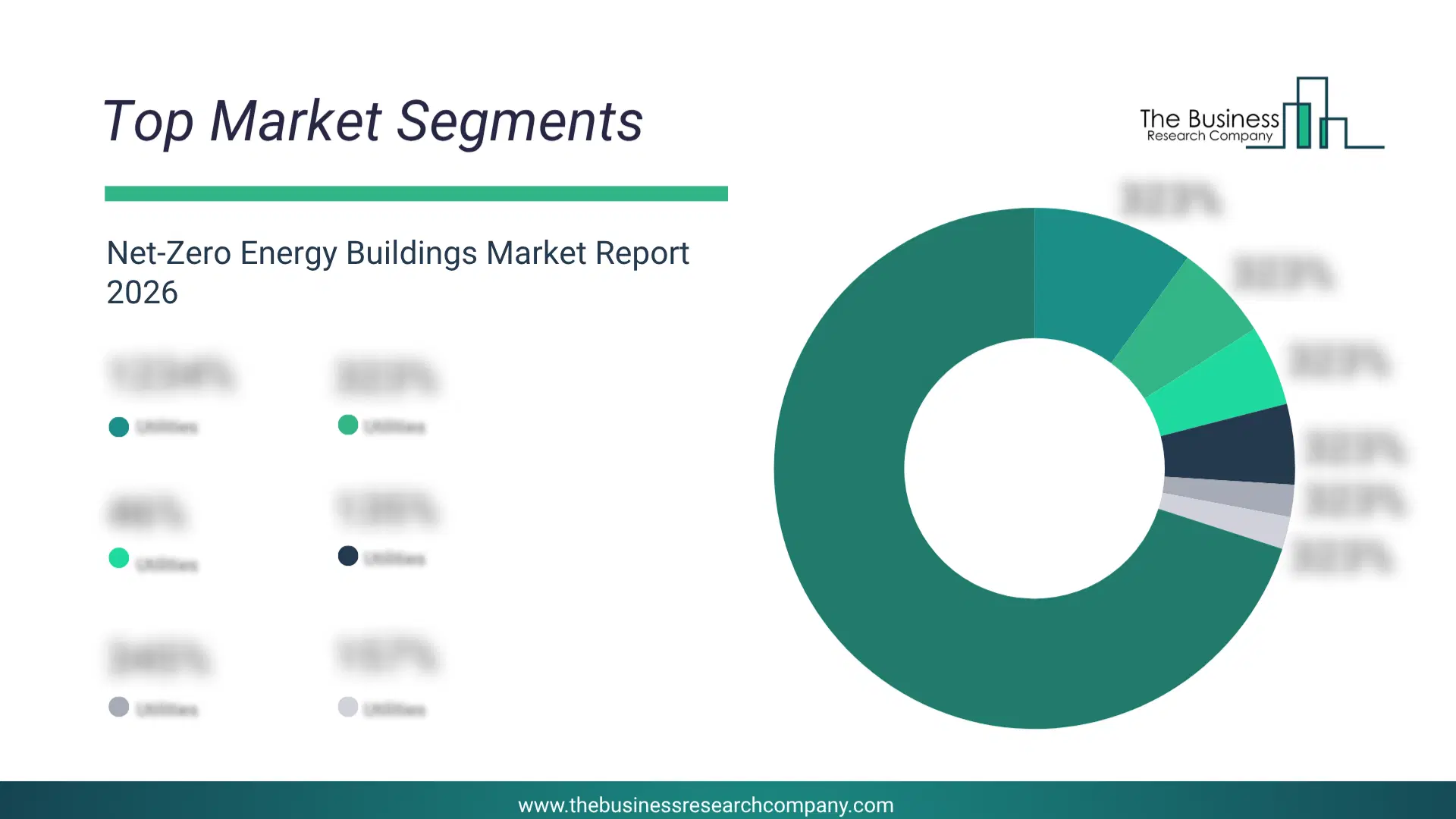
1) By Equipment: Lighting, Walls And Roofs, Heating, Ventilation, And Air Conditioning (HVAC) Systems, Other Equipment 2) By Service: Software, Consulting And Designing 3) By Construction Phase: New Construction, Renovation Or Retrofit, Hybrid Approach 4) By Technology Integration: Passive Design Strategies, Energy-Efficient Systems, Renewable Energy Sources 5) By End-User: Residential, Non-Residential Subsegments: 1) By Lighting: LED Lighting, Smart Lighting Systems, Daylighting Systems 2) By Walls And Roofs: Insulated Walls, Green Roofs, Solar Roof Panels 3) By Heating, Ventilation, And Air Conditioning (HVAC) Systems: Energy-Efficient HVAC Units, Heat Pumps, Ventilation Systems With Energy Recovery 4) By Other Equipment: Renewable Energy Systems, Energy Storage Systems, Smart Building Management SystemsWhat Is The Driver Of The Net-Zero Energy Buildings Market?
The increase in the demand for renewable energy sources is expected to propel the growth of the net-zero energy buildings market going forward. Renewable energy sources, such as solar, wind, and hydropower, can be replenished naturally over time. The demand for renewable energy sources increases due to social contagion, decentralized energy generation, corporate commitments, public health awareness, and climate change mitigation. Net-zero energy buildings minimize energy consumption through efficient design and construction by generating on-site renewable energy to offset their energy needs. These buildings set a benchmark for energy efficiency and environmental stewardship, making them pivotal in transitioning to a more sustainable future. For instance, in 2022, according to a report published by the Department of Energy, a US-based government organization, domestic solar energy generation is projected to rise by 75% from 163 billion kilowatt-hours (kWh) in 2023 to 286 billion kWh in 2025. Therefore, the increase in the adoption of renewable energy sources drives the net-zero energy buildings industry.Key Players In The Global Net-Zero Energy Buildings Market
Major companies operating in the net-zero energy buildings market are Hitachi Ltd., Siemens AG, General Electric Company, Panasonic Corporation, Schneider Electric SE, Mitsubishi Electric Corporation, Honeywell International Inc., Deutsche Bank AG, Daikin Industries Ltd., Johnson Controls Inc., Carrier Global Corporation, Trane Technologies PLC, Skanska AB, Mahindra Group, Kingspan Group PLC, Lendlease Corp, Rockwool Group, CannonDesign Inc., Integral Group Inc., GI Quo Vadis Inc.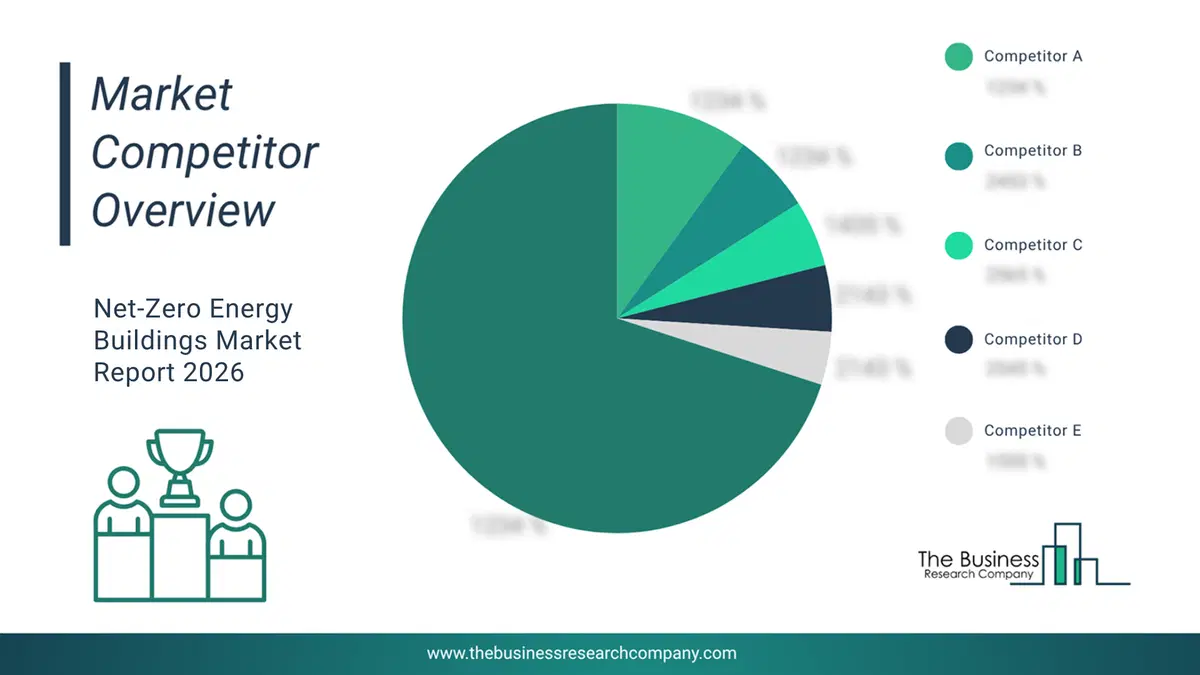
This chart is for illustrative purposes; the full report includes a detailed competitor analysis and comprehensive overview of the top 10 companies in the market.
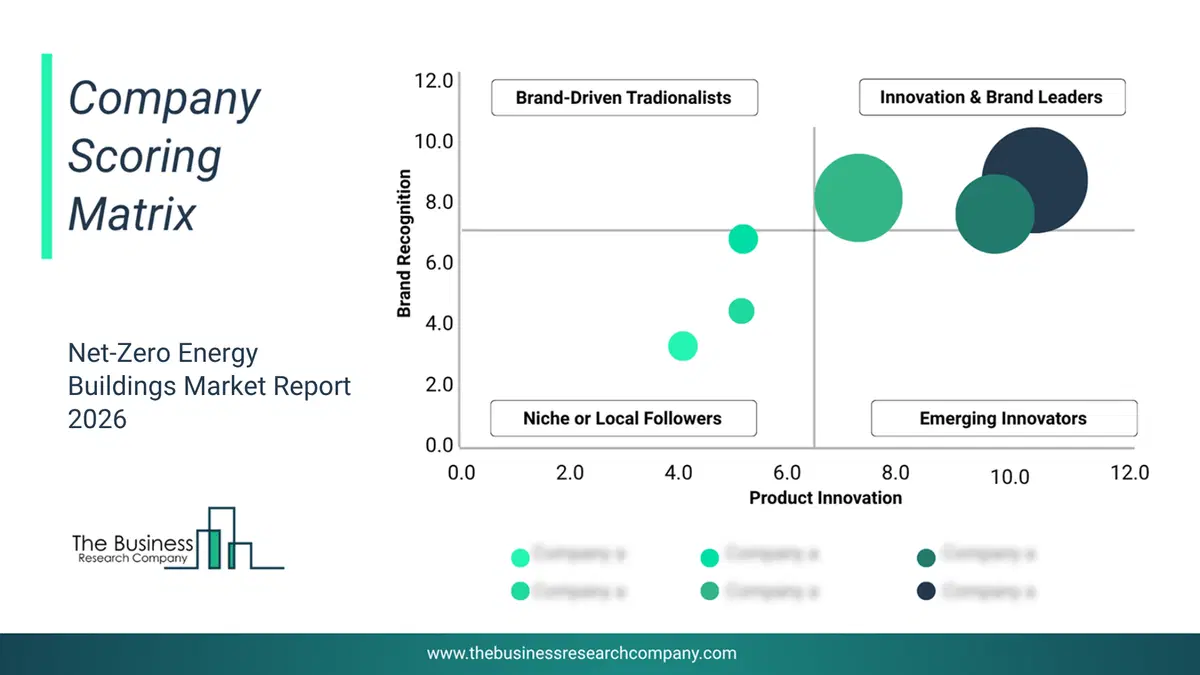
This chart maps companies by product innovation and brand strength, with bubble size indicating relative revenue, helping identify market leaders, challengers, and niche players. This is an illustrative chart; the full report provides a complete and accurate competitive analysis.
Global Net-Zero Energy Buildings Market Trends and Insights
Major companies operating in the net-zero energy buildings market are focusing on developing innovative solutions, such as portfolio-wide digital building performance platforms, to meet the rising demand for real-time operational transparency, energy & carbon emissions tracking, and scalable asset-level optimization. A portfolio-wide digital building performance platform is a cloud-based software system that aggregates data from across multiple buildings to provide a unified “single pane of glass” view of performance—in contrast to traditional building management systems, which typically focus on a single building or siloed systems and lack full integration of IT, OT, energy, water, and emissions data. For instance, in March 2025, Siemens AG, a Germany-based technology company, launched “Building X Portfolio Manager,” a global SaaS offering that unifies real estate, energy, sustainability, and operational data across multi-site portfolios. The product is built as a modular, serverless cloud application that integrates IT/OT data, real-time analytics, and AI-driven insights; it offers configurable dashboards for C-level sustainability managers and facility operators; it supports emissions reporting, benchmarking, and audit-ready workflows; it can be applied across offices, hospitals, airports, malls, and more; and it aims to enable organizations to optimize energy/resource use, track carbon emissions, and streamline operations—thereby directly supporting the goals of net-zero energy buildings.What Are Latest Mergers And Acquisitions In The Net-Zero Energy Buildings Market?
In May 2023, Vantem Global Inc., a US-based company specializing in innovative construction technologies, acquired Affinity Building Systems LLC for an undisclosed amount. This acquisition marked Vantem's strategic move to expand its portfolio by incorporating Affinity Building's expertise in providing net-zero energy buildings. Affinity Building Systems LLC is a US-based construction technology company developing innovative solutions for net-zero energy buildings.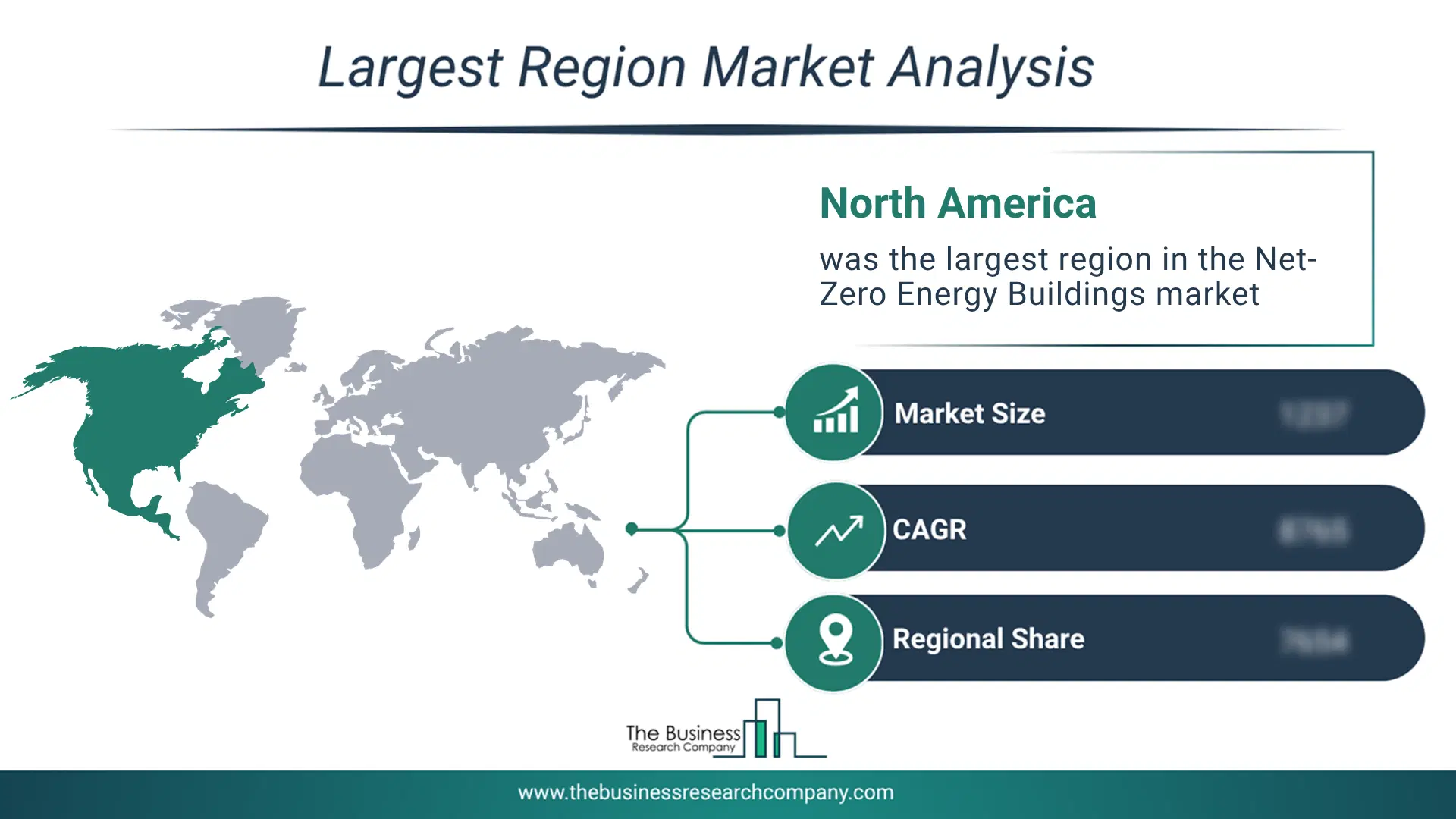
Regional Insights
North America was the largest region in the net-zero energy buildings market in 2025. Europe is expected to be the fastest-growing region in the forecast period. The regions covered in this market report are Asia-Pacific, South East Asia, Western Europe, Eastern Europe, North America, South America, Middle East, Africa. The countries covered in this market report are Australia, Brazil, China, France, Germany, India, Indonesia, Japan, Taiwan, Russia, South Korea, UK, USA, Canada, Italy, Spain.What Defines the Net-Zero Energy Buildings Market?
The net-zero energy buildings market consists of revenues earned by entities by providing energy generation services, energy storage services, energy efficiency services, smart building technologies and related water conservation and management services. The market value includes the value of related goods sold by the service provider or included within the service offering. The net-zero energy buildings market also includes sales of high-performance insulation, energy-efficient windows, led lighting, and smart thermostats. Values in this market are ‘factory gate’ values, that is the value of goods sold by the manufacturers or creators of the goods, whether to other entities (including downstream manufacturers, wholesalers, distributors, and retailers) or directly to end customers. The value of goods in this market includes related services sold by the creators of the goods.How is Market Value Defined and Measured?
The market value is defined as the revenues that enterprises gain from the sale of goods and/or services within the specified market and geography through sales, grants, or donations in terms of the currency (in USD unless otherwise specified). The revenues for a specified geography are consumption values that are revenues generated by organizations in the specified geography within the market, irrespective of where they are produced. It does not include revenues from resales along the supply chain, either further along the supply chain or as part of other products.
This chart presents market attractiveness based on a quantitative evaluation of growth, competition, strategic alignment, and risk, offering a clear view of opportunity areas for decision-making. This chart is for illustrative purposes; the full report contains the complete analysis.

This chart highlights the Total Addressable Market (TAM) by estimating the maximum revenue opportunity using an assumption-driven approach, supporting strategic planning and opportunity sizing across markets. The chart is illustrative; the full report provides a more comprehensive analysis.
What Key Data and Analysis Are Included in theNet-Zero Energy Buildings Market Report 2026?
The net-zero energy buildings market research report is one of a series of new reports from The Business Research Company that provides market statistics, including industry global market size, regional shares, competitors with the market share, detailed market segments, market trends and opportunities, and any further data you may need to thrive in the net-zero energy buildings industry. The market research report delivers a complete perspective of everything you need, with an in-depth analysis of the current and future state of the industry.Net-Zero Energy Buildings Market Report Forecast Analysis
| Report Attribute | Details |
|---|---|
| Market Size Value In 2026 | $52.64 billion |
| Revenue Forecast In 2030 | $103.16 billion |
| Growth Rate | CAGR of 18.4% from 2026 to 2030 |
| Base Year For Estimation | 2025 |
| Actual Estimates/Historical Data | 2020-2025 |
| Forecast Period | 2026 - 2030 |
| Market Representation | Revenue in USD Billion and CAGR from 2026 to 2030 |
| Segments Covered | Equipment, Service, Construction Phase, Technology Integration, End-User |
| Regional Scope | Asia-Pacific, Western Europe, Eastern Europe, North America, South America, Middle East, Africa |
| Country Scope | The countries covered in this market report are Australia, Brazil, China, France, Germany, India, Indonesia, Japan, Taiwan, Russia, South Korea, UK, USA, Canada, Italy, Spain |
| Key Companies Profiled | Hitachi Ltd., Siemens AG, General Electric Company, Panasonic Corporation, Schneider Electric SE, Mitsubishi Electric Corporation, Honeywell International Inc., Deutsche Bank AG, Daikin Industries Ltd., Johnson Controls Inc., Carrier Global Corporation, Trane Technologies PLC, Skanska AB, Mahindra Group, Kingspan Group PLC, Lendlease Corp, Rockwool Group, CannonDesign Inc., Integral Group Inc., GI Quo Vadis Inc. |
| Customization Scope | Request for Customization |
| Pricing And Purchase Options | Explore Purchase Options |