
Neurophotonics Market Report 2026
Global Outlook – By Component (Devices And Equipment, Software And Data Analysis Platforms, Consumables And Accessories, Services), By Technology (Optical Coherence Tomography, Laser Stimulation And Modulation Systems, Photoacoustic Imaging, Optogenetics, Fluorescence Imaging, Functional Near-Infrared Spectroscopy, Two-Photon Microscopy), By Distribution Channel (Online Platforms, Distributors And Channel Partners, Direct Sales), By Application (Research, Diagnostics, Therapeutics), By End-User (Academic And Research Institutes, Hospitals And Clinics, Pharma And Biotech Companies) – Market Size, Trends, Strategies, and Forecast to 2030
Neurophotonics Market Overview
• Neurophotonics market size has reached to $1.92 billion in 2025 • Expected to grow to $3.28 billion in 2030 at a compound annual growth rate (CAGR) of 11.3% • Growth Driver: Surge In Demand For Non-Invasive Imaging Techniques Fueling Growth Of The Market Through Advanced Light-Based Visualization And Real-Time Brain Monitoring • Market Trend: Advancing Neurophotonics With Optogenetic And Optical Sensor Tools For Enhanced Neural Research • North America was the largest region in 2025 and Asia-Pacific is the fastest growing region.What Is Covered Under Neurophotonics Market?
Neurophotonics refers to the science and technology of applying light-based methods—such as optical imaging, spectroscopy, and laser stimulation to study, monitor, and modulate the structure and functions of the brain and nervous system. It enables non-invasive or minimally invasive visualization of neural activity, supporting advancements in brain mapping, diagnostics, mental health research, and neurological disorder treatment. The main components of neurophotonics are devices and equipment, software and data analysis platforms, consumables and accessories, and services. Devices and equipment refer to advanced optical and photonic instruments used to study and manipulate neural activity with high spatial and temporal resolution, enabling visualization, stimulation, and measurement of neuronal circuits. The technologies such as optical coherence tomography, laser stimulation and modulation systems, photoacoustic imaging, optogenetics, fluorescence imaging, functional near-infrared spectroscopy, and two-photon microscopy. They are distributed through online platforms, distributors and channel partners, and direct sales. The applications research, diagnostics, and therapeutics and the key end users including academic and research institutes, hospitals and clinics, and pharmaceutical and biotech companies.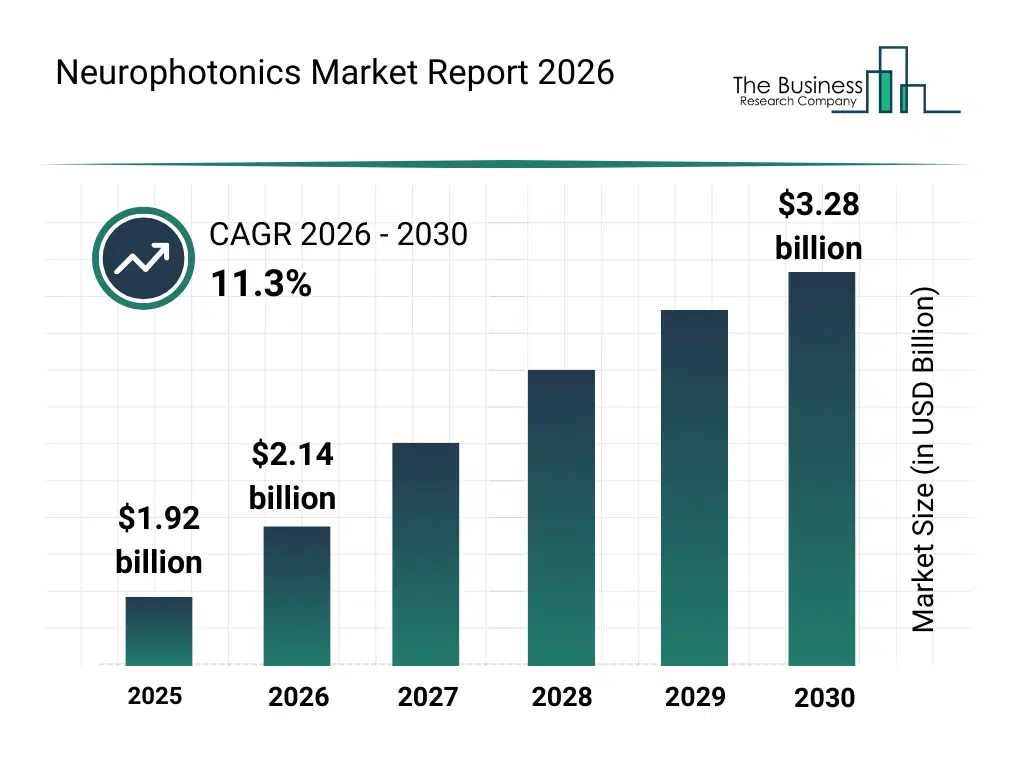
What Is The Neurophotonics Market Size and Share 2026?
The neurophotonics market size has grown rapidly in recent years. It will grow from $1.92 billion in 2025 to $2.14 billion in 2026 at a compound annual growth rate (CAGR) of 11.6%. The growth in the historic period can be attributed to increasing demand for noninvasive neuroimaging, growing adoption of optical imaging in neuroscience research, rising prevalence of neurological disorders driving diagnostic needs, expanding use of brain mapping technologies in academic institutions, and growing investment in biomedical photonics by government and private organizations.What Is The Neurophotonics Market Growth Forecast?
The neurophotonics market size is expected to see rapid growth in the next few years. It will grow to $3.28 billion in 2030 at a compound annual growth rate (CAGR) of 11.3%. The growth in the forecast period can be attributed to increasing focus on early detection of mental health and neurodegenerative diseases, rising adoption of optical neuromodulation for therapeutic applications, growing integration of artificial intelligence in neuroimaging data analysis, expanding clinical trials adopting photonic brain monitoring tools, and increasing commercialization of advanced laser-based neurotechnology platforms. Major trends in the forecast period include technology advancements in optical coherence and functional spectroscopy, innovations in multimodal brain imaging systems, rapid developments in noninvasive neural stimulation technology, continuous research and development in photonic brain signal monitoring, and integration of cloud-based and real-time analytics for neuroscience data.
Global Neurophotonics Market Segmentation
1) By Component: Devices And Equipment, Software And Data Analysis Platforms, Consumables And Accessories, Services 2) By Technology: Optical Coherence Tomography, Laser Stimulation And Modulation Systems, Photoacoustic Imaging, Optogenetics, Fluorescence Imaging, Functional Near-Infrared Spectroscopy, Two-Photon Microscopy 3) By Distribution Channel: Online Platforms, Distributors And Channel Partners, Direct Sales 4) By Application: Research, Diagnostics, Therapeutics 5) By End-User: Academic And Research Institutes, Hospitals And Clinics, Pharma And Biotech Companies Subsegments: 1) By Devices And Equipment: Optical Neuroimaging Devices, Laser Stimulation Systems, Photonic Sensors, Fiber Optic Instruments, Imaging Accessories 2) By Software And Data Analysis Platforms: Neuroimaging Data Analysis Software, Brain Mapping Software, Visualization Platforms, Signal Processing Software, Cloud Based Analytics Platforms 3) By Consumables And Accessories: Optical Fibers, Imaging Reagents, Laser Safety Equipment, Photonic Consumables, Calibration Kits 4) By Services: Training And Support Services, Research And Development Services, Clinical Consultation Services, Data Management ServicesWhat Is The Driver Of The Neurophotonics Market?
The rising demand for non-invasive imaging techniques is expected to propel the growth of the neurophotonics market going forward. Non-invasive imaging techniques are methods that allow researchers and clinicians to visualize internal neurological structures and activity without surgery or penetrating the body, using technologies such as MRI, fMRI, EEG, MEG, and optical imaging. The rise in demand for non-invasive imaging techniques is due to increasing requirements in neuroscience research for safer, repeatable, and high-resolution tools that can study brain structure and function without risk to subjects. Neurophotonics supports this demand by providing advanced light-based imaging technologies that enable precise visualization of neural circuits and real-time monitoring of brain activity. For instance, in July 2025, according to the National Institutes of Health (NIH) BRAIN Initiative, a US-based government research initiative, in 2023, the ultra-high-resolution Connectome 2.0 MRI scanner was developed. Over the next decade, the market is forecast to expand at a compound annual growth rate (CAGR) of roughly 10.7–11.2% from 2025 to 2033, with projections indicating a market size of around USD 5.1 billion by 2033 as light based neuroimaging gains broader clinical and research adoption. Therefore, the rising demand for non-invasive imaging techniques is driving the growth of the neurophotonics industry.Key Players In The Global Neurophotonics Market
Major companies operating in the neurophotonics market are Hitachi Ltd., Olympus Corporation, Coherent Corp., Bruker Corporation, HORIBA Ltd., Hamamatsu Photonics K.K., Leica Microsystems GmbH, Thorlabs Inc., Spectra-Physics, NeuroLight Technologies Ltd., Inscopix Inc., NeuroNexus Technologies Inc., Intelligent Imaging Innovations Inc., Femtonics Limited, NIRx Medical Technologies LLC, Hemophotonics S.L., Carl Zeiss AG, Artinis Medical Systems B.V., Plexon Inc., Vielight Inc., Nanoscope Technologies LLC, Neurophotometrics Ltd.
This chart is for illustrative purposes; the full report includes a detailed competitor analysis and comprehensive overview of the top 10 companies in the market.
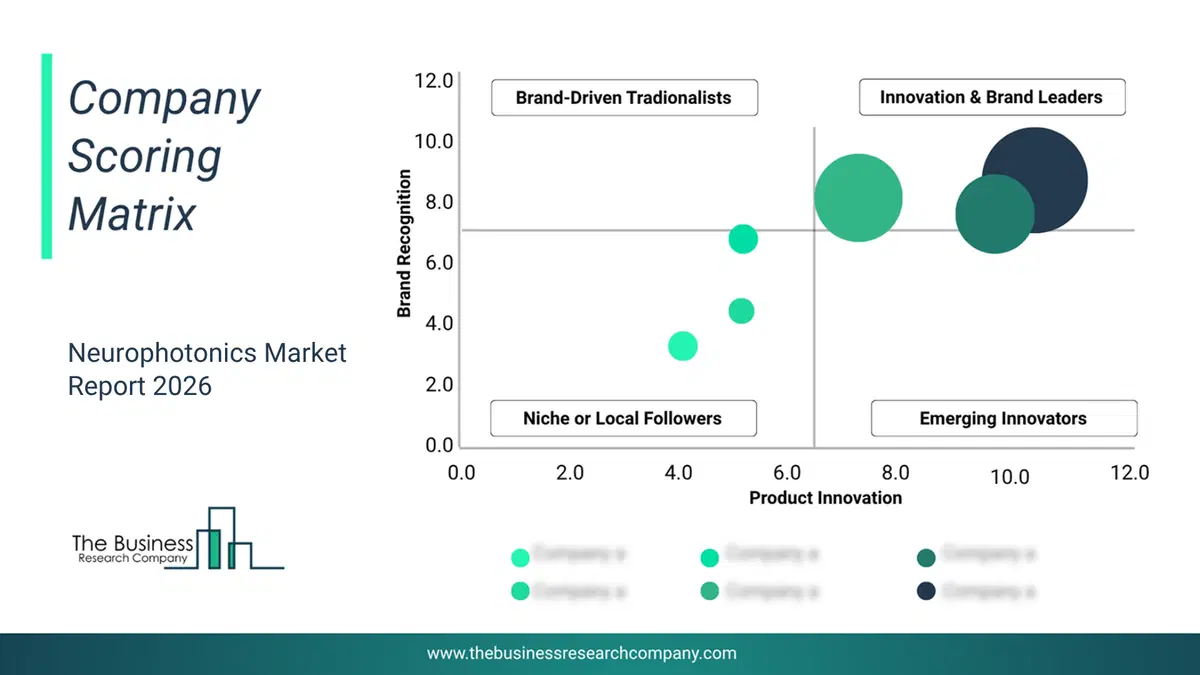
This chart maps companies by product innovation and brand strength, with bubble size indicating relative revenue, helping identify market leaders, challengers, and niche players. This is an illustrative chart; the full report provides a complete and accurate competitive analysis.
Global Neurophotonics Market Trends and Insights
Major companies operating in the Neurophotonics market are focusing on developing advanced tools, such as optogenetic and optical sensor instruments, to enhance neural activity measurement, control, and translational neuroscience research. Optogenetic and optical sensor instruments refer to engineered light delivery systems and optical sensors that can stimulate and record neural activity at cellular resolution, providing critical insights into nervous system function. For instance, in September 2025, the NIH Common Fund Venture Program awarded grants under the Advancing Non Invasive Optical Imaging Approaches for Biological Systems initiative to support the development of real-time optical imaging systems capable of deep tissue imaging and molecular contrast, including methods such as synthetic wavelength imaging. These federally funded programs facilitate the creation of next-generation neurophotonics tools that industry players can adopt and commercialize for research and clinical applications.What Are Latest Mergers And Acquisitions In The Neurophotonics Market?
In October 2023, MBF Bioscience, a US-based provider of quantitative imaging solutions for bioscience research and neuroscience applications, acquired Neurophotometrics LLC for an undisclosed amount. Through this acquisition, MBF Bioscience aims to expand its neurophotonics capabilities by integrating Neurophotometrics’ optical instrumentation for fiber photometry and neural activity imaging, enhancing its support for advanced neuroscience research. Neurophotometrics LLC is a US-based developer of specialized optical systems designed to record and analyze neural activity in research settings.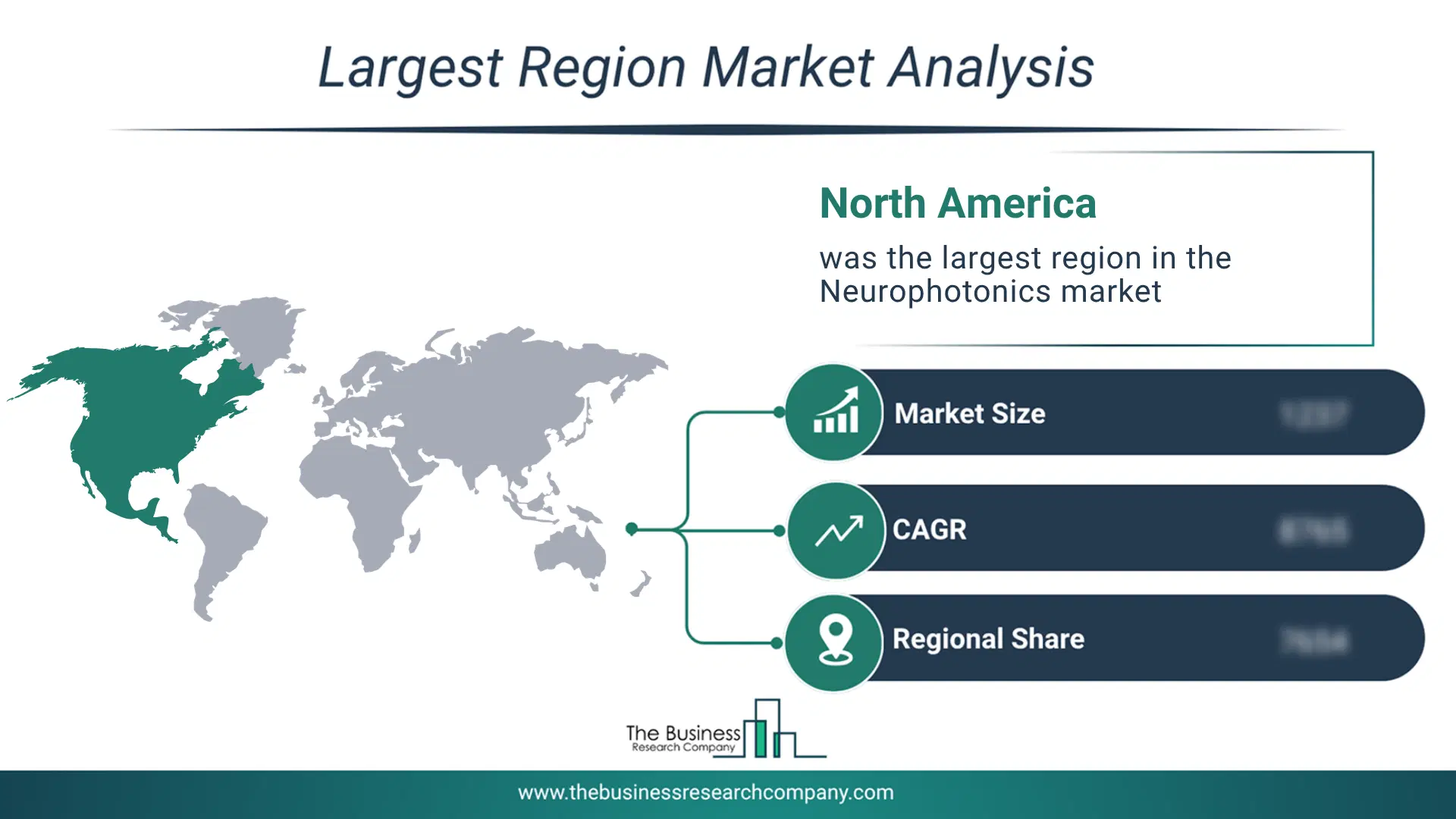
Regional Insights
North America was the largest region in the neurophotonics market in 2025. Asia-Pacific is expected to be the fastest-growing region in the forecast period. The regions covered in this market report are Asia-Pacific, South East Asia, Western Europe, Eastern Europe, North America, South America, Middle East, Africa. The countries covered in this market report are Australia, Brazil, China, France, Germany, India, Indonesia, Japan, Taiwan, Russia, South Korea, UK, USA, Canada, Italy, Spain.What Defines the Neurophotonics Market?
The neurophotonics market consists of revenues earned by entities providing technologies, systems, and solutions such as optical neuroimaging tools, brain stimulation devices, photonic sensors, laser-based diagnostics, and biomedical optics integration. The market value includes the value of related equipment and software sold by the solution providers or included within their technology offerings. The neurophotonics market includes sales of optical imaging systems, laser sources, photodetectors, fiber-optic probes, microscopes, and related neuroimaging instruments. Values in this market are ‘factory gate’ values, meaning the value of goods sold by the manufacturers or creators of the goods, whether to other entities (including downstream distributors, wholesalers, and research institutions) or directly to end customers. The value of goods in this market includes related services sold by the creators of the goods.How is Market Value Defined and Measured?
The market value is defined as the revenues that enterprises gain from the sale of goods and/or services within the specified market and geography through sales, grants, or donations in terms of the currency (in USD unless otherwise specified). The revenues for a specified geography are consumption values that are revenues generated by organizations in the specified geography within the market, irrespective of where they are produced. It does not include revenues from resales along the supply chain, either further along the supply chain or as part of other products.
This chart presents market attractiveness based on a quantitative evaluation of growth, competition, strategic alignment, and risk, offering a clear view of opportunity areas for decision-making. This chart is for illustrative purposes; the full report contains the complete analysis.

This chart highlights the Total Addressable Market (TAM) by estimating the maximum revenue opportunity using an assumption-driven approach, supporting strategic planning and opportunity sizing across markets. The chart is illustrative; the full report provides a more comprehensive analysis.
What Key Data and Analysis Are Included in the Neurophotonics Market Report 2026?
The neurophotonics market research report is one of a series of new reports from The Business Research Company that provides market statistics, including industry global market size, regional shares, competitors with the market share, detailed market segments, market trends and opportunities, and any further data you may need to thrive in the neurophotonics industry. The market research report delivers a complete perspective of everything you need, with an in-depth analysis of the current and future state of the industry.Neurophotonics Market Report Forecast Analysis
| Report Attribute | Details |
|---|---|
| Market Size Value In 2026 | $2.14 billion |
| Revenue Forecast In 2030 | $3.28 billion |
| Growth Rate | CAGR of 11.3% from 2026 to 2030 |
| Base Year For Estimation | 2025 |
| Actual Estimates/Historical Data | 2020-2025 |
| Forecast Period | 2026 - 2030 |
| Market Representation | Revenue in USD Billion and CAGR from 2026 to 2030 |
| Segments Covered | Component, Technology, Distribution Channel, Application, End-User |
| Regional Scope | Asia-Pacific, Western Europe, Eastern Europe, North America, South America, Middle East, Africa |
| Country Scope | The countries covered in the report are Australia, Brazil, China, France, Germany, India, Indonesia, Japan, Taiwan, Russia, South Korea, UK, USA, Canada, Italy, Spain. |
| Key Companies Profiled | Hitachi Ltd., Olympus Corporation, Coherent Corp., Bruker Corporation, HORIBA Ltd., Hamamatsu Photonics K.K., Leica Microsystems GmbH, Thorlabs Inc., Spectra-Physics, NeuroLight Technologies Ltd., Inscopix Inc., NeuroNexus Technologies Inc., Intelligent Imaging Innovations Inc., Femtonics Limited, NIRx Medical Technologies LLC, Hemophotonics S.L., Carl Zeiss AG, Artinis Medical Systems B.V., Plexon Inc., Vielight Inc., Nanoscope Technologies LLC, Neurophotometrics Ltd. |
| Customization Scope | Request for Customization |
| Pricing And Purchase Options | Explore Purchase Options |