
Non-Peptide Small Molecule Glucagon-Like Peptide (GLP)-1 Multi-Indication Pipeline Market Report 2026
Global Outlook – By Drug Class (Pure Glucagon Like Peptide One, Dual Agonists, Triple Agonists, Combination Therapies), By Molecule Class (Non Peptide Small Molecule, Glucose Dependent Insulinotropic Polypeptide And Glucagon Like Peptide One Dual Agonist, Amylin Analog, Oral Peptide), By Route Of Administration (Oral, Injectable Comparator Or Reference, Other Delivery Formats ), By Indication (Type Two Diabetes, Obstructive Sleep Apnea, Cardiovascular Disease, Osteoarthritis, Hypertension), By Development Stage (Phase One, Phase Two, Phase Three, Food And Drug Administration Approved) – Market Size, Trends, Strategies, and Forecast to 2030
Non-Peptide Small Molecule Glucagon-Like Peptide (GLP)-1 Multi-Indication Pipeline Market Overview
• Non-Peptide Small Molecule Glucagon-Like Peptide (GLP)-1 Multi-Indication Pipeline market size has reached to $3.68 billion in 2025 • Expected to grow to $14.39 billion in 2030 at a compound annual growth rate (CAGR) of 31.4% • Growth Driver: The Increasing Prevalence Of Obesity Driving The Growth Of The Market Due To Unhealthy Dietary Habits • Market Trend: Clinical Trial Advances For Oral Therapy Targeting Obesity And Metabolic Health • North America was the largest region in 2025 and Asia-Pacific is the fastest growing region.What Is Covered Under Non-Peptide Small Molecule Glucagon-Like Peptide (GLP)-1 Multi-Indication Pipeline Market?
A non-peptide small molecule glucagon-like peptide-1 (GLP-1) multi-indication pipeline refers to the development of orally available, non-peptide compounds that activate or modulate GLP-1 receptor pathways to replicate the hormone’s metabolic effects. It is focused on creating drug candidates that can address multiple metabolic and physiological conditions associated with GLP-1 signaling through a single therapeutic mechanism, without relying on peptide-based formulations. The main drug classes of non-peptide small molecule glucagon-like peptide (GLP)-1 multi-indication pipeline include pure glucagon like peptide one, dual agonists, triple agonists, and combination therapies. Pure glucagon like peptide one refers to GLP-1 based therapeutic agents designed to regulate glucose metabolism and support weight management through incretin pathways. These drug classes are based on molecule classes including non peptide small molecule, glucose dependent insulinotropic polypeptide and glucagon like peptide one dual agonist, amylin analog, and oral peptide and are administered through oral, injectable comparator or reference, and other delivery formats. They are used across indications such as type two diabetes, obstructive sleep apnea, cardiovascular disease, osteoarthritis, and hypertension and progress through development stages including phase one, phase two, phase three, and food and drug administration approved.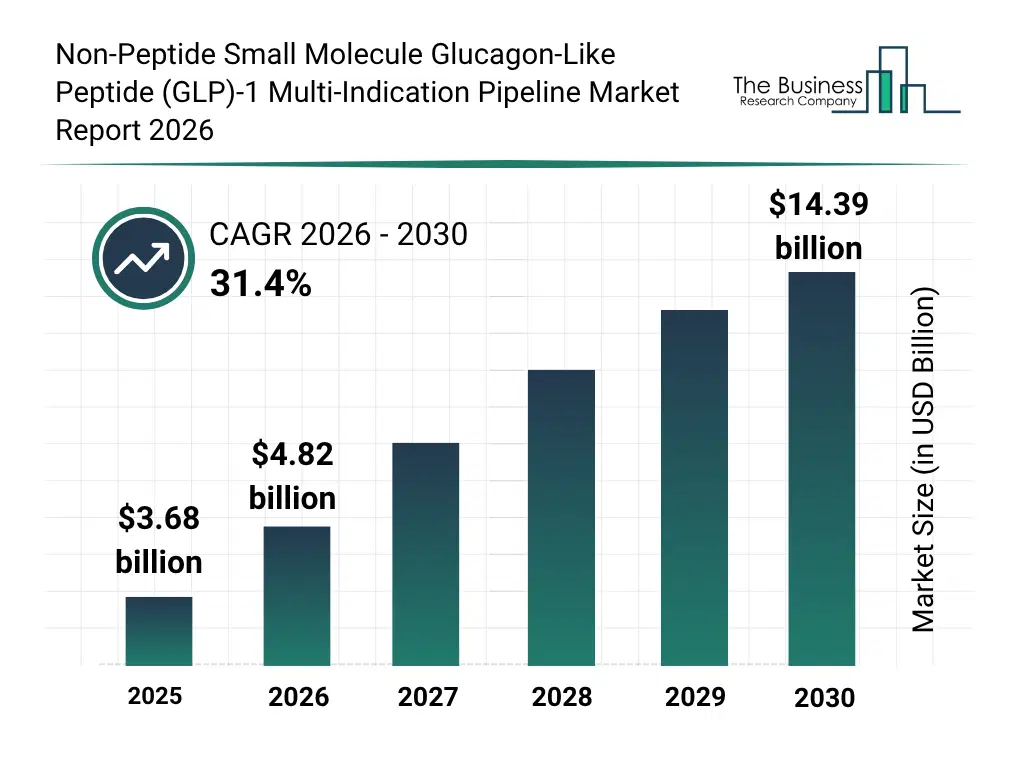
What Is The Non-Peptide Small Molecule Glucagon-Like Peptide (GLP)-1 Multi-Indication Pipeline Market Size and Share 2026?
The non-peptide small molecule glucagon-like peptide (GLP)-1 multi-indication pipeline market size has grown exponentially in recent years. It will grow from $3.68 billion in 2025 to $4.82 billion in 2026 at a compound annual growth rate (CAGR) of 31.2%. The growth in the historic period can be attributed to dominance of peptide based glp-1 injectable therapies, rising global prevalence of type two diabetes and obesity, limited oral bioavailability of early glp-1 compounds, high cost and long timelines of peptide drug development, regulatory approvals of first generation glp-1 receptor agonists.What Is The Non-Peptide Small Molecule Glucagon-Like Peptide (GLP)-1 Multi-Indication Pipeline Market Growth Forecast?
The non-peptide small molecule glucagon-like peptide (GLP)-1 multi-indication pipeline market size is expected to see exponential growth in the next few years. It will grow to $14.39 billion in 2030 at a compound annual growth rate (CAGR) of 31.4%. The growth in the forecast period can be attributed to growth of oral small molecule glp-1 agonist pipelines, expansion of multi-indication metabolic treatment applications, increased innovation in non peptide receptor modulation technologies, strategic collaborations and licensing among pharma and biotech firms, shift toward personalized metabolic disease management approaches. Major trends in the forecast period include expansion of oral non-peptide glp-1 receptor agonist development, growth of multi-indication metabolic disease therapeutics targeting obesity and diabetes, increasing adoption of combination metabolic therapies for enhanced efficacy, advancement in small molecule drug discovery for glp-1 pathway modulation, development of next-generation oral bioavailability enhancement technologies for peptide-free metabolic drugs.
Global Non-Peptide Small Molecule Glucagon-Like Peptide (GLP)-1 Multi-Indication Pipeline Market Segmentation
1) By Drug Class: Pure Glucagon Like Peptide One, Dual Agonists, Triple Agonists, Combination Therapies 2) By Molecule Class: Non Peptide Small Molecule, Glucose Dependent Insulinotropic Polypeptide And Glucagon Like Peptide One Dual Agonist, Amylin Analog, Oral Peptide 3) By Route Of Administration: Oral, Injectable Comparator Or Reference, Other Delivery Formats 4) By Indication: Type Two Diabetes, Obstructive Sleep Apnea, Cardiovascular Disease, Osteoarthritis, Hypertension 5) By Development Stage: Phase One, Phase Two, Phase Three, Food And Drug Administration Approved Subsegments: 1) By Pure Glucagon Like Peptide One: Oral Small Molecule Agonists, Injectable Peptide Analogues, Long Acting Formulations, Rapid Acting Formulations 2) By Dual Agonists: Glucagon Like Peptide One And Glucose Dependent Insulinotropic Polypeptide Agonists, Glucagon Like Peptide One And Glucagon Receptor Agonists, Central And Peripheral Metabolic Dual Agonists, Oral Dual Receptor Agonists 3) By Triple Agonists: Glucagon Like Peptide One Glucose Dependent Insulinotropic Polypeptide And Glucagon Receptor Agonists, Multi Hormone Receptor Agonists, Metabolic Energy Balance Triple Agonists, Oral Triple Receptor Agonists 4) By Combination Therapies: Metformin Based Combinations, Sodium Glucose Cotransporter Two Inhibitor Combinations, Insulin Based Combinations, Dipeptidyl Peptidase Four Inhibitor CombinationsWhat Is The Driver Of The Non-Peptide Small Molecule Glucagon-Like Peptide (GLP)-1 Multi-Indication Pipeline Market?
The increasing prevalence of obesity is expected to propel the growth of the non-peptide small molecule glucagon-like peptide (GLP)-1 multi-indication pipeline market going forward. Obesity refers to a medical condition characterized by excessive accumulation of body fat that may negatively affect health and increase the risk of diseases such as diabetes, heart disease, and hypertension. The increasing prevalence of obesity is due to unhealthy dietary habits, including excessive consumption of high-calorie, processed, and sugary foods combined with low physical activity levels. Non-peptide small molecule glucagon-like peptide (GLP)-1 multi-indication pipeline addresses obesity by enabling orally active GLP-1 receptor agonists that regulate appetite, increase satiety, and improve metabolic function to drive sustained body weight reduction. For instance, in May 2025, according to the Office for Health Improvement and Disparities, a UK-based government body, from 2023 to 2024, an estimated 64.5% of adults aged 18 and over in England were overweight or living with obesity, up from 64.0% in 2022 to 2023. Therefore, the increasing prevalence of obesity is driving the growth of the non-peptide small molecule glucagon-like peptide (GLP)-1 multi-indication pipeline industry.Key Players In The Global Non-Peptide Small Molecule Glucagon-Like Peptide (GLP)-1 Multi-Indication Pipeline Market
Major companies operating in the non-peptide small molecule glucagon-like peptide (glp)-1 multi-indication pipeline market are Eli Lilly and Company, AstraZeneca PLC, Novo Nordisk A/S, Amgen, Viking Therapeutics Inc., Structure Therapeutics Inc., Metsera, Sciwind Biosciences Co. Ltd., Boehringer Ingelheim International GmbH, Roche Holding AG, Pfizer Inc., Regeneron Pharmaceuticals Inc., Zealand Pharma A/S, Hansoh Pharmaceutical Group Company Limited, Jiangsu Hengrui Pharmaceuticals Co Ltd., Septerna Inc., Eccogene Inc., Corxel Pharmaceuticals Limited, Gan And Lee Pharmaceuticals Co Ltd., Ascletis Pharma Inc., PegBio Co.Ltd., Regor Therapeutics Group Ltd.Global Non-Peptide Small Molecule Glucagon-Like Peptide (GLP)-1 Multi-Indication Pipeline Market Trends and Insights
Major companies operating in the non-peptide small molecule glucagon-like peptide (GLP)-1 multi-indication pipeline market are focusing on conducting clinical trials to develop innovative products, such as oral small-molecule GLP-1 receptor agonists to improve patient convenience, enhance metabolic disease management, and expand treatment options beyond injectable therapies. Oral small-molecule GLP-1 receptor agonists refer to chemically synthesized non-peptide compounds designed to mimic the activity of natural GLP-1 hormones by binding to and activating GLP-1 receptors, helping regulate blood glucose levels, suppress appetite, and support weight loss without requiring peptide-based injections. For instance, in April 2026, Structure Therapeutics Inc., a US-based pharmaceutical company, announced that the first patients had been dosed in the Phase 2b ACCESS clinical study evaluating its oral small-molecule GLP-1 receptor agonist GSBR-1290 for the treatment of obesity. The study is designed to evaluate the safety, tolerability, and efficacy of the therapy in individuals with obesity, with a focus on its potential to support clinically meaningful weight reduction and improved metabolic outcomes. GSBR-1290 represents an oral, non-peptide alternative to injectable GLP-1 therapies, aiming to improve patient convenience and long-term treatment adherence.What Are Latest Mergers And Acquisitions In The Non-Peptide Small Molecule Glucagon-Like Peptide (GLP)-1 Multi-Indication Pipeline Market?
In January 2024, F. Hoffmann-La Roche Ltd., a Switzerland-based pharmaceutical and diagnostics company, acquired Carmot Therapeutics Inc. for $2.7 billion. Through this acquisition, F. Hoffmann-La Roche Ltd. aims to strengthen its obesity and diabetes pipeline by gaining access to Carmot Therapeutics, Inc.’s portfolio of metabolic disease therapies, including CT-996, an oral non-peptide small-molecule GLP-1 receptor agonist, along with other GLP-1 or GIP assets targeting obesity and type 2 diabetes. Carmot Therapeutics Inc. is a US-based clinical-stage biotechnology company developing a non-peptide small-molecule GLP-1 receptor agonist-based pipeline for metabolic diseases.Regional Outlook
North America was the largest region in the non-peptide small molecule glucagon-like peptide (GLP)-1 multi-indication pipeline market in 2025. Asia-Pacific is expected to be the fastest-growing region in the forecast period. The regions covered in this market report are Australia, Brazil, China, France, Germany, India, Indonesia, Japan, Taiwan, Russia, South Korea, UK, USA, Canada, Italy, Spain. The countries covered in this market report are Australia, Brazil, China, France, Germany, India, Indonesia, Japan, Taiwan, Russia, South Korea, UK, USA, Canada, Italy, Spain.What Defines the Non-Peptide Small Molecule Glucagon-Like Peptide (GLP)-1 Multi-Indication Pipeline Market?
The non-peptide small molecule glucagon-like peptide-1 (GLP-1) multi-indication pipeline market consists of sales of small-molecule metabolic disorder therapeutics, obesity management therapeutics, and non-alcoholic steatohepatitis therapeutics. Values in this market are ‘factory gate’ values, that is the value of goods sold by the manufacturers or creators of the goods, whether to other entities (including downstream manufacturers, wholesalers, distributors and retailers) or directly to end customers. The value of goods in this market includes related services sold by the creators of the goods.How is Market Value Defined and Measured?
The market value is defined as the revenues that enterprises gain from the sale of goods and/or services within the specified market and geography through sales, grants, or donations in terms of the currency (in USD unless otherwise specified). The revenues for a specified geography are consumption values that are revenues generated by organizations in the specified geography within the market, irrespective of where they are produced. It does not include revenues from resales along the supply chain, either further along the supply chain or as part of other products.What Key Data and Analysis Are Included in the Non-Peptide Small Molecule Glucagon-Like Peptide (GLP)-1 Multi-Indication Pipeline Market Report 2026?
The non-peptide small molecule glucagon-like peptide (GLP)-1 multi-indication pipeline market research report is one of a series of new reports from The Business Research Company that provides non-peptide small molecule glucagon-like peptide (GLP)-1 multi-indication pipeline market statistics, including non-peptide small molecule glucagon-like peptide (GLP)-1 multi-indication pipeline industry global market size, regional shares, competitors with a non-peptide small molecule glucagon-like peptide (GLP)-1 multi-indication pipeline market share, detailed non-peptide small molecule glucagon-like peptide (GLP)-1 multi-indication pipeline market segments, market trends and opportunities, and any further data you may need to thrive in the non-peptide small molecule glucagon-like peptide (GLP)-1 multi-indication pipeline industry. This non-peptide small molecule glucagon-like peptide (GLP)-1 multi-indication pipeline market research report delivers a complete perspective of everything you need, with an in-depth analysis of the current and future scenario of the industry.Non-Peptide Small Molecule Glucagon-Like Peptide (GLP)-1 Multi-Indication Pipeline Market Report Forecast Analysis
| Report Attribute | Details |
|---|---|
| Market Size Value In 2026 | $4.82 billion |
| Revenue Forecast In 2030 | $14.39 billion |
| Growth Rate | CAGR of 31.4% from 2026 to 2030 |
| Base Year For Estimation | 2025 |
| Actual Estimates/Historical Data | 2020-2025 |
| Forecast Period | 2026 - 2030 |
| Market Representation | Revenue in USD Billion and CAGR from 2026 to 2030 |
| Segments Covered | Drug Class, Molecule Class, Route Of Administration, Indication, Development Stage |
| Regional Scope | Asia-Pacific, Western Europe, Eastern Europe, North America, South America, Middle East, Africa |
| Country Scope | The countries covered in the non-peptide small molecule glucagon-like peptide (GLP)-1 multi-indication pipeline market report are Australia, Brazil, China, France, Germany, India, Indonesia, Japan, Taiwan, Russia, South Korea, UK, USA, Canada, Italy, Spain. |
| Key Companies Profiled | Eli Lilly and Company, AstraZeneca PLC, Novo Nordisk A/S, Amgen, Viking Therapeutics Inc., Structure Therapeutics Inc., Metsera, Sciwind Biosciences Co. Ltd., Boehringer Ingelheim International GmbH, Roche Holding AG, Pfizer Inc., Regeneron Pharmaceuticals Inc., Zealand Pharma A/S, Hansoh Pharmaceutical Group Company Limited, Jiangsu Hengrui Pharmaceuticals Co Ltd., Septerna Inc., Eccogene Inc., Corxel Pharmaceuticals Limited, Gan And Lee Pharmaceuticals Co Ltd., Ascletis Pharma Inc., PegBio Co.Ltd., Regor Therapeutics Group Ltd. |
| Customization Scope | Request for Customization |
| Pricing And Purchase Options | Explore Purchase Options |