
Omics CRO Services Market 2026
By Type Of Omics Services (Genomics, Transcriptomics, Proteomics, Metabolomics, Lipidomics, Multiomics, Single-Cell Omics, Other Type Of Omics Services), By Technology Platform (Next-Generation Sequencing (NGS), Microarray Technology, Mass Spectrometry, Chromatography, Bioinformatics Tools, Other Technology Platforms), By Application (Drug Discovery And Development, Diagnostics, Personalized Medicine, Other Applications), By End Users (Research And Academic Institutions, Pharmaceutical And Biotechnology Companies, Clinical And Diagnostic Laboratories), And By Region, Opportunities And Strategies – Global Forecast To 2035
Omics CRO (Contract Research Organization) services Market Definition
Omics CRO (Contract Research Organization) services refer to outsourced research solutions specializing in large-scale biological data analysis in fields such as genomics, transcriptomics, proteomics, metabolomics, and epigenomics. These services offer comprehensive support, encompassing sample processing, high-throughput data generation, bioinformatics analysis, and interpretation, to expedite research and development in pharmaceuticals, biotechnology, and personalized medicine. The primary purpose of omics CRO services is to enable organizations to conduct complex, high-volume omics studies efficiently without incurring significant investment in in-house infrastructure. The omics CRO services market consists of sales, by entities (organizations, sole traders, or partnerships) of outsourced research and analytical services that apply different technologies for drug discovery, precision medicine, and biomarker identification.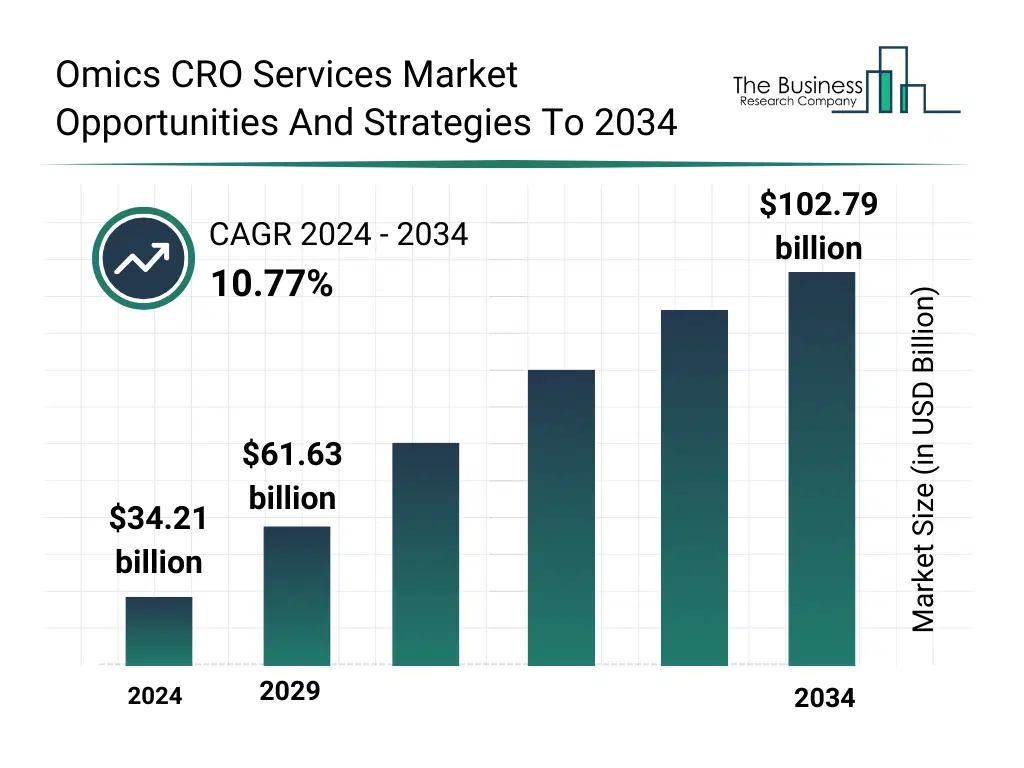
Omics CRO (Contract Research Organization) services Market Size
The global omics CRO services market reached a value of nearly $34,209.94 million in 2024, having grown at a compound annual growth rate (CAGR) of 13.55% since 2019. The market is expected to grow from $34,209.94 million in 2024 to $61,628.89 million in 2029 at a rate of 12.49%. The market is then expected to grow at a CAGR of 10.77% from 2029 and reach $ 102,794.04 million in 2034. Growth in the historic period resulted from rise of personalized medicine, favorable government initiatives, rise of automated lab robotics, increased number of biobanks. Factors that negatively affected growth in the historic period were high cost of omics technologies and data integration challenges. Going forward, rising pharma and biotech R&D expenditure, growth of the biotech startup, growth in genetics and rare-disease programs, increasing global clinical trial will drive the growth. Factor that could hinder the growth of the omics CRO services market in the future include technical limitations, ethical and privacy concerns and trade wars and tariffs.Omics CRO (Contract Research Organization) services Market Drivers
The key drivers of the omics cro (contract research organization) services market include: Rising Pharma And Biotech Research And Development (R&D) Expenditure The rising pharma and biotech R&D expenditure is expected to propel the growth of the omics CRO services market going forward. Pharmaceutical and biotechnology R&D expenditure drives demand for omics CRO services by increasing the need for advanced genomic, proteomic, and metabolomic analyses to support drug discovery and biomarker identification. As companies invest more in developing targeted and personalized therapies, they increasingly outsource omics-based research to specialized CROs for cost efficiency and access to cutting-edge technologies. This trend accelerates innovation and enhances the precision of clinical and translational research. Therefore, the rising pharma & biotech R&D expenditure will drive the growth of the omics CRO services market. The rising pharma and biotech R&D expenditure growth contribution during the forecast period in 2024 is 1.5%.Omics CRO (Contract Research Organization) services Market Restraints
The key restraints on the omics cro (contract research organization) services market include: Technical Limitations The technical limitations are expected to hamper the growth of the omics CRO services market. Technical limitations affect omics CRO services by restricting the accuracy, throughput, and reproducibility of multi-omics analyses, which can delay data generation and impact the reliability of biomarker discovery or patient stratification. Limitations in sequencing depth, sample quality, bioinformatics capabilities, or instrumentation sensitivity can lead to incomplete datasets or higher error rates. Consequently, these challenges can increase project timelines, costs, and the risk of suboptimal clinical or research outcomes. Therefore, the technical limitations may hinder the growth of the omics CRO services market. Growth affected by technical limitations challenges during the forecast period in 2024 is -2.5%.Omics CRO (Contract Research Organization) services Market Trends
Major trends shaping the omics cro (contract research organization) services market include: Omics CRO (Contract Research Organization) services Key companies operating in the omics CRO services market are adopting a strategic partnership approach to enhance technology integration and expand market reach. A strategic partnership typically refers to a collaborative relationship between two or more organizations where they combine their resources, expertise, and efforts to achieve common goals or objectives. For instance, in November 2024, Frontage Laboratories, US-based contract research organization (CRO) providing integrated preclinical, clinical, and analytical services, partnered with Medicover Integrated Clinical Services (MICS), a Poland-based clinical and diagnostic services provider, his strategic partnership aims to integrate Frontage's clinical trial services with Medicover's advanced genomic testing solutions. Medicover, operating over 100 laboratories across 13 countries, provides comprehensive genomic analysis services, including next-generation sequencing (NGS), molecular pathology, and pharmacogenomics. Strategic Collaborations Driving Advanced Spatial Transcriptomics Companies in the omics CRO services market are increasingly engaging in strategic partnerships to combine technological expertise, foster innovation, and support advanced research initiatives aimed at expanding their service capabilities and global reach. A strategic partnership typically refers to a collaborative relationship between two or more organizations where they combine their resources, expertise, and efforts to achieve common goals or objectives. For instance, in March 2024, Firalis Molecular Precision (FMP), a France-based Contract Research Organization (CRO) and Contract Development and Manufacturing Organization (CDMO), has partnered with Vizgen, a US-based spatial omics technology, to launch a new Grant Program for researchers across Europe. Building on the success of their previous collaboration, which supported research into spatial immune cell organization in triple-negative breast cancer (TNBC) tumors, this initiative will provide a selected researcher with access to FMP’s MERSCOPE Platform, leveraging Vizgen’s MERFISH technology and predesigned gene panels for single-cell spatial analysis. The program is designed to enable advanced spatial transcriptomics studies, fostering deeper insights into cellular interactions and functional states to support the development of novel therapeutic strategies in oncology, neurology, and immunology.Opportunities And Recommendations In The Omics CRO Services Market
Opportunities – The top opportunities in the omics CRO services market segmented by type of omics services will arise in the genomics segment, which will gain $9,089.38 million of global annual sales by 2029. The top opportunities in the omics CRO services market segmented by technology platform will arise in the next-generation sequencing (NGS) segment, which will gain $11,002.61 million of global annual sales by 2029. The top opportunities in the omics CRO services market segmented by application will arise in the drug discovery and development segment, which will gain $11,489.32 million of global annual sales by 2029. The top opportunities in the omics CRO services market segmented by end user will arise in the pharmaceutical and biotechnology companies’ segment, which will gain $16,259.02 million of global annual sales by 2029. Recommendations- To take advantage of the opportunities, The Business Research Company recommends the omics cro services companies to focus on scalable organoid screening to speed preclinical decisions, focus on single-cell omics services, focus on mass spectrometry capabilities , focus on diagnostics applications, expand in emerging markets, continue to focus on developed markets, focus on genomic and ngs-based partnerships to capture growth, focus on spatial transcriptomics partnerships to accelerate differentiated growth, focus on value-based and flexible pricing discipline, prioritize credibility and buyer relevance, build expert visibility and capture demand, focus on pharmaceutical and biotechnology companies.
Omics CRO Services Market Segmentation
The omics CRO services market is segmented by type, by technology platform, by application, and by end users.By Type –
The omics cro services market is segmented by type into:
- a) Genomics
- b) Transcriptomics
- c) Proteomics
- d) Metabolomics
- e) Lipidomics
- f) Multiomics
- g) Single-cell omics
- h) Other type of omics services
By Technology Platform –
The omics cro services market is segmented by technology platform into:
- a) Next-generation sequencing (NGS)
- b) Mass spectrometry
- c) Bioinformatics tools
- d) Chromatography
- e) Microarray technology
- f) Other technology platforms
By Application –
The omics cro services market is segmented by application into:
- a) Drug discovery and development
- b) Diagnostics
- c) Personalized medicine
- d) Other applications
By End-Users –
The omics cro services market is segmented by end-users into:
- a) Pharmaceutical and biotechnology companies
- b) Research and academic institutions
- c) Clinical and diagnostic laboratories
By Geography - The omics cro services market is segmented by geography into:
- • China
- • India
- • Japan
- • Australia
- • Indonesia
- • South Korea
- • Bangladesh
- • Thailand
- • Vietnam
- • Malaysia
- • Singapore
- • Phillipines
- • Hong kong
- • New Zealand
- • USA
- • Canada
- • Mexico
- • Brazil
- • Argentina
- • Chile
- • Colombiia
- • Peru
- • France
- • Germany
- • UK
- • Italy
- • Spain
- • Austria
- • Belgium
- • Denmark
- • Finland
- • Ireland
- • Netherland
- • Norway
- • Portugal
- • Sweden
- • Switzerland
- • Russia
- • Czech Republic
- • Poland
- • Romania
- • Ukraine
- • Saudi Arabia
- • Israel
- • Iran
- • Turkey
- • UAE o Africa
- • Egypt
- • Nigeria
- • South Africa
-
o Asia Pacific