

Omnichannel Retail Commerce Platform Market Report 2026
Global Outlook – By Solution (E-commerce, Order Management, Pos(Point Of Sale), Customer Relationship Management (CRM), Warehouse Management, Retail Order Broker Cloud Service, Other Solutions), By Deployment (Software As A Service (SaaS), On- premises), By Organization (Small And Medium Sized Enterprises (SMEs), Large Enterprises), By End User (Consumer Electronics, Apparel And Footwear, Fast-Moving Consumer Goods (FMCG), Other End Users) – Market Size, Trends, Strategies, and Forecast to 2030
Omnichannel Retail Commerce Platform Market Overview
• Omnichannel Retail Commerce Platform market size has reached to $7.48 billion in 2025 • Expected to grow to $14.57 billion in 2030 at a compound annual growth rate (CAGR) of 14.3% • Growth Driver: E-Commerce's Meteoric Rise Igniting Omnichannel Platform Revolution • Market Trend: Reliance Retail's Tira Revolutionizes Beauty Shopping With Its Seamless Omni-Channel Platform • North America was the largest region in 2025 and Asia-Pacific is the fastest growing region.Market Gains By 2030 – Top Opportunities By Segment
Market Gain identifies the most promising market opportunities by highlighting the segments or products expected to generate the highest incremental revenue growth over the next five years.
What Is Covered Under Omnichannel Retail Commerce Platform Market?
An omnichannel retail commerce platform is a comprehensive, integrated technological solution that facilitates seamless and cohesive retail experiences across multiple channels and touchpoints. The platform integrates and synchronizes retail channels, enabling consistent communication, transactions, and customer interactions. The main types of solutions in an omnichannel retail commerce platform are e-commerce, order management, point of sale (POS), customer relationship management (CRM), warehouse management, retail order broker cloud service, and others. E-commerce refers to the buying and selling of goods or services over the internet. It includes different deployments by software as a service (SaaS) and on-premises and is employed in various organizations, such as small and medium-sized enterprises (SMEs) and large enterprises, and end users are consumer electronics, apparel and footwear, fast-moving consumer goods (FMCG), and others.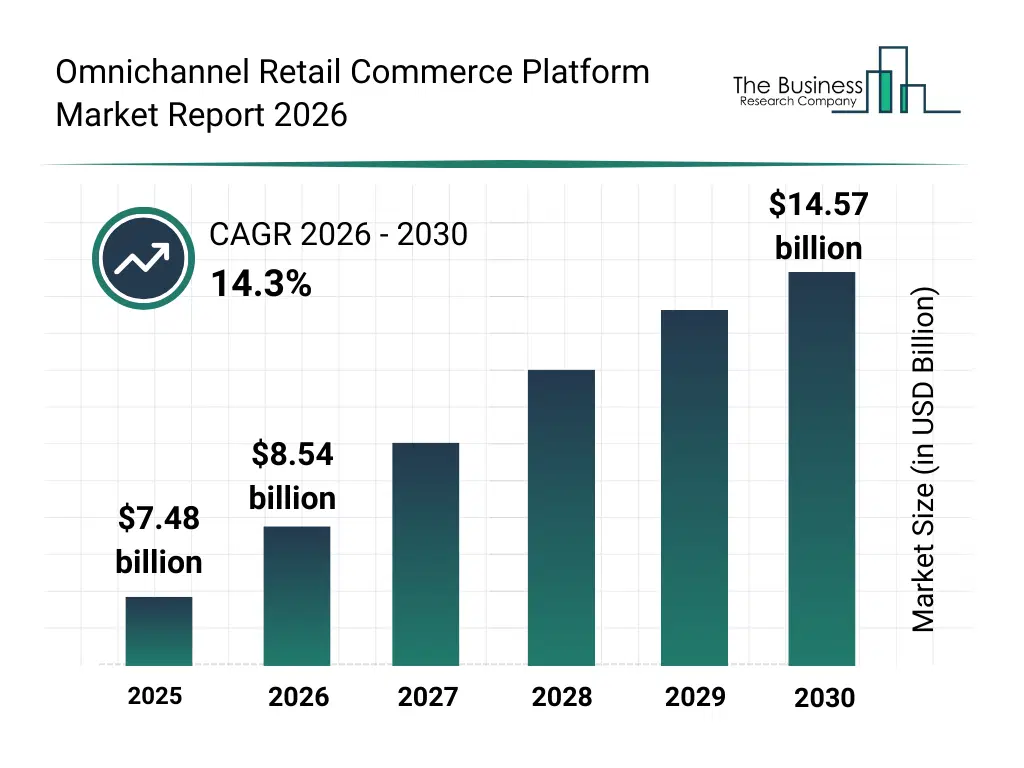
What Is The Omnichannel Retail Commerce Platform Market Size and Share 2026?
The omnichannel retail commerce platform market size has grown rapidly in recent years. It will grow from $7.48 billion in 2025 to $8.54 billion in 2026 at a compound annual growth rate (CAGR) of 14.2%. The growth in the historic period can be attributed to rise of multi-channel retail strategies, growth of e-commerce platforms, increasing consumer demand for consistent shopping experiences, expansion of digital payment systems, adoption of cloud-based retail software.What Is The Omnichannel Retail Commerce Platform Market Growth Forecast?
The omnichannel retail commerce platform market size is expected to see rapid growth in the next few years. It will grow to $14.57 billion in 2030 at a compound annual growth rate (CAGR) of 14.3%. The growth in the forecast period can be attributed to increasing demand for personalized omnichannel experiences, rapid growth of mobile and social commerce, rising investments in retail automation, increasing need for real-time data visibility, scalability requirements for global retail operations. Major trends in the forecast period include unified commerce platform adoption, real-time inventory synchronization across channels, expansion of buy online pick up in store (BOPIS) capabilities, growth of headless and API-first commerce architectures, increasing focus on seamless customer journey orchestration.
Global Omnichannel Retail Commerce Platform Market Segmentation
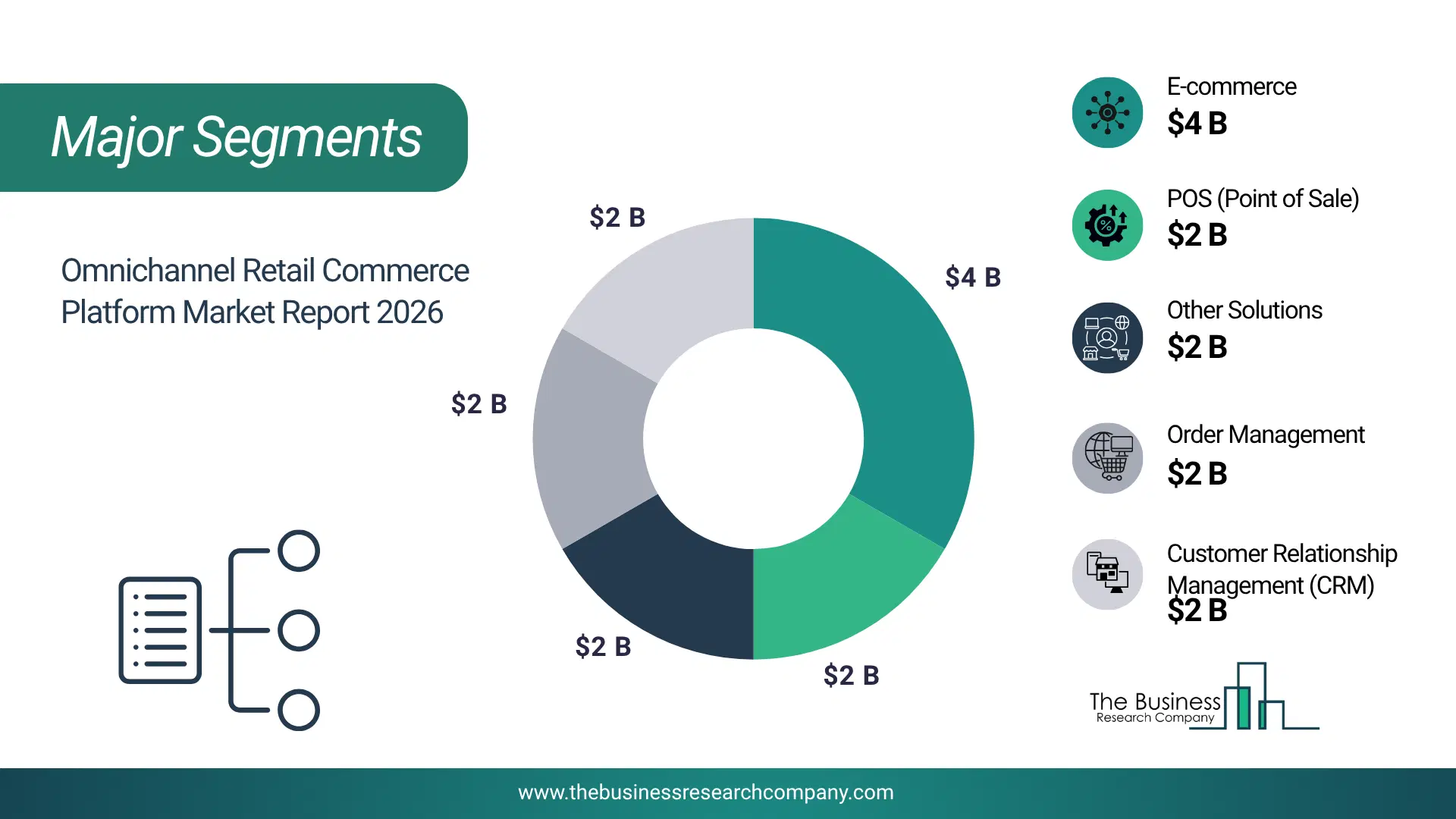
1) By Solution: E-commerce, Order Management, Pos(Point Of Sale), Customer Relationship Management (CRM), Warehouse Management, Retail Order Broker Cloud Service, Other Solutions 2) By Deployment: Software As A Service (SaaS), On- premises 3) By Organization: Small And Medium Sized Enterprises (SMEs), Large Enterprises 4) By End User: Consumer Electronics, Apparel And Footwear, Fast-Moving Consumer Goods (FMCG), Other End Users Subsegments: 1) By E-commerce: Online Storefront, Mobile Commerce (mCommerce), Social Commerce Integration, Marketplace Integrations 2) By Order Management: Order Processing, Inventory Visibility and Management, Order Fulfillment and Tracking, Return Management 3) By POS (Point of Sale): Mobile POS, Self-Checkout Systems, In-Store POS Terminals, Cloud-Based POS 4) By Customer Relationship Management (CRM): Customer Data Management, Loyalty Programs and Rewards, Customer Engagement and Personalization, Customer Support and Ticketing 5) By Warehouse Management: Inventory Tracking, Demand Forecasting, Picking and Packing Automation, Shipping and Logistics Coordination 6) By Retail Order Broker Cloud Service: Real-Time Inventory Allocation, Omnichannel Order Routing, Multi-Location Fulfillment Optimization, Drop Shipping Management 7) By Other Solutions: Analytics and Reporting, Product Information Management (PIM), Payment Processing Integration, Marketing and Promotions Management The top segments in the omnichannel retail commerce platform market will be: • E-commerce will reach $4.48 Billion by 2030. • POS (Point of Sale) will reach $2.15 Billion by 2030. • Other Solutions will reach $1.84 Billion by 2030. • Order Management will reach $1.96 Billion by 2030. • Customer Relationship Management (CRM) will reach $1.62 Billion by 2030.What Is The Driver Of The Omnichannel Retail Commerce Platform Market?
The surging e-commerce sales are expected to propel the growth of the omnichannel retail commerce platform market going forward. Electronic commerce, commonly known as e-commerce, refers to the buying and selling goods and services over the internet or other electronic networks. It encompasses a wide range of transactions, including online retail sales and online auctions. It arises because of convenience for consumers, accessibility, vast product selection, time-saving, and efficiency. E-commerce is utilized in omnichannel retail commerce platforms to create a seamless and integrated shopping experience for customers across various channels, providing retailers with the essential infrastructure and capabilities to engage with customers, drive sales, and deliver. For instance, according to the United States Census Bureau, a US-based government agency, total e-commerce sales in 2023 were $1,118.7 billion, an increase of 7.6% from 2022. Therefore, surging e-commerce sales are driving the growth of the omnichannel retail commerce platform industry.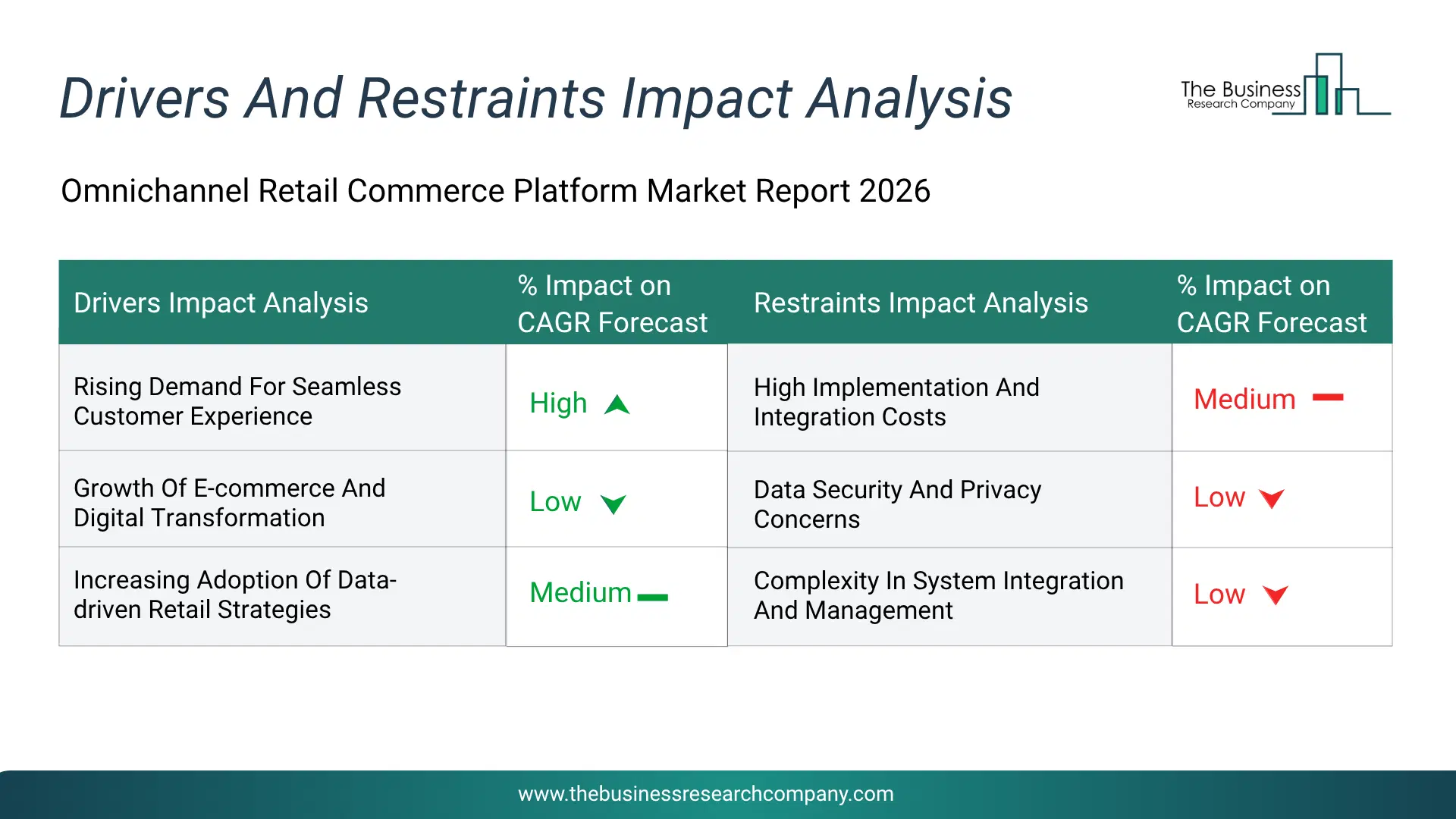
Infographic Chart Showing Key Market Drivers Analysis And Restraints For Omnichannel Retail Commerce Platform Market
The chart presents an impact analysis of key drivers and restraints, quantifying their relative influence on the market's growth rate and helping assess the balance between growth enablers and limiting factors. This chart offers a high-level perspective; the full report contains more detailed insights.
How Will The Drivers Impact Growth In The Global Omnichannel Retail Commerce Platform Market?
• Rising Demand For Seamless Customer Experience (High) – During the forecast period, the rising demand for seamless customer experience is expected to become a key growth driver for the omnichannel retail commerce platform market by 2030. The increasing expectation for a unified and frictionless shopping journey across physical stores, mobile apps, websites, and social platforms is a major driver for omnichannel retail commerce platforms. Customers demand consistent product availability, pricing, and personalized interactions across all touchpoints. This encourages retailers to adopt integrated systems that synchronize inventory, transactions, and customer data in real time. Features such as buy online pick up in-store (BOPIS) and cross-channel returns enhance convenience. These capabilities improve customer satisfaction and retention. As competition intensifies, experience-driven strategies are becoming essential. • Growth Of E-commerce And Digital Transformation (Low) – During the forecast period, the growth of e-commerce and digital transformation is expected to emerge as a major factor driving the expansion of the omnichannel retail commerce platform market by 2030. Businesses are investing in digital tools to remain competitive and expand their reach. Integration of online and offline channels enables efficient operations and improved customer engagement. These platforms centralize inventory, order management, and customer data, reducing inefficiencies. Technologies such as cloud computing, AI, and analytics enhance platform capabilities. • Increasing Adoption Of Data-driven Retail Strategies (Medium) – During the forecast period, the increasing adoption of data-driven retail strategies is expected to act as a key growth catalyst for the omnichannel retail commerce platform market by 2030. Retailers are increasingly leveraging data analytics to improve decision-making and customer engagement. Omnichannel platforms integrate data from multiple touchpoints to provide a unified customer view. This enables personalized marketing, targeted promotions, and better customer service. Real-time insights help optimize inventory management and demand forecasting. Businesses can improve operational efficiency and profitability using data-driven strategies.How Will The Restraints Impact Growth In The Global Omnichannel Retail Commerce Platform Market?
• High Implementation And Integration Costs (High) – During the forecast period, high implementation and integration costs are significantly restricting the growth of the omnichannel retail commerce platform market. The substantial investment required for deploying unified commerce systems, integrating legacy infrastructure, and maintaining multi-channel platforms is limiting adoption, particularly among small and medium-sized retailers. • Data Security And Privacy Concerns (Low) – During the forecast period, data security and privacy concerns are significantly restricting the growth of the omnichannel retail commerce platform market. Increasing risks related to data breaches, regulatory compliance requirements, and customer data protection laws are creating challenges for retailers in managing secure and compliant omnichannel ecosystems. • Complexity In System Integration And Management (Medium) – During the forecast period, complexity in system integration and management is significantly restricting the growth of the omnichannel retail commerce platform market. The challenge of synchronizing multiple sales channels, backend systems, payment gateways, and customer data platforms is increasing operational difficulties and slowing down seamless omnichannel deployment.Key Players In The Global Omnichannel Retail Commerce Platform Market
Major companies operating in the omnichannel retail commerce platform market are SAP SE, Oracle Corporation, Salesforce Inc, Microsoft Corporation, International Business Machines Corporation IBM, Shopify Inc, BigCommerce Holdings Inc, Wix.com Ltd, Lightspeed Commerce Inc, NCR Voyix Corporation, Diebold Nixdorf Incorporated, Toshiba Corporation, Adobe Inc, VTEX, Commercetools GmbH, Elastic Path Software Inc, Mirakl SAS, Kibo Commerce, Manhattan Associates Inc, Epicor Software Corporation, Zoho Corporation, Squarespace Inc, GoDaddy Inc, Aptos LLC, NewStore Inc, Spryker Systems GmbH, Tulip Retail Inc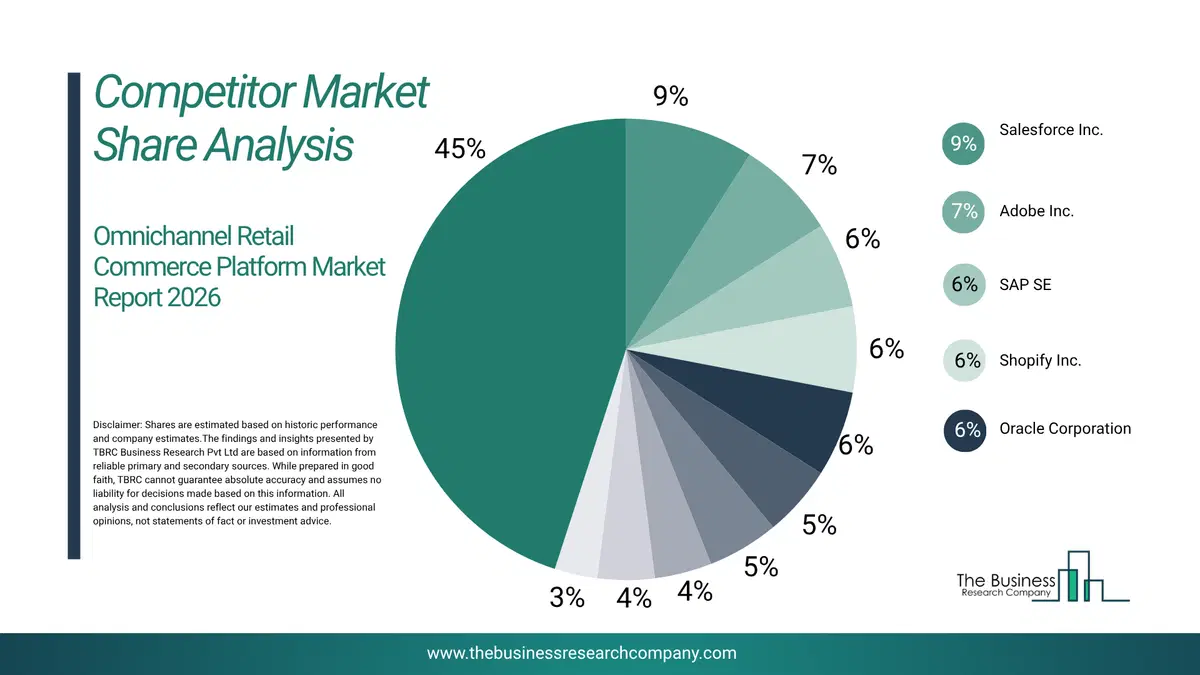
This chart is for illustrative purposes; the full report includes a detailed competitor analysis and comprehensive overview of the top 10 companies in the market.
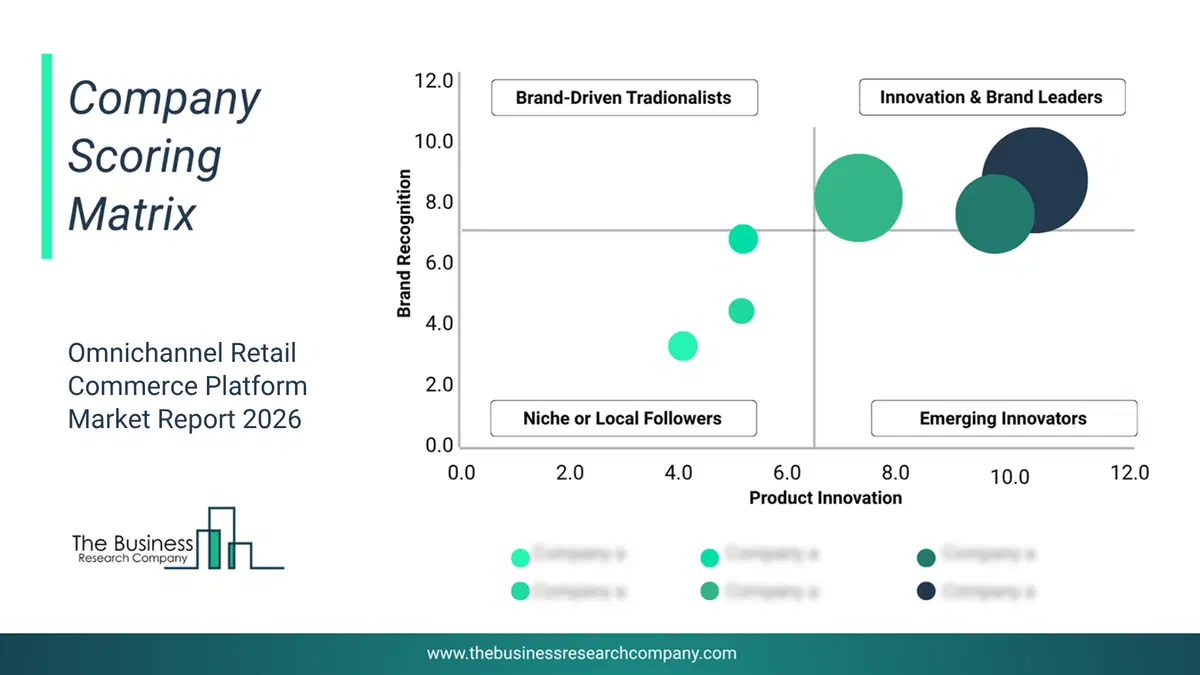
This chart maps companies by product innovation and brand strength, with bubble size indicating relative revenue, helping identify market leaders, challengers, and niche players. This is an illustrative chart; the full report provides a complete and accurate competitive analysis.
Global Omnichannel Retail Commerce Platform Market Trends and Insights
Major companies operating in the omnichannel retail commerce platform market are focusing on developing advanced retail platforms, such as omnichannel beauty retail platforms, to enhance customer engagement, brand visibility, and competitive positioning across physical and digital channels. Omnichannel beauty retail platforms are integrated digital ecosystems that connect online and offline touchpoints, enabling consumers to seamlessly browse, interact with, and purchase beauty products through a unified and personalized shopping experience. For instance, in April 2023, Reliance Retail, an India-based retail company, launched an omnichannel beauty retail platform called Tira. The platform features a curated assortment of both global and home-grown beauty brands, making it a comprehensive destination for all things beauty. Additionally, this online platform is easy to navigate, with a clear and clutter-free interface that showcases shoppable videos, blogs, tutorials, trend-setting tips, personal recommendations, and a virtual try-on feature for color cosmetics.What Are Latest Mergers And Acquisitions In The Omnichannel Retail Commerce Platform Market?
In March 2023, Criteo S.A., a France-based advertising company, acquired Brandcrush for an undisclosed amount. The acquisition aims to accelerate offline retail media solutions and solidify its position in the omnichannel retail media landscape by providing a more comprehensive and efficient solution for retailers and brands. Brandcrush is an Australia-based omnichannel retail media technology company that offers a platform for buying and selling omnichannel retail media, including offline media channels.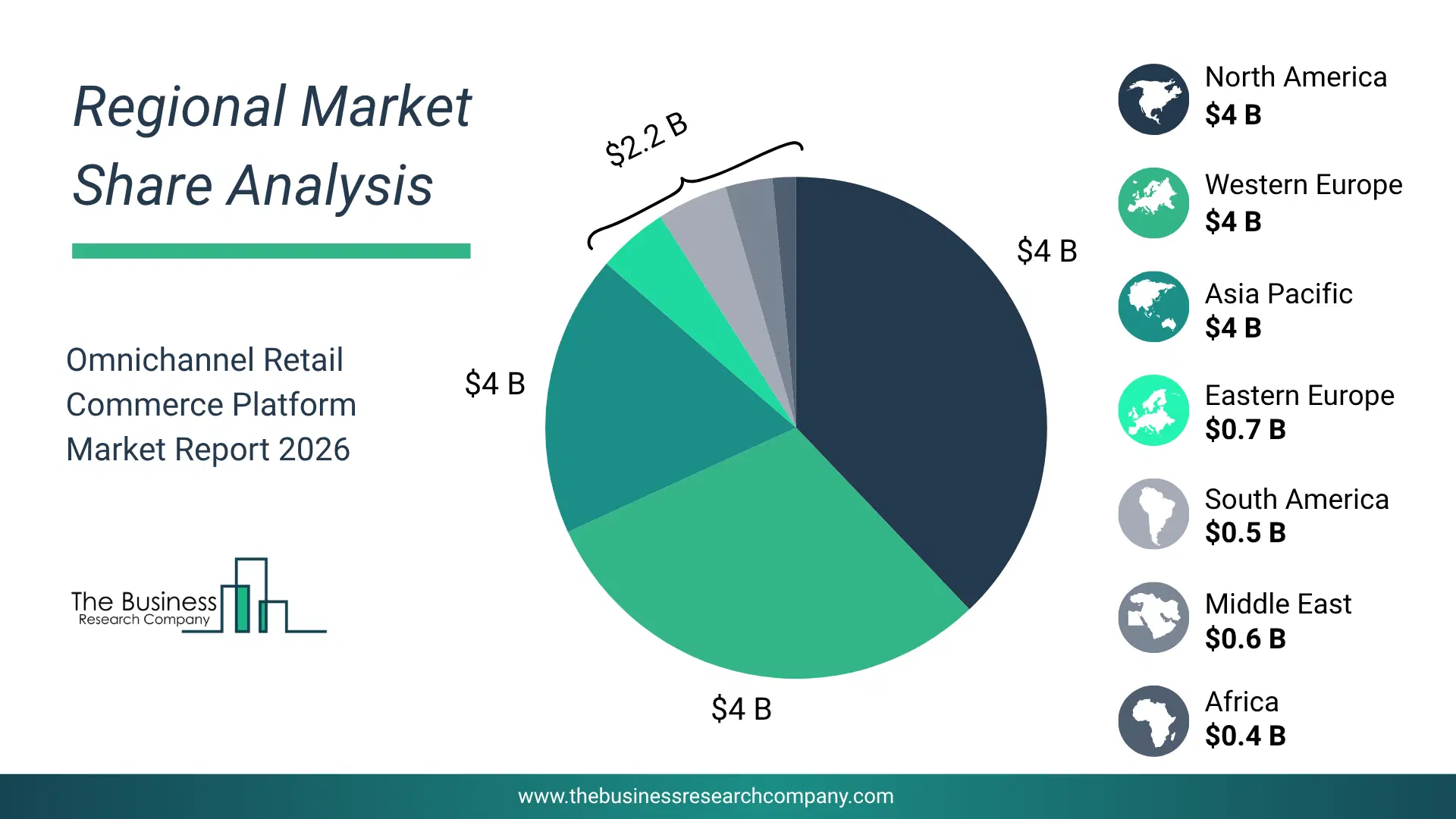
Regional Outlook
North America was the largest region in the omnichannel retail commerce platform market in 2025. Asia-Pacific is expected to be the fastest-growing region in the forecast period. The regions covered in this market report are Asia-Pacific, South East Asia, Western Europe, Eastern Europe, North America, South America, Middle East and Africa. The countries covered in this market report are Australia; Brazil; China; France; Germany; India; Indonesia; Japan; Taiwan; Russia; South Korea; UK; USA; Canada; Italy; Spain.What Defines the Omnichannel Retail Commerce Platform Market?
The omnichannel retail commerce platform market includes revenues earned by entities by providing services such as inventory management, order management, return and exchange management, and customer relationship management. The market value includes the value of related goods sold by the service provider or included within the service offering. Only goods and services traded between entities or sold to end consumers are included.How is Market Value Defined and Measured?
The market value is defined as the revenues that enterprises gain from the sale of goods and/or services within the specified market and geography through sales, grants, or donations in terms of the currency (in USD unless otherwise specified). The revenues for a specified geography are consumption values that are revenues generated by organizations in the specified geography within the market, irrespective of where they are produced. It does not include revenues from resales along the supply chain, either further along the supply chain or as part of other products.
This chart presents market attractiveness based on a quantitative evaluation of growth, competition, strategic alignment, and risk, offering a clear view of opportunity areas for decision-making. This chart is for illustrative purposes; the full report contains the complete analysis.

This chart highlights the Total Addressable Market (TAM) by estimating the maximum revenue opportunity using an assumption-driven approach, supporting strategic planning and opportunity sizing across markets. The chart is illustrative; the full report provides a more comprehensive analysis.
What Key Data and Analysis Are Included in the Omnichannel Retail Commerce Platform Market Report 2026?
The omnichannel retail commerce platform market research report is one of a series of new reports from The Business Research Company that provides market statistics, including industry global market size, regional shares, competitors with the market share, detailed market segments, market trends and opportunities, and any further data you may need to thrive in the omnichannel retail commerce platform industry. The market research report delivers a complete perspective of everything you need, with an in-depth analysis of the current and future state of the industry.Omnichannel Retail Commerce Platform Market Report Forecast Analysis
| Report Attribute | Details |
|---|---|
| Market Size Value In 2026 | $8.54 billion |
| Revenue Forecast In 2030 | $14.57 billion |
| Growth Rate | CAGR of 14.3% from 2026 to 2030 |
| Base Year For Estimation | 2025 |
| Actual Estimates/Historical Data | 2020-2025 |
| Forecast Period | 2026 - 2030 |
| Market Representation | Revenue in USD Billion and CAGR from 2026 to 2030 |
| Segments Covered | Solution, Deployment, Organization, End User |
| Regional Scope | Asia-Pacific, Western Europe, Eastern Europe, North America, South America, Middle East, Africa |
| Country Scope | The countries covered in the report are Australia, Brazil, China, France, Germany, India, Indonesia, Japan, Taiwan, Russia, South Korea, UK, USA, Canada, Italy, Spain. |
| Key Companies Profiled | SAP SE, Oracle Corporation, Salesforce Inc, Microsoft Corporation, International Business Machines Corporation IBM, Shopify Inc, BigCommerce Holdings Inc, Wix.com Ltd, Lightspeed Commerce Inc, NCR Voyix Corporation, Diebold Nixdorf Incorporated, Toshiba Corporation, Adobe Inc, VTEX, Commercetools GmbH, Elastic Path Software Inc, Mirakl SAS, Kibo Commerce, Manhattan Associates Inc, Epicor Software Corporation, Zoho Corporation, Squarespace Inc, GoDaddy Inc, Aptos LLC, NewStore Inc, Spryker Systems GmbH, Tulip Retail Inc |
| Customization Scope | Request for Customization |
| Pricing And Purchase Options | Explore Purchase Options |