
Once-Weekly Basal Insulin Therapy Market Report 2026
Global Outlook – By Drug Type (Biosimilar Weekly Insulin, Insulin Icodec Awiqli, Next Generation Ultra Long Acting Insulin), By Indication (Insulin Naive Patients, Type Two Diabetes, Type One Diabetes, Patients Requiring Basal Insulin Intensification), By Age Group (Geriatric, Adults, Pediatric), By End User (Ambulatory Care Centers, Hospitals, Diabetes Care Clinics, Homecare Settings) – Market Size, Trends, Strategies, and Forecast to 2030
Once-Weekly Basal Insulin Therapy Market Overview
• Once-Weekly Basal Insulin Therapy market size has reached to $3.4 billion in 2025 • Expected to grow to $6.51 billion in 2030 at a compound annual growth rate (CAGR) of 13.9% • Growth Driver: Rising Global Diabetes Prevalence Fueling The Growth Of The Market Due To Increasing Demand For Convenient Long-acting Diabetes Management Solutions • Market Trend: Advanced Basal Insulin Formulations Transforming Diabetes Management • North America was the largest region in 2025 and Asia-Pacific is the fastest growing region.What Is Covered Under Once-Weekly Basal Insulin Therapy Market?
Once-weekly basal insulin therapy is a long-acting insulin treatment designed to control blood glucose levels in people with diabetes through a single injection per week. It provides continuous basal insulin coverage to help maintain stable blood sugar throughout the week. These therapies are developed to reduce injection frequency, improve patient adherence, and simplify diabetes management compared to daily basal insulin treatments. The main drug types of once-weekly basal insulin therapy include biosimilar weekly insulin, insulin icodec Awiqli, and next generation ultra long acting insulin. Biosimilar weekly insulin refers to biologically similar insulin formulations designed to provide long-lasting basal glucose control with reduced dosing frequency. These therapies are used across indications including insulin naive patients, type two diabetes, type one diabetes, and patients requiring basal insulin intensification. They are applicable across age groups such as geriatric, adults, and pediatric populations and they are utilized by end users including ambulatory care centers, hospitals, diabetes care clinics, and homecare settings.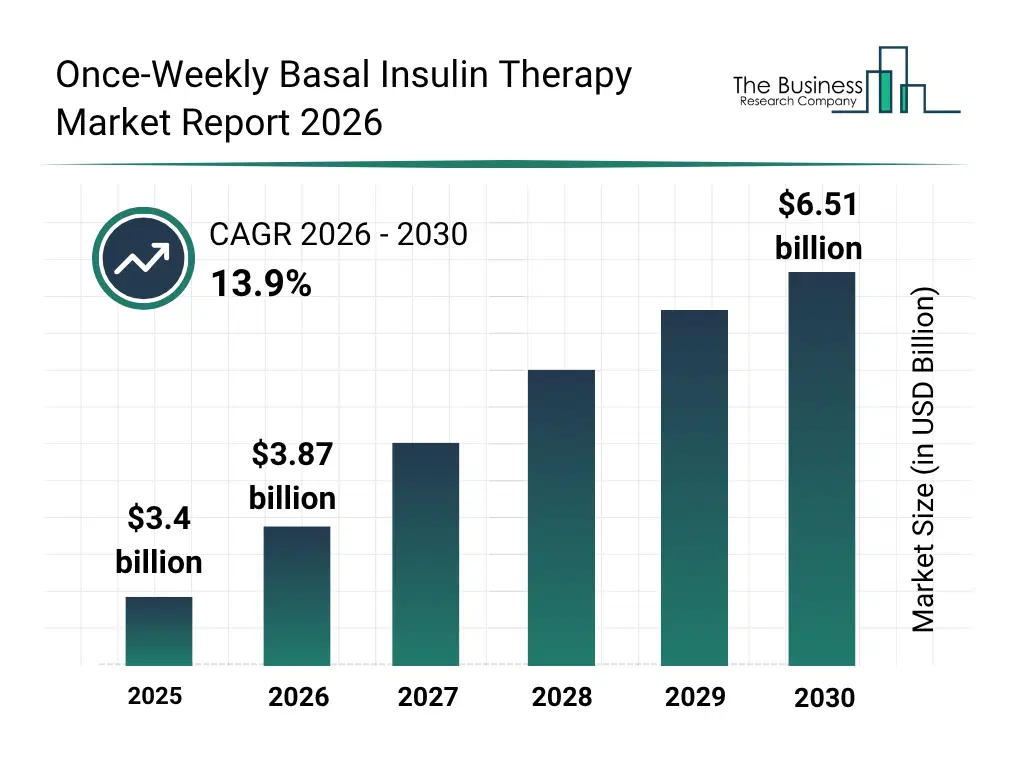
What Is The Once-Weekly Basal Insulin Therapy Market Size and Share 2026?
The once-weekly basal insulin therapy market size has grown rapidly in recent years. It will grow from $3.4 billion in 2025 to $3.87 billion in 2026 at a compound annual growth rate (CAGR) of 13.7%. The growth in the historic period can be attributed to dominance of daily basal insulin injection regimens, limited duration of early insulin analog formulations, poor patient adherence to frequent injection schedules, high complexity of traditional glucose monitoring systems, lack of once weekly basal insulin therapy options.What Is The Once-Weekly Basal Insulin Therapy Market Growth Forecast?
The once-weekly basal insulin therapy market size is expected to see rapid growth in the next few years. It will grow to $6.51 billion in 2030 at a compound annual growth rate (CAGR) of 13.9%. The growth in the forecast period can be attributed to shift toward ultra long acting insulin innovations, increasing demand for patient centric diabetes management solutions, growth of home based and decentralized care models, advancement in sustained release insulin technologies, expansion of basal insulin intensification treatment pathways. Major trends in the forecast period include development of ultra long acting once-weekly basal insulin analogs, improved patient adherence through reduced injection frequency therapies, expansion of prefilled pen and auto injector insulin delivery systems, clinical focus on reducing hypoglycemia risk and improving glycemic stability, increasing adoption of homecare based diabetes management solutions.
Global Once-Weekly Basal Insulin Therapy Market Segmentation
1) By Drug Type: Biosimilar Weekly Insulin, Insulin Icodec Awiqli, Next Generation Ultra Long Acting Insulin 2) By Indication: Insulin Naive Patients, Type Two Diabetes, Type One Diabetes, Patients Requiring Basal Insulin Intensification 3) By Age Group: Geriatric, Adults, Pediatric 4) By End User: Ambulatory Care Centers, Hospitals, Diabetes Care Clinics, Homecare Settings Subsegments: 1) By Biosimilar Weekly Insulin: Reference Biologic Weekly Insulin, Interchangeable Weekly Insulin, Long Acting Biosimilar Insulin, Recombinant Biosimilar Insulin, Prefilled Pen Biosimilar Insulin 2) By Insulin Icodec Awiqli: Prefilled Injection Pen, Basal Once Weekly Insulin, Extended Duration Insulin Therapy, Adult Diabetes Therapy, Subcutaneous Insulin Formulation 3) By Next Generation Ultra Long Acting Insulin: Ultra Long Duration Basal Insulin, Hepato Preferential Insulin, Glucose Responsive Insulin, Combination Basal Insulin Therapy, Smart Insulin FormulationsWhat Are The Drivers Of The Once-Weekly Basal Insulin Therapy Market?
The rising global diabetes prevalence is expected to propel the growth of the once-weekly basal insulin therapy market going forward. Diabetes prevalence refers to the increasing number of individuals diagnosed with diabetes within a population over a specific period. The global diabetes prevalence is increasing due to rising obesity levels and aging populations, which continue to increase diabetes incidence worldwide. Once-weekly basal insulin therapy helps in the management of diabetes mellitus by providing long-acting blood glucose control with fewer injections, improving treatment adherence, and patient convenience. For instance, in April 2025, according to the International Diabetes Federation, a Belgium-based diabetes organization, 589 million adults aged 20–79 years were living with diabetes globally in 2024, and the total number is projected to increase to 853 million by 2050. Therefore, the rising global diabetes prevalence is driving the growth of the once-weekly basal insulin therapy industry. The increasing prevalence of obesity is expected to propel the growth of the once-weekly basal insulin therapy market going forward. Obesity refers to a chronic medical condition characterized by excessive body fat accumulation that increases the risk of metabolic and cardiovascular diseases, including diabetes. The increasing prevalence of obesity is rising due to unhealthy dietary habits, sedentary lifestyles, and reduced physical activity levels worldwide. Once-weekly basal insulin therapy is used in the management of diabetes mellitus to provide long-acting blood glucose control with fewer injections, improving treatment adherence and patient convenience. For instance, in March 2024, according to the World Obesity Federation, a UK-based organization focused on obesity prevention, treatment, and policy advocacy, the number of adults living with obesity is projected to increase from 1.01 billion in 2025 to 1.53 billion by 2035. Therefore, the increasing prevalence of obesity is driving the growth of the once-weekly basal insulin therapy industry.Key Players In The Global Once-Weekly Basal Insulin Therapy Market
Major companies operating in the once-weekly basal insulin therapy market are Eli Lilly and Company, Novo Nordisk A/S, Sanofi, Biocon, Gan & Lee Pharmaceuticals,Tonghua Dongbao Pharmaceutical Co. Ltd.,Gerresheimer AG,Ypsomed Holding AGGlobal Once-Weekly Basal Insulin Therapy Market Trends and Insights
Major companies operating in the once-weekly basal insulin therapy market are focusing on developing advanced long-acting insulin formulations to reduce injection frequency, improve treatment adherence, and enhance patient convenience in diabetes management. Long-acting insulin formulations are insulin therapies designed to provide a steady and prolonged release of insulin to maintain stable blood glucose levels while reducing blood sugar fluctuations and the need for frequent injections. For instance, in March 2026, Novo Nordisk, a Denmark-based pharmaceutical company, received U.S. FDA approval for Awiqli (insulin icodec), the first once-weekly basal insulin treatment for adults with type 2 diabetes. The therapy is designed to reduce injection frequency while supporting improved patient convenience and long-term diabetes management, aligning with the growing adoption of digitally enabled diabetes care solutions.Regional Outlook
North America was the largest region in the once-weekly basal insulin therapy market in 2025. Asia-Pacific is expected to be the fastest-growing region in the forecast period. The regions covered in this market report are Australia, Brazil, China, France, Germany, India, Indonesia, Japan, Taiwan, Russia, South Korea, UK, USA, Canada, Italy, Spain. The countries covered in this market report are Australia, Brazil, China, France, Germany, India, Indonesia, Japan, Taiwan, Russia, South Korea, UK, USA, Canada, Italy, Spain.What Defines the Once-Weekly Basal Insulin Therapy Market?
The once-weekly basal insulin therapy market consists of sales of long-acting weekly insulin formulations, diabetes management therapies, ultra-long-acting insulin analogs, and related products. Values in this market are ‘factory gate’ values, that is the value of goods sold by the manufacturers or creators of the goods, whether to other entities (including downstream manufacturers, wholesalers, distributors and retailers) or directly to end customers. The value of goods in this market includes related services sold by the creators of the goods.How is Market Value Defined and Measured?
The market value is defined as the revenues that enterprises gain from the sale of goods and/or services within the specified market and geography through sales, grants, or donations in terms of the currency (in USD unless otherwise specified). The revenues for a specified geography are consumption values that are revenues generated by organizations in the specified geography within the market, irrespective of where they are produced. It does not include revenues from resales along the supply chain, either further along the supply chain or as part of other products.What Key Data and Analysis Are Included in the Once-Weekly Basal Insulin Therapy Market Report 2026?
The once-weekly basal insulin therapy market research report is one of a series of new reports from The Business Research Company that provides once-weekly basal insulin therapy market statistics, including once-weekly basal insulin therapy industry global market size, regional shares, competitors with a once-weekly basal insulin therapy market share, detailed once-weekly basal insulin therapy market segments, market trends and opportunities, and any further data you may need to thrive in the once-weekly basal insulin therapy industry. This once-weekly basal insulin therapy market research report delivers a complete perspective of everything you need, with an in-depth analysis of the current and future scenario of the industry.Once-Weekly Basal Insulin Therapy Market Report Forecast Analysis
| Report Attribute | Details |
|---|---|
| Market Size Value In 2026 | $3.87 billion |
| Revenue Forecast In 2030 | $6.51 billion |
| Growth Rate | CAGR of 13.9% from 2026 to 2030 |
| Base Year For Estimation | 2025 |
| Actual Estimates/Historical Data | 2020-2025 |
| Forecast Period | 2026 - 2030 |
| Market Representation | Revenue in USD Billion and CAGR from 2026 to 2030 |
| Segments Covered | Drug Type, Indication, Age Group, End User |
| Regional Scope | Asia-Pacific, Western Europe, Eastern Europe, North America, South America, Middle East, Africa |
| Country Scope | The countries covered in the once-weekly basal insulin therapy market report are Australia, Brazil, China, France, Germany, India, Indonesia, Japan, Taiwan, Russia, South Korea, UK, USA, Canada, Italy, Spain. |
| Key Companies Profiled | Eli Lilly and Company, Novo Nordisk A/S, Sanofi, Biocon, Gan & Lee Pharmaceuticals,Tonghua Dongbao Pharmaceutical Co. Ltd.,Gerresheimer AG,Ypsomed Holding AG |
| Customization Scope | Request for Customization |
| Pricing And Purchase Options | Explore Purchase Options |