

Particulate Matter Monitoring Market Report 2026
Global Outlook – By Product Type (Indoor Monitoring, Outdoor Monitoring ), By Particle Size (PM1, PM2.5, PM5, PM10 ), By Technology (Light Scattering, Beta-Attenuation, Gravimetric, Opacity, Other Technologies ), By Application (Process Industries, Ambient Air Monitoring, Indoor Air Monitoring, Healthcare, Other Applications) – Market Size, Trends, Strategies, and Forecast to 2030
Particulate Matter Monitoring Market Overview
• Particulate Matter Monitoring market size has reached to $1.72 billion in 2025 • Expected to grow to $2.99 billion in 2030 at a compound annual growth rate (CAGR) of 11.6% • Growth Driver: Surging Oil And Gas Industry Boosts Particulate Matter Monitoring Market • Market Trend: Advancements in Sensor Fusion Technology for Enhanced Particulate Matter Monitoring • North America was the largest region in 2025.What Is Covered Under Particulate Matter Monitoring Market?
Particulate matter monitoring refers to a device that measures the level of common air pollutants. They are used for the continuous measurements of particle concentrations as they provide valuable data enabling trends that are to be tracked. The main product types in the market for particulate matter monitoring are indoor monitoring and outdoor monitoring. Indoor monitoring refers to a way to gather data on people or things inside a building, which is in the home, office, or factory. The particle size is PM1, PM2.5, PM5, and PM10. The technologies are light scattering, beta-attenuation, gravimetric, opacity, and other technologies. The various applications involved process industries, ambient air monitoring, indoor air monitoring, healthcare, and other applications.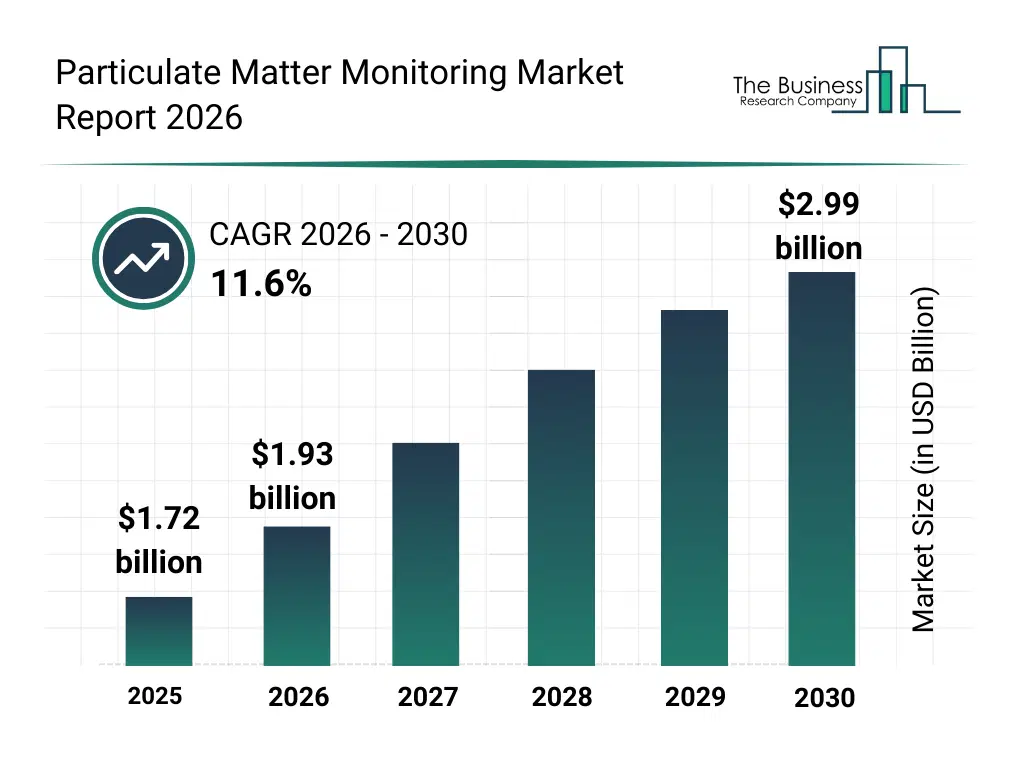
What Is The Particulate Matter Monitoring Market Size and Share 2026?
The particulate matter monitoring market size has grown rapidly in recent years. It will grow from $1.72 billion in 2025 to $1.93 billion in 2026 at a compound annual growth rate (CAGR) of 11.8%. The growth in the historic period can be attributed to increase in urban air pollution levels, implementation of air quality regulations, growth in industrial emissions monitoring, expansion of environmental monitoring programs, rising public health awareness.What Is The Particulate Matter Monitoring Market Growth Forecast?
The particulate matter monitoring market size is expected to see rapid growth in the next few years. It will grow to $2.99 billion in 2030 at a compound annual growth rate (CAGR) of 11.6%. The growth in the forecast period can be attributed to stricter emission and air quality standards, smart city development initiatives, growing focus on indoor air quality, increasing adoption in healthcare environments, advancements in sensor accuracy and miniaturization. Major trends in the forecast period include rising deployment of continuous air quality monitoring systems, growing adoption of real-time particulate sensors, increased use of portable and mobile monitoring devices, expansion of urban ambient air monitoring networks, higher demand for high-accuracy multi-particle detection.Tariff Impact On Particulate Matter Monitoring Market
Tariffs have impacted the particulate matter monitoring market by increasing the cost of imported sensors, optical components, electronic modules, and calibration equipment used in monitoring systems. These effects are most evident in outdoor and ambient air monitoring applications, particularly across asia-pacific and europe where component sourcing is globally distributed. Higher tariffs have raised system procurement costs and slowed large-scale deployment of monitoring networks. At the same time, tariffs have encouraged domestic sensor manufacturing, regional assembly, and local supplier development, supporting long-term market resilience.
Global Particulate Matter Monitoring Market Segmentation
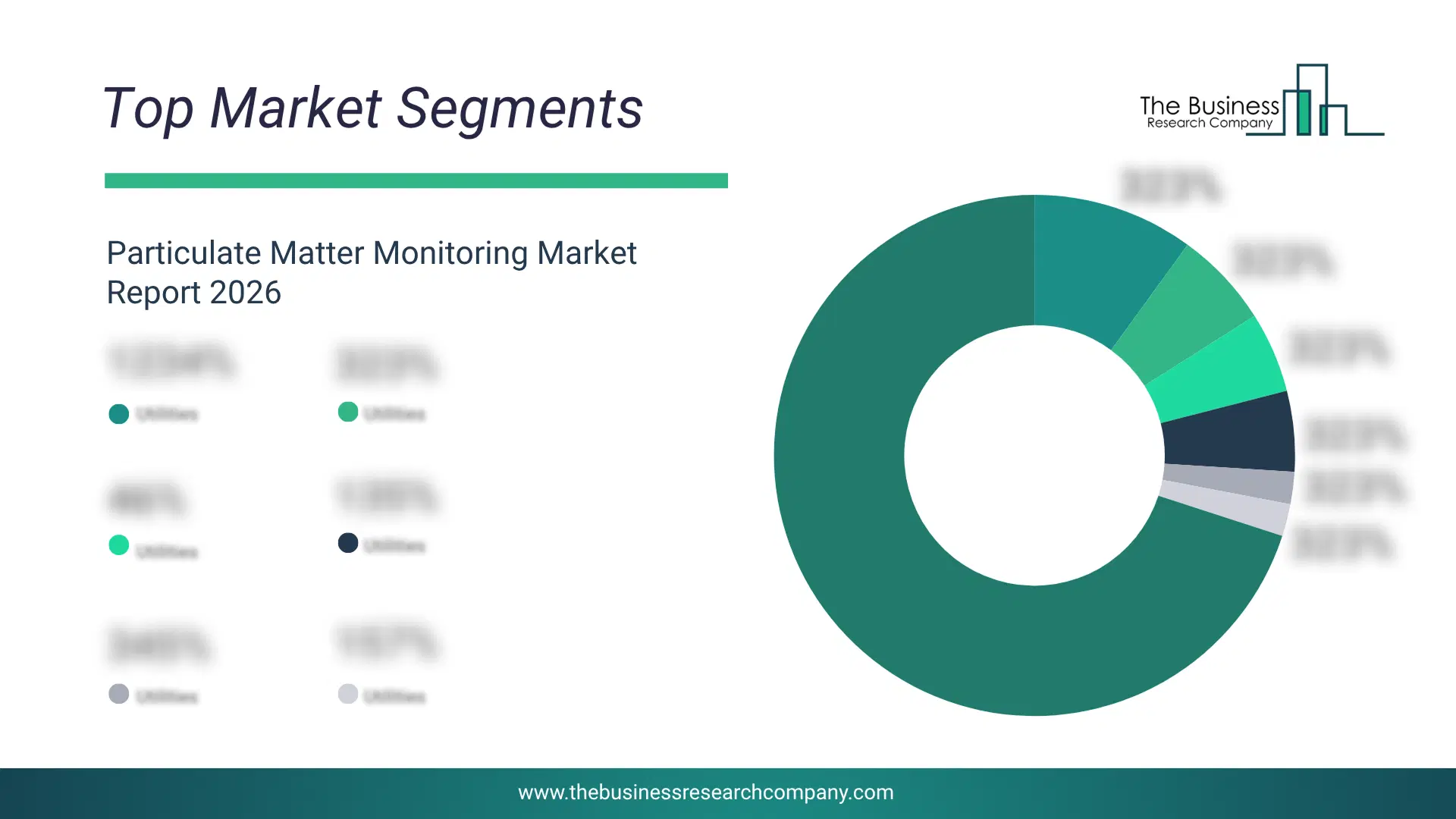
1) By Product Type: Indoor Monitoring, Outdoor Monitoring 2) By Particle Size: PM1, PM2.5, PM5, PM10 3) By Technology: Light Scattering, Beta-Attenuation, Gravimetric, Opacity, Other Technologies 4) By Application: Process Industries, Ambient Air Monitoring, Indoor Air Monitoring, Healthcare, Other Applications Subsegments: 1) By Indoor Monitoring: Portable Indoor Monitors, Fixed Indoor Monitoring Systems 2) By Outdoor Monitoring: Stationary Outdoor Monitors, Mobile Outdoor Monitoring SystemsWhat Is The Driver Of The Particulate Matter Monitoring Market?
The growing oil and gas industry is expected to propel the growth of the particulate matter monitoring market going forward. The oil and gas industry is the sector that deals with a multi-stage process that includes discovering a resource, conveying it to a refinery, and processing it into a finished product. In the oil and gas sectors, a continuous emission monitoring system (CEMS) is required to determine a gas or particulate matter concentration or emission rate. For instance, in December 2024, according to the Energy Information Administration a US-based government agency, U.S. oil production rose from 12.2 million b/d in December 2022 to 13.3 million b/d in December 2023 (an increase of 1.1 million b/d), while natural-gas gross withdrawals increased from 121.1 Bcf/d in December 2022 to 128.8 Bcf/d in December 2023 (a rise of 7.7 Bcf/d). Therefore, the growth of the oil and gas industry is driving the growth of the particulate matter monitoring industry.Key Players In The Global Particulate Matter Monitoring Market
Major companies operating in the particulate matter monitoring market are Aeroqual Ltd., Met One Instruments Inc., Rupprecht & Patashnick Co. Inc., Pegasor Oy, Ecotech Pty Ltd., Environnement SA, Testo AG, KANOMAX USA Inc., Palas GmbH, Cerex Monitoring Solutions LLC, PerkinElmer Inc., Teledyne Technologies Incorporated, Tisch International Incorporated, Opsis AB, ACOEM Group, GRIMM Aerosol Technik GmbH & Co. KG, MSP Corporation, GrayWolf Sensing Solutions, FLIR Systems Inc., Naneos GmbH, Particle Measuring Systems, MCZ Centrum s.r.o., Sintrol, Nephelometer Systems Ltd.
This chart is for illustrative purposes; the full report includes a detailed competitor analysis and comprehensive overview of the top 10 companies in the market.
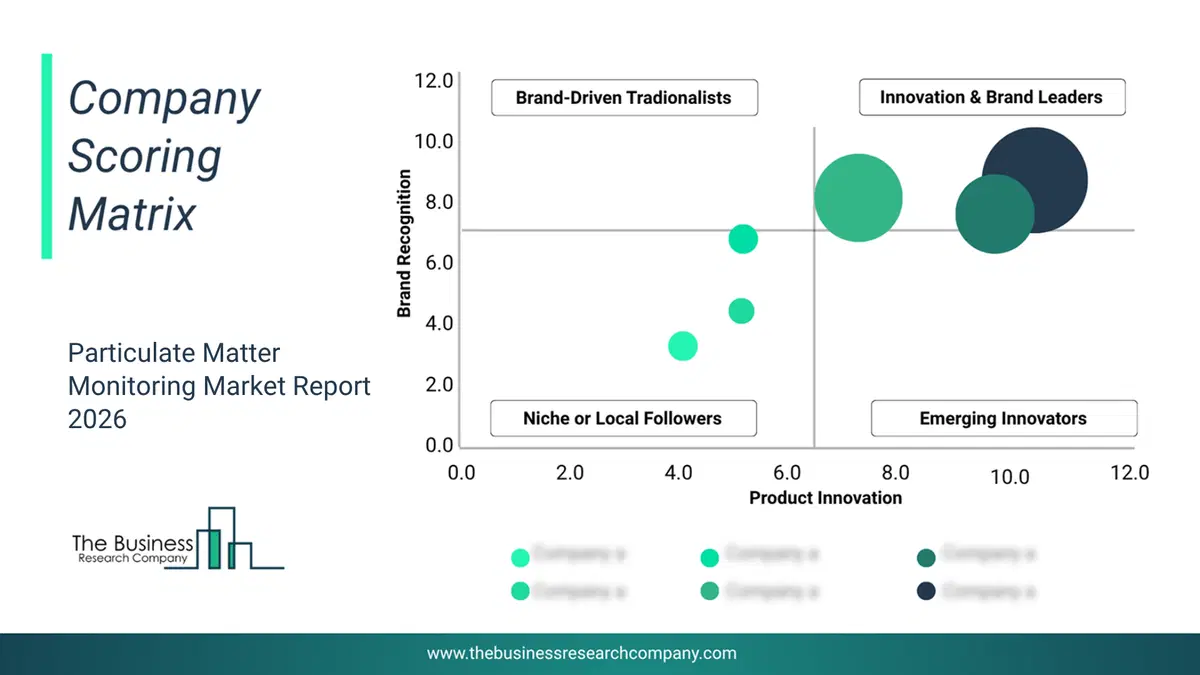
This chart maps companies by product innovation and brand strength, with bubble size indicating relative revenue, helping identify market leaders, challengers, and niche players. This is an illustrative chart; the full report provides a complete and accurate competitive analysis.
Global Particulate Matter Monitoring Market Trends and Insights
Major companies operating in the Particulate Matter Monitoring Market are focusing on developing sensor fusion technology to enhance measurement accuracy, real-time data analysis, and the overall effectiveness of air quality monitoring systems. Sensor fusion technology combines data from multiple sensors to enhance the accuracy and reliability of information and improve decision-making in various applications. For instance, In August 2024, Renesas Electronics, a Japan-based semiconductor manufacturing company, launched the RRH62000. The RRH62000 can monitor up to seven different parameters simultaneously, including particulate matter (PM1, PM2.5, PM10), total volatile organic compounds (VOCs), temperature, and humidity.What Are Latest Mergers And Acquisitions In The Particulate Matter Monitoring Market?
In July 2023, Thermo Fisher Scientific Inc., a US-based biotechnology company, acquired CorEvitas, LLC, for an undisclosed amount. With its acquisitions, Thermo Fisher Scientific typically aims to enhance its capabilities in various areas, such as expanding its portfolio of products and services, increasing its market presence, and improving its technological offerings. CorEvitas is a US-based health data and analytics company that specializes in real-world evidence generation.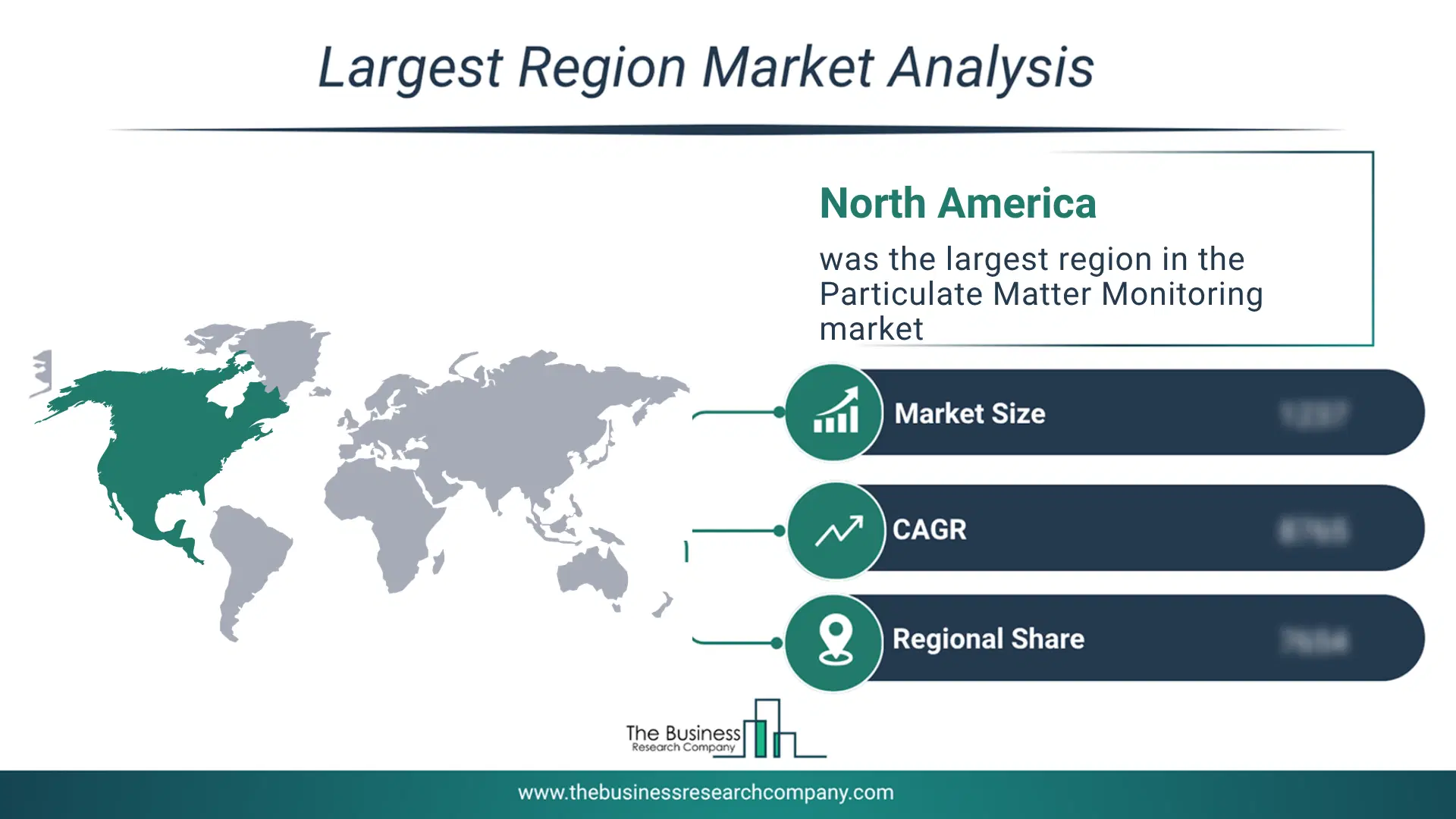
Regional Outlook
North America was the largest region in the particulate matter monitoring market in 2025. The regions covered in this market report are Asia-Pacific, South East Asia, Western Europe, Eastern Europe, North America, South America, Middle East, Africa The countries covered in this market report are Australia, Brazil, China, France, Germany, India, Indonesia, Japan, Taiwan, Russia, South Korea, UK, USA, Canada, Italy, Spain.What Defines the Particulate Matter Monitoring Market?
The particulate matter monitoring market consists of sales of services such as air quality analysis, ambient gas monitoring, ambient particulate monitoring, sensor air quality monitoring, source gas monitoring, industrial hygiene, and wastewater gas monitoring. Values in this market are ‘factory gate’ values, that is the value of goods sold by the manufacturers or creators of the goods, whether to other entities (including downstream manufacturers, wholesalers, distributors, and retailers) or directly to end customers.How is Market Value Defined and Measured?
The market value is defined as the revenues that enterprises gain from the sale of goods and/or services within the specified market and geography through sales, grants, or donations in terms of the currency (in USD unless otherwise specified). The revenues for a specified geography are consumption values that are revenues generated by organizations in the specified geography within the market, irrespective of where they are produced. It does not include revenues from resales along the supply chain, either further along the supply chain or as part of other products.
This chart presents market attractiveness based on a quantitative evaluation of growth, competition, strategic alignment, and risk, offering a clear view of opportunity areas for decision-making. This chart is for illustrative purposes; the full report contains the complete analysis.

This chart highlights the Total Addressable Market (TAM) by estimating the maximum revenue opportunity using an assumption-driven approach, supporting strategic planning and opportunity sizing across markets. The chart is illustrative; the full report provides a more comprehensive analysis.
What Key Data and Analysis Are Included in the Particulate Matter Monitoring Market Report 2026?
The particulate matter monitoring market research report is one of a series of new reports from The Business Research Company that provides market statistics, including industry global market size, regional shares, competitors with the market share, detailed market segments, market trends and opportunities, and any further data you may need to thrive in the particulate matter monitoring industry. The market research report delivers a complete perspective of everything you need, with an in-depth analysis of the current and future state of the industry.Particulate Matter Monitoring Market Report Forecast Analysis
| Report Attribute | Details |
|---|---|
| Market Size Value In 2026 | $1.93 billion |
| Revenue Forecast In 2030 | $2.99 billion |
| Growth Rate | CAGR of 11.6% from 2026 to 2030 |
| Base Year For Estimation | 2025 |
| Actual Estimates/Historical Data | 2020-2025 |
| Forecast Period | 2026 - 2030 |
| Market Representation | Revenue in USD Billion and CAGR from 2026 to 2030 |
| Segments Covered | Product Type, Particle Size, Technology, Application |
| Regional Scope | Asia-Pacific, Western Europe, Eastern Europe, North America, South America, Middle East, Africa |
| Key Companies Profiled | Aeroqual Ltd., Met One Instruments Inc., Rupprecht & Patashnick Co. Inc., Pegasor Oy, Ecotech Pty Ltd., Environnement SA, Testo AG, KANOMAX USA Inc., Palas GmbH, Cerex Monitoring Solutions LLC, PerkinElmer Inc., Teledyne Technologies Incorporated, Tisch International Incorporated, Opsis AB, ACOEM Group, GRIMM Aerosol Technik GmbH & Co. KG, MSP Corporation, GrayWolf Sensing Solutions, FLIR Systems Inc., Naneos GmbH, Particle Measuring Systems, MCZ Centrum s.r.o., Sintrol, Nephelometer Systems Ltd. |
| Customization Scope | Request for Customization |
| Pricing And Purchase Options | Explore Purchase Options |