
Pasta Market Report 2026
Global Outlook – By Product Type (Dried Pasta, Fresh Pasta, Filled Pasta, Instant Pasta, Gluten Free Pasta), By Ingredient Type (Wheat Based Pasta, Semolina Pasta, Whole Wheat Pasta, Rice Based Pasta, Corn Based Pasta, Multigrain Pasta, Legume Based Pasta), By Packaging Type (Boxed Packaging, Bagged Packaging, Canned Pasta, Frozen Packaging), By Application (Main Course Meals, Ready To Eat Meals, Ready To Cook Meals, Snacks And Quick Meals), By End User (Household Consumers, Restaurants And Cafes, Hotels, Catering Services, Institutional Buyers) – Market Size, Trends, Strategies, and Forecast to 2030
Pasta Market Overview
• Pasta market size has reached to $69.76 billion in 2025 • Expected to grow to $74.83 billion in 2030 at a compound annual growth rate (CAGR) of 7.5% • Growth Driver: Increasing Demand For Convenient Meals Fueling The Growth Of The Market Due To Quick Preparation, Easy Consumption, And Rising Preference For Time-saving Food Options • Market Trend: Product Innovation In Ready To Eat And Instant Pasta Segments • Europe was the largest region in 2025 and Asia-Pacific is the fastest growing region.What Is Covered Under Pasta Market?
Pasta refers to a food product made primarily from unleavened dough of wheat flour mixed with water, and sometimes eggs or other ingredients, which is shaped into various forms and typically dried for preservation. It is designed to provide a versatile, shelf-stable staple food that can be prepared through boiling or baking and adapted to a wide range of culinary applications. It is produced using standardized processing techniques to ensure consistency in texture, cooking performance, and nutritional profile. The main product types of pasta include dried pasta, fresh pasta, filled pasta, instant pasta, and gluten free pasta. Dried pasta refers to pasta that is dehydrated for long shelf life and convenient storage while retaining its texture after cooking. These products are categorized based on ingredient type into wheat based pasta, semolina pasta, whole wheat pasta, rice based pasta, corn based pasta, multigrain pasta, and legume based pasta depending on formulation preferences. They are offered in packaging types including boxed packaging, bagged packaging, canned pasta, and frozen packaging to preserve freshness and usability. They find applications including main course meals, ready to eat meals, ready to cook meals, and snacks and quick meals, and they are used by several end users such as household consumers, restaurants and cafes, hotels, catering services, and institutional buyers.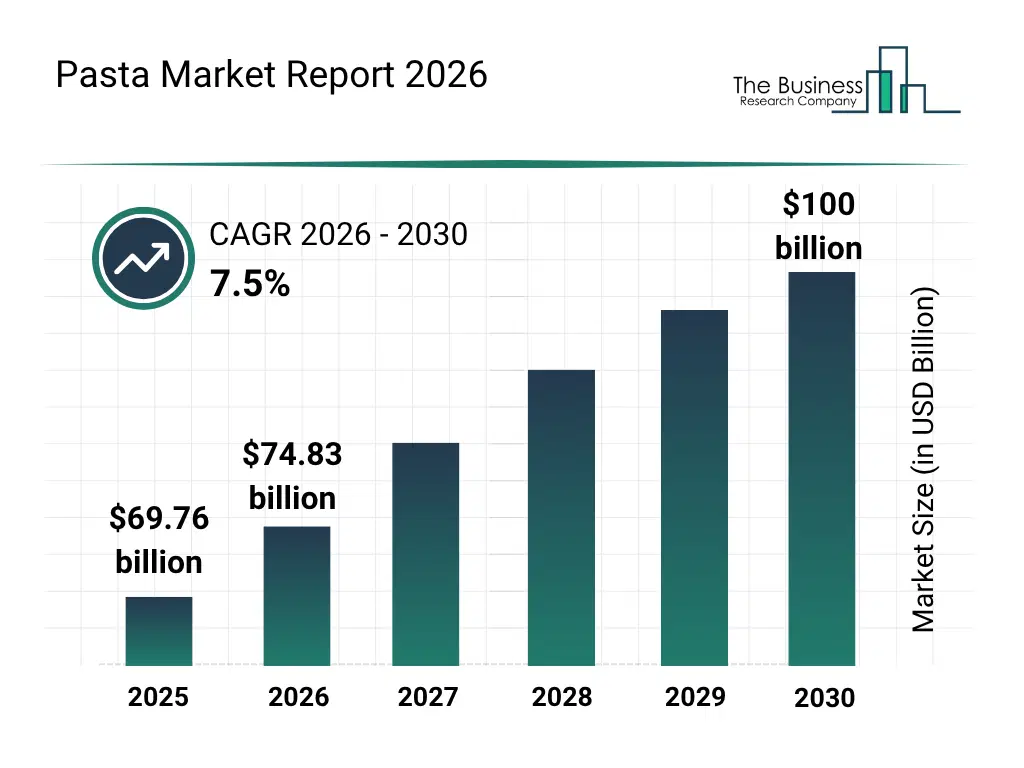
What Is The Pasta Market Size and Share 2026?
The pasta market size has grown strongly in recent years. It will grow from $69.76 billion in 2025 to $74.83 billion in 2026 at a compound annual growth rate (CAGR) of 7.3%. The growth in the historic period can be attributed to growing consumption of convenience foods, rising urbanization and busy lifestyles, increasing popularity of italian cuisine globally, expansion of retail food distribution channels, growing demand for affordable staple foods.What Is The Pasta Market Growth Forecast?
The pasta market size is expected to see strong growth in the next few years. It will grow to $100 billion by 2030 at a compound annual growth rate (CAGR) of 7.5%. The growth in the forecast period can be attributed to increasing demand for plant-based food products, rising health consciousness among consumers, growing innovation in gluten-free and functional pasta, expansion of online grocery retail channels, increasing adoption of premium and organic pasta products. Major trends in the forecast period include increasing demand for gluten-free pasta products, rising popularity of high-protein and legume-based pasta, growing consumer preference for premium artisan pasta, expansion of ready-to-cook and instant pasta offerings, rising adoption of innovative sustainable packaging solutions.
Global Pasta Market Segmentation
1) By Product Type: Dried Pasta, Fresh Pasta, Filled Pasta, Instant Pasta, Gluten Free Pasta 2) By Ingredient Type: Wheat Based Pasta, Semolina Pasta, Whole Wheat Pasta, Rice Based Pasta, Corn Based Pasta, Multigrain Pasta, Legume Based Pasta 3) By Packaging Type: Boxed Packaging, Bagged Packaging, Canned Pasta, Frozen Packaging 4) By Application: Main Course Meals, Ready To Eat Meals, Ready To Cook Meals, Snacks And Quick Meals 5) By End User: Household Consumers, Restaurants And Cafes, Hotels, Catering Services, Institutional Buyers Subsegments: 1) By Dried Pasta: Long Cut Pasta, Short Cut Pasta, Sheet Pasta, Specialty Shapes 2) By Fresh Pasta: Long Fresh Pasta, Stuffed Fresh Pasta, Sheet Fresh Pasta, Artisan Fresh Pasta 3) By Filled Pasta: Meat-Filled Pasta, Cheese-Filled Pasta, Vegetable-Filled Pasta, Mixed Filling Pasta 4) By Instant Pasta: Cup Pasta, Packet Pasta, Ready-To-Eat Pasta Meals, Flavored Instant Pasta 5) By Gluten-Free Pasta: Rice-Based Pasta, Corn-Based Pasta, Quinoa-Based Pasta, Legume-Based Pasta, Multi-Grain Gluten-Free PastaWhat Is The Driver Of The Pasta Market?
The increasing demand for convenient meals is expected to propel the growth of the pasta market going forward. Convenient meals are food products that require minimal preparation time and enable quick consumption with limited cooking effort. The demand for convenient meals is increasing due to rising urban employment levels that reduce time available for home cooking. Pasta is widely used in convenient meals as it cooks quickly, is easy to prepare, pairs with various sauces and ingredients, and is available in ready-to-eat or instant formats. For instance, in October 2024, according to the Department Of Agriculture, a US-based government statistics source, in 2023, food away from home accounted for 58.5% of total food spending compared to 56.0% in 2022. Therefore, the increasing demand for convenient meals is driving the growth of the pasta industry.Key Players In The Global Pasta Market
Major companies operating in the pasta market are Nestlé S.A.; The Campbell’s Company; Jollibee Foods Corporation; Barilla G. e R. Fratelli S.p.A; Ebro Foods S.A.; TreeHouse Foods Inc; Panzani Group; Makfa Joint Stock Company; Borges International Group S.L.U.; F.lli De Cecco di Filippo Fara San Martino S.p.A; La Molisana S.p.A; Pastificio Lucio Garofalo S.p.A; Pastas Gallo S.L.; Italpasta Limited; Giovanni Rana USA Inc.; Eataly S.r.l.; Pizza Hut LLC; Blue Bird Foods (India) Private Limited; Banza LLC; Gustora Foods Pvt. Ltd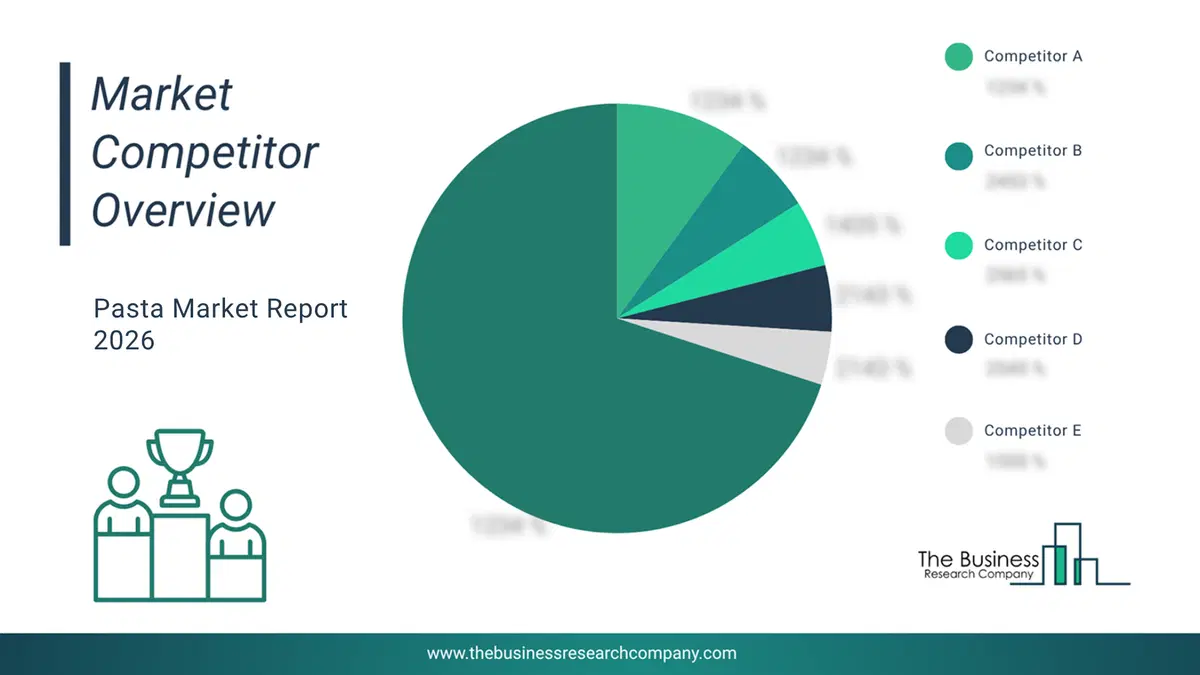
This chart is for illustrative purposes; the full report includes a detailed competitor analysis and comprehensive overview of the top 10 companies in the market.
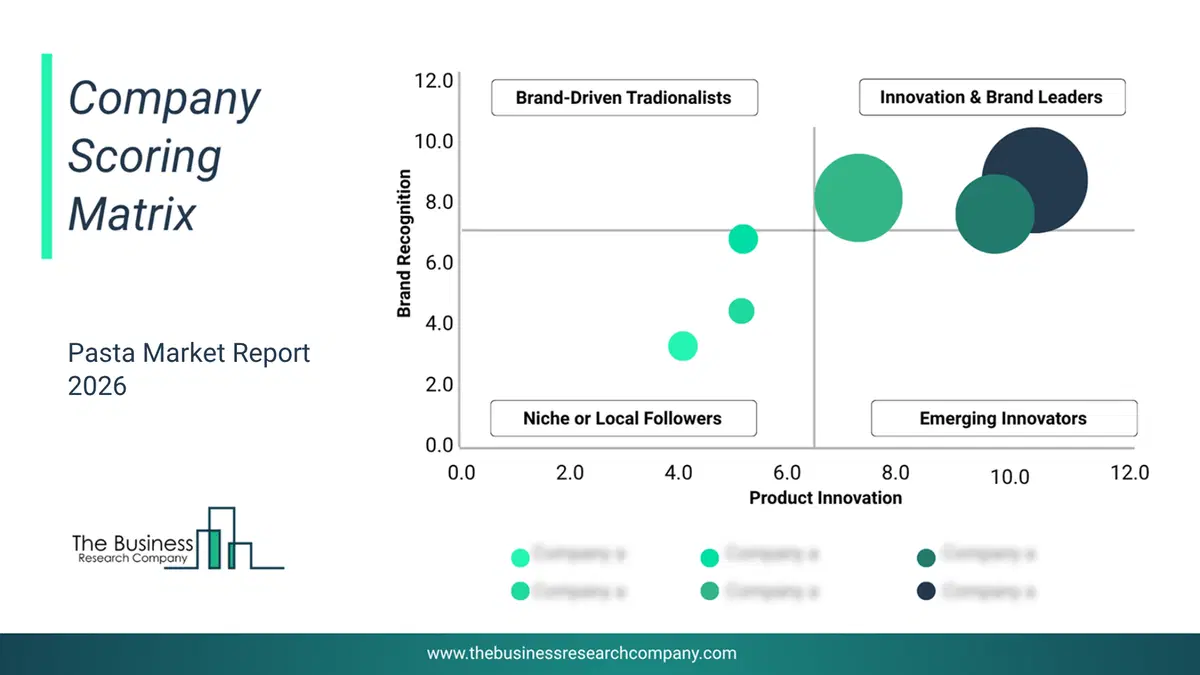
This chart maps companies by product innovation and brand strength, with bubble size indicating relative revenue, helping identify market leaders, challengers, and niche players. This is an illustrative chart; the full report provides a complete and accurate competitive analysis.
Global Pasta Market Trends and Insights
Major companies operating in the pasta market are focusing on developing innovative products, such as rapid-cook ready-to-eat pasta to enhance meal convenience, reduce preparation time, and maintain product quality through steam-cooking technology, microwave-ready packaging, and natural ingredient formulations. Rapid-cook ready-to-eat pasta refer to processed pasta products designed for extremely short cooking or heating times while preserving texture, flavor, and nutritional integrity through advanced processing and packaging technologies. For instance, in April 2023, Pasta Noodle Co., a US-based food company, launched a rapid-cook ready-to-eat pasta range featuring a two-minute preparation time, steam-cooked pasta technology, and formulations made with natural ingredients and no preservatives to deliver an authentic Italian-style eating experience. The product line debuted in three flavors such as Marinara, Spicy Marinara, and Italian Mac and Cheese and was designed to deliver authentic Italian-style pasta meals without requiring cookware or a stovetop. The innovation aimed to meet rising demand for convenient, high-quality meal solutions in the ready-to-eat pasta segment.What Are Latest Mergers And Acquisitions In The Pasta Market?
In December 2024, Platinum Equity LLC, a US-based private equity investment company, acquired a majority stake in F.lli Polli S.p.A. for an undisclosed amount. Through this acquisition, Platinum Equity aims to expand its portfolio in the packaged food sector by strengthening capabilities in condiments, preserves, and complementary pasta-related categories. F.lli Polli S.p.A. is an Italy-based food company that produces pasta condiments, pesto sauces, vegetable preserves, and ready-to-use food products.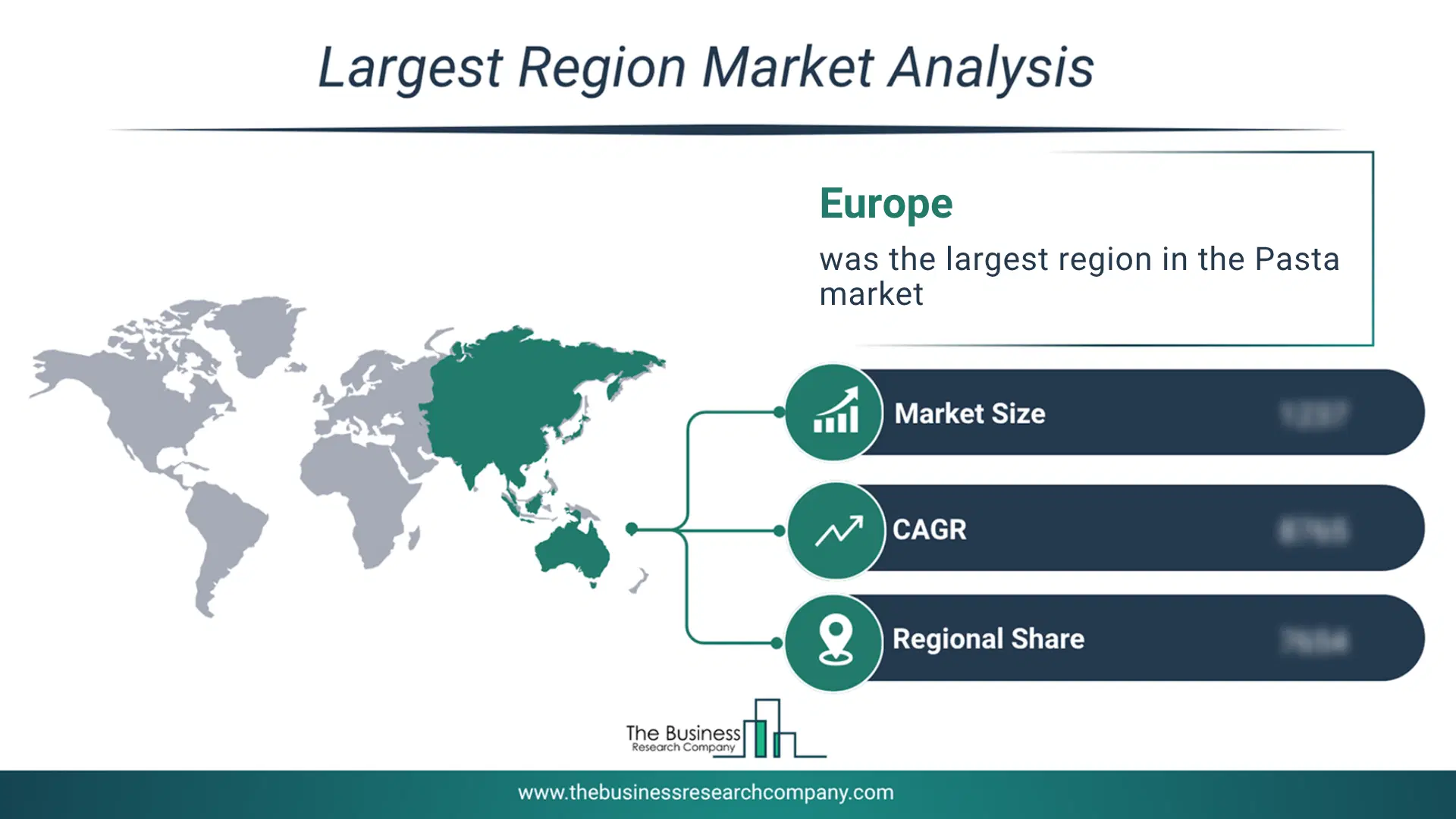
Regional Insights
Europe was the largest region in the pasta market in 2025. Asia-Pacific is expected to be the fastest-growing region in the forecast period. The regions covered in this market report are Asia-Pacific, South East Asia, Western Europe, Eastern Europe, North America, South America, Middle East, Africa. The countries covered in this market report are Australia, Brazil, China, France, Germany, India, Indonesia, Japan, Taiwan, Russia, South Korea, UK, USA, Canada, Italy, Spain.What Defines the Pasta Market?
The pasta market consists of sales of frozen pasta, whole wheat pasta, semolina pasta, stuffed pasta, noodles, macaroni, spaghetti, penne, fusilli, ravioli, lasagna sheets, and ready-to-cook pasta meals. Values in this market are ‘factory gate’ values, that is, the value of goods sold by the manufacturers or creators of the goods, whether to other entities (including downstream manufacturers, wholesalers, distributors, and retailers) or directly to end customers. The value of goods in this market includes related services sold by the creators of the goods.How is Market Value Defined and Measured?
The market value is defined as the revenues that enterprises gain from the sale of goods and/or services within the specified market and geography through sales, grants, or donations in terms of the currency (in USD unless otherwise specified). The revenues for a specified geography are consumption values that are revenues generated by organizations in the specified geography within the market, irrespective of where they are produced. It does not include revenues from resales along the supply chain, either further along the supply chain or as part of other products.
This chart presents market attractiveness based on a quantitative evaluation of growth, competition, strategic alignment, and risk, offering a clear view of opportunity areas for decision-making. This chart is for illustrative purposes; the full report contains the complete analysis.

This chart highlights the Total Addressable Market (TAM) by estimating the maximum revenue opportunity using an assumption-driven approach, supporting strategic planning and opportunity sizing across markets. The chart is illustrative; the full report provides a more comprehensive analysis.
What Key Data and Analysis Are Included in the Pasta Market Report 2026?
The pasta market research report is one of a series of new reports from The Business Research Company that provides market statistics, including industry global market size, regional shares, competitors with the market share, detailed market segments, market trends and opportunities, and any further data you may need to thrive in the pasta industry. The market research report delivers a complete perspective of everything you need, with an in-depth analysis of the current and future state of the industry.Pasta Market Report Forecast Analysis
| Report Attribute | Details |
|---|---|
| Market Size Value In 2026 | $74.83 billion |
| Revenue Forecast In 2030 | $100 billion |
| Growth Rate | CAGR of 7.50% from 2026 to 2030 |
| Base Year For Estimation | 2025 |
| Actual Estimates/Historical Data | 2020-2025 |
| Forecast Period | 2026 - 2030 |
| Market Representation | Revenue in USD Billion and CAGR from 2026 to 2030 |
| Segments Covered | Product Type, Ingredient Type, Packaging Type, Application, End User |
| Regional Scope | Asia-Pacific, Western Europe, Eastern Europe, North America, South America, Middle East, Africa |
| Country Scope | The countries covered in the report are Australia, Brazil, China, France, Germany, India, Indonesia, Japan, Taiwan, Russia, South Korea, UK, USA, Canada, Italy, Spain. |
| Key Companies Profiled | Nestlé S.A.; The Campbell’s Company; Ebro Foods S.A.; TreeHouse Foods Inc.; Barilla G. e R. Fratelli S.p.A; Jollibee Foods Corporation; Borges International Group S.L.U.; Eataly S.r.l.; Panzani Group; Giovanni Rana USA Inc.; Pasta Zara SpA; Pastificio Lucio Garofalo S.p.A; F.lli De Cecco di Filippo Fara San Martino S.p.A; La Molisana S.p.A; Pastas Gallo S.L.; Makfa Joint Stock Company; Italpasta Limited; Blue Bird Foods (India) Private Limited; Banza LLC; Gustora Foods Pvt. Ltd |
| Customization Scope | Request for Customization |
| Pricing And Purchase Options | Explore Purchase Options |