
Peer-to-Peer (P2P) Lending Market Report 2026
Global Outlook – By Loan Type (Consumer Credit Loans, Small Business Loans), By Business Model (Marketplace Lending, Alternative Marketplace Lending), By End User (Business, Personal) – Market Size, Trends, Strategies, and Forecast to 2030
Peer-to-Peer (P2P) Lending Market Overview
• Peer-to-Peer (P2P) Lending market size has reached to $250.11 billion in 2025 • Expected to grow to $938.02 billion in 2030 at a compound annual growth rate (CAGR) of 30.1% • Growth Driver: Digital Transformation In Banking Fuels P2P Lending Market Growth • Market Trend: Advancements In Decentralized Lending Solutions • North America was the largest region in 2025 and Aisa-Pacific is the fastest growing region.Market Gains By 2030 – Top Opportunities By Segment
Market Gain identifies the most promising market opportunities by highlighting the segments or products expected to generate the highest incremental revenue growth over the next five years.
What Is Covered Under Peer-to-Peer (P2P) Lending Market?
Peer-to-peer lending (P2P) refers to a method of lending money directly to individuals or businesses without the use of an official financial institution as a middleman. P2P lending is typically done through internet platforms that connect potential borrowers with lenders. The peer-to-peer (P2P) lending is used to connect investors wanting higher returns on their investments with verified borrowers seeking unsecured personal loans. The main types of loans in peer-to-peer (P2P) lending are consumer credit loans, small business loans, student loans, and real estate loans. The traditional lending model refers to a traditional mode of transaction that is used for purchasing or selling goods or services from one person to another without using the internet. It refers to an older method of business style and comes under a traditional business that includes direct interaction between seller and buyer and is carried out by face-to-face, telephone lines, or mail systems. The two types of business models include traditional lending and alternate marketplace lending that are provided to end-users such as businesses and individuals.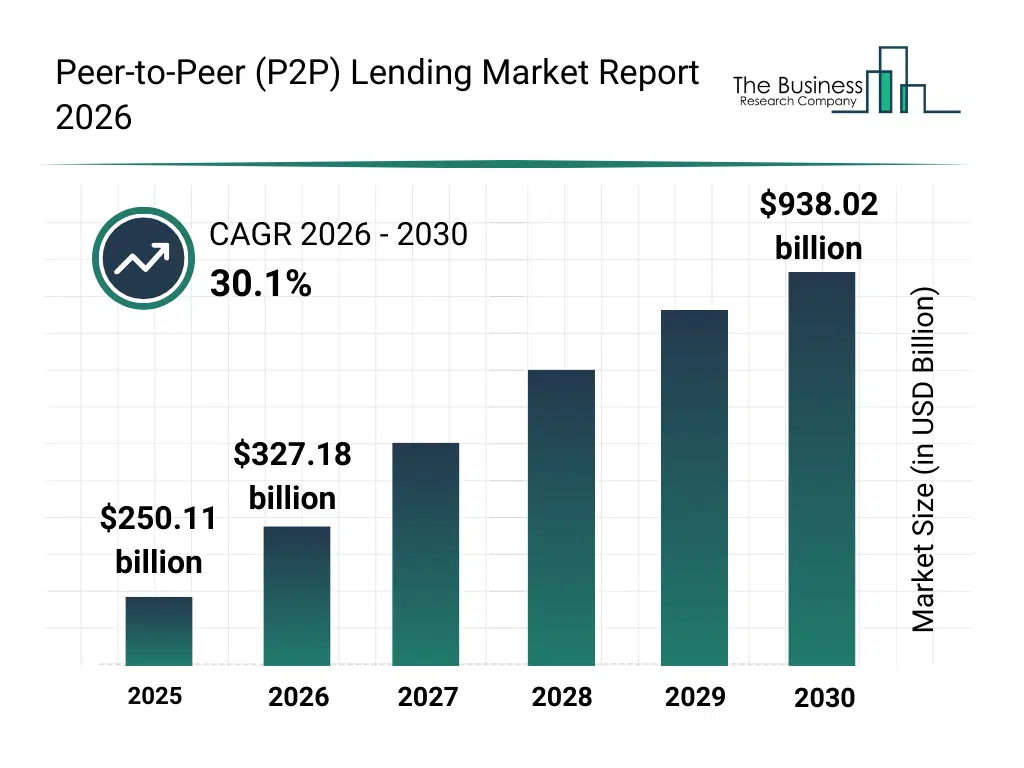
What Is The Peer-to-Peer (P2P) Lending Market Size and Share 2026?
The peer-to-peer (p2p) lending market size has grown exponentially in recent years. It will grow from $250.11 billion in 2025 to $327.18 billion in 2026 at a compound annual growth rate (CAGR) of 30.8%. The growth in the historic period can be attributed to increasing demand for unsecured personal loans, limited access to traditional banking credit, rising internet penetration, growth of fintech platforms, increasing participation of retail investors.What Is The Peer-to-Peer (P2P) Lending Market Growth Forecast?
The peer-to-peer (p2p) lending market size is expected to see exponential growth in the next few years. It will grow to $938.02 billion in 2030 at a compound annual growth rate (CAGR) of 30.1%. The growth in the forecast period can be attributed to increasing regulatory oversight of p2p platforms, rising adoption of blockchain for loan transparency, expansion of small business financing demand, growing focus on platform risk management, increasing cross-border p2p lending activity. Major trends in the forecast period include increasing use of ai-based credit assessment models, rising adoption of alternative lending platforms, growing focus on risk-based pricing mechanisms, expansion of digital investor-borrower marketplaces, enhanced emphasis on platform transparency.
Global Peer-to-Peer (P2P) Lending Market Segmentation
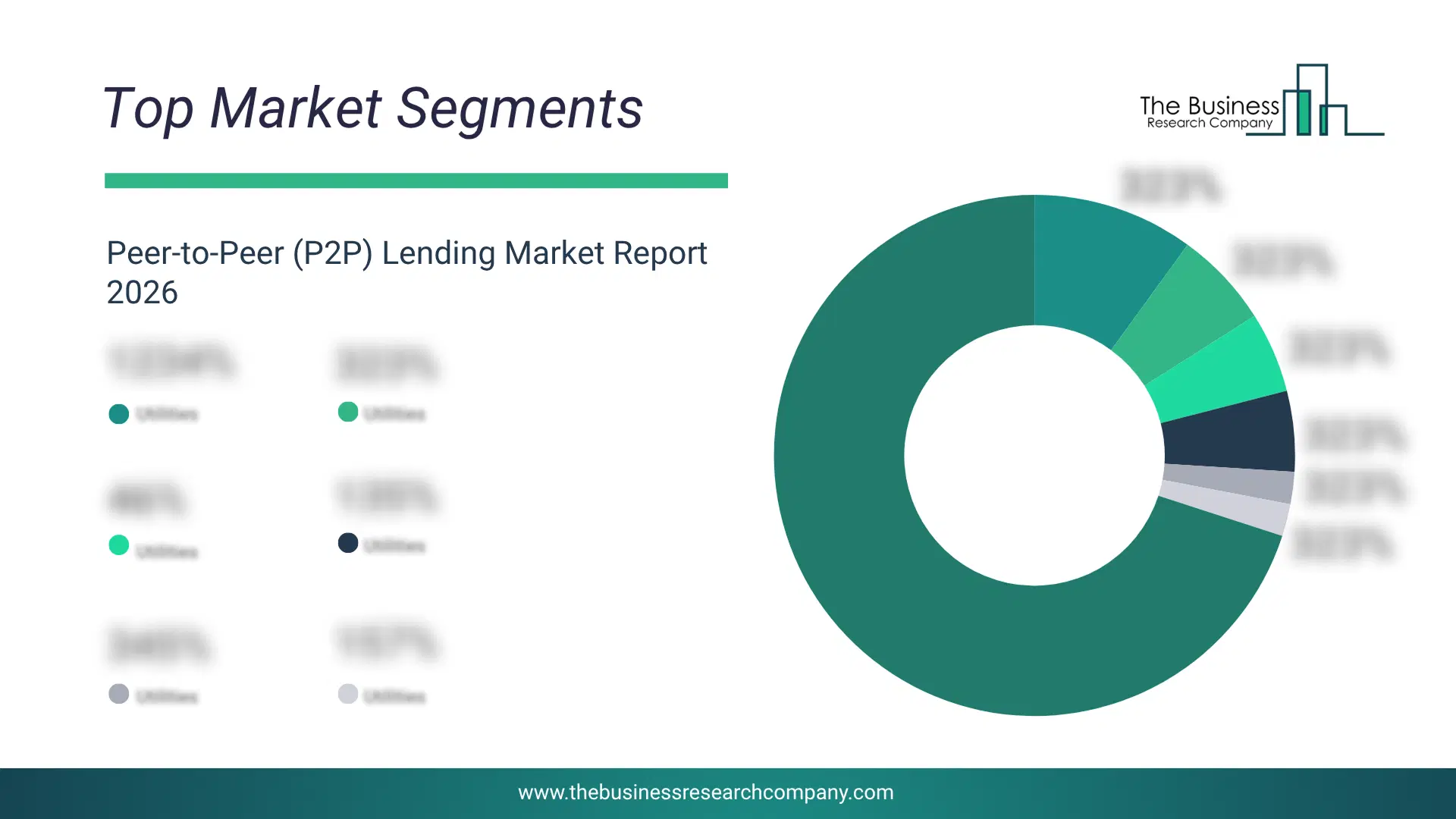
1) By Loan Type: Consumer Credit Loans, Small Business Loans 2) By Business Model: Marketplace Lending, Alternative Marketplace Lending 3) By End User: Business, Personal Subsegments: 1) By Consumer Credit Loans: Personal Loans, Debt Consolidation Loans, Home Improvement Loans, Medical Expense Loans 2) By Small Business Loans: Start-Up Loans, Working Capital Loans, Equipment Financing, Franchise Financing The top segments in the peer-to-peer (p2p) lending market will be: • Consumer Credit Loans will reach $484.31 Billion by 2030. • Real Estate Loans will reach $232.39 Billion by 2030. • Small Business Loans will reach $158.31 Billion by 2030. • Student Loans will reach $58.22 Billion by 2030.What Is The Driver Of The Peer-to-Peer (P2P) Lending Market?
Increasing digitization in the banking industry is expected to propel the growth of the peer to peer (P2P) lending market going forward. Digital innovation in the banking industry is transforming financial services such as mobile money, peer-to-peer (P2P), or marketplace lending. For instance, in July 2025, according to the Bangko Sentral ng Pilipinas, a Philippines-based central banking authority, digital retail payments accounted for 57.4% of total transaction volume in 2024, marking a year-on-year increase of 4.6 percentage points from 2023. Therefore, the increasing digitization in the banking industry is driving the growth of the peer to peer (P2P) lending market.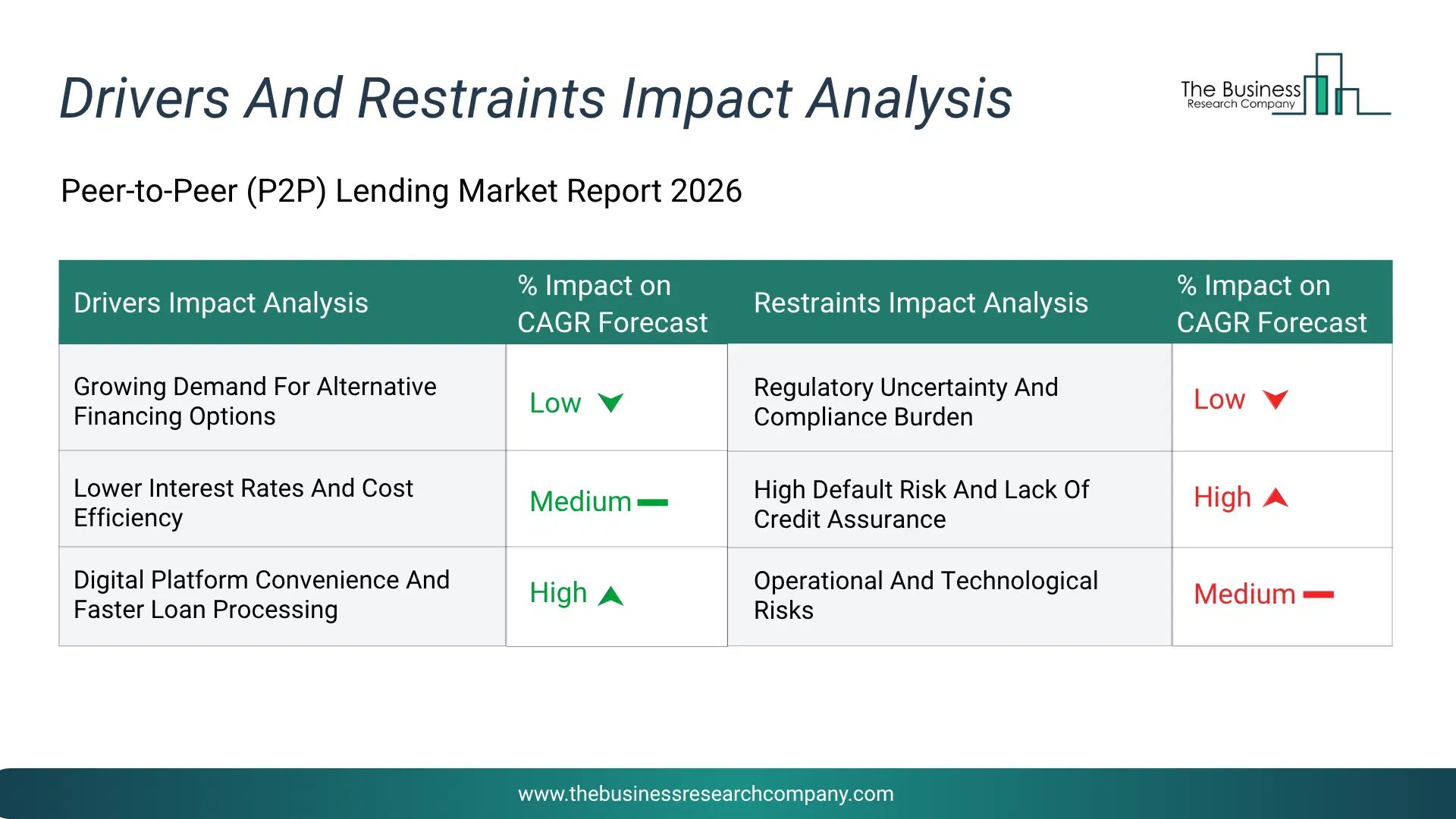
Infographic Chart Showing Key Market Drivers Analysis And Restraints For Peer-To-Peer (P2P) Lending Market
The chart presents an impact analysis of key drivers and restraints, quantifying their relative influence on the market's growth rate and helping assess the balance between growth enablers and limiting factors. This chart offers a high-level perspective; the full report contains more detailed insights.
How Will The Drivers Impact Growth In The Global Peer-to-Peer (P2P) Lending Market?
• Growing Demand For Alternative Financing Options (Low) – During the forecast period, the growing demand for alternative financing options is expected to become a key growth driver for the peer-to-peer (P2P) lending market by 2030. Growing demand for alternative financing options acts as a major driver for the peer-to-peer lending market as traditional banking systems often fail to meet the needs of underserved individuals and small businesses. Many borrowers face strict eligibility criteria, long approval times, and lack of access to formal credit channels. P2P platforms provide an accessible and flexible solution, enabling borrowers to secure funds quickly. This rising demand is particularly strong in emerging economies where financial inclusion is still developing. Additionally, investors are attracted by the opportunity to earn higher returns compared to conventional savings instruments. The dual benefit for both borrowers and lenders significantly accelerates market growth. As awareness and trust in alternative finance increase, the adoption of P2P lending platforms continues to expand globally. • Lower Interest Rates And Cost Efficiency (Medium) – During the forecast period, the lower interest rates and cost efficiency is expected to emerge as a major factor driving the expansion of the peer-to-peer (P2P) lending market by 2030. Lower interest rates and cost efficiency drive the growth of the peer-to-peer lending market by offering a financially attractive alternative to traditional financial institutions. Since P2P platforms eliminate intermediaries such as banks, they operate with reduced overhead costs. These savings are passed on to borrowers in the form of lower interest rates while still ensuring competitive returns for lenders. The digital nature of these platforms reduces expenses related to infrastructure, staffing, and operations. This efficiency makes P2P lending particularly appealing in price-sensitive markets. Furthermore, lower costs enhance scalability and allow platforms to serve a larger customer base. As cost advantages become more evident, both borrowers and investors increasingly prefer P2P lending solutions. • Digital Platform Convenience And Faster Loan Processing (High) – During the forecast period, the digital platform convenience and faster loan processing is expected to act as a key growth catalyst for the peer-to-peer (P2P) lending market by 2030. Digital platform convenience and faster loan processing significantly contribute to the expansion of the peer-to-peer lending market. These platforms leverage advanced technologies such as artificial intelligence and automated systems to streamline loan approvals. Borrowers can complete applications online and receive approvals within a short time, often within hours. This speed and convenience provide a strong advantage over traditional banks, which typically involve lengthy procedures. Additionally, user-friendly interfaces and mobile accessibility enhance customer experience. Increased internet penetration and smartphone usage further support adoption. As consumers prioritize speed and ease of access, digital lending platforms continue to gain widespread acceptance.How Will The Restraints Impact Growth In The Global Peer-to-Peer (P2P) Lending Market?
• Regulatory Uncertainty And Compliance Burden (Low) – During the forecast period, the regulatory uncertainty and compliance burden act as a significant restraint on the peer-to-peer lending market by creating operational challenges for platform providers. Governments and regulatory bodies impose strict guidelines to ensure investor protection and financial stability. These regulations often include licensing requirements, caps on lending and borrowing, and mandatory disclosures. Frequent changes in policies can create uncertainty, making it difficult for companies to plan long-term strategies. Compliance with these regulations increases operational costs and administrative workload. Smaller platforms may struggle to meet these requirements, limiting their ability to compete effectively. Additionally, regulatory restrictions can hinder innovation and flexibility in service offerings. As a result, market growth may slow due to these ongoing compliance challenges. • High Default Risk And Lack Of Credit Assurance (Medium) – During the forecast period, the high default risk and lack of credit assurance present a major restraint for the peer-to-peer lending market by discouraging investor participation. Unlike traditional banks, P2P platforms generally do not guarantee repayment, exposing lenders to potential financial losses. Many borrowers on these platforms may have limited or weak credit histories, increasing the probability of default. Economic instability can further worsen repayment capacity, leading to higher default rates. The absence of collateral in many cases adds to the overall risk exposure. This uncertainty can reduce investor confidence and limit capital inflow into the platforms. Risk-averse investors may prefer safer financial instruments, thereby slowing market expansion. Managing and mitigating credit risk remains a critical challenge for sustained growth. • Operational And Technological Risks (High) – During the forecast period, the operational and technological risks act as a constraint on the peer-to-peer lending market due to the heavy reliance on digital infrastructure. System failures, cyberattacks, and data breaches can disrupt platform operations and compromise sensitive user information. Such incidents can damage the reputation of platforms and reduce user trust. Continuous investment is required to maintain secure and efficient systems, which can increase operational costs. Smaller companies may find it difficult to keep up with evolving technological requirements. Additionally, technical glitches can impact transaction processing and user experience. Dependence on technology also makes platforms vulnerable to external disruptions. These risks collectively hinder the smooth functioning and growth of the market.Key Players In The Global Peer-to-Peer (P2P) Lending Market
Major companies operating in the peer-to-peer (p2p) lending market are Upstart, Funding Circle, Peerform, Kiva, Mintos, RateSetter, Zopa, Bondora, Auxmoney, Funding Societies, StreetShares, Crowdstacker, JustUs, MyConstant, Lendable, FairFinance, Patch of Land, LendInvest, LoanNow, SoFi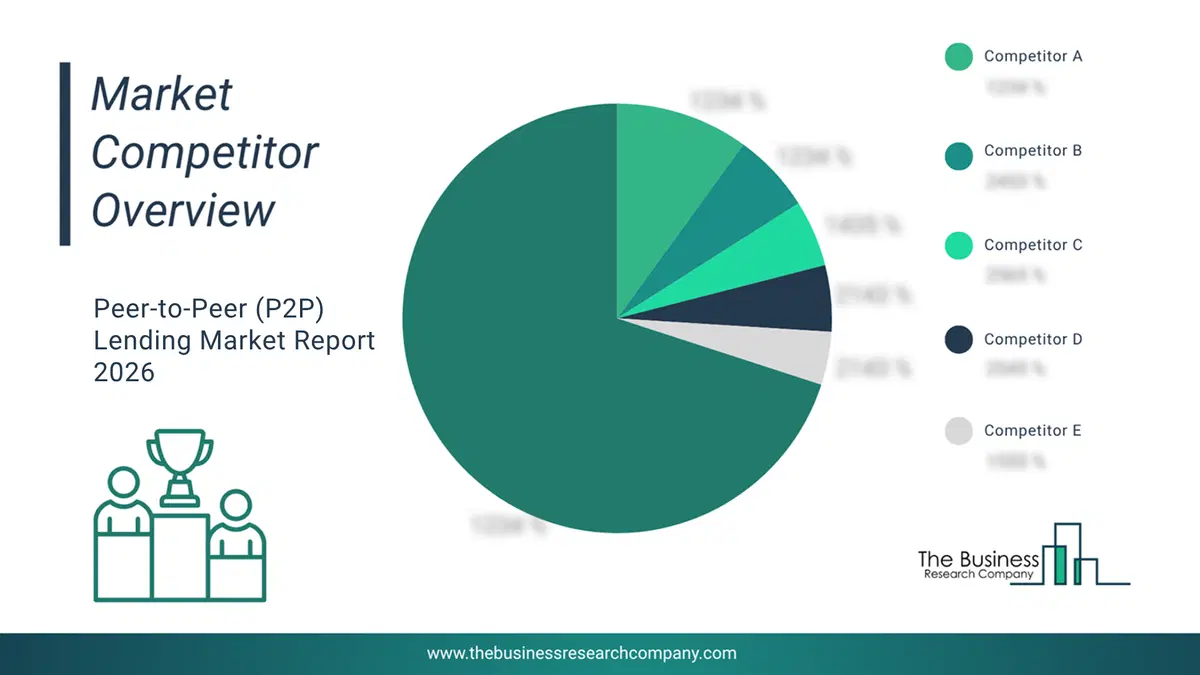
This chart is for illustrative purposes; the full report includes a detailed competitor analysis and comprehensive overview of the top 10 companies in the market.
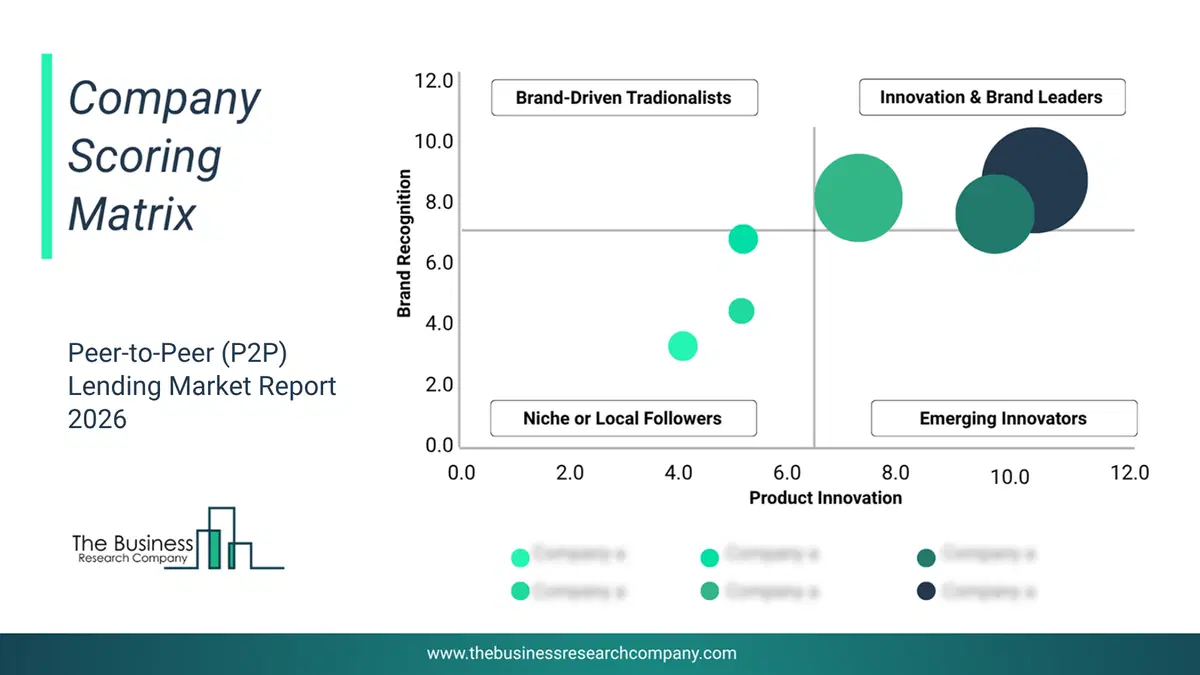
This chart maps companies by product innovation and brand strength, with bubble size indicating relative revenue, helping identify market leaders, challengers, and niche players. This is an illustrative chart; the full report provides a complete and accurate competitive analysis.
Global Peer-to-Peer (P2P) Lending Market Trends and Insights
Major companies operating in the peer-to-peer (P2P) lending market are focusing on developing innovative platform solutions such as decentralized finance (DeFi)-based lending platforms to enhance transparency, automation, and cost efficiency in lending processes. Decentralized finance-based lending platforms are digital lending systems that use blockchain technology and smart contracts to directly connect borrowers and investors, eliminating traditional intermediaries and enabling secure, transparent, and automated transactions. For instance, in December 2024, Definder Global, a UK-based blockchain-focused technology company, launched its peer-to-peer lending platform, a DeFi-based solution designed to facilitate funding for real-world asset projects by linking investors with businesses through blockchain-enabled smart contracts. The platform features capabilities such as automated loan execution, transparent transaction tracking, and reduced intermediary costs. Definder’s peer-to-peer lending platform improves funding accessibility, enhances operational efficiency, and supports faster, more transparent lending outcomes.What Are Latest Mergers And Acquisitions In The Peer-to-Peer (P2P) Lending Market?
In September 2023, EntrePay, a Brazil-based financial technology company, acquired Wealth Money for an undisclosed amount. With this acquisition, EntrePay aimed to expand its digital financial services ecosystem by integrating a peer-to-peer lending platform to strengthen its presence in alternative credit solutions. Wealth Money is a Brazil-based financial technology company that specializes in providing peer-to-peer lending services that connect individual investors directly with borrowers seeking business loans.Regional Outlook
North America was the largest region in the peer to peer (P2P) lending market in 2025.Aisa-Pacific is expected to be the fastest-growing region in the forecast period. The regions covered in this market report are Asia-Pacific, South East Asia, Western Europe, Eastern Europe, North America, South America, Middle East, Africa. The countries covered in this market report are Australia, Brazil, China, France, Germany, India, Indonesia, Japan, Taiwan, Russia, South Korea, UK, USA, Canada, Italy, Spain.What Defines the Peer-to-Peer (P2P) Lending Market?
The peer-to-peer lending (P2P) market includes revenues earned by secured and unsecured loans. The market value includes the value of related goods sold by the service provider or included within the service offering. Only goods and services traded between entities or sold to end consumers are included.How is Market Value Defined and Measured?
The market value is defined as the revenues that enterprises gain from the sale of goods and/or services within the specified market and geography through sales, grants, or donations in terms of the currency (in USD unless otherwise specified). The revenues for a specified geography are consumption values that are revenues generated by organizations in the specified geography within the market, irrespective of where they are produced. It does not include revenues from resales along the supply chain, either further along the supply chain or as part of other products.
This chart presents market attractiveness based on a quantitative evaluation of growth, competition, strategic alignment, and risk, offering a clear view of opportunity areas for decision-making. This chart is for illustrative purposes; the full report contains the complete analysis.

This chart highlights the Total Addressable Market (TAM) by estimating the maximum revenue opportunity using an assumption-driven approach, supporting strategic planning and opportunity sizing across markets. The chart is illustrative; the full report provides a more comprehensive analysis.
What Key Data and Analysis Are Included in the Peer-to-Peer (P2P) Lending Market Report 2026?
The peer-to-peer (p2p) lending market research report is one of a series of new reports from The Business Research Company that provides market statistics, including Market Report 2026?global market size, regional shares, competitors with the market share, detailed market segments, market trends and opportunities, and any further data you may need to thrive in the peer-to-peer (p2p) lending Market Report 2026? The market research report delivers a complete perspective of everything you need, with an in-depth analysis of the current and future state of the Market Report 2026?Peer-to-Peer (P2P) Lending Market Report Forecast Analysis
| Report Attribute | Details |
|---|---|
| Market Size Value In 2026 | $327.18 billion |
| Revenue Forecast In 2030 | $938.02 billion |
| Growth Rate | CAGR of 30.8% from 2026 to 2030 |
| Base Year For Estimation | 2025 |
| Actual Estimates/Historical Data | 2020-2025 |
| Forecast Period | 2026 - 2030 |
| Market Representation | Revenue in USD Billion and CAGR from 2026 to 2030 |
| Segments Covered | Loan Type, Business Model, End User |
| Regional Scope | Asia-Pacific, Western Europe, Eastern Europe, North America, South America, Middle East, Africa |
| Country Scope | The countries covered in the report are Australia, Brazil, China, France, Germany, India, Indonesia, Japan, Taiwan, Russia, South Korea, UK, USA, Canada, Italy, Spain. |
| Key Companies Profiled | Upstart, Funding Circle, Peerform, Kiva, Mintos, RateSetter, Zopa, Bondora, Auxmoney, Funding Societies, StreetShares, Crowdstacker, JustUs, MyConstant, Lendable, FairFinance, Patch of Land, LendInvest, LoanNow, SoFi |
| Customization Scope | Request for Customization |
| Pricing And Purchase Options | Explore Purchase Options |