

Personal Luxury Goods Market Report 2026
Global Outlook – By Product Type (Apparel, Footwear, Bags, Jewelry, Watches, Accessories), By Distribution Channel (Online Retail, Department Stores, Exclusive Brand Stores, Luxury Boutiques), By Application (Affluent Consumers, High-Net-Worth Individuals), By End User (Women, Unisex, Men) – Market Size, Trends, Strategies, and Forecast to 2035
Personal Luxury Goods Market Overview
• Personal Luxury Goods market size has reached to $428.24 billion in 2025 • Expected to grow to $737.38 billion in 2030 at a compound annual growth rate (CAGR) of 11.5% • Growth Driver: Growing High-Net-Worth Population Boosting The Market Demand Due To Rising Affluent Consumption • Market Trend: Strategic Partnerships Expand Presence Of Luxury Watch Brands In Emerging Markets • Asia-Pacific was the largest region and fastest growing region.What Is Covered Under Personal Luxury Goods Market?
Personal luxury goods are high-end, premium-priced consumer products designed to reflect exclusivity and superior quality. Their core purpose is to convey status, wealth, and personal identity while offering exceptional craftsmanship, aesthetics, and durability. Personal luxury goods also function as aspirational purchases, enhancing lifestyle, emotional satisfaction, and social distinction. The main product types of personal luxury goods include apparel, footwear, bags, jewelry, watches, and accessories. Apparel refers to high-end fashion clothing designed using premium materials and craftsmanship to reflect exclusivity and brand prestige. These products are distributed through online retail, department stores, exclusive brand stores, and luxury boutiques. They find application in affluent consumers and high-net-worth individuals, serving end users including women, unisex, and men.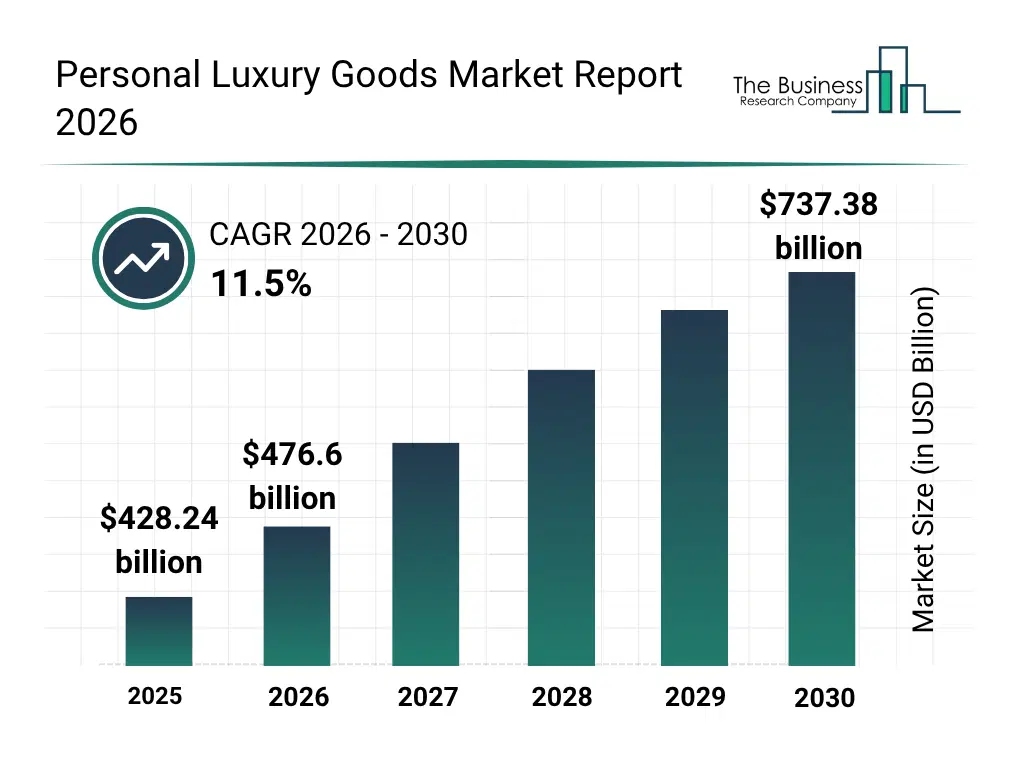
What Is The Personal Luxury Goods Market Size and Share 2026?
The personal luxury goods market size has grown rapidly in recent years.It will grow from $428.24 billion in 2025 to $476.6 billion in 2026 at a compound annual growth rate (CAGR) of 11.3%. The growth in the historic period can be attributed to heritage brand dominance, craftsmanship-led product differentiation, limited global retail penetration, traditional in-store luxury purchasing behavior, high brand loyalty among affluent consumers.What Is The Personal Luxury Goods Market Growth Forecast?
The personal luxury goods market size is expected to see rapid growth in the next few years.It will grow to $737.38 billion by 2030 at a compound annual growth rate (CAGR) of 11.5%. The growth in the forecast period can be attributed to ai-driven personalization in luxury retail, expansion of digital luxury marketplaces, rising demand for sustainable luxury materials, growth of metaverse-based luxury experiences, increasing penetration of luxury goods in emerging economies.Major trends in the forecast period include rise of experiential luxury retail formats, growing demand for limited edition and personalized luxury products, expansion of resale and circular luxury economy, increasing influence of celebrity and influencer-driven luxury branding, growth of digital-first luxury commerce platforms.
Global Personal Luxury Goods Market Segmentation
1) By Product Type: Apparel, Footwear, Bags, Jewelry, Watches, Accessories 2) By Distribution Channel: Online Retail, Department Stores, Exclusive Brand Stores, Luxury Boutiques 3) By Application: Affluent Consumers, High-Net-Worth Individuals 4) By End User: Women, Unisex, Men Subsegments: 1) By Apparel: Luxury Dresses, Luxury Jackets And Coats, Luxury Shirts And Tops, Luxury Trousers And Pants, Luxury Knitwear And Sweaters 2) By Footwear: Luxury Sneakers, Luxury Formal Shoes, Luxury Boots, Luxury Sandals, Luxury Loafers 3) By Bags: Luxury Handbags, Luxury Tote Bags, Luxury Shoulder Bags, Luxury Crossbody Bags, Luxury Clutch Bags 4) By Jewelry: Luxury Diamond Jewelry, Luxury Gold Jewelry, Luxury Platinum Jewelry, Luxury Gemstone Jewelry, Luxury Pearl Jewelry 5) By Watches: Luxury Mechanical Watches, Luxury Automatic Watches, Luxury Quartz Watches, Luxury Chronograph Watches, Luxury Smart Watches 6) By Accessories: Luxury Sunglasses, Luxury Belts, Luxury Scarves And Shawls, Luxury Wallets And Card Holders, Luxury Hats And CapsWhat Is The Driver Of The Personal Luxury Goods Market?
The increasingly high net worth population is expected to propel the growth of the personal luxury goods industry going forward.High net worth population refers to individuals possessing substantial investable assets, typically exceeding USD 1 million, along with strong discretionary spending power.The rise in the high-net-worth population is driven mainly by wealth accumulation in developed economies due to strong financial markets and robust economic growth.A growing high net worth population drives demand for personal luxury goods by increasing purchasing power for premium products while enhancing brand exclusivity and sustaining market growth through higher discretionary spending and aspirational consumption.For instance, in March 2025, according to World Population Review, a US-based online resource that provides comprehensive global statistics on population, the number of millionaires was 21.95 million in 2023 and is projected to reach approximately 25.33 million by 2028.Therefore, the increasing high net worth population is driving the growth of the personal luxury goods industry.Key Players In The Global Personal Luxury Goods Market
Major companies operating in the personal luxury goods market are LVMH Moët Hennessy Louis Vuitton SE, Compagnie Financière Richemont SA, Kering SA, Rolex SA, The Estée Lauder Companies Inc., Hermès International SCA, The Swatch Group Ltd, Prada S. p. A., Burberry Group plc, Moncler S. p. A., Giorgio Armani S. p. A., Ermenegildo Zegna N. V., Chopard International SA, Tod's S. p. A., Dolce & Gabbana S. r. l., Longchamp SAS, Breitling SA, Graff Diamonds International Ltd, Mulberry Group plc, Audemars Piguet Holding SAGlobal Personal Luxury Goods Market Trends and Insights
Major companies operating in the personal luxury goods market are focusing on adopting strategic collaborations to enhance brand prestige, diversify premium offerings, and attract affluent consumers. Strategic collaborations are partnerships where organizations combine complementary strengths and resources to achieve shared goals, drive innovation, and enhance efficiency. For instance, in March 2026, Titan’s Helios Luxe, an India-based watch company, partnered with Alexander Shorokhoff, a Germany-based luxury watchmaker, to introduce its exclusive handcrafted timepieces in India. This collaboration aims to cater to the growing demand for high-end, limited-edition watches among affluent consumers, enhancing product diversity and reinforcing the brand’s positioning in the luxury watch segment.What Are Latest Mergers And Acquisitions In The Personal Luxury Goods Market?
In April 2025, Mytheresa, a Germany-based online luxury fashion retailer, successfully acquired Yoox Net-A-Porter (YNAP) from Compagnie Financière Richemont for an undisclosed amount. Through this acquisition, Mytheresa aims to strengthen its position in the global personal luxury goods market by expanding its digital retail capabilities, enhancing brand portfolio offerings, and leveraging YNAP’s established e-commerce infrastructure and customer base. Compagnie Financière Richemont is a Switzerland-based manufacturer of a wide range of personal luxury goods.Regional Insights
Asia-Pacific was the largest region in the personal luxury goods market in 2025. Asia-Pacific is expected to be the fastest-growing region in the forecast period. The regions covered in this market report are Asia-Pacific, South East Asia, Western Europe, Eastern Europe, North America, South America, Middle East and Africa. The countries covered in this market report are Australia, Brazil, China, France, Germany, India, Indonesia, Japan, Taiwan, Russia, South Korea, UK, USA, Canada, Italy, Spain.What Defines the Personal Luxury Goods Market?
The personal luxury goods market consists of sales of fragrances, sunglasses, leather wallets, and silk scarves. Values in this market are ‘factory gate’ values, that is, the value of goods sold by the manufacturers or creators of the goods, whether to other entities (including downstream manufacturers, wholesalers, distributors, and retailers) or directly to end customers. The value of goods in this market includes related services sold by the creators of the goods.What is the Market Assessment and Strategic Outlook for the Personal Luxury Goods Industry?
The personal luxury goods market research report is one of a series of new reports from The Business Research Company that provides market statistics, including industry global market size, regional shares, competitors with the market share, detailed market segments, market trends and opportunities, and any further data you may need to thrive in the personal luxury goods industry. The market research report delivers a complete perspective of everything you need, with an in-depth analysis of the current and future state of the industry.What is the Market Assessment and Strategic Outlook for the Personal Luxury Goods Market Report 2026?
The personal luxury goods market research report is one of a series of new reports from The Business Research Company that provides personal luxury goods market statistics, including personal luxury goods industry global market size, regional shares, competitors with a personal luxury goods market share, detailed personal luxury goods market segments, market trends and opportunities, and any further data you may need to thrive in the personal luxury goods industry. This personal luxury goods market research report delivers a complete perspective of everything you need, with an in-depth analysis of the current and future scenario of the industry.Personal Luxury Goods Market Report Forecast Analysis
| Report Attribute | Details |
|---|---|
| Market Size Value In 2026 | $476.6 billion |
| Revenue Forecast In 2035 | $737.38 billion |
| Growth Rate | CAGR of 11.5% from 2026 to 2035 |
| Base Year For Estimation | 2025 |
| Actual Estimates/Historical Data | 2020-2025 |
| Forecast Period | 2026 - 2030 - 2035 |
| Market Representation | Revenue in USD Billion and CAGR from 2026 to 2035 |
| Segments Covered | Product Type, Distribution Channel, Application, End User |
| Regional Scope | Asia-Pacific, Western Europe, Eastern Europe, North America, South America, Middle East, Africa |
| Country Scope | The countries covered in the report are Australia, Brazil, China, France, Germany, India, Indonesia, Japan, Taiwan, Russia, South Korea, UK, USA, Canada, Italy, Spain. |
| Key Companies Profiled | LVMH Moët Hennessy Louis Vuitton SE, Compagnie Financière Richemont SA, Kering SA, Rolex SA, The Estée Lauder Companies Inc., Hermès International SCA, The Swatch Group Ltd, Prada S. p. A., Burberry Group plc, Moncler S. p. A., Giorgio Armani S. p. A., Ermenegildo Zegna N. V., Chopard International SA, Tod's S. p. A., Dolce & Gabbana S. r. l., Longchamp SAS, Breitling SA, Graff Diamonds International Ltd, Mulberry Group plc, Audemars Piguet Holding SA |
| Customization Scope | Request for Customization |
| Pricing And Purchase Options | Explore Purchase Options |