
Pest Control Market Report 2026
Global Outlook – By Pest Type (Insects, Termites, Rodents, Wildlife ), By Control Method (Chemical, Mechanical, Biological ), By Mode of Application (Powder, Sprays, Pellets, Traps, Baits ), By Application (Commercial, Residential, Agriculture, Industrial) – Market Size, Trends, Strategies, and Forecast to 2030
Pest Control Market Overview
• Pest Control market size has reached to $26.66 billion in 2025 • Expected to grow to $40 billion in 2030 at a compound annual growth rate (CAGR) of 8.4% • Growth Driver: Increasing Urbanization Is Anticipated To Fuel The Pest Control Market • Market Trend: Innovative Smart Monitoring Enhances Proactive Rodent Control And Management Efficiency • North America was the largest region in 2025 and Asia-Pacific is the fastest growing region.What Is Covered Under Pest Control Market?
The pest control is the process of managing (by using deterrents or repellents) or removing pests from the house or place of business. Pest control services include screening and sealing of openings to avoid entry of pests inside the premises. It has various methods to control or prevent entry and infestation of pests. It helps in reducing illness and risk of harmful diseases and keeps the environment toxin-free. The main types of pest control are insects, termites, rodents, and wildlife. Insects are any of a group of arthropods (such as bugs or bees) having a distinct head, thorax, and abdomen, only three pairs of legs, and usually one or two pairs of wings (Insecta). They are controlled by chemical, mechanical, and biological methods with applications in powder, sprays, pellets, traps, and baits. They have applications in various industries such as commercial, residential, agriculture, and industrial.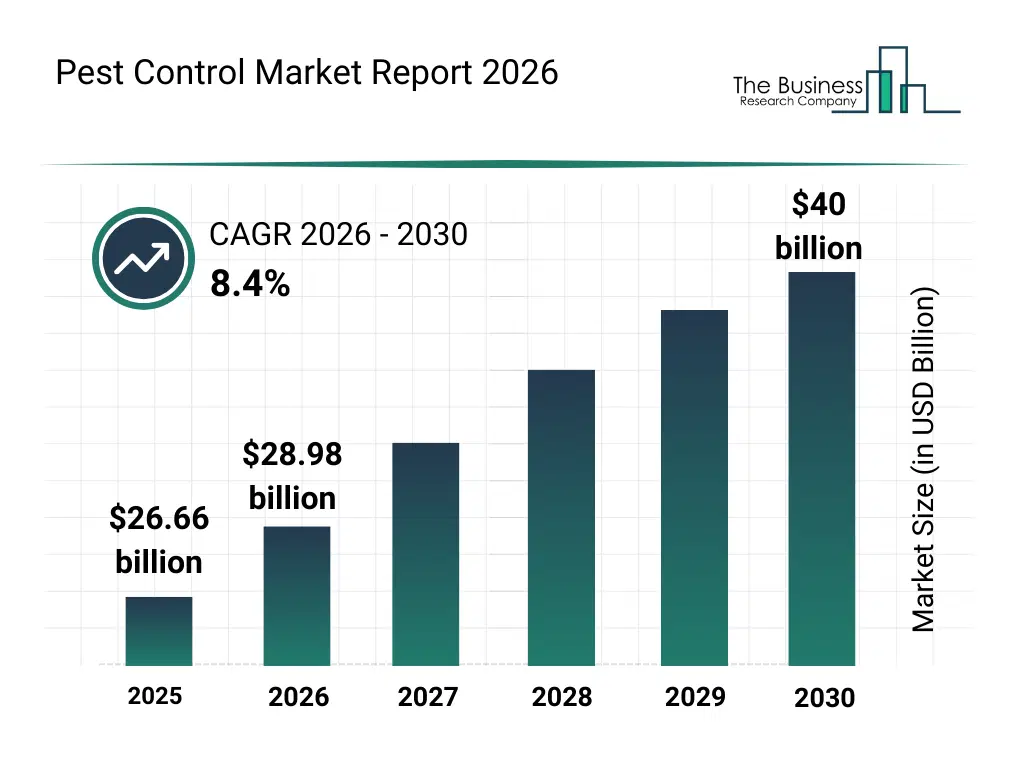
What Is The Pest Control Market Size and Share 2026?
The pest control market size has grown strongly in recent years. It will grow from $26.66 billion in 2025 to $28.98 billion in 2026 at a compound annual growth rate (CAGR) of 8.7%. The growth in the historic period can be attributed to increasing urbanization and infrastructure growth, rising incidence of pest-related diseases, expansion of commercial facilities, growing awareness of hygiene standards, availability of chemical pest control products.What Is The Pest Control Market Growth Forecast?
The pest control market size is expected to see strong growth in the next few years. It will grow to $40 billion in 2030 at a compound annual growth rate (CAGR) of 8.4%. The growth in the forecast period can be attributed to increasing demand for sustainable pest control solutions, rising adoption of non-toxic pest management methods, expansion of agriculture pest management services, growing regulatory focus on chemical usage, increasing investments in biological pest control technologies. Major trends in the forecast period include increasing adoption of integrated pest management solutions, rising demand for eco-friendly pest control methods, growing use of biological pest control agents, expansion of commercial pest control services, enhanced focus on preventive pest management.
Global Pest Control Market Segmentation
1) By Pest Type: Insects, Termites, Rodents, Wildlife 2) By Control Method: Chemical, Mechanical, Biological 3) By Mode of Application: Powder, Sprays, Pellets, Traps, Baits 4) By Application: Commercial, Residential, Agriculture, Industrial Subsegments: 1) By Insects: Ants, Cockroaches, Bed Bugs, Flies, Mosquitoes, Beetles 2) By Termites: Subterranean Termites, Drywood Termites, Dampwood Termites 3) By Rodents: Rats, Mice, Squirrels 4) By Wildlife: Raccoons, Skunks, Deer, Birds, BatsWhat Is The Driver Of The Pest Control Market?
The increasing urbanization is expected to propel the growth of the pest control market going forward. Urbanization refers to the growing concentration of populations within cities and metropolitan areas, driven by the expansion of infrastructure, housing, and economic activity in urban regions. A principal factor contributing to increasing urbanization is the pursuit of improved employment opportunities, as cities typically offer more diverse and higher-paying jobs, which attract individuals seeking economic stability and career advancement. Pest control support in this context helps maintain healthier, safer, and more sanitary urban environments as population density rises. For instance, in April 2023, according to the World Bank Group, a US-based bank, reported that currently, more than half of the global population resides in urban regions. By 2045, this urban population is projected to surge to 6 billion, marking 1.5 times increase. Therefore, the increasing urbanization is driving the growth of the pest control industry.Key Players In The Global Pest Control Market
Major companies operating in the pest control market are Bayer AG, Syngenta AG, BASF SE, FMC Corporation, Rentokil Initial plc, Anticimex Group, Ecolab Inc., Control Solutions, Inc., Woodstream Corporation, Bell Laboratories Inc., Corteva Agriscience, Sumitomo Chemical Co., Ltd., De Sangosse, PelGar International, SC Johnson Professional, Truly Nolen of America, Inc., Dodson Pest Control Inc., Arrow Exterminators Inc., Vestergaard, Massey Services Inc., ServiceMaster Global Holdings, Inc., MGK (McLaughlin Gormley King Company), Lloyd Pest Control Ltd., Fox Pest Control
This chart is for illustrative purposes; the full report includes a detailed competitor analysis and comprehensive overview of the top 10 companies in the market.
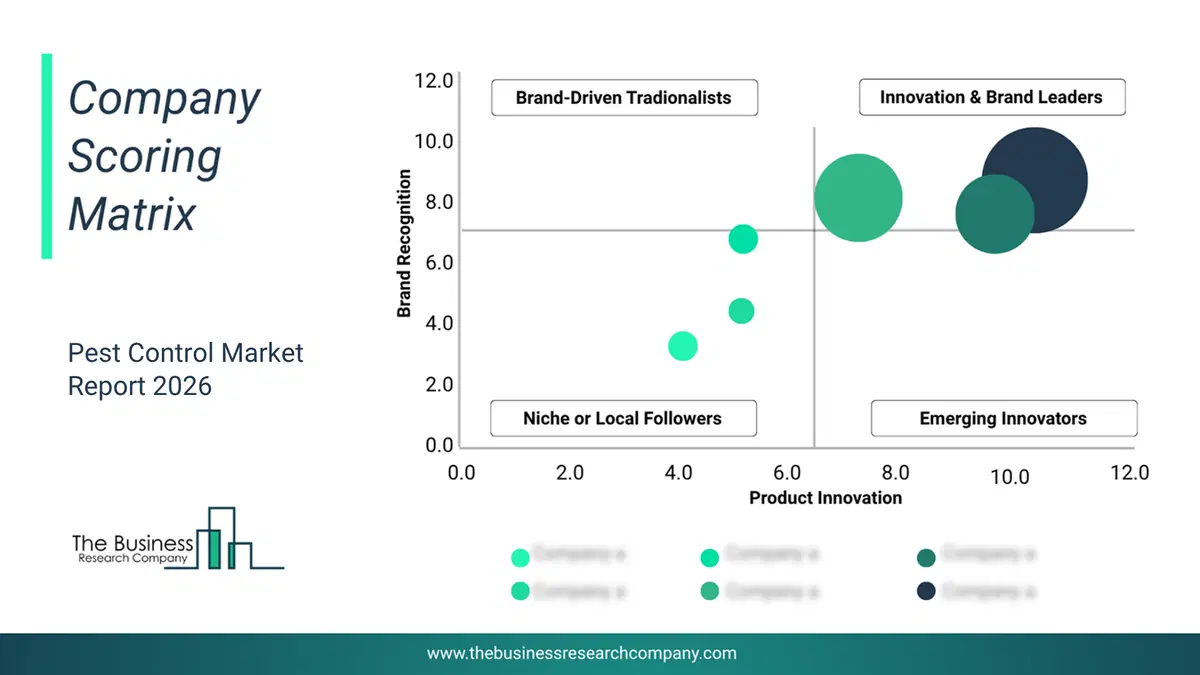
This chart maps companies by product innovation and brand strength, with bubble size indicating relative revenue, helping identify market leaders, challengers, and niche players. This is an illustrative chart; the full report provides a complete and accurate competitive analysis.
Global Pest Control Market Trends and Insights
Major companies operating in the pest control market are launching innovative products such as the smart rodent monitoring system to provide proactive rodent control by offering real-time monitoring and data analytics, improving efficiency and effectiveness in pest management. A smart rodent monitoring system is a digital surveillance solution that utilizes sensors and wireless technology to continuously track and report rodent activity in real time, enabling proactive pest management and reducing the need for traditional traps. For instance, in October 2023, Syngenta, a Switzerland-based science-based agtech company, launched the SecureChoice remote detection system. This system utilizes advanced dual sensing technology to accurately monitor rodent activity and sends real-time alerts through a digital dashboard, enhancing the efficiency of pest control operations. This innovative solution not only enables pest professionals to pinpoint rodent entry points for timely interventions but also incorporates data analytics and machine learning for predictive analysis, ensuring a sustainable and effective approach to rodent management.What Are Latest Mergers And Acquisitions In The Pest Control Market?
In April 2023, Rollins, Inc., a US-based provider of residential and commercial pest control and wildlife-control services, acquired Fox Pest Control for $350 million. With this acquisition, Rollins aimed to accelerate its long-term growth strategy by gaining efficient entry into new geographic markets across the U.S., expanding its customer base, and offering additional services under its existing brand umbrella. Fox Pest Control is a US-based provider of residential pest-management services, offering door-to-door and digital-channel pest-control solutions.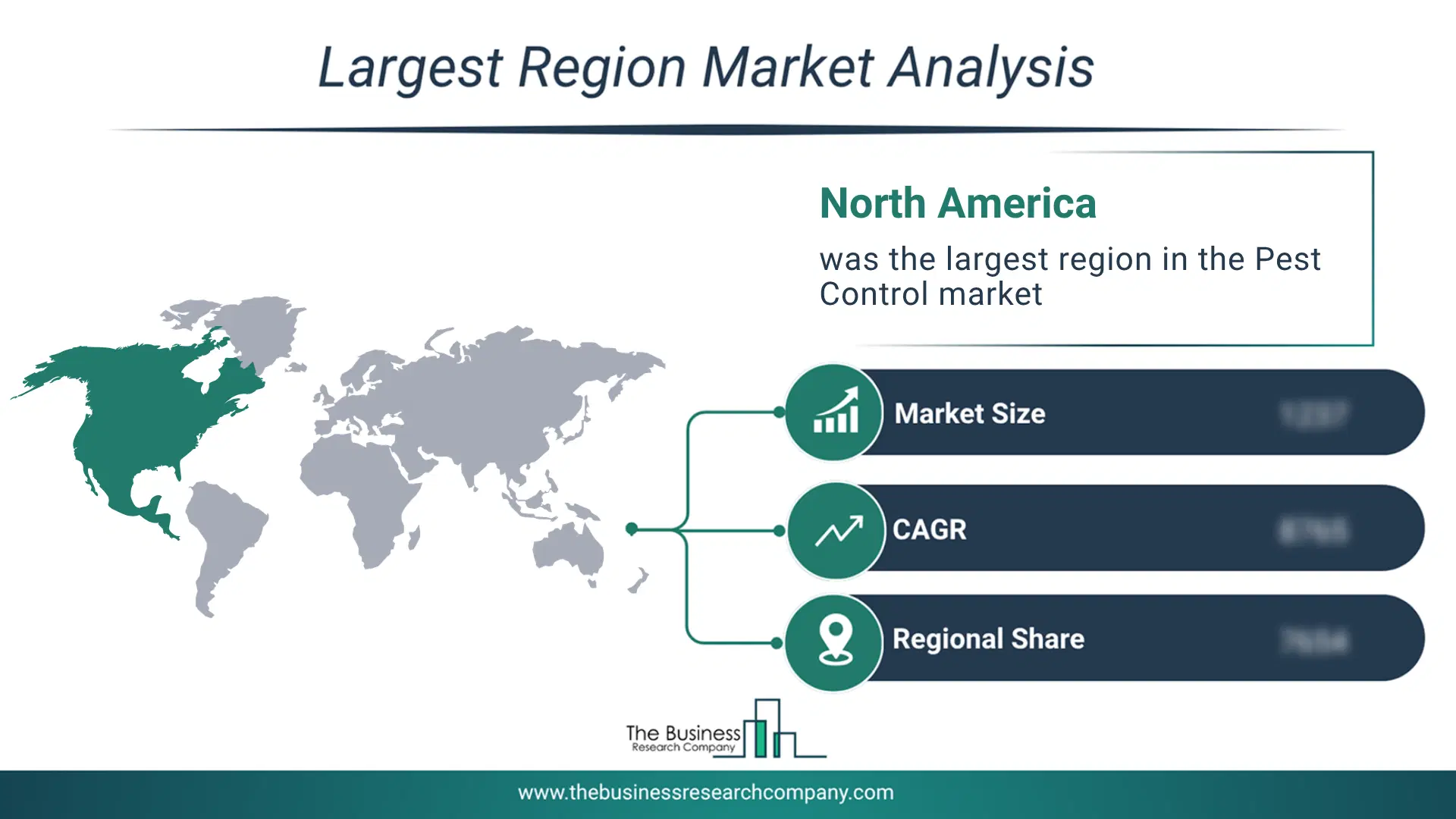
Regional Insights
North America was the largest region in the pest control market in 2025. Asia-Pacific is expected to be the fastest-growing region in the forecast period. The regions covered in this market report are Asia-Pacific, South East Asia, Western Europe, Eastern Europe, North America, South America, Middle East, Africa The countries covered in this market report are Australia, Brazil, China, France, Germany, India, Indonesia, Japan, Taiwan, Russia, South Korea, UK, USA, Canada, Italy, SpainWhat Defines the Pest Control Market?
The pest control market consists of revenues earned by entities by providing chemical pest control, biological pest control and organic pest control. Values in this market are ‘factory gate’ values, that is the value of goods sold by the manufacturers or creators of the goods, whether to other entities (including downstream manufacturers, wholesalers, distributors, and retailers) or directly to end customers. The value of goods in this market includes related services sold by the creators of the goods.How is Market Value Defined and Measured?
The market value is defined as the revenues that enterprises gain from the sale of goods and/or services within the specified market and geography through sales, grants, or donations in terms of the currency (in USD unless otherwise specified). The revenues for a specified geography are consumption values that are revenues generated by organizations in the specified geography within the market, irrespective of where they are produced. It does not include revenues from resales along the supply chain, either further along the supply chain or as part of other products.
This chart presents market attractiveness based on a quantitative evaluation of growth, competition, strategic alignment, and risk, offering a clear view of opportunity areas for decision-making. This chart is for illustrative purposes; the full report contains the complete analysis.

This chart highlights the Total Addressable Market (TAM) by estimating the maximum revenue opportunity using an assumption-driven approach, supporting strategic planning and opportunity sizing across markets. The chart is illustrative; the full report provides a more comprehensive analysis.
What Key Data and Analysis Are Included in the Pest Control Market Report 2026?
The pest control market research report is one of a series of new reports from The Business Research Company that provides market statistics, including industry global market size, regional shares, competitors with the market share, detailed market segments, market trends and opportunities, and any further data you may need to thrive in the pest control industry. The market research report delivers a complete perspective of everything you need, with an in-depth analysis of the current and future state of the industry.Pest Control Market Report Forecast Analysis
| Report Attribute | Details |
|---|---|
| Market Size Value In 2026 | $28.98 billion |
| Revenue Forecast In 2030 | $40 billion |
| Growth Rate | CAGR of 8.7% from 2026 to 2030 |
| Base Year For Estimation | 2025 |
| Actual Estimates/Historical Data | 2020-2025 |
| Forecast Period | 2026 - 2030 |
| Market Representation | Revenue in USD Billion and CAGR from 2026 to 2030 |
| Segments Covered | Pest Type, Control Method, Mode of Application, Application |
| Regional Scope | Asia-Pacific, Western Europe, Eastern Europe, North America, South America, Middle East, Africa |
| Country Scope | The countries covered in this market report are Australia, Brazil, China, France, Germany, India, Indonesia, Japan, Taiwan, Russia, South Korea, UK, USA, Canada, Italy, Spain |
| Key Companies Profiled | Bayer AG, Syngenta AG, BASF SE, FMC Corporation, Rentokil Initial plc, Anticimex Group, Ecolab Inc., Control Solutions, Inc., Woodstream Corporation, Bell Laboratories Inc., Corteva Agriscience, Sumitomo Chemical Co., Ltd., De Sangosse, PelGar International, SC Johnson Professional, Truly Nolen of America, Inc., Dodson Pest Control Inc., Arrow Exterminators Inc., Vestergaard, Massey Services Inc., ServiceMaster Global Holdings, Inc., MGK (McLaughlin Gormley King Company), Lloyd Pest Control Ltd., Fox Pest Control |
| Customization Scope | Request for Customization |
| Pricing And Purchase Options | Explore Purchase Options |