
Piston Compressor Market Report 2026
Global Outlook – By Type (Air-Cooled Compressors, Water-Cooled Compressors, Single-Stage Compressors, Two-Stage Or Multi-Stage Compressors), By Capacity Or Pressure (Low Pressure, Medium Pressure, High Pressure), By Lubrication Type (Oil-Lubricated, Oil-Free), By Portability (Stationary, Portable), By End-User Industry (Manufacturing, Oil And Gas, Construction, Automotive And Transportation, Food And Beverage, Healthcare And Pharmaceuticals, Other End-Users) – Market Size, Trends, Strategies, and Forecast to 2030
Piston Compressor Market Overview
• Piston Compressor market size has reached to $10.61 billion in 2025 • Expected to grow to $14.01 billion in 2030 at a compound annual growth rate (CAGR) of 5.7% • Growth Driver: Rising Industrial Manufacturing Activity Fueling The Growth Of The Market Due To Increasing Demand For Efficient Compression Solutions • Asia-Pacific was the largest region in 2025 and North America is the fastest growing region.What Is Covered Under Piston Compressor Market?
Piston compressors are mechanical devices that use reciprocating pistons to compress air or gas and store it under high pressure. They operate in cycles, drawing in air during the suction stroke and compressing it during the compression stroke, delivering it to a storage tank or system. They are valued for high-pressure output and reliability and are used to provide pressurized air or gas for powering tools, machinery, and pneumatic systems. The main types of piston compressors are air-cooled compressors, water-cooled compressors, single-stage compressors, and two-stage or multi-stage compressors. Air-cooled compressors refer to a type of piston compressor that uses ambient air to dissipate heat generated during compression, helping to maintain operational efficiency and reliability during continuous or intermittent use. The capacity or pressure categories include low pressure, medium pressure, and high pressure. The lubrication types include oil-lubricated and oil-free. Portability categories include stationary and portable and the key end-user industries including manufacturing, oil and gas, construction, automotive and transportation, food and beverage, healthcare and pharmaceuticals, and others.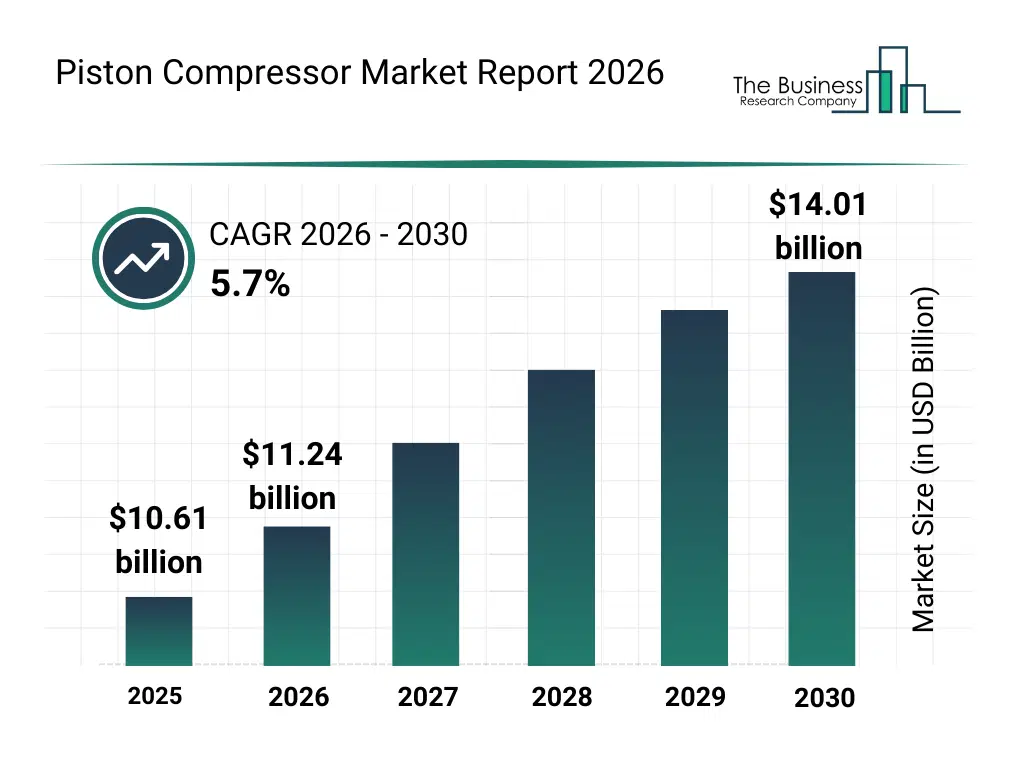
What Is The Piston Compressor Market Size and Share 2026?
The piston compressor market size has grown strongly in recent years. It will grow from $10.61 billion in 2025 to $11.24 billion in 2026 at a compound annual growth rate (CAGR) of 5.9%. The growth in the historic period can be attributed to increasing industrial applications, growing manufacturing sector demand, expansion of the oil and gas industry, rising infrastructure development, and rising demand for energy?efficient compressors.What Is The Piston Compressor Market Growth Forecast?
The piston compressor market size is expected to see strong growth in the next few years. It will grow to $14.01 billion in 2030 at a compound annual growth rate (CAGR) of 5.7%. The growth in the forecast period can be attributed to rising industrialization in emerging economies, growing manufacturing and construction activities, increasing demand for compact and portable piston compressors, expansion of the oil and gas and energy sectors, and rising emphasis on energy efficiency and sustainable compressors. Major trends in the forecast period include technological advancements in compressor design, integration of smart or IoT?enabled compressors, development of energy?efficient piston compressors, customization and modular compressor systems, and adoption of oil?free and environmentally friendly compressors.
Global Piston Compressor Market Segmentation
1) By Type: Air-Cooled Compressors, Water-Cooled Compressors, Single-Stage Compressors, Two-Stage Or Multi-Stage Compressors 2) By Capacity Or Pressure: Low Pressure, Medium Pressure, High Pressure 3) By Lubrication Type: Oil-Lubricated, Oil-Free 4) By Portability: Stationary, Portable 5) By End-User Industry: Manufacturing, Oil And Gas, Construction, Automotive And Transportation, Food And Beverage, Healthcare And Pharmaceuticals, Other End-Users Subsegments: 1) By Air-Cooled Compressors: Portable Air-Cooled Units, Stationary Air-Cooled Units, Lubricated Air-Cooled Units, Oil-Free Air-Cooled Units 2) By Water-Cooled Compressors: Industrial Water-Cooled Units, Heavy-Duty Water-Cooled Units, Lubricated Water-Cooled Units, Oil-Free Water-Cooled Units 3) By Single-Stage Compressors: Reciprocating Single-Stage Units, Belt-Driven Single-Stage Units, Direct-Drive Single-Stage Units, Portable Single-Stage Units 4) By Two-Stage Or Multi-Stage Compressors: Reciprocating Multi-Stage Units, High-Pressure Multi-Stage Units, Industrial Multi-Stage Units, Oil-Free Multi-Stage UnitsWhat Are The Drivers Of The Piston Compressor Market?
The rising industrial manufacturing activity is expected to propel the piston compressor market going forward. Industrial manufacturing activity refers to the production of goods across sectors such as automotive, chemicals, electronics, and machinery, which require reliable and high-performance compressed air solutions. The rise in industrial manufacturing activity is due to increasing demand for industrial goods. The piston compressor supports rising industrial manufacturing activity by providing robust, energy-efficient, and high-pressure air compression systems that ensure consistent performance across industrial operations. For instance, in May 2025, according to the Office for National Statistics, a UK-based government agency, production output in the first quarter of 2025 was estimated to have increased by 1.1% compared with the fourth quarter of 2024, marking the first rise in the quarterly series since the first quarter of 2024. Therefore, the rising industrial manufacturing activity is driving the growth of the piston compressor industry. The rising construction activity is expected to propel the growth of the piston compressor market going forward. Construction activity refers to the planning, approval, and building of residential and non?residential structures and infrastructure projects that require pneumatic tools and compressed air systems for operation. The rise in construction activity is due to increasing infrastructure development and urbanization. Piston compressor supports rising construction activity by supplying reliable compressed air for powering tools, operating equipment, and supporting on-site processes across residential, commercial, and infrastructure projects. For instance, in February 2025, according to Statistics Canada, a Canada?based national statistics agency, the number of dwelling units authorized for construction increased by 24,100 units (+9.1%) to 287,100 units in 2024 from 2023. Therefore, rising construction activity is driving the growth of the piston compressor industry.Key Players In The Global Piston Compressor Market
Major companies operating in the piston compressor market are Continental AG, Siemens Energy AG, Mitsubishi Heavy Industries Ltd., Atlas Copco AB, PUMA Industrial Co. Ltd., Ingersoll Rand Inc., Kaeser Kompressoren SE, Bitzer SE, Burckhardt Compression Holding AG, CAP S.r.l., Ariel Corporation, NEUMAN & ESSER Group, Kirloskar Pneumatic Company Limited, Bauer Kompressoren GmbH, Ever-Power Technology Co. Ltd., Huade Mechanical & Electrical Equipment Co. Ltd., Indo-Air Compressors Private Limited, Zen Air Tech Private Limited, MK Engineering Works, Arihant Engineering Works
This chart is for illustrative purposes; the full report includes a detailed competitor analysis and comprehensive overview of the top 10 companies in the market.
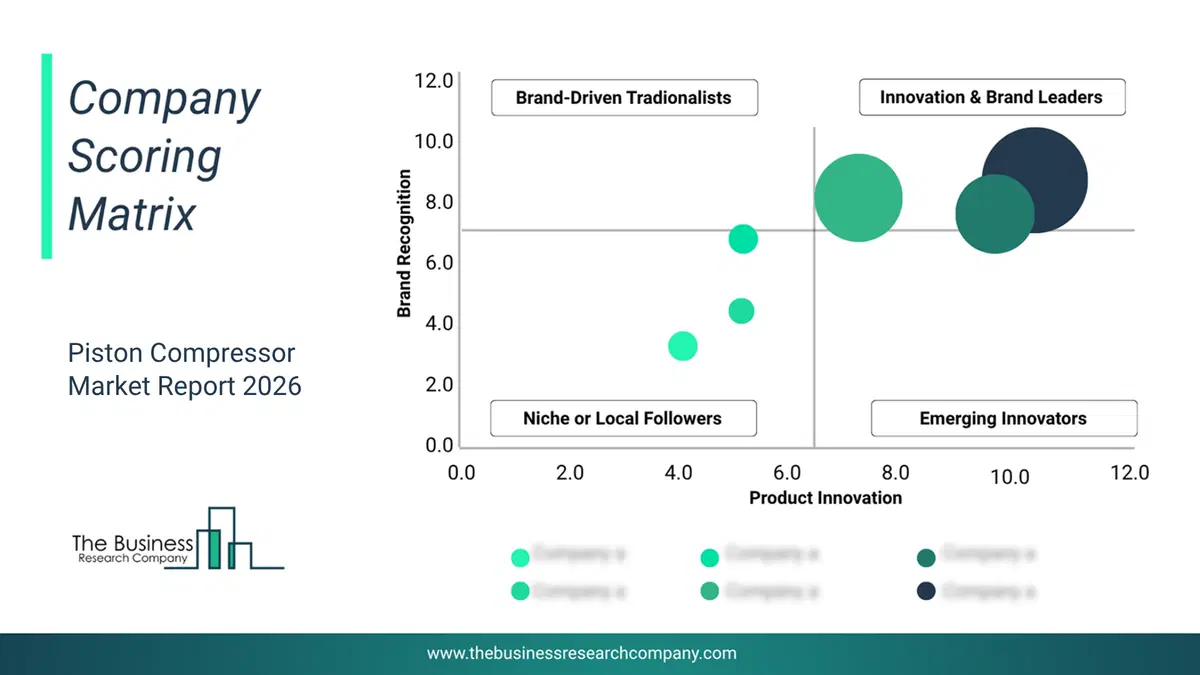
This chart maps companies by product innovation and brand strength, with bubble size indicating relative revenue, helping identify market leaders, challengers, and niche players. This is an illustrative chart; the full report provides a complete and accurate competitive analysis.
What Are Latest Mergers And Acquisitions In The Piston Compressor Market?
In March 2023, Danfoss A/S, a Denmark-based engineering company, acquired BOCK GmbH for an undisclosed amount. With this acquisition, Danfoss sought to reinforce its leadership as a provider of greener cooling and heating solutions by integrating BOCK's CO2 and low-global warming potential compressors into its full-solution portfolio. BOCK GmbH is a Germany-based provider of carbon dioxide (CO2) and low-GWP semi-hermetic reciprocating compressors for refrigeration and air conditioning applications.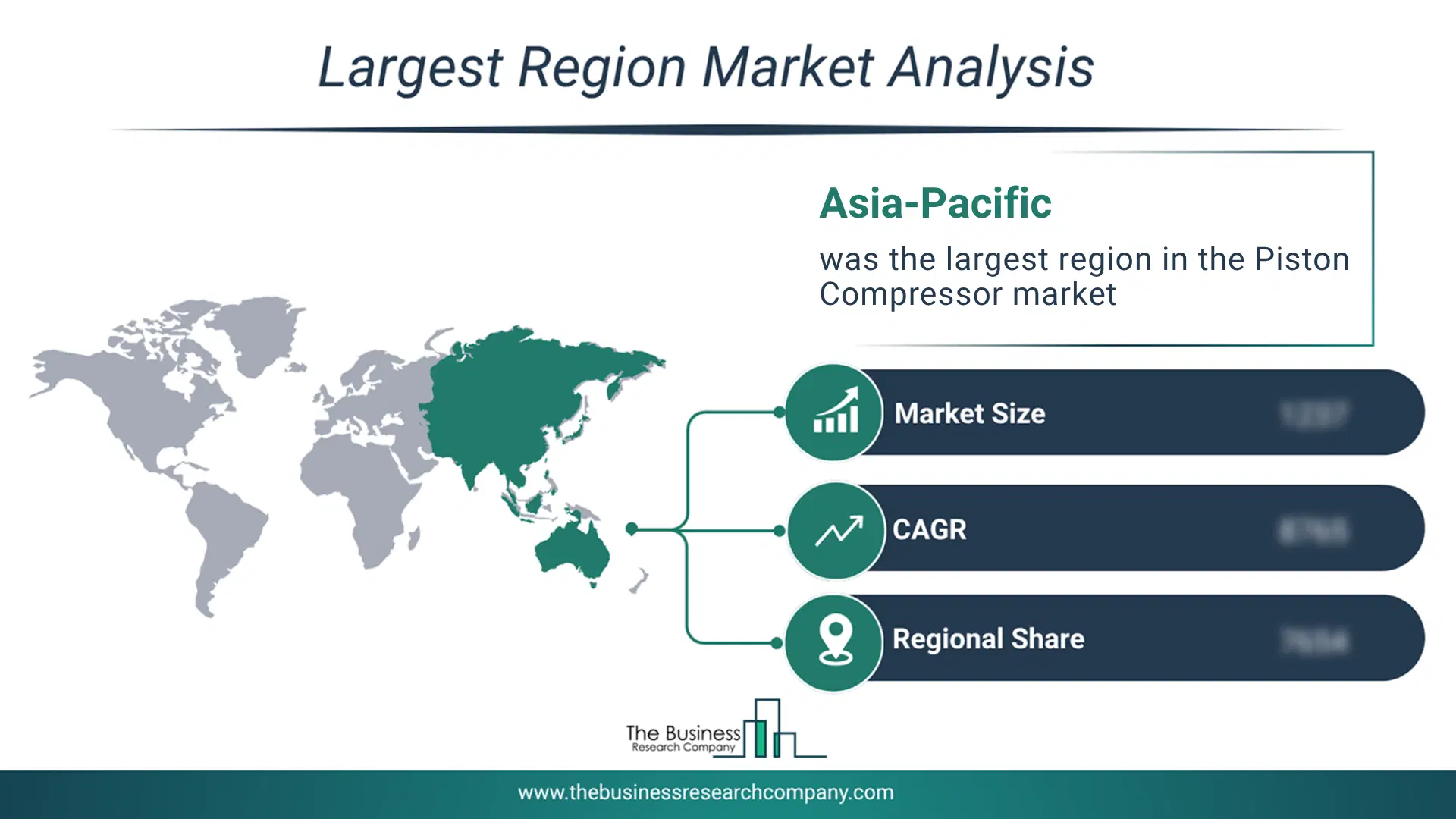
Regional Insights
Asia-Pacific was the largest region in the piston compressor market in 2025. North America is expected to be the fastest-growing region in the forecast period. The regions covered in this market report are Asia-Pacific, South East Asia, Western Europe, Eastern Europe, North America, South America, Middle East, Africa. The countries covered in this market report are Australia, Brazil, China, France, Germany, India, Indonesia, Japan, Taiwan, Russia, South Korea, UK, USA, Canada, Italy, Spain.What Defines the Piston Compressor Market?
The piston compressor market consists of sales of single-stage and multi-stage piston compressors, reciprocating air compressors, oil-lubricated and oil-free piston compressors, portable and stationary compressor units, and compressor accessories. Values in this market are ‘factory gate’ values, referring to the value of goods sold by the manufacturers or creators of the compressors, whether to other entities (including downstream manufacturers, wholesalers, distributors and retailers) or directly to end customers. The value of goods in this market includes related services offered by the creators of the compressors.How is Market Value Defined and Measured?
The market value is defined as the revenues that enterprises gain from the sale of goods and/or services within the specified market and geography through sales, grants, or donations in terms of the currency (in USD unless otherwise specified). The revenues for a specified geography are consumption values that are revenues generated by organizations in the specified geography within the market, irrespective of where they are produced. It does not include revenues from resales along the supply chain, either further along the supply chain or as part of other products.
This chart presents market attractiveness based on a quantitative evaluation of growth, competition, strategic alignment, and risk, offering a clear view of opportunity areas for decision-making. This chart is for illustrative purposes; the full report contains the complete analysis.

This chart highlights the Total Addressable Market (TAM) by estimating the maximum revenue opportunity using an assumption-driven approach, supporting strategic planning and opportunity sizing across markets. The chart is illustrative; the full report provides a more comprehensive analysis.
What Key Data and Analysis Are Included in the Piston Compressor Market Report 2026?
The piston compressor market research report is one of a series of new reports from The Business Research Company that provides market statistics, including industry global market size, regional shares, competitors with the market share, detailed market segments, market trends and opportunities, and any further data you may need to thrive in the piston compressor industry. The market research report delivers a complete perspective of everything you need, with an in-depth analysis of the current and future state of the industry.Piston Compressor Market Report Forecast Analysis
| Report Attribute | Details |
|---|---|
| Market Size Value In 2026 | $11.24 billion |
| Revenue Forecast In 2030 | $14.01 billion |
| Growth Rate | CAGR of 5.7% from 2026 to 2030 |
| Base Year For Estimation | 2025 |
| Actual Estimates/Historical Data | 2020-2025 |
| Forecast Period | 2026 - 2030 |
| Market Representation | Revenue in USD Billion and CAGR from 2026 to 2030 |
| Segments Covered | Type, Capacity Or Pressure, Lubrication Type, Portability, End-User Industry |
| Regional Scope | Asia-Pacific, Western Europe, Eastern Europe, North America, South America, Middle East, Africa |
| Key Companies Profiled | Continental AG, Siemens Energy AG, Mitsubishi Heavy Industries Ltd., Atlas Copco AB, PUMA Industrial Co. Ltd., Ingersoll Rand Inc., Kaeser Kompressoren SE, Bitzer SE, Burckhardt Compression Holding AG, CAP S.r.l., Ariel Corporation, NEUMAN & ESSER Group, Kirloskar Pneumatic Company Limited, Bauer Kompressoren GmbH, Ever-Power Technology Co. Ltd., Huade Mechanical & Electrical Equipment Co. Ltd., Indo-Air Compressors Private Limited, Zen Air Tech Private Limited, MK Engineering Works, Arihant Engineering Works |
| Customization Scope | Request for Customization |
| Pricing And Purchase Options | Explore Purchase Options |